Donate

Memory

Memory studies are among the most interesting focuses of contemporary researchers. It involves honoring and commemorating past events or people and their experiences. Remembering the past is intertwined with many other aspects of society, politics, and culture. It is based on historical understandings of specific periods, depends on religious traditions or political ideologies, and often aims at making group identities. It is also a field of conflicts and contestation. Educational Platform offers researchers materials that can help to understand what, how, and why people in the region used to remember. We focus on specific topics of propaganda, the issues of political historicism, and ideological cults. Our materials aim to provide the content of commemoration practices and the processes of remembering.

Filter by periods:

Primary Sources

Documents (18)

Image for “The Tatarbunary Uprising” in the Context of Soviet Memory Politics: From the Minutes of the Izmail Oblast Architectural Commission Meeting of December 28, 1949
“The Tatarbunary Uprising” in the Context of Soviet Memory Politics: From the Minutes of the Izmail Oblast Architectural Commission Meeting of December 28, 1949
The minutes of the Izmail Oblast Architectural Commission meeting on December 28, 1949, record the discussion of the initial design for a monument to the “heroes of the Tatarbunary Uprising” in the village of Tatarbunary. A joint resolution of the Izmail Oblast Executive Committee and the Oblast Committee of the Communist Party of Ukraine (Bolsheviks) mandated its construction to commemorate the 25th anniversary of the event. The monument was placed in the village center during a solemn rally on September 18, 1949, at a grave prepared by Soviet authorities for the reburial of the fallen insurgents. This document exemplifies the practical application of Soviet monumental propaganda principles in the postwar era. The criticism...
Image for A Soviet-Style Commemoration: Celebrations Marking the 150th Anniversary of Alexander Suvorov’s Death in the Izmail Oblast, 1950
A Soviet-Style Commemoration: Celebrations Marking the 150th Anniversary of Alexander Suvorov’s Death in the Izmail Oblast, 1950
The source presented here is an internal party report on preparing and executing celebrations marking the 150th anniversary of Alexander Suvorov’s death—a large-scale commemorative event held across the Soviet Union on May 18, 1950. In addition to all-Union and republic-level festivities, local ceremonies honoring the Russian commander’s victories against the Ottoman Empire also played an important role in commemorating him. In this context, the Izmail Oblast occupied a special place in the celebrations, particularly the city of Izmail, which Soviet discourse of the time described as the “city of glory of Russian arms.” The commemoration practices in the Suvorov District deserve special attention; the district’s association with the general led local party and...
Image for The First Soviet History of the Ukrainian Part of Bessarabia, 1945
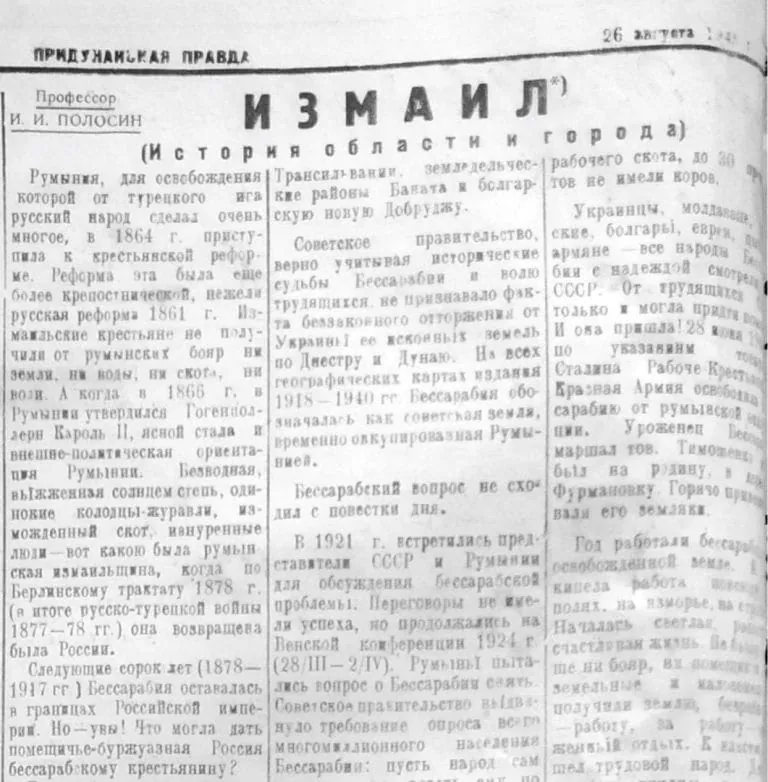
The First Soviet History of the Ukrainian Part of Bessarabia, 1945
The article “Izmail (History of the Oblast and the City)” offers the first comprehensive account of the Ukrainian part of Bessarabia, or Budzhak, from the official Soviet perspective. Published in August 1945 as a series of installments in the newspaper Pridunayskaya Pravda, the article coincided with the first anniversary of the “liberation” of the Izmail Oblast by Soviet troops. The final installment appeared on August 26, the day of the official celebrations, which included the unveiling of a monument to Russian commander Alexander Suvorov in Izmail. Notably, the Soviet authorities entrusted the preparation of the historical material on the Izmail Oblast to Ivan Ivanovich Polosin, a professor at V. I. Lenin Moscow State...
Image for Post-war Soviet memory policy: from the 1948 report of the Izmail Suvorov Historical Museum
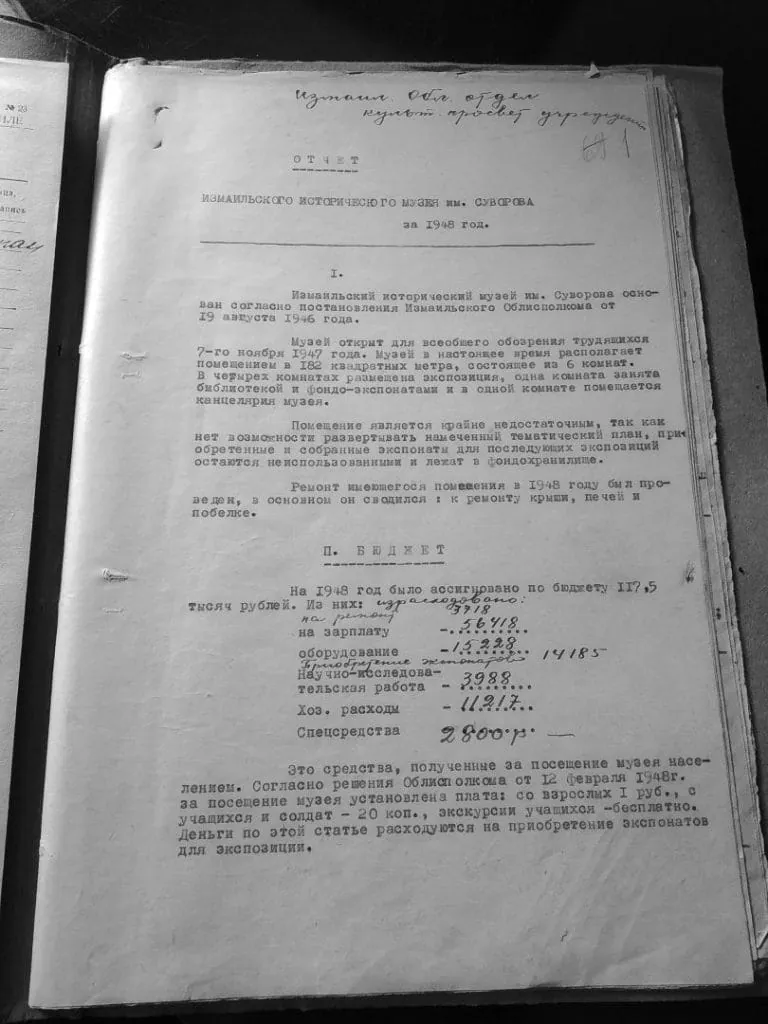
Post-war Soviet memory policy: from the 1948 report of the Izmail Suvorov Historical Museum
The document presented here is a valuable source for studying the Soviet authorities’ memory policy in the Izmail Oblast during the early postwar years. The report details the activities of the newly established museum during its first year of operation and contains information typical of such administrative records—covering exhibition development, collection management, research, display, and propaganda work—while also outlining the institution’s priorities for the coming year. At the same time, the source allows us to trace how the heroic image of the Russian military commander Suvorov was constructed in the region—an image that became a central component of the official Soviet historical narrative. To establish the Izmail Suvorov Historical Museum, Soviet authorities enlisted...
icon
Women’s Accounts of Extreme Violence: Stanislawa Kwiecinska’s Memoirs of Volhynia in 1943
This excerpt from her memoirs is by Stanislawa Kwiecinska (née Jelenkowska), the grandmother of the author of this commentary. Stanislawa was born on June 18, 1929, on the Stavchyny khutir, situated between the Polish village of Stara Huta and the Ukrainian village of Ruska Huta in Volhynia during the Second Polish Republic. She wrote her memoirs with her many descendants in mind: 9 children, 24 grandchildren, and 5 great-grandchildren. Stanislawa made notes in a notebook in the 2000s, and her youngest daughter, Anna Sikora, later typed the text and arranged for its publication in 2018.  These memoirs serve as a testament to the life and values of traditional Polish communities in Volhynia before...
icon
“Perestroika” at Lviv Enterprises, an Interview from the “Industrial Biographies of the City” Collection
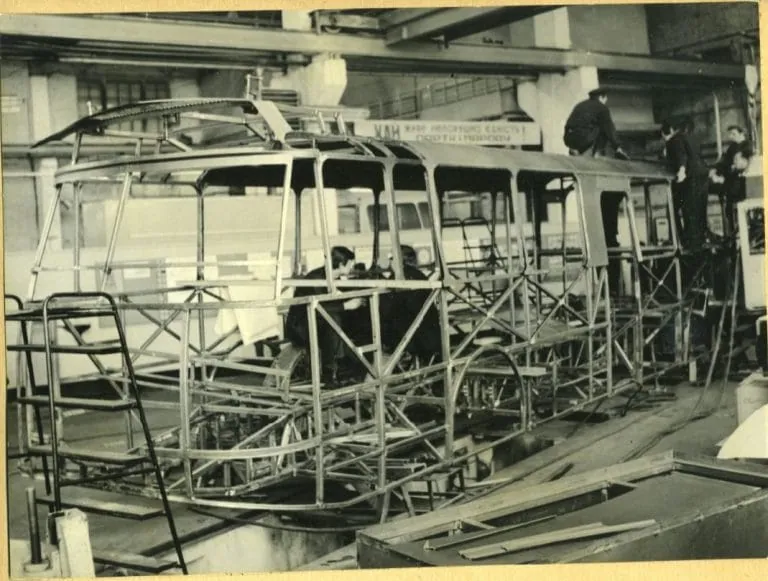
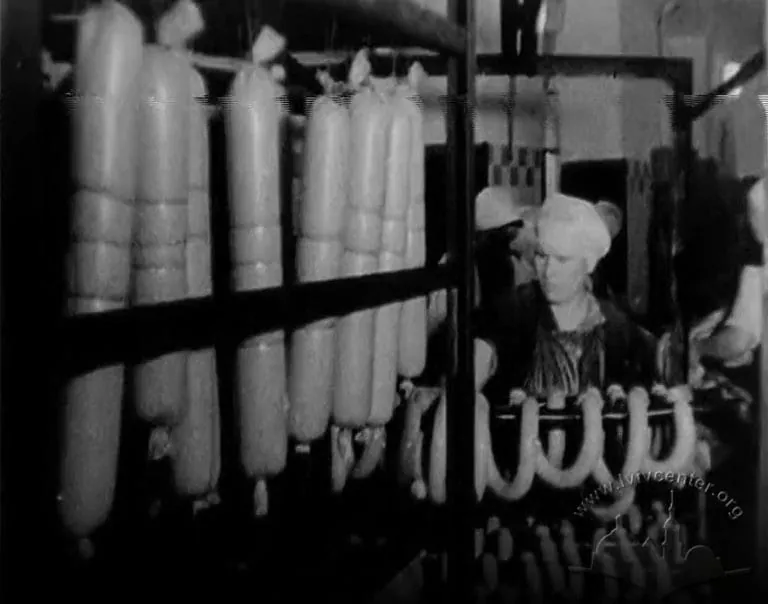
The materials presented here are excerpts from interviews with workers in Lviv’s radio-electronic, machine-building, processing, light, and food industries. These interviews are part of the Un/Archiving Post/Industry project, carried out in 2020–2021, which aimed to collect surviving materials related to the industrial heritage of the Lviv and Donetsk regions and to foster dialogue between generations, regions, and institutions. The recorded bibliographic conversations have been incorporated into the Urban Media Archive’s oral history collection, “Industrial Biographies of the City.” This collection preserves respondents’ memories and reflections on their childhoods and families, the city, education, work, and society, dating back to the 1950s. The selection of quotes listed below spans the period of Perestroika, the...
Show more Collapse all

Images (0)

Show more Collapse all

Videos (0)

Show more Collapse all

Audio (1)

icon
The Volhynia village of Zelenyi Dub during World War II: an interview with Antonina Huk
This testimony is from Antonina Huk, the grandmother of the author of this commentary. The interview, recorded in 2021, is one of six conversations with her about the events of World War II in Zelenyi Dub, Volhynia. During the interwar period, the village belonged to Buderazh gmina in Zdolbuniv powiat, Volhynia voivodeship of the Second Polish-Lithuanian Commonwealth, with a population made up of roughly equal numbers of Polish and Ukrainian residents. Antonina, born in 1931 in the neighboring village of Ruska Huta, moved to Zelenyi Dub as a young child and, by 1943—the height of the Polish-Ukrainian conflict in the region—was a 12-year-old girl. Antonina Huk’s account of the past does not unfold...
Show more Collapse all

Modules (1)

This module by Petro Dolhanov recounts the events of World War II in the Volyn village of Zelenyi Dub. The author analyzes the testimony of his grandmother, Antonina Huk, contextualizing it and cross-referencing it with other available source materials.

Digital stories (0)

Reflections

Texts (0)

Show more Collapse all

Podcasts (0)

Show more Collapse all

Videos (0)

Show more Collapse all

Syllabi (5)

In the last decade, the Ukrainian parliament has issued two laws outlining the legal framework for dealing with the Russian imperial and Soviet past. These laws have sparked numerous scholarly debates on how to address the imperial past, Ukraine's status as part of the Romanov Empire and the Soviet Union, and what to do with the cultural products created over the centuries.  This course aims to explore the Soviet legacy in present-day Ukraine and provide students with the necessary theoretical and methodological tools for studying, researching, and writing about Soviet history and culture. The implications for modern Ukrainian identity and politics, particularly in the context of the ongoing war with Russia, will be...
This course covers the period from the partitions of Poland through the Russian and Habsburg Empires, the Soviet Union and interwar Poland. Students will familiarize with the geopolitical results of Russia’s westward and Austria’s eastward expansions and will focus among other overarching themes on the shtetl, the unique East European Jewish habitat; on Hasidism, a Ukraine-born popular movement of religious enthusiasm; on the interaction between Zionists and Ukrainian nationalists in Galicia; on the development of Ukrainization and Yiddishization (or Ukrainian and Jewish korenizatsiia) in the 1920s and the situation of Jews in Poland in the 1920s; on the Holocaust and its aftermath; on Ukrainians and Jews in the dissident movement; and on Jewish-Ukrainian...
Ukraine’s twentieth century was tragically marked by much politically motivated violence and authoritarian regimes as well as movements, from the radical left and the radical right. These forces and events did not only do great harm in the past but left memories and legacies that are still challenging to contemporary Ukraine. In this class, we will focus on several key issues of history, memory, and politics. The readings cannot be exhaustive. Instead, our aim is to read and discuss a sample of important short texts that allow us to reflect more broadly on the underlying questions.
In 1939, on the eve of the Holocaust, east European Jewry constituted the most important and culturally influential Jewish community in the world. As a result of half a century of mass migration, up to 90% of world Jewry either lived in Eastern Europe or were children of immigrants from there. Jews were particularly prominent in East European cities. In Galicia, for example, Jews constituted a plurality or majority of nearly every major city. (L’viv was an exception, where they made up “only” a quarter of the population.) This course will survey the modern history of this once vital community – social, economic, political, religious and cultural – from the Polish partitions until...
The course explores the ways in which Jewish history and culture are narrated and visualized in the new museum and exhibitions projects in post-communist East Central Europe, and how those museums as public institutions, and curatorial interventions contribute to establishing, (re)shaping, countering or petrifying respective national narratives, the understanding of cultural difference and prejudice.