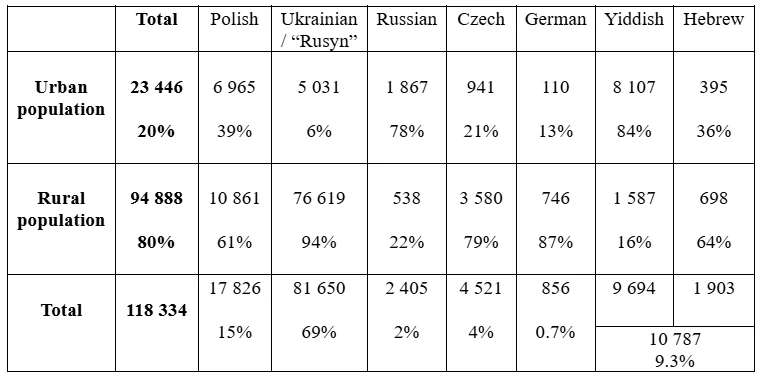
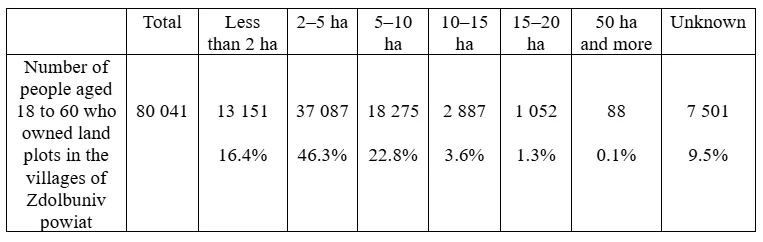
Jan Vereshchynskyi, a Polish resident of Zelenyi Dub, recalled in his memoirs that his family owned 13.5 hectares of land, placing them among the 3.6% of Zdolbuniv powiat residents who held large tracts of 10 to 15 hectares. He emphasized that cultivating such a large area required significant effort: “…with the agricultural technology of the time, it demanded grueling labor from our parents, in which the older children also actively participated” [13]. In other words, no one lived a noble lifestyle here—even the wealthier peasants had to work hard. Feliks Jasinski, from the village of Kuty, wrote in his memoirs that “the residents of this village (that is, Zelenyi Dub, P.D.) were wealthier than others” [14]. This likely explains why some residents of overpopulated neighboring villages sought a better life in Zelenyi Dub.
Some Ukrainians in Zelenyi Dub also lived “wealthier.” After World War II, Antonina Vozniuk married Petro Huk from a significantly wealthier Ukrainian family in Zelenyi Dub, which, before the war, had even owned its own oil mill and several hectares of arable land. This family lived next to the Vereshchynskyis’ estate. Residents of neighboring villages would come to Syla Huk’s home to have oil pressed—one of the key products that substituted for animal fats during Christian fasts, which were observed more strictly in those days. Syla Huk’s family lost most of their property in 1943.
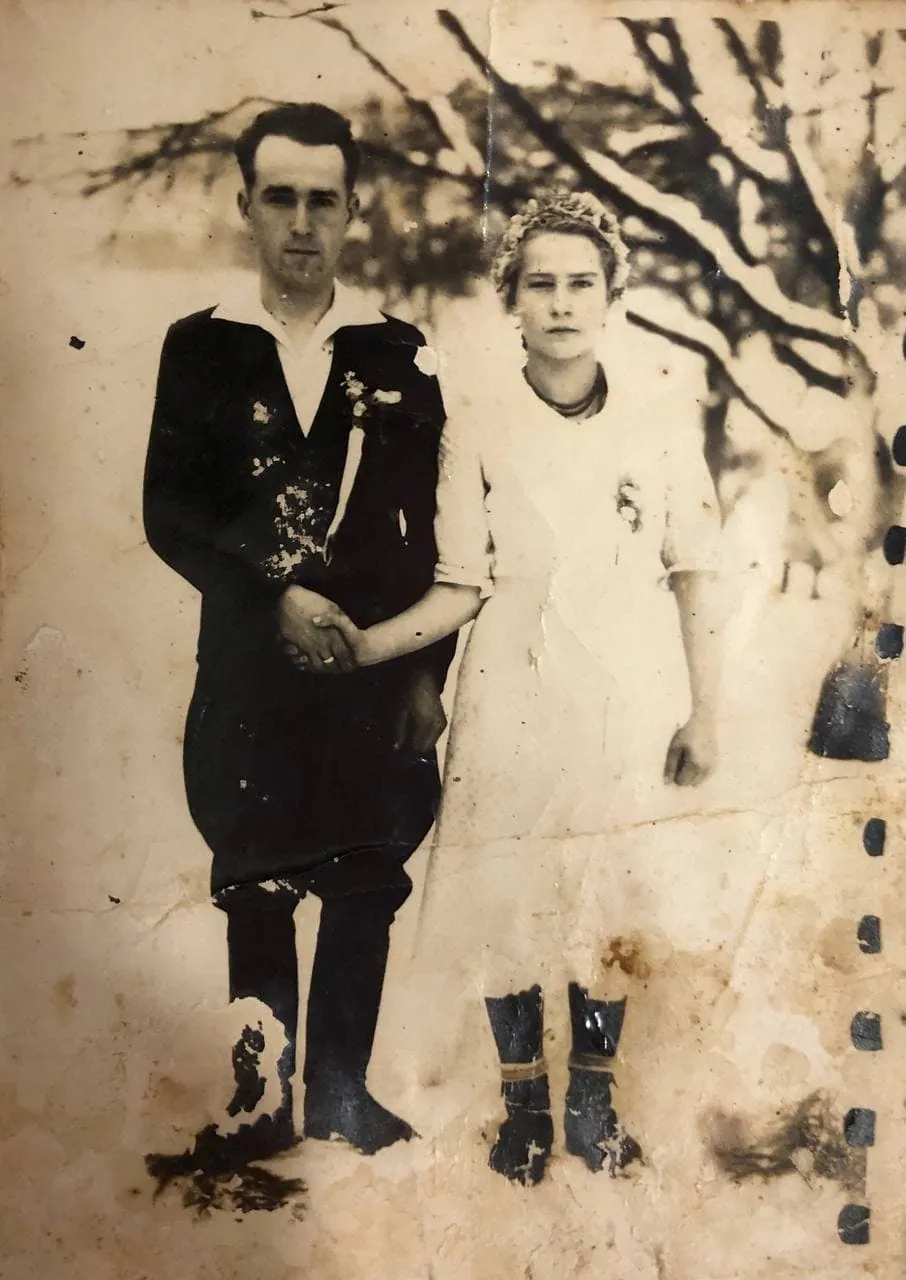
When the UPA was killing Polish villagers and burning their houses, the fire—apparently carried by the wind—spread to the Ukrainian part of the village. As a result, Syla’s three sons—Petro, Anastasii, and Savatii—had to find wives who already owned homes. Was the marriage between Antonina Vozniuk and Petro Huk dictated by rational calculation? Perhaps, in part. Throughout her life, Antonina Huk often recalled how Petro Huk had initially courted her sister Hanna, who, in her words, was more attractive. Nevertheless, he chose Antonina, who demonstrated far greater domestic skills and diligence. He needed a good “housewife,” and she needed a husband with the right skills and experience in farming. That is how they found each other. This does not mean there was no love at all, but in a traditional world where people had to work hard, love took on a unique character. It is striking that these young people chose each other on their own, rather than marrying at their parents’ behest—a significant innovation in the rural world compared to the previous century.
Historical Eras Reflected in the Testimonies. “The First Soviets.”
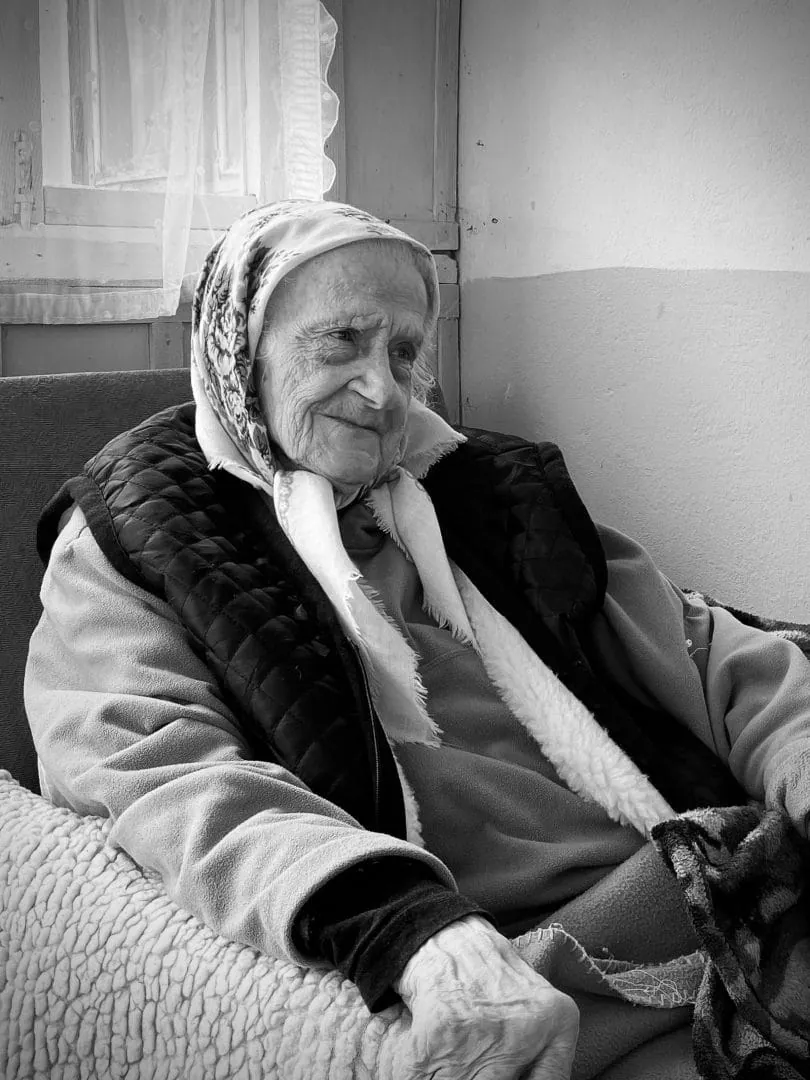
I will briefly focus on my grandmother’s recollections of the different historical periods she lived through. Because she was so young at the time, Antonina Huk remembers very little about interwar Poland. She recalls playing with neighborhood children but does not remember anything specific about the country itself. Having never attended school, she was poorly socialized with the Second Polish Republic and knew almost nothing about it from personal experience. Nor does she remember the “first Soviets”—the arrival of Soviet rule and its policies in 1939–1941. At that time, the Buderazh and Mizoch gminas were merged into a single Mizoch district within Rivne oblast. These administrative and territorial changes would remain in place, at least in part, throughout World War II.
Another resident of Zelenyi Dub, Ambrozy Vereshchynskyi, recalls this period: “…Ukrainians and Jews enthusiastically welcomed the Red Army’s entry into our territory. As it later turned out, they were mostly spies and informants working against the Poles. They compiled lists for the NKVD of which Poles were to be sent into exile” [15]. Such memories are typical among members of various ethnic groups who, when faced with totalitarian violence, withdrew into themselves and their own suffering. Both Jews and Ukrainians also suffered greatly under Soviet rule. Ukrainian memoirs often state that they were, in fact, the primary victims of Soviet policies.
Ambrozy recalls that his family was saved from dispossession and deportation to Siberia thanks to a bribe the Vereshchynskyis gave to the Soviet authorities through the village headman, For Huk—the brother of Syla Huk (the father of the narrator’s future husband). The fact that For Huk served as the village head is confirmed in one of Antonina Huk’s later testimonies [16]. However, she knows nothing about his ability to influence who was included on lists of those subject to dispossession.
The Beginning of the German Occupation and the Holocaust
The testimonies presented here contain perhaps the most information about the period of the German occupation. Paradoxically, Antonina Huk states that she hardly ever encountered Germans in person—she only saw them from several kilometers away while watching German troops move through the village of Andrushivka:
I only ever saw the Germans when they were passing by. They’d ride these big motorcycles—the ones with guns. So we’d run out to this little hill—where Sergei lived, and there was a girl named Nastia, they called her “Doysykha” because she was from Moshchanytsia. We’d run out there and watch as the Germans rode from Peremorivka to Andrushivka [17].
Jan Vereshchynskyi also described these events from a Polish perspective:
On June 25, in the town of Andrushivka, about 3 km from Zelenyi Dub, German troops were moving toward Surazh and on to Ostroh on the Horyn, toward the former Polish border. Ukrainians from all directions gathered to greet their allies…
They traveled at regular intervals, maintaining the established order. First came a group of motorcyclists, followed by small vehicles carrying soldiers armed with machine guns, who continued to tow heavy vehicles with machine guns mounted on their cabs… Ukrainian girls presented the soldiers with flowers; joy and euphoria reigned [18].
In general, in the villages of Volhynia, the Germans were often greeted with flowers, bread, and salt. Special wooden structures were even erected for official welcoming ceremonies. Later, Antonina Huk learned about German policies mainly through hearsay, as she did not see representatives of the occupying authorities in person. Under German occupation, the village of Zelenyi Dub remained part of the Mizoch district. However, the German authorities abolished Rivne oblast, which had been established by the Soviet regime, and incorporated the Mizoch district into Zdolbuniv gebiet (district), which became part of Rivne gebiet in 1943. Interestingly, news of German policy specifics reached Zelenyi Dub much more quickly from the neighboring town of Shumsk (about 18 km away) than from the more distant Mizoch (about 25 km), which served as the administrative center. Zelenyi Dub would remain closely tied to events in Shumsk well into the 1990s, even though it continued to fall under the administrative jurisdiction of Mizoch and Zdolbuniv.
Because of these ties to Shumsk, Antonina Huk recalls in her testimony that the events of the Holocaust took place there, rather than in Mizoch: “And when the war was going on, they said, they set up these ghettos for the Jews [zhydy—tr.note] in Shumsk. They set up these ghettos, and they herded them there—those poor Jews. They herded them into those ghettos, herded them. That’s what my parents told me. Then they dug a trench and lined them up over that trench, mowed them down with a machine gun—they all fell into it. And they covered them with earth. After they were buried under the earth, the ground kept moving for three or four days… I don’t know exactly who was shooting. Ukrainians, they said. Ukrainians were shooting Jews. They were exterminating Jews and Poles” [19].
The narrator uses the word “Zhydy” rather than “Jews,” as was common in the interwar Polish discourse she knew. At that time, this term (still used in modern Polish) was not considered discriminatory. The claim that “the ground kept moving for three or four days” is a widespread folkloric motif found in many regions of Ukraine. In this way, villagers often dramatized the events of the mass murder of the Jewish population in their stories. Moreover, in some cases, individuals—especially children—may indeed have been buried alive, as documented in many records.
One analytical comment should be added to Antonina Huk’s testimony: the narrator erroneously claims that “Ukrainians shot Jews.” While Ukrainians serving in the auxiliary police did participate in some shootings of Jews, the events described by Antonina Huk took place on August 13, 1942, when the Germans liquidated the Shumsk ghetto. The shootings were carried out by Germans from an SD unit based in Rivne, with the assistance of the German Shumsk gendarmerie and officers of the Shumsk District Auxiliary Police [20]. In other words, this violence was initiated by the Nazi occupation authorities. Why, then, did the narrator believe Ukrainians committed these murders? Several explanations are possible, though it is unclear which is most plausible. One factor may be the popular Soviet narrative about “Ukrainian-German nationalists” as accomplices in these crimes—a view widespread in the postwar years, which Antonina Huk may have heard from others, since she did not watch much television or read newspapers. This narrative could have overlapped with her own experiences related to the Ukrainian nationalist underground, which unfolded before her eyes. She may also have heard about or encountered the auxiliary police, which in the Mizoch district until March 1943 consisted almost exclusively of ethnic Ukrainians. At the same time, Antonina Huk practically never encountered Germans throughout the war. From her perspective, their crimes and policies may have seemed distant and intangible. The face of occupation policy was the local people working in district administrations and village police forces.
Antonina Huk would return once more to the story of the liquidation of the Shumsk ghetto at the end of her testimony:
– And you were talking about Shumsk. After the war, where they shot those Jews—was there anything there? Did they put up a monument or something?
– I don’t know. There were monuments there, because when I used to walk with Nadia—when I went to visit her—we’d walk from work past the Jewish graves, right there, and there were monuments…
– Graves.
– …for Jews, on Jewish graves.
– Mm-hmm.
– There were some.
– Where they shot people?
– What?
– Well, [those graves were] where they were shot.
– Yes. Well, there, where they were shot [21].
These words reveal confusion between the Jewish cemetery in Shumsk and the actual site where the town’s Jews were shot during the ghetto’s liquidation. In reality, the shooting did not occur at the Jewish cemetery, but near one of the Christian cemeteries [22]. This confusion is common among the non-Jewish population today: people tend to conflate traditional cemeteries, where Jews were buried before the war, with the sites of mass shootings during the Holocaust. This conflation inadvertently erases centuries of coexistence with Jews, as evidenced by the preserved cemeteries. By transforming them into sites of mass murder, collective memory reduces the history of Ukrainian-Jewish relations to nothing more than their tragic culmination—the events of the Holocaust.
Volhynia ’43
In her testimony, Antonina Huk focused most on the killings of the Polish population. In Zelenyi Dub, this likely occurred in two waves: the first attack took place in early June 1943.
This was a reactive response by the UPA to an attack by the Germans and the Polish auxiliary police on the village of Derman, during which part of the village was burned down and dozens of Ukrainian residents were killed. At that time, UPA fighters burned down Hurby, Kudryn, Kamintsi, and part of Zelenyi Dub. Mykola Androshchuk, the former commandant of the Mizoch Auxiliary Police and then head of the UPA field gendarmerie, left the following account: “In retaliation against the Poles, who had acted so brazenly in Zaluzhzhia, both detachments burned down exclusively Polish settlements on their way back, including Hurby, Kudryn, Kamintsi, part of Zelenyi Dub, and the surrounding khutirs in the Mizoch district.” [23].
German documents confirm that the Polish Schutzmannschaft did indeed exceed its authority and committed acts of violence against the Ukrainian civilian population. Rumors among Polish police officers about violence against Poles in neighboring districts likely played a role. In response to this action, the UPA decided to punish the easiest targets—the Polish civilian population living in Hurby, Kudryn, Kamintsi, and Zelenyi Dub.
Of course, this served as a trigger that influenced the dynamics of the conflict, which had been unfolding throughout Volhynia since March 1943, but it was not the cause of these events. One of the direct perpetrators may have been a unit of the OUN Security Service led by district commander Trokhym Lukashyvech Lachman (born in 1920 in Derman 1). The operatives under his command were Mykola Kupriyanovych Martyniuk (born in 1918, from Derman 1), Oleksii Mykytovych Spychak (born in 1909, from Derman 1), and Mykola Naumovych Halaburda (born in 1923, from Derman 1) [24]. These names appear in historical documentary sources related to the burning of Hurby.
Mykola Androshchuk also wrote in his memoirs: “On May 29, the Germans concentrated a large number of troops and conducted a raid on the Verkhivskyi, Derman, and Novomalynskyi forests. At that time, Commander Eney was in the forest with a detachment led by Chornomorets and Zalizniak. Chornomorets already had three chotas [platoon—tr.note]—a full company of soldiers—while Zalizniak had two chotas” [25]. These memoirs indicate that during the German operation, the commander of the UPA’s southern group, “Bohun”—“Eney” (Petro Oliinyk)—was at the Zaluzhzhia khutir near Derman and had the authority to decide on a retaliatory operation. The memoirs also mention the lower-level commanders of two UPA units likely involved in the attack—the “Chornomorets” company (led by Yevhen Basiuk) and the “Zalizniak” company (led by Volodymyr Vynohorodskyi). The core of the latter unit consisted of members of the Mizoch district Schutzmannschaft, who on October 13, 1942, participated in the liquidation of the Mizoch ghetto. Their commander, Volodymyr Vynohorodskyi, was then the commandant of the Mizoch district Schutzmannschaft. Thus, these men already had experience with violence against civilian populations.
Jerzy Jelenkowski, citing the memoirs of Irena Hayovnychek, asserts that the attack on Hurby took place on June 4, 1943 [26]. Feliks Jasinski, citing other sources, mentions June 5, 1943 [27]. According to him, of all four settlements (Hurby, Kudryn, Kamintsi, and Zelenyi Dub), only Hurby had the potential to organize a self-defense unit, but the villagers never made use of it. In the 1930s, an organization called “Strilets” operated in Hurby, led by D. Lapinskyi [28]. However, some of their weapons had already been confiscated by the Soviet authorities in 1939–1941. Additionally, “Jew hunters”—local Germans (so-called “Volksdeutsche”) named Hreber and Ihnatovych—frequently visited Hurby from Mizoch. They were notorious for tracking down and killing surviving Jews hiding in the surrounding forests. Notably, they uncovered a hiding place in the “Bednarka” tract where several Jews stayed. Most were killed with the help of German gendarmes from Mizoch named Otto and Gustav Gille [29]. These thorough searches for Jews also led to constant raids among the Poles of Hurby, which literally disarmed them on the eve of the UPA attack. One of these local Germans or Polish residents informed the German gendarmerie in Mizoch that the Stankevych family from Hurby possessed a revolver: “A gendarme arrived, threatened Stankevych, who confessed and handed over the revolver, and the gendarme shot him on the spot” [30].
According to Jasinski, because they were under constant German pressure, former members of “Strilets” did not keep their weapons ready but hid them away. Therefore, we know nothing about any possible resistance from Hurby residents during the UPA attack in early June 1943. Another reason for the lack of resistance may have been a degree of trust in local Ukrainian residents, who had promised not to attack Hurby or Zelenyi Dub. Thus, the Holocaust became another indirect factor influencing the dynamics of violence by disarming the Polish residents of Hurby.
However, it is likely that not all Polish settlements in Zelenyi Dub were destroyed during the June attack. Ambrozy and Jan Vereshchynskyi provided accounts of the final burning of the Poles and the Polish part of Zelenyi Dub [31], citing the date of July 3, 1943. On that day, most residents of Polish origin were herded into the Vereshchynskyis’ barn and set on fire.
Antonina Huk recounts these same events from her perspective:
There was this barn—a Polish barn. They herded them inside and set it on fire. The Poles burned—they were buried right there behind the store. I ran over there with that Polish girl I mentioned earlier—the one with the little one, about my age—and someone yelled at us, “Get out of here, or the same thing will happen to you right now.” [32]
For a short time, Antonina’s family helped a Polish woman who had survived, whose name was also Antonina:
There was a woman whose house was near ours in Zelenyi Dub. Her name was Antoshka, just like mine. She was about my age and had a little girl who suffered from a terrible cough—they said it was whooping cough. She had nowhere to stay with her kid, nowhere to spend the night in Vyshky—no one would take them in, because whenever the little one coughed, people would hear. Back then, the Soviets were patrolling through Verkhovtsi, and the banderites might hear them and kill them. So she was afraid, and she spent nights with us, with her little girl. [33]
The woman mentioned by the narrator could have been Antonina Yasinska, the cousin of Jan and Ambrozy Vereshchynskyi [34]. The child who had whooping cough was most likely not hers, but that of another Polish woman from the village of Zelenyi Dub named Krayevska. Antonina Yasinska probably helped care for the child, since Krayevska had two children, and both of them were fortunate enough to survive the attack that took place in July 1943.
Antonina Huk recalls witnessing the murder of one of the Polish men during this attack: “There was this one Pole, a man, out in our garden—back at home, in the garden—there was a linden tree, and the poor man climbed up thinking he could hide there. But they found him and killed him right up in that tree. He climbed up that linden tree… That’s how it was.” [35].
This was likely Lukash Vereshchynskyi. Ambrozy Vereshchynskyi, who managed to escape the attackers, also described his death: “For a moment, I glanced toward the gunfire and saw an older man—our cousin Lukash Vereshchynskyi—running away, with the banderites chasing him and shooting at him, and at me as well, because he was running in my direction. Fortunately, I had moved to a relatively safe distance and lay down in the stubble, as I was very tired. As it turned out later, that poor Lukash, utterly exhausted, collapsed, and the bandits killed him right there.” [36]
This attack on the Poles of Zelenyi Dub was the result of one of the most intense waves of UPA attacks on Polish villages in Volhynia, ongoing since late June. Mykola Androshchuk, the head of the UPA field gendarmerie, also left his recollections: “At that time, UPA commander Klym Savur was in the south. Following his orders, on the night of June 29–30—exactly two years after the proclamation of independence in Lviv—the UPA launched a large-scale operation against the remaining Polish settlements. Alongside UPA units, all local combat groups in the area participated. That night, commanders Savur and Eney were at the Bushchany khutirs, observing from a high mound as fires burned across the region—a sign of protest against all foreign invaders encroaching on Ukrainian freedom and land.” [37]
A significant number of Polish residents who survived fled to Shumsk, Mizoch, and Soviet partisan units. Feliks Jasinski testified: “Residents from Khynivka, Kurdyn, Mosty II, and partly from Stara Huta and Zelenyi Dub fled to this town (Mizoch—author’s note) and settled there in empty Jewish houses” [38]. Vinsentii Romanovskyi, who witnessed the attacks on Polish villages, also confirmed the flight of many Polish refugees to Mizoch and their settlement in former Jewish homes [39].
Other Polish residents fled to areas near the village of Teremne, where Anton Odukha’s Soviet partisan detachment was stationed. Quite a few of them also perished on July 25–26, 1943, as a result of an attack by UPA units on the Mykhailov Detachment. Maksym Skorupskyi participated in this attack on behalf of the UPA. He described the circumstances as follows: “After dinner, the sotnyks and chota commanders were called to a starshyna meeting. Kurin commander Osyp spread a detailed topographic map on the table and began outlining the planned operation for the next day. It was then that I learned the precise details. On a high point in the Surazh Forest, not far from the village of Teremne (Shumsk District), there was a camp of Soviet partisans. The garrison consisted of 200 Bolsheviks and about 300 Poles with their families, who had fled from nearby villages. The Soviets and some Poles were well-armed, with rifle positions dug around the camp. By their presence, the Soviet partisans had paralyzed UPA communications and plagued the surrounding villages.” [40] In this testimony, Skorupskyi acknowledged that the Soviet partisan detachment included not only Polish fighters but also many families who had fled the surrounding villages.
The murder of the Poles affected the fate of surviving Jews, who had received help from them while living near Zelenyi Dub. Antonina Huk knew practically nothing about these events, which is why she does not mention them in her memoirs. For example, Yona Oliker, a member of the local Jewish community who survived the liquidation of the Mizoch ghetto and was hiding in the forest near Zelenyi Dub, left some desperate recollections: “In Zelenyi Dub, Poles were burned in a barn. The Zelinskyi family, with whom I had been hiding for some time, fled into the forest. I saw them at the home of a Ukrainian family, where the Zelinskyis would come at night to bake bread. Once, they shared some bread with me, but I never saw them again after that. Our situation kept getting worse. Ukrainians were killing Jews, and we could no longer turn to the Poles for help, because they, too, were terrified by the banderites and hiding in the forests. No one was bringing us food anymore.” [41]
To be fair, not only Ukrainians but also local Poles sometimes killed Jews: the Polish Omanskyi family in Baliarnia killed the parents of the partisan Itzhak Wasserman [42], and the Polish police in Mizoch killed a Jewish boy hiding from the Germans [43]. However, Jan [44] and Ambrozy Vereshchynskyi [45] recall in their memoirs how someone—presumably one of their Ukrainian fellow villagers—was involved in the deaths of 5–7 Jews hiding near Zelenyi Dub. This took place in a ravine near the dirt road leading to Andrushivka, which runs along the entrance to Zelenyi Dub from Kamintsi and Hurby. One of the many unmarked graves of countless Jewish victims is likely located somewhere there. Meir’s mother, Feiha Weltfreund, may be buried there. Meir often visited the Polish Petrovskyi family at their farmstead in Kamintsi, not far from the place the Vereshchynskyis described. Weltfreund described his mother’s death as follows: “They were sitting in a pit; the Ukrainians came, seized them in that pit, and killed them there. They drew their weapons and killed them in that pit, and the boy was wounded in that pit” [46]. He knew this story from the accounts of one of the surviving eyewitnesses. Weltfreund was a prisoner of the Mizoch ghetto who survived its liquidation. Unfortunately, for obvious reasons, he does not remember exactly where this happened. At the site of his mother’s death, Meir erected a makeshift memorial from a birch trunk, carving the name “Feiha” into it.