
Localities: Mizoch, Andrushivka, Ozerko, Zelenyi Dub, Buderazh Cheskyi, Borshchivka, Zdolbuniv, Hurby, Kamiana Hora, Teremne, Shumsk, Dubno, Rivne, Varkovychi, Ozeriakhy, Kremenets.
Jews: Filmen, Lipa Shenfeld, Itzko Wasserman, Halbmilon (“Half a million”), Nute Lerner, Chaya Bix, Chana Trukhler, Abe Stifel.
Germans: Otto, Gille (Gustav) [5], Reichel, Max Schmale, Ch.F. Grebe
Ukrainians: Pikarets, Pachebula (Yosyp Modestovych) [6]
Yona Oliker — Butcher
Address: Holon, 126 Arlozorov St.
Workplace address: Shekem Company, Azor.
Table of Contents
The town of Mizoch, Volhynia voivodeship, Zdolbuniv powiat, prewar period.
The 1941 pogrom, organized by Ukrainians.
Forced labor at the sugar factory in Mizoch. Non-commissioned officer Reichel.
Crimes committed by Max Schmale in Zdolbuniv.
Meeting with engineer Fritz Grebe.
The murder of Lipa Shenfeld committed by Schmale.
The liquidation of the ghetto in Mizoch in October 1942.
Jews set fire to houses.
Escape to villagers near Mizoch.
Hiding in the Czech colonies of Ozerko and Buderazh Cheskyi.
The murder of ten Jews by gendarmes from Mizoch: Otto and Gille (Gustav).
Bunkers in the Gurben Forest.
Jewish partisans in the vicinity of Andrushivka and Zelenyi Dub.
Revenge by the partisan Itzko Wasserman for the death of his family.
An attack by Jewish partisans on a warehouse in Shumsk and the murder of a guard.
A Seder in a forest bunker on the outskirts of Andrushivka.
Procuring food with a weapon in hand.
The Bandera forces’ rout of a group of “forest Jews.”
With the Czech partisans in Buderazh.
Borshchivka (Cheska), which Ukrainians called “Palestine”—the Jews’ last refuge before liberation.
My name is Yona Oliker. I was born on May 15, 1914, in Mizoch. My father, Eliyahu, was a butcher. My mother, Enya (née Sapir), was a homemaker. My siblings—Wolf, Nahum, Rivka, and Matilda—were killed by the Nazis in Mizoch. I graduated from high school in Mizoch, after which I helped my father.
When World War II broke out, I was living in Mizoch. I stayed there until the ghetto was liquidated in October 1942. During the liquidation, I escaped to the countryside and hid with villagers in Andrushivka, Zelenyi Dub, and Buderazh Cheskyi. Later, I fled to the forests near Hurby and Kamiana Hora, where I hid in dugouts with other Jews.
In the final year before liberation, we obtained food by force of arms. We joined the Czech partisans in the Czech settlements of Ozerko and Buderazh Cheskyi and moved about freely. We lived in the village of Borshchivka Cheska, which the Ukrainians nicknamed “Palestine” in mockery of the Jews who lived there.
In 1944, the Red Army liberated us. From 1944 to 1945, I lived in Zdolbuniv. From there, I was repatriated to Poland, settling in the city of Lodz. In 1945, I married Esther (née Yasin). At the end of 1945, my wife and I left for Germany, where we stayed in a displaced persons (DP) camp in Berlin. Later, we moved to a DP camp in Eschwege, and eventually, in 1949, we left for Israel.
We have two children: Rivka, 14, and Susanna, 10.
Mizoch in the Prewar Years
The village of Mizoch (Volhynia voivodeship, Zdolbuniv powiat) was developed before World War I by Jozef Dunin-Karwinski. According to Jewish accounts, the first settlers were a Jewish family named Mizoch, from whom the town took its name.
One of the wealthiest Jews in Mizoch was Halbmilon (nicknamed “Half a Million” by Poles and Ukrainians), who owned three factories, including a sugar factory. The brewery was also Jewish-owned, and Wasserman owned a mill. Mizoch was especially renowned for supplying apples and pears throughout Poland. Our fruit was shipped to Katowice and Warsaw, and exports were substantial.
Alongside the major fruit buyers, Mizoch’s Jewish community included many artisans and small merchants. Poles, Ukrainians, and Czechs also lived in the town. Before the war, relations among these groups and the Jews were good, but during the war, the Ukrainians revealed a different side.
The town had three synagogues, and the rabbi was Natan Nute Lerner.
There was no Jewish school. Young people belonged to Zionist organizations such as Ha-Shomer Ha-Tzaʿir and Gordonia. In the summer, they organized trips to the forest, where they sang together, and life was good. Everything changed after the Germans arrived.
The pogrom in 1941, organized by Ukrainians
The Germans entered the town a few days after the war began and immediately permitted the Ukrainians to loot. We could feel the heavy hand that had descended upon us. Ukrainian peasants began smashing windows, then rushed at the Jews with axes and knives, targeting only Jewish homes and stores.
The looters were led by Ivan Pikaret, a farmer who had been a Communist before the war but completely changed when the Germans arrived. Yarmoliuk also commanded the Ukrainian looters.
During this time, the Ukrainians killed Chaya Bix and Chana Trukhler and severely beat Elia Sheindlos. Had they not been so preoccupied with looting, they likely would have killed even more Jews.
After three hours of murder and looting, German gendarmes dispersed the entire gang, arresting Yarmoliuk and Pikaret.
I had a neighbor named Sheindlos, who invited me and my father to his apartment to pray Minyan. He also invited a few other Jews so we could all pray together. Suddenly, Ukrainian police burst in, shouting that we were engaging in counterrevolutionary activities, and took us to the police station. There, they beat and tortured us, with my father suffering the most. That night, they released us. However, on Sunday, two Germans arrived, took everyone who had been at Sheindlos’s apartment for prayer the day before, and ripped the tallit and tefillin off my father, as he was in the middle of praying. They led us into the courtyard, and I saw one of the Germans cut off half of my father’s beard. After that, they herded us through the streets, picking up other Jews along the way, until they had gathered about 150 people and brought everyone to the police station.
At that time, the Judenrat [a Jewish administrative body of self-government established by the German occupation authorities—ed.note] did not yet exist, but the Germans appointed Abe Stifel as head of the Jewish community. His son was among those captured. Stifel pleaded with the Germans to release those who had not been at the minyan. They dispersed the rest, but ten of us were detained. We were taken to a small room that served as a prison in the Polish municipality, where they herded us in and beat us.
There was a Volksdeutsche woman in town named Zbrojanowska who served as an interpreter for the German commandant. She went to great lengths to secure our release. Three days later, we were set free.
Forced labor at the sugar factory in Mizoch. Unteroffizier Reichel
After a while, we began forced labor. I was assigned to the sugar factory, where the supervisor was unteroffizier Reichel. He was actually quite decent—he didn’t beat us and generally treated us well. Still, he was greedy for possessions. I’ll share one such incident:
At the factory, we worked in three shifts, though operations stopped during the off-season. A week before the liquidation of the Mizoch ghetto, the factory resumed work.
At the time, everyone said this couldn’t possibly be the end for us. If they’d intended to liquidate the ghetto, they wouldn’t have restarted the factory, so people were hopeful. Everyone signed up for work. But then, in October 1942, ghettos throughout the region began to be liquidated. Rescued Jews from Varkovychi, Dubno, Rivne, Ozeriany, and Kremenets were hiding with us.
It seemed as if things would continue for a few more months. The day before the final liquidation, we were still loading sugar. My brother was working with me, wearing a wonderful pair of yellow shoes. Reichel ordered him to take them off and hand them over. I ran over, sensing something was wrong. Reichel wasn’t in the habit of stealing from us, so if he asked for the shoes, it was probably because he knew my brother wouldn’t need them tomorrow.
“Warum soll mein Bruder die Stiefel abgeben?” [Why does my brother have to give up his boots?] I asked Reichel, since we were on good terms. “Das ist ein schlechtes Zeichen” [That’s a bad sign], I added.
“Hab keine Angst” [Don’t be afraid], he replied. But I already had a bad feeling, and that night I didn’t even undress. At midnight, I heard gunshots.
The Liquidation of the Ghetto in Mizoch. The Crimes of Max Schmale. A Meeting with Engineer Grebe
Even before the ghetto was liquidated in the winter of 1941–1942, Jews were rounded up for (forced) labor in Zdolbuniv. Although I had a sugar factory worker’s pass, a Ukrainian policeman caught me and took me to the House of Riflemen, where more than a hundred Jews were already being held. Then, they sent us to Zdolbuniv.
In Zdolbuniv, we were registered and sent to work that same day. I was assigned to the construction of the Zdolbuniv train station. They gave me wheelbarrows (Schubkarren), and I had to haul dirt with them. The wheelbarrows were heavy and often veered off the path onto the road, which led to severe beatings from the Germans. The worst beatings came from the construction foreman, Max Schmale, who worked for the Jung company. Schmale would hit us with whatever he had on hand—bricks, rubber. After his beatings, the doctor would always issue a sick leave for a few days so we could rest in bed. Schmale beat me many times, striking my head and back. He was tall, wore glasses, and had a raincoat with a fur collar. He was a nightmare for all the Jews on the construction site.
One day, I ran away from work. I left with a group who were chipping ice off the railroad tracks. Schmale spotted me there and beat me severely. From the blows, I fell and tore my shoes.
That same day, Schmale severely beat Lipa Shenfeld, also from Mizoch. Later, after these beatings, Lipa died. His wife said that he had escaped from the Zdolbuniv station and walked all the way to Mizoch—an 18-kilometer journey. He was frail by nature, but even a healthy person would have been bedridden after such beatings from Schmale, let alone someone like Lipa. Shenfeld was a merchant, a middle-aged man.
Lipa Shenfeld had a brother, Mordechai Shenfeld. He now lives in Israel, in the kibbutz Mishmar HaSharon.
When I got back on my feet after Schmale’s beating, I realized I was practically barefoot; my shoes had torn when I fell. It was winter—January or February, I can’t remember exactly. The cold and the beating completely wore me out.
As soon as I recovered a little, I went to Schmale. I showed him I was barefoot and asked for one day off to find some shoes. He replied: “Los, du Erbrecher! Du brauchst keine Schuhe haben! Ein Hund kann auch barfuss laufen!” [Come on, you criminal! You don’t need shoes! A dog can run barefoot too!].
The next day, I went to work already feeling very sick. A Jewish man told me there was an office in town run by Engineer Grebe, and that I could ask him for help.
After lunch, I ran away from work, took off my yellow patches, and went to Grebe’s office.
I walked into the office with my heart pounding, unsure what to expect—what if they beat me there, too?
There I met Engineer Kaufman. I told him I wanted to see Engineer Grebe. “All right, I’ll take you there,” he said. We went to Grebe’s office. He was a pleasant-looking young man, and spoke to me like a human being, very politely. I only intended to ask for one day off to find some shoes, but when I showed him I was practically barefoot in the middle of winter, he completely released me from my duties at the station and sent me back to Mizoch. I told him everything—all about how Schmale had beaten me.
So I returned to Mizoch and immediately visited Lipa Shenfeld’s wife, but he was already gone. Life dragged on until October 13, 1942. On that day, the ghettos in Zdolbuniv and Mizoch were liquidated simultaneously.
Along with all the Jews, the members of the Judenrat in Mizoch also perished: Abe Stifel, Yoine Nemirov, Shmuel Bunis, Melech Hozak, Menek Ridner, Taler, and police commander Blumenkrans.
When I heard gunshots on the night of October 12–13, 1942, I went down to the basement. In the morning, when I emerged, I saw the ghetto was already surrounded. I ran to my brother Nahum. “There’s nothing we can do anymore, Nahum, we’re under siege. All we can do is burn everything down.” He threw his clothes from the closet onto the floor and set them on fire.
I ran out into the street. My uncle was standing in the doorway of one of the houses. “Come to us; we’ll hide you,” he said. At that moment, I saw my wife’s sister run up to the wall of her house and splash kerosene from a bottle onto it.
A blaze erupted; everything around us was on fire, with Jews setting houses ablaze one after another. It was so hot that I threw off my fur coat. It was clear we wouldn’t survive in the burning house, so we ran out into the street. There, they were rounding up Jews fleeing in all directions. A Ukrainian policeman named Serchuk herded us together with the others—about a thousand people had gathered.
When we reached the square where dentist Fidelman’s apartment was, we saw his entire family being led out. Gendarmes Otto and Gille (Gustav) were present.
Otto, who was on good terms with Fidelman, had once promised him he would survive. When Fidelman was led out, Otto ran up to him: “Fidelma, gib mir deine Geldtasche, die Schweine werden dir daas unterwegs wegnehmen. Wenn du zurueckkommst, bekkomst du von mir die Goldtasche zurueck” [Fidelman, give me your wallet; those pigs will steal it from you on the way. When you come back, I’ll give you your gold wallet back.]
Fidelman gave him everything he had, certain he would be saved—that he would return and Otto would give him everything back. So he went along with the rest of us. They led us to a small pine forest near the sugar factory.
A hundred meters from the pine forest where we were being led, there was a narrow bridge over a shallow river. At one point, I jumped off the bridge into the water. At the time, we were being led by a policeman, Vynohorodskyi (Volodymyr) [7], but he didn’t notice me slip away.
I hid where the bridge curves and saw a woman who had also escaped from the group. She told me she was from Berest-on-the-Bug and had already escaped five times during various ghetto liquidations. We stayed in the water until evening. Several more times, Jews were led across that bridge to the small pine forest—where they were shot. That’s where Fidelman and his family were killed.
At night, we got out of the water. I remembered I had a friend, a Ukrainian peasant named Daniel Rybak, so we went to him.
We fled to the villagers on the outskirts of Mizoch. Bunkers in the Gurben Forest
Daniel Rybak let us in and allowed us to spend the night in his barn. I couldn’t sleep at all; I kept wondering if anyone in my family had survived.
During the night, I got up and walked along the dirt roads to our house in town. It stood empty.
The doors and windows were wide open; even the furniture had been carried out. Only the wind howled and cats meowed—otherwise, there was no trace of a human being. I saw many dead bodies. My father, who had been shot, was lying in the garden. Inside the house, I found my brother-in-law’s body; he was naked. I went into the neighbor’s house, hoping someone might be hiding there.
Suddenly, I heard a child crying and ran toward the sound. Our cousin was lying near my sister’s house—she had been shot and was dead. Her one-year-old son was alive, and it was his crying I had heard. I tried to take the child from my sister’s stiffened arms, but he began to cry even harder. When I heard gunshots and realized the police were approaching, fear took over and I ran away. I wasn’t able to pull the child from her lifeless embrace.
When I returned to Rybak at dawn, he told us to leave. The woman I had fled with the day before asked me to take her out to the road leading to Rivne, and I did.
Then I went to Rybak’s brother. After spending a day there, he asked me to leave. “You understand, I can’t risk the lives of my whole family for your sake.”
I had no one else to turn to and headed back to town. “Let them kill me,” I thought. “There’s no way out anyway.” I was utterly exhausted and didn’t care anymore. On the way, I saw some Ukrainians carrying sacks full of stolen Jewish property. I also ran into a young Ukrainian I knew. When I told him I was going to turn myself in so they could kill me, he said, “You fool, it’s not too late,” and tried to persuade me to run away. He gave me a piece of bread and urged, “Run away, hide.”
I went to the farmstead where my brother had sent his thirteen-year-old son, Usher, to work as a shepherd. Many Jews did this back then, hoping to save their children. When I entered the farmer’s house where Usher worked, a Ukrainian man lunged at me with an axe. I wrenched it from his hands. “Where’s Usher?” I asked. “Usher was killed,” he replied.
“Give me your jacket,” he said. “I’ll give it to you,” I replied, “but in exchange, give me some peasant clothes.” He brought me a tattered zupan. I changed and set off for the Czech colony of Ozerko.
A Czech woman I knew well lived in Ozerko. When I walked in, she was terrified. “Run away!” she cried out. I asked her to go to the wife of the local teacher, Mrs. Herasymchuk, to explain my situation and ask for help. How happy I was when she returned and told me I should go to Mrs. Herasymchuk.
When Mrs. Herasymchuk saw the state I was in—how ragged and hungry I was—she burst into tears. “Don’t worry,” she said, “you can stay with me.”
That evening, Perla Mizoch came into the house. Mrs. Herasymchuk had been hiding her in her attic. Perla was freezing; her teeth were chattering. “I’m cold,” she said, “but I really want to live.” Perla was still very young.
Mrs. Herasymchuk took us to the woodshed, where we fell asleep. In the morning, I heard loud crying in the yard. It was Lisa Melamed with her son Yasha from Mizoch. Lisa looked terrible. She told us she had been hiding in a bunker with thirty people for four days. Terrible things were happening—people were drinking their own urine out of thirst.
With Lisa’s arrival, there were now four of us. The next day, Mrs. Herasymchuk told us, “Children, you must leave here.” She asked us to go to her home in Mizoch and hide in the barn. She was terrified because the day before, an entire family of a convert—who had been hiding his sister—had been shot.
Passing through the forests, we arrived at Buderazh Cheskyi. The Czech woman, to whom we had given our shoes and a ring, let us stay for a week. But her husband was very unhappy. “They’ll drive you to your grave,” he said. Eventually, I left. Lisa and her little son stayed behind.
It was November, and the frost was bitter. I wandered all night until I found my way back to the place I had left. I burrowed into the hay in a barn and stayed there for two days. Only when my bread ran out and people came to thresh grain did I flee in the middle of the night.
Once again, I found myself in dire straits. For a while, I stayed with Rybak again, at Mrs. Herasymchuk’s. Eventually, I made myself a shelter in the hay in her barn—she didn’t know I was hiding there. At night, I would go out to ask some farmers I knew for food.
One day, I heard her arranging with neighbors to come and thresh the grain. By then I realized I couldn’t stay any longer.
[probably some part is missing—ed.] …A Ukrainian woman was spinning. I stayed there all day. She gave me potatoes, and it was warm inside her house. In the evening, Keile Kopyt came. “Don’t worry,” she said, “there are many Jews in this forest. You’ll be able to join them.” She was hiding there as well; there were shelters in the forest. This was on the outskirts of Andrushivka. After that, I went to the village of Zelenyi Dub.
Jewish partisans on the outskirts of Andrushivka and Zelenyi Dub
Partisan Revenge
(Only) Volksdeutsche lived in Baliarna [8], and they harassed the Ukrainians, especially one named Syla [9]. Among them was Ihnatovych—the very man who had betrayed the cave hideout where ten Jews were concealed.
The partisans decided to burn down Baliarna. Eight of them—five Jews, two Poles, and one Czech woman—set the houses on fire. This happened in early 1943.
There was also talk of the case of Itzko Wasserman, who took revenge on the Pole who had killed his family. The Wasserman family had been hiding at a Pole’s house on the outskirts of the Gurben Forest, but that Pole killed them. Later, I saw the bodies of the Wassermans myself. At the time, I was helping on Adolka Zelinskyi’s farm. One day, I went to a stream to fetch water and found the bodies of the Wasserman family. Keila Tsizin and I determined they were the Wassermans: Yosl, his wife Beila, and Tevi Maylich with his wife and son. We dug a grave and buried them.
When news spread about the Pole who had killed the Wasserman family, the partisans Itzo Wasserman and his friend Yurgilevich went to that Pole’s house at night and knocked on the window. “Who’s there?” they asked. “Ukrainian police,” Itzo replied. “I heard Jews are hiding at your place.” The woman replied, “If they were here, I would have killed them myself.” “Open up,” Itzo repeated.
As soon as they entered, Itzo declared, “I am Wasserman.” They brought out the Polish man’s family, lined everyone up against the wall, and shot them.
Once, while walking through the forest, I met a Jew from Dubno who told me about the partisans—of whom he was a member—who had come to Shumsk at night intending to rob a warehouse. They killed the guards, took everything they wanted from the warehouse, and headed back.
There were eight of them, hiding in the Kamiana Hora forest. However, they made a mistake: they let the cart driver go, and he led the Germans to them. The partisans held their position on the hill, armed with rifles and a machine gun. A battle ensued, and a dozen or so Germans were killed. All the partisans died, except for the one who told me this story. This happened in early 1943 [10].
The banderites’ massacre of a group of “forest Jews”
I never stayed in one place for long. When rumors began circulating in Zelenyi Dub that the Germans were approaching, I moved back and forth between there and Andrushivka. When things became dangerous in both villages, I fled to Teremne.
One day, I was once again taking shelter at the home of a Pole named Rutevych. There I met a fourteen-year-old girl named Hana Furer, who was grinding flour for matzo on a millstone. She told me that many Jews were in the forest and wanted to celebrate Seder there. I helped her grind the flour, then went with her into the forest, where I met many Jews from Mizoch: Arek Lufshyts, Shymon Garber, and his young son, Leve. I stayed with them for eight days.
We celebrated Seder, ate matzah, and prayed. Some time later, I met Moshe Meizlich, who told me that Itzo Wasserman had wanted to spare the parents of the Pole who had killed his family, but Yurgilevich wouldn’t allow it. People in the village said, “Itzo did the right thing.”
Meanwhile, the Bandera followers had already begun killing Poles and burning their villages. The Zelinskyis’ neighbor, Lozinskyi, was killed along with his entire family. In Zelenyi Dub, Poles were burned in a barn. The Zelinskyi family, with whom I had been hiding for some time, fled into the forest.
I saw them at the home of a Ukrainian family, where the Zelinskyis would come at night to bake bread. Once, they shared some bread with me, but I never saw them again after that.
Our situation kept getting worse. Ukrainians were killing Jews, and we could no longer turn to the Poles for help, because they, too, were terrified by the banderites and hiding in the forests. No one was bringing us food anymore, so we had to fend for ourselves. We had a few revolvers. We didn’t ask for anything—we simply took whatever we needed: chickens, livestock, bread.
One day in May 1943, the banderites surrounded us in the Gurben Forest. We had been careless—we built a fire, and they spotted us.
Nine of us were killed in the battle, six were captured alive, and fourteen scattered in different directions.
We had a designated meeting place in case we were routed. The next day, fourteen of us made it there. We buried the nine who had been killed and moved to a new location. We had to find a way to keep living, so we found a cave in the rocks and hid there.
One day, Arek Lufshyts went to fetch water and met a Pole. We wanted to kill him, fearing he would betray us. However, Arek said he knew the man—that he was a Pole.
We let him go, but it proved to be our undoing. Three days later—in July or August 1943—we were surrounded by the banderites. I saw them closing in, shouted to my comrades to run, and escaped myself along a path the banderites didn’t know about.
I walked for a long time until I reached another forest. At night, I went to a designated spot and whistled, but no one answered. In that forest, I met other Jews. At dawn, Nuna Langer approached with her daughter, Hayusia. She told me that the banderites who had surrounded us had claimed to be Soviet partisans. They had Soviet leaflets and tried to persuade the women to bring their husbands, assuring them no harm would come to them. Among those Ukrainians, Nuna recognized Skobyzniak from our region. I told her they were lying and that they were banderites. Indeed, it later turned out they had killed seventeen people from our group and taken Arek Lufshyts. They left the women behind.
Then we went to the Czech town of Buderazh, where we joined a Czech partisan unit made up of peasants from the surrounding villages. Their leaders were Josef Altman and Milek Dus [11]. They had weapons, and the Ukrainians lived in harmony with them out of fear. The Ukrainians demanded only that the Jews not carry weapons, but they no longer attacked us.
A dozen or so Jews who had escaped the banderites’ encirclement settled in the village of Borshchivka, a Czech colony. The Ukrainians used to call it “Palestine.” On February 3, 1944, the Russians arrived.
I confirm this testimony: Yona Oliker.
Dr. A. Raba recorded this testimony.

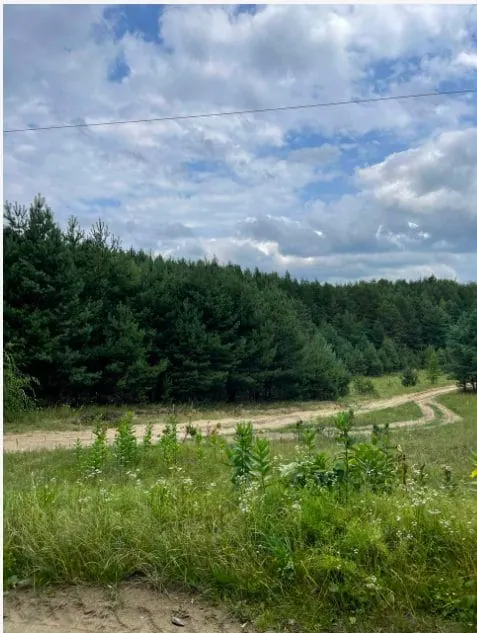

Another essential perspective for triangulating sources about World War II events in the village of Zelenyi Dub comes from the Jewish populations of Mizoch and Shumsk—the two largest shtetls situated equidistant from the village. In fact, no Jews lived in Zelenyi Dub itself. To understand how they came to be in the area during the German occupation, it’s helpful to draw on Tim Cole’s interpretive approach. In his study of the Holocaust, Cole proposed examining it through the lens of landscapes: both the real and mental maps that Jews carried during the violence [1].
As German occupation policy evolved, these mental maps shifted in the perceptions of Jewish community members—some areas were seen as relatively safe, while others became associated with mortal danger. For a time, the ghettos in Mizoch and Shumsk were perceived as relatively safe. However, beginning in May 1942, a second wave of violence swept through Volhynia, claiming the lives of approximately 160,000 Volhynian Jews. The Shumsk ghetto was liquidated on August 13, and the Mizoch ghetto on October 13–14, 1942. Most liquidation operations occurred in August and September. I believe it was during these months that, in the minds of Jews from Shumsk and Mizoch, the ghettos shifted from being seen as relatively safe to being recognized as sites of mortal danger. After the liquidations, this transformation was irreversible—the district centers (Mizoch and Shumsk) now posed a mortal threat. There, the German gendarmerie outposts and the largest number of Schutzmannschaft officers were based, tasked with “hunting” down survivors.
From that point on, the remote and sparsely populated areas near Zelenyi Dub began to attract Jewish survivors as places of relative safety. These areas had little infrastructure and were accessible only by a few dirt roads. Zelenyi Dub itself was small and so remote that there was no Schutzmannschaft station there. Its dense surrounding forests offered hope of temporary refuge from the mortal danger closer to “civilization.” This landscape-driven reality led many Jewish fugitives from Shumsk and Mizoch to seek shelter in the forests near Zelenyi Dub. In the neighboring village of Andrushivka, several Jewish families had lived even before the war. Administratively, Andrushivka belonged to Shumsk district of the Kremenets gebit, so most of its Jews were held in the Shumsk ghetto under German occupation. The Shumsk Memorial Book tells us that some survived the liquidation operation, fleeing to the forests near Andrushivka and Zelenyi Dub not only because these areas were sparsely populated and far from the German threat, but also because this felt like home—they knew local Ukrainian and Polish peasants who might come to their aid. Indeed, these peasants often provided such help to “their” Jews [2].
You can learn more about those who fled here from the Mizoch and Shumsk Memorial Books and from the video testimonies of Meir Weltfreund, recorded for the USC Shoah Foundation’s Visual History Archive [3]. Weltfreund spoke at length about how hundreds of Jewish refugees wandered through the forests near villages such as Mosty, Hurby, Kamintsi, Zelenyi Dub, Maidanska Huta, and others. They banded together in survival groups, most numbering several dozen people. If a group grew too large, it risked attracting attention from local villagers and, eventually, the Schutzmannschaft and gendarmes, who would launch raids on such forest camps and kill most of their inhabitants. Smaller groups were also targeted, but it was easier for them to hide in the dense forest, and they had a better chance of remaining undetected, at least for a while. Sometimes even ordinary villagers—both Polish and Ukrainian—would participate in the “hunt” for survivors. For them, being near Jewish fugitives could mean a mortal threat: after a series of ghetto liquidations, German occupation authorities imposed the death penalty for any assistance given to Jews. The prospect of acquiring Jewish clothing or the belief that fugitives carried mythical “Jewish gold” may also have motivated some to turn Jews over to the police or to kill them themselves.
Among all the Jewish fugitives from the area of Zelenyi Dub, Yona Oliker, a member of the Mizoch Jewish community, is perhaps the most frequently recalled. Oliker’s written testimony, preserved in the Yad Vashem archives in Polish, provides a highly revealing Jewish perspective on World War II events near Zelenyi Dub. In fact, Oliker left two accounts: the testimony from the Yad Vashem archives presented here, and his recollections from the Mizoch Memorial Book [4]. However, the latter are less informative and contain fewer names and specific details. In contrast, the Yad Vashem testimony is rich in detail: it includes the names of specific Ukrainians and Poles, German gendarmes and Schutzmannschaft officers, and villages and farmsteads where acts of violence occurred. Notably, these memoirs are being published in Ukrainian for the first time, whereas the Ukrainian-language version of the Mizoch Memorial Book was posted on the Jewish Gen website several years ago.
Another notable feature of this source is that much of its information can be cross-referenced with other materials. For this reason, I have included numerous editorial footnotes in the text, explaining various names and titles and corroborating Oliker’s statements with other sources. As a result, reading this source requires close attention to both the main text and the comments in the footnotes.