
Body
Filter by periods:
Primary Sources
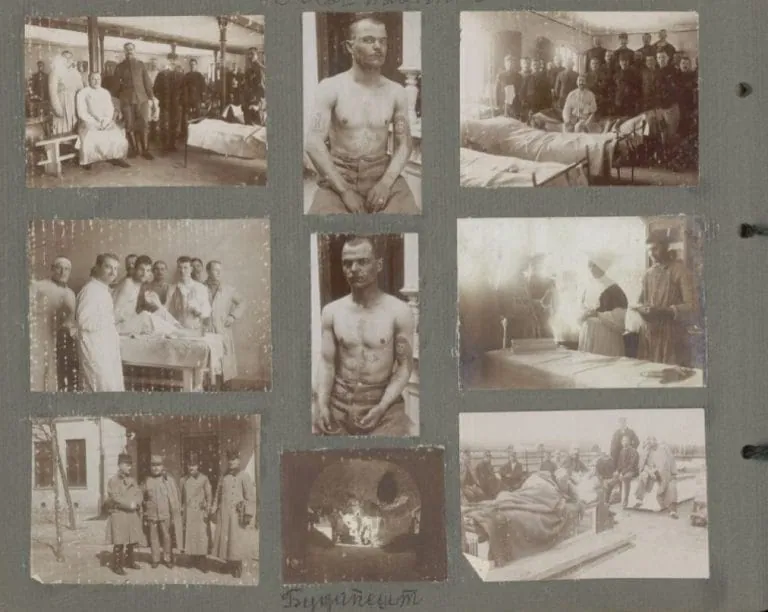
Vocational Rehabilitation of World War I Veterans with Disabilities
Both documents presented below are excerpts from the public discourse on the reintegration of soldiers maimed on the battlefields of World War I, which was invariably linked to productive work and self-reliance. The scale of the war, the introduction of new weaponry, and advances in medicine resulted in an unprecedented number of veterans with disabilities, particularly amputees. As social problems deepened, economic crises unfolded, and labor shortages worsened, the countries involved in this global conflict were compelled to reconsider their approach to supporting wounded soldiers. This led to a shift away from a paternalistic, welfare-based model toward one focused on rehabilitation and social protection. Rehabilitation systems in various countries were designed not only...
Stanisław Laskownicki about duels in Lviv at the beginning of the 20th century
Stanisław Laskownicki (1892–1978), a graduate of Lviv University and a future professor of urology, left behind a collection of memoirs titled "Sword, Bayonet, Lancet" ("Szpada, bagnet, lancet"). In these writings, he described the leisure activities of Lviv's youth, including their involvement in sports. He paid particular attention to fencing, which was highly popular in student circles at that time, and to duels as a method of conflict resolution.
Marko Cheremshyna, Short Story “The Invalid”
This short story by Mark Cheremshyna (real name Ivan Semaniuk; 1874–1927), a Ukrainian writer, lawyer, and Doctor of Law, explores the aftermath of the First World War and the struggles faced by its veterans, all set against the vivid backdrop of Hutsul culture.

Child maintenance in the Russian Empire
This source concerns a case that was brought to a district court in Veisenshtein (now Paide in Estonia) in the late nineteenth century. The complainant, Lena Izup, was an illiterate Estonian-speaking peasant who worked as a domestic servant. Her complaint lay with Mart Tambok, another Estonian-speaking peasant who she claimed was the father of her child. Lena Izup asked Revel’ District Court to ‘make an order’ against Tambok, which meant force him to acknowledge paternity and pay financial maintenance for the child’s upbringing. The case was heard in September 1890 and Mart was ordered by the court to pay Lena a one-off sum of 15 rubles, plus 10 rubles per year of child...
“Świat Płciowy”on prostitution in Lviv, article 1905
This article was published in Lviv' monthly Świat Płciowy (Sexual World) and was based on 1904 statistics. In the Habsburg Empire prostitution was controlled by police registration. The system of control distinguished two forms of sexual trade - registered and unregistered prostitution. Persons suspected of the latter were subject to legal prosecution. Prostitutes had to undergo regular medical check-ups at their own expense and pay for treatment if needed. These circumstances were one of the most obvious motives for avoiding entering the register. According to Nancy M. Wingfield's research, 90% of women who worked in the sex trade in the late Austrian Empire were not registered with the police. In early 20th-century Galician...
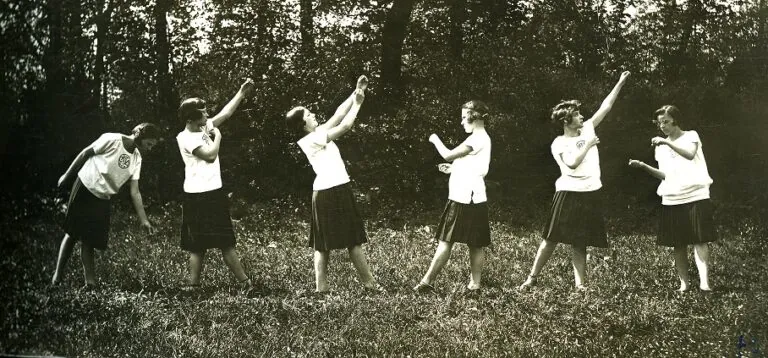
Photo of the physical exercises, Lviv, 1927
The photo is from Stepan Haiduchok collection. It is one of the series of photos of physical exercises. The format is adjusted to the composition: five women stand in one row and demonstrate the body positions as part of dynamic exercises (bending forward, arm stretching, steps). The static vertical lines of the trees in the background contrast with the movements of women. The expressiveness of the composition is built on tonal and texture contrast. The composition is divided in half by the horizon line. The background of the photos' lower part (grass) has a neutral tone, so the dark skirts and light legs are distinctly presented. Conversely, the background of the upper part...
Reflections
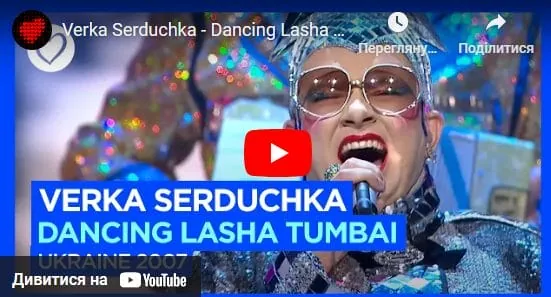
Verka Serdiuchka and Ukrainian National Identity at Eurovision 2007
This video is a recording of Verka Serdiuchka’s representation of Ukraine in the Eurovision Song Contest 2007 with the song “Dancing Lasha Tumbai.” Verka Serdiuchka is a drag persona performed by a male Ukrainian comedian, actor and singer Andriy Danylko. The character of Serdiuchka embodies a unique cultural archetype: a strong yet simple post-Soviet woman with Ukrainian rural origins. This is usually reflected in the lyrics, her costume designs and her use of “Surzhyk,” a mixed language combining Ukrainian and Russian elements. Danylko’s persona is often labelled as a "jester", both by nationalist-leaning audiences and in some academic circles (Yekelchyk 2010). Some others refer to it as "drinking songs" with heavy use of...
The course aims to engage students in a dialogue with different disciplinary frameworks that explore the concepts of sexuality and decoloniality, and their intersection with other epistemic categories. These frameworks, which include anthropology, sociology, gender, queer, and trans* studies, are introduced with attention to and focus on the “decolonial option” as a method and source of knowledge.
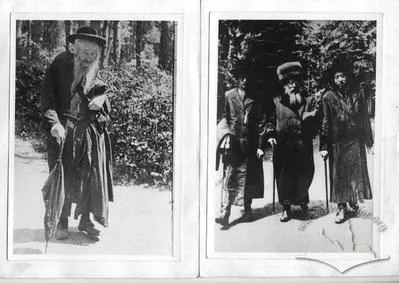
This course forms a part of Jewish History, Multiethnic Past, and Common Heritage: Urban Experience in Eastern Europe summer school.
This intensive 5-lecture mini-course (12 academic hours) takes a close look at various urban centers (sometimes the shtetl-like and sometimes the city-like) that shaped Jewish-Polish-Ukrainian cultural encounters that inspired the rising literary figures to explore East European multi-cultural urban legacy and make this legacy central in their creative writing. Students will explore various forms of East European urban culture—a shtetl (Chortkiv and Berdychiv), a provincial center (Chernivtsi and Ternopil), a city (Kyiv), a metropolis with a strong East European diaspora presence (Montreal and New York). This course will provide students with methodological tools at the intersection of the literary and cultural studies, urban studies, and social history.
At the end of the eighteenth century the Russian Empire acquired the largest Jewish population in the world. Although Jews and Christians had lived side by side with one another for over three hundred years in the Polish-Lithuanian Commonwealth, their life-worlds were distinct. The Great War, the Russian Revolution, and the Holocaust radically transformed the Jews of Russia, however, and the distinct culture of Russian-Jewry remains a crucial part of Jewish heritage today.
The course will cover the major development of the East European Jewry from the mid-eighteenth century till the present. More specifically, it will focus on the apparently largest category of modern Jewish history, i.e. modernity itself. The course will start with the discussion of what modernity means in contemporary scholarly discourse, and—more specifically—how it is applied today in historiography of East European Jewry. This introduction will provide a frame for the focus of the course: the analysis of the changing life patters and differing strategies of adopting, rejecting, or negotiating modernity in every-day lives of East European Jews.
This intensive 5-lecture mini-course (12 academic hours) introduces key broad themes that explore modernization and anti-modernization, urbanization and migration, secularization and acculturation and a new stratification of the Jewish society in East Europe. While it looks at the Russian empire and its western borderlands and Austrian Empire and its eastern borderlands, it focuses on Ukraine in its to-date geographical boundaries that include Galicia and Bukovina. The course does not have any prerequisites and provides broad contextualization of the selfimposed and empire-orchestrated reforms within the Jewish society against the backdrop of the Late Imperial Russia and the "long nineteenth century."
The course offers a short introduction to some of the key concepts and literary and cultural practices that shaped the represenations of modern Jewish spaces in Eastern Europe as well as their contemporary reconstructions and exhibitions. While focusing on (Jewish) Poland and Yiddish culture, this course introduces critical tools for understanding and interpreting modern (Jewish) contructions and experiences of space and place.
In 1939, on the eve of the Holocaust, east European Jewry constituted the most important and culturally influential Jewish community in the world. As a result of half a century of mass migration, up to 90% of world Jewry either lived in Eastern Europe or were children of immigrants from there. Jews were particularly prominent in East European cities. In Galicia, for example, Jews constituted a plurality or majority of nearly every major city. (L’viv was an exception, where they made up “only” a quarter of the population.) This course will survey the modern history of this once vital community – social, economic, political, religious and cultural – from the Polish partitions until...