
Izmail Oblast Department of Cultural and Educational Work
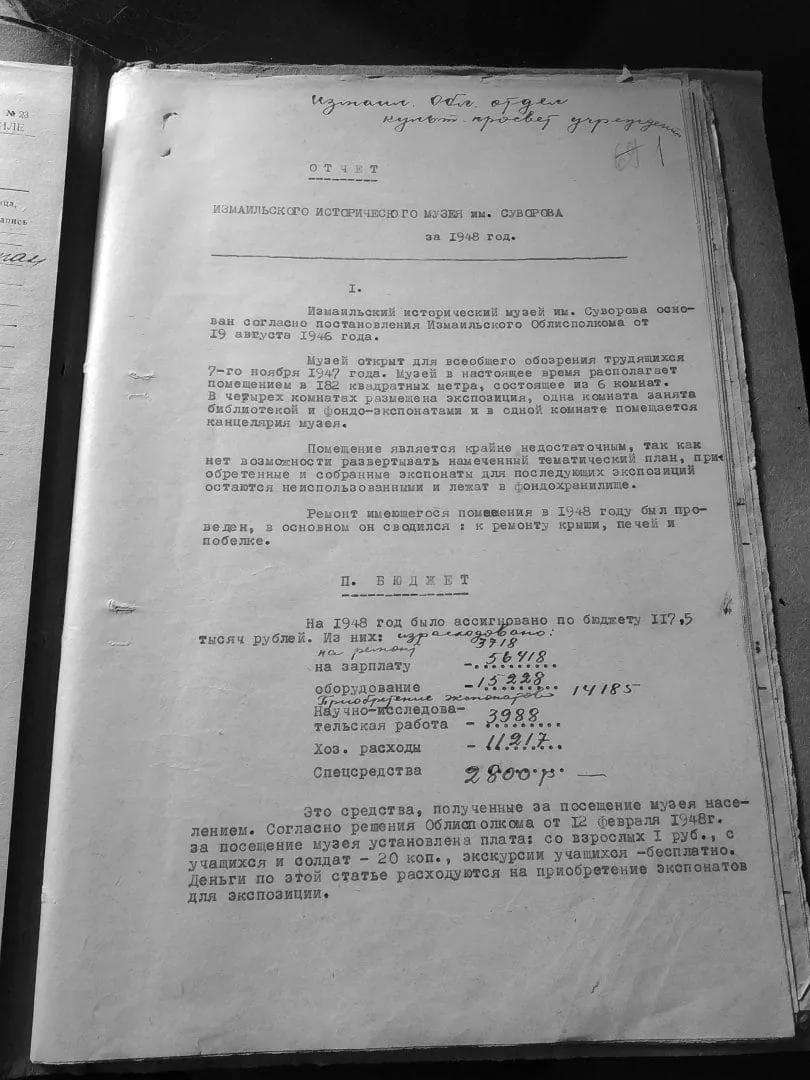
REPORT
IZMAIL HISTORICAL MUSEUM named after SUVOROV
for 1948
The Izmail Suvorov Historical Museum was established by a resolution of the Izmail Oblast Executive Committee dated August 19, 1946.
The museum opened to the public on November 7, 1947. It currently occupies 182 square meters and consists of six rooms: four are devoted to the exhibition, one contains the library and reserve collection, and one serves as the museum’s administrative office.
The premises are severely inadequate, making it impossible to fully implement the planned thematic layout. Exhibits acquired and collected for future displays remain unused and stored away.
Repairs to the premises were carried out in 1948, though these were mostly limited to fixing the roof and stoves and whitewashing the walls.
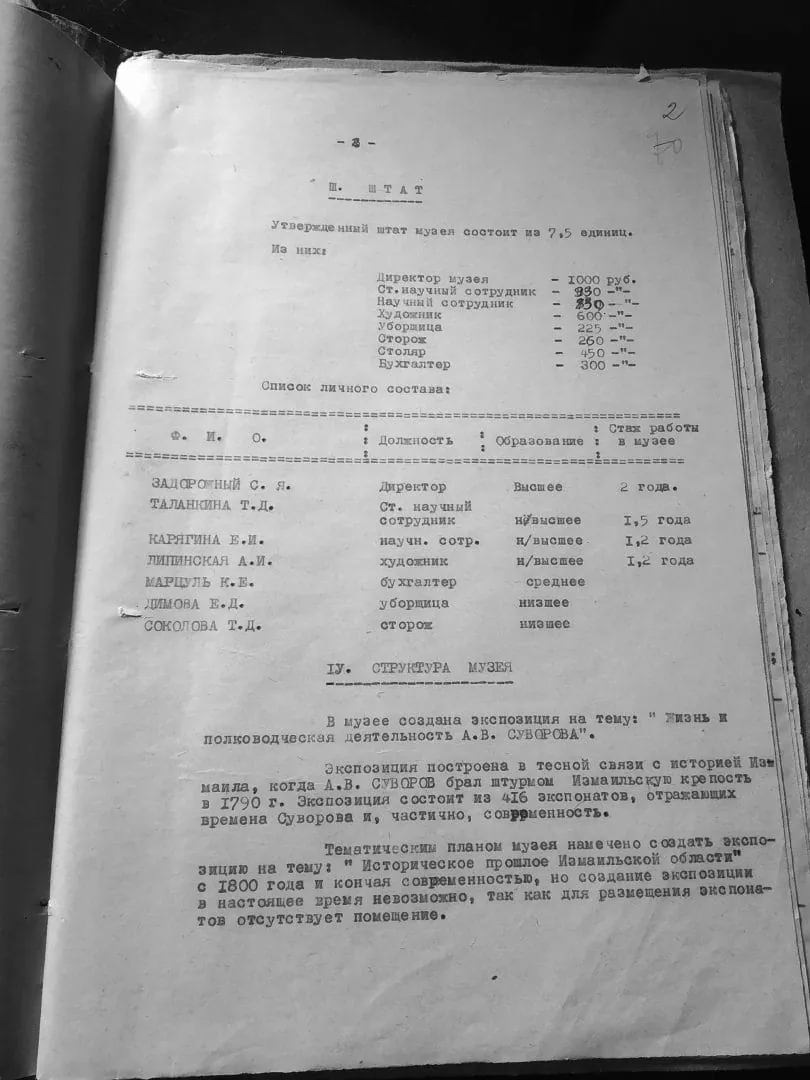
MUSEUM STRUCTURE
The museum features an exhibition titled The Life and Military Career of A. V. Suvorov, which is closely connected to the history of Izmail—especially the storming of the Izmail Fortress by A. V. Suvorov in 1790. The exhibition contains 416 artifacts that illustrate both the Suvorov era and, to some extent, the present day.
The museum’s thematic plan also envisions an exhibition titled The Historical Past of the Izmail Oblast (covering the period from 1800 to the present); however, this cannot be realized at present due to insufficient space to display the exhibits.
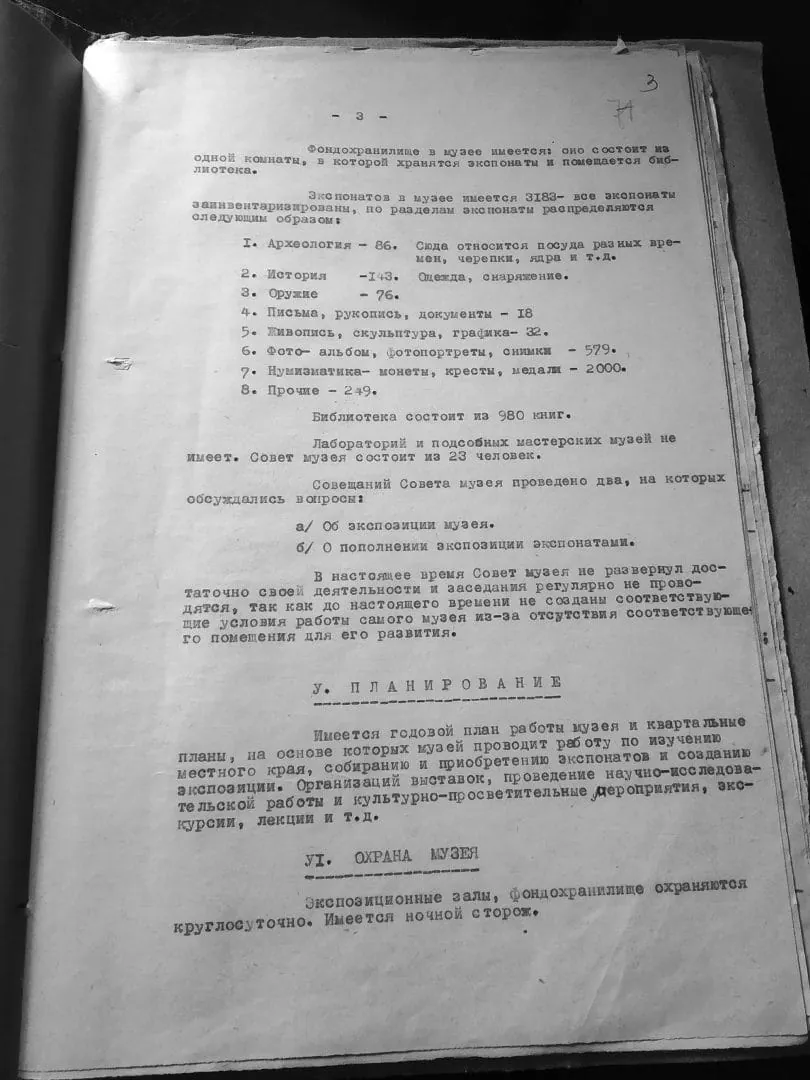
The museum has a single storage room that also serves as the library and holds all artifacts.
The museum’s collection comprises 3,183 inventoried artifacts, distributed across the following categories:
- Archaeology – 86 (including pottery from various periods, shards, cannonballs, etc.).
- History – 143 (clothing, equipment).
- Weapons – 76.
- Letters, manuscripts, and documents – 18.
- Painting, sculpture, and graphic art – 32.
- Photo albums, photographic portraits, snapshots – 579.
- Numismatics – 2,000 (coins, crosses, medals).
- Miscellaneous – 249.
The library contains a total of 980 books.
The museum has no laboratories or auxiliary workshops. Its council consists of 23 members.
Two council meetings have been held to discuss the following topics:
- a) The museum exhibition.
- b) Adding new artifacts to the exhibition.
Currently, the Museum Council has not yet fully commenced its activities, and regular meetings are not being held, as the necessary working conditions for the museum have not been established due to the lack of suitable premises for its development.
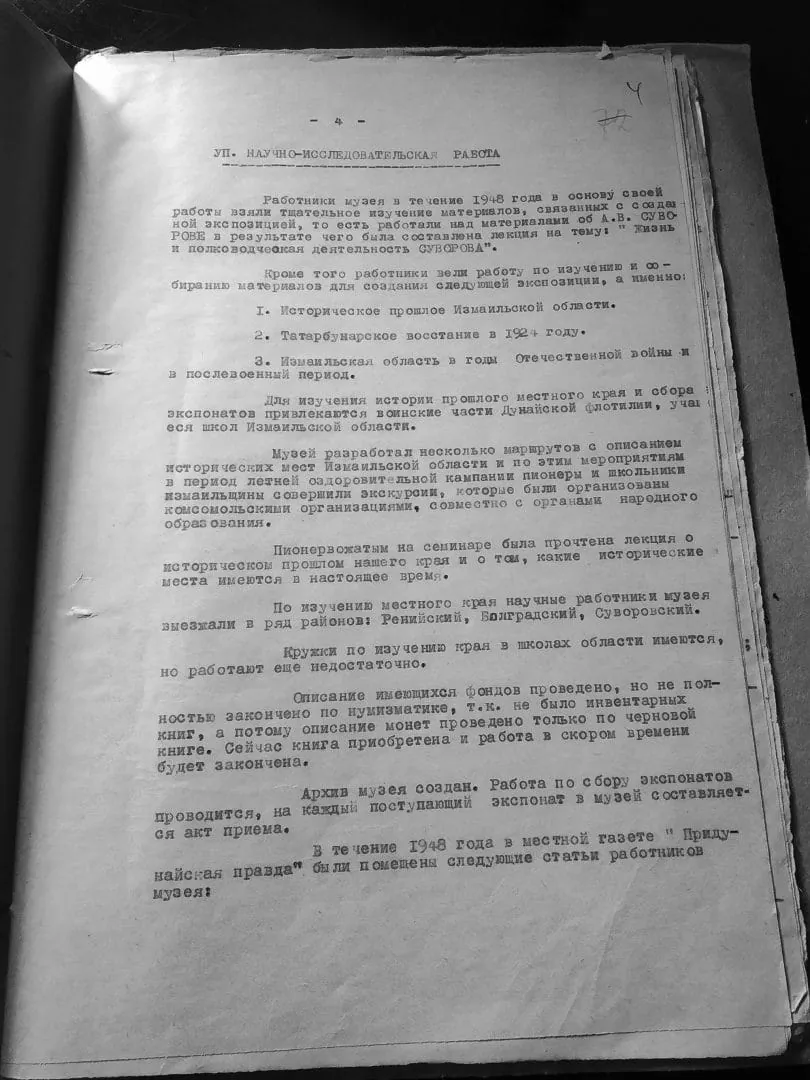
RESEARCH ACTIVITIES
Throughout 1948, museum staff concentrated on thoroughly studying materials related to the existing exhibition—specifically, those concerning A.V. Suvorov—which led to the preparation of a lecture titled The Life and Military Career of Suvorov.
In addition, staff researched and collected materials for future exhibitions, including:
- The historical past of the Izmail Oblast.
- The 1924 Tatarbunary Uprising.
- The Izmail Oblast during the Great Patriotic War and the postwar period.
Military units of the Danube Flotilla and schoolchildren from the Izmail Oblast also participate in researching the area’s history and collecting artifacts.
The museum developed several itineraries featuring historical sites in the Izmail Oblast. During the summer recreation season, Young Pioneers and local schoolchildren participated in excursions organized by Komsomol organizations in collaboration with public education authorities.
Young Pioneer leaders attended a seminar where a lecture covered the region’s history and current sites.
To study the local area, museum researchers visited the districts of Reni, Bolgrad, and Suvorov.
Although local history study groups exist in the oblast’s schools, their activities are not yet sufficiently active.
Cataloging of the existing collections has been carried out, but the numismatic collection is not yet fully completed. This was due to the previous lack of inventory ledgers, so staff initially cataloged coins using a rough draft log. Now that an inventory ledger has been acquired, the work will soon be finished.
A museum archive has been established. The museum is collecting artifacts and creating an acceptance record for each item received.
In 1948, the local newspaper Pridunayskaya Pravda published the following articles by museum staff:
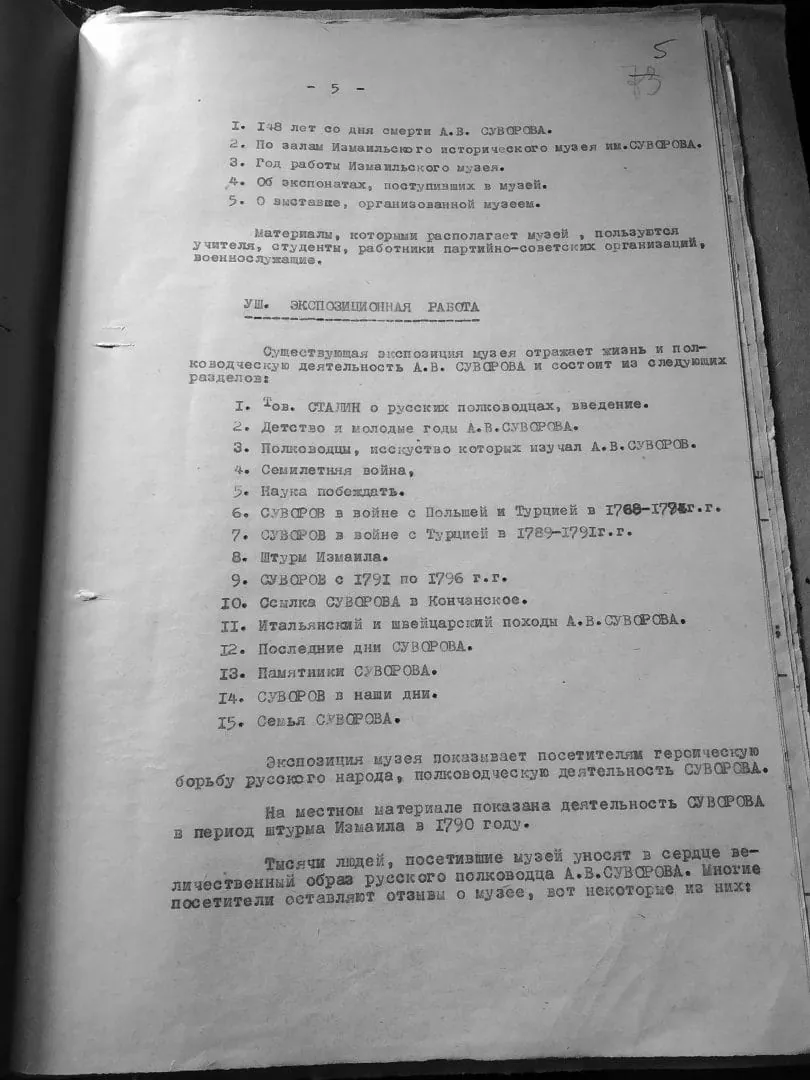
- 148th Anniversary of the Death of A. V. Suvorov.
- Touring the Halls of the Izmail Suvorov Historical Museum.
- A Year of Work at the Izmail Museum.
- On Exhibits Acquired by the Museum.
- On an Exhibition Organized by the Museum.
The museum’s materials are used by teachers, students, officials from Party and Soviet organizations, and military personnel.
EXHIBITION ACTIVITIES
The museum’s current exhibition highlights the life and military career of A. V. Suvorov, consisting of the following sections:
- Comrade Stalin on Russian military commanders: Introduction.
- The childhood and youth of A. V. Suvorov.
- Military commanders whose art of war A. V. Suvorov studied.
- The Seven Years’ War.
- The Science of Victory.
- Suvorov in the wars with Poland and Turkey (1768–1794).
- Suvorov in the war with Turkey (1789–1791).
- The Storming of Izmail.
- Suvorov from 1791 to 1796.
- Suvorov’s exile to Konchanskoye.
- A. V. Suvorov’s Italian and Swiss campaigns.
- Suvorov’s final days.
- Monuments to Suvorov.
- Suvorov today.
- Suvorov’s family.
The museum exhibition introduces visitors to the heroic struggle of the Russian people and Suvorov’s military leadership.
Local materials highlight Suvorov’s actions during the storming of Izmail in 1790.
Thousands of visitors to the museum leave with a lasting impression of the great Russian military commander A. V. Suvorov. Many share their thoughts in the museum’s guestbook; here are a few examples:
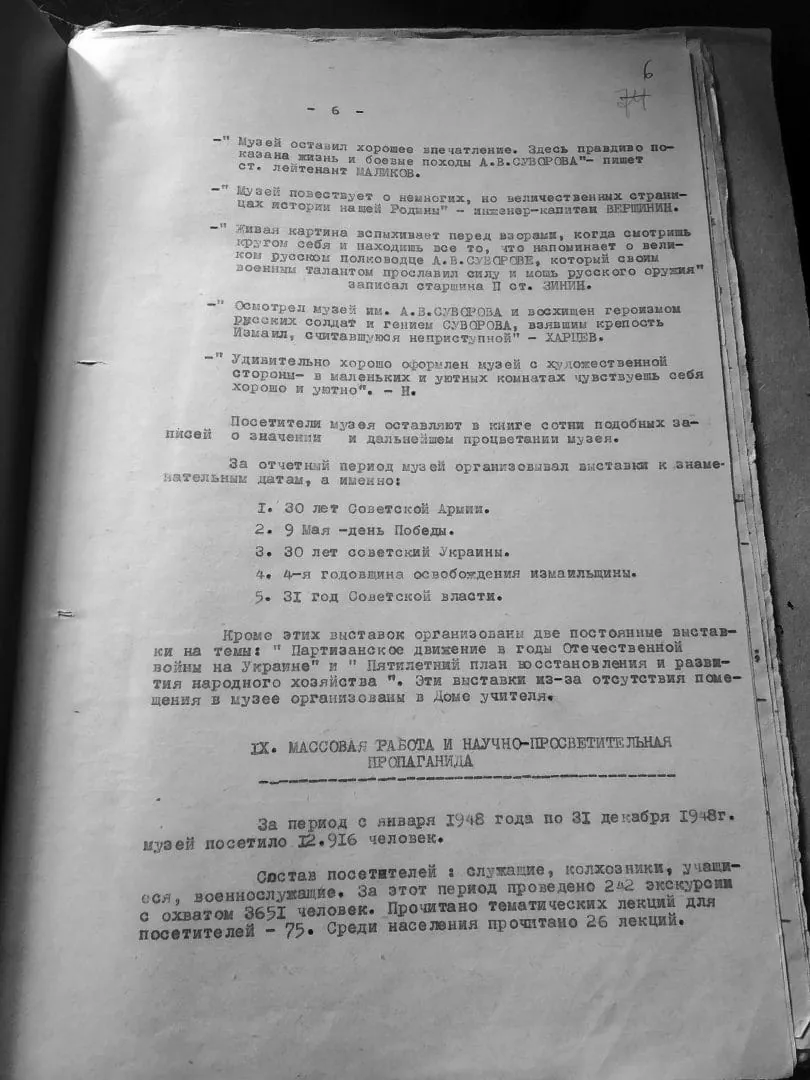
– “The museum left a positive impression. It truthfully portrays the life and military campaigns of A. V. Suvorov,” writes Senior Lieutenant Malikov.
– “The museum recounts a few—yet magnificent—chapters in the history of our Motherland,” writes Engineer-Captain Vershinin.
– “A vivid scene flashes before one’s eyes when looking around and seeing so many reminders of the great Russian commander A. V. Suvorov, whose military genius brought glory to the might and power of Russian arms,” writes Petty Officer 2nd Class Zinin.
– “I visited the A. V. Suvorov Museum and am filled with admiration for the heroism of Russian soldiers and the genius of Suvorov, who captured the fortress of Izmail—a stronghold considered impregnable,” writes Kharchev.
– “The museum is wonderfully designed from an artistic standpoint; the small, cozy rooms create a pleasant and welcoming atmosphere,” writes N.
Visitors leave hundreds of similar entries in the guestbook, remarking on the museum’s significance and wishing it future prosperity.
During the reporting period, the museum organized exhibitions to commemorate significant dates, including:
- 30 Years of the Soviet Army.
- May 9 – Victory Day.
- 30 Years of Soviet Ukraine.
- 4th Anniversary of the Liberation of the Izmail Region.
- 31 Years of Soviet Power.
In addition, two permanent exhibitions were created: The Partisan Movement in Ukraine During the Great Patriotic War and The Five-Year Plan for the Restoration and Development of the National Economy. Because the museum lacked space, the museum set up these exhibitions at the Teachers’ House.
MASS OUTREACH AND SCIENTIFIC-EDUCATIONAL PROMOTION
From January 1 to December 31, 1948, the museum received 12,916 visitors.
Visitors included office workers, collective farmers, students, and military personnel. During this period, the museum conducted 242 guided tours, reaching a total of 3,651 people. Seventy-five thematic lectures were delivered to visitors, and 26 lectures were presented to the general public.
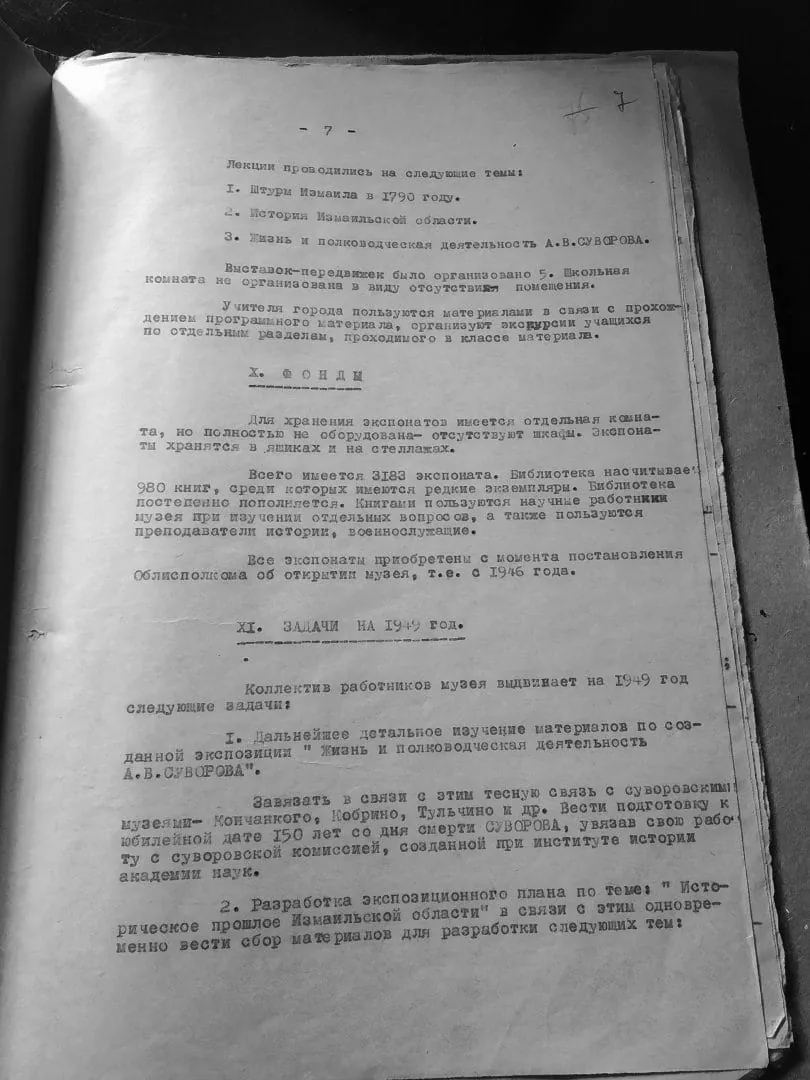
Lectures covered the following topics:
- The Storming of Izmail in 1790.
- The History of the Izmail Oblast.
- The Life and Military Career of A. V. Suvorov.
Выставок-передвижек было организовано 5. Школьная комната не организована в виду отсутствия помещения.
Five traveling exhibitions were organized. However, schools could not establish a dedicated classroom facility due to a lack of available space.
Local teachers use the museum’s materials alongside the curriculum and organize student tours focused on specific topics being studied in class.
COLLECTIONS
A separate room is designated for storing exhibits, but it is not fully equipped because it lacks storage cabinets. Exhibits are therefore kept in boxes and on shelving units.
There are 3,183 exhibits in total. The library contains 980 books, including some rare volumes, and its collection is gradually expanding. The museum’s research staff uses the books for specialized studies, as do history teachers and military personnel.
All exhibits have been acquired since the Oblast Executive Committee’s decree opening the museum in 1946.
OBJECTIVES FOR 1949
The museum staff has set the following objectives for 1949:
- Further detailed study of materials related to the established exhibition The Life and Military Career of A. V. Suvorov.
To this end, the museum will establish close ties with other Suvorov museums, such as those in Konchanskoye, Kobrino, Tulchino, and others. Preparation for the 150th anniversary of Suvorov’s death will involve coordinating efforts with the Suvorov Commission established under the Institute of History of the Academy of Sciences.
- Develop an exhibition plan on the topic of The Historical Past of the Izmail Oblast and simultaneously collect materials for the following subjects:
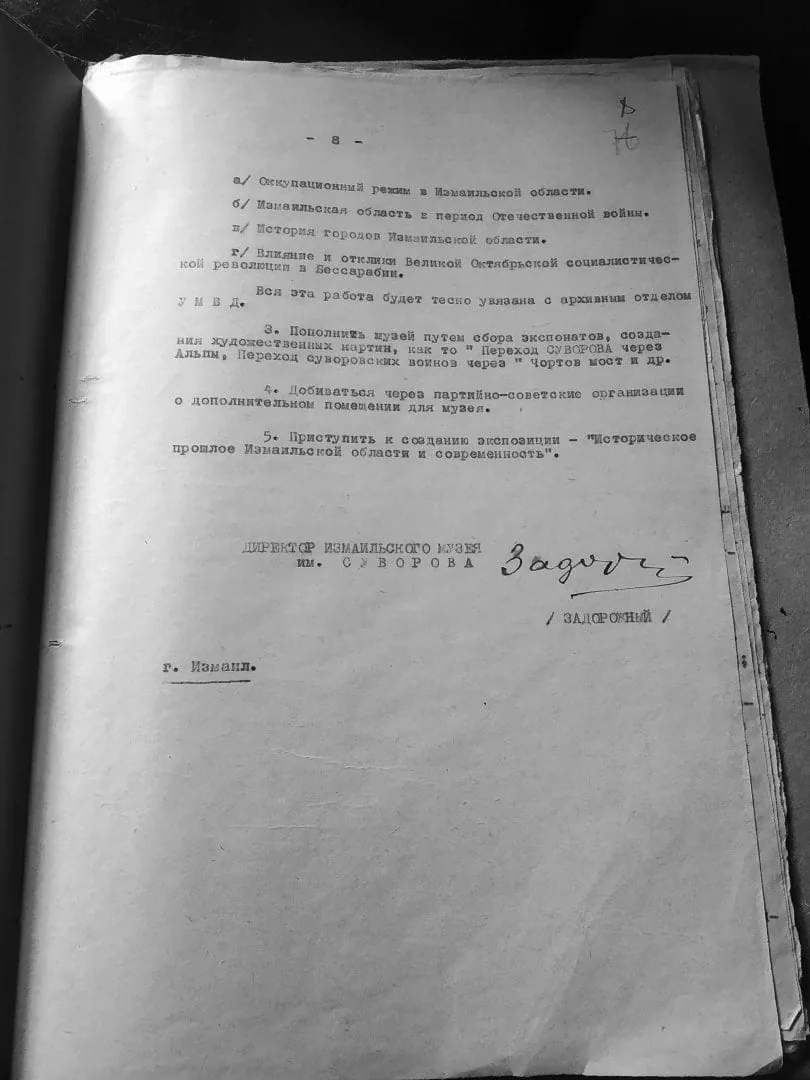
- a) The occupation regime in the Izmail Oblast.
- b) The Izmail Oblast during the Patriotic War.
- c) The history of towns in the Izmail Oblast.
- d) The impact of and reactions to the Great October Socialist Revolution in Bessarabia.
All this work will be closely coordinated with the Archives Department of the Directorate of the Ministry of Internal Affairs.
- Expand the museum’s holdings by collecting artifacts and commissioning artworks, such as Suvorov Crossing the Alps, Suvorov’s Troops Crossing the Devil’s Bridge, and others.
- Secure additional premises for the museum through Party and Soviet organizations.
- Begin work on the exhibition titled The Historical Past of the Izmail Oblast and the Present Day.
DIRECTOR OF THE IZMAIL SUVOROV
HISTORICAL MUSEUM
/ZADOROZHNYI/
City of Izmail


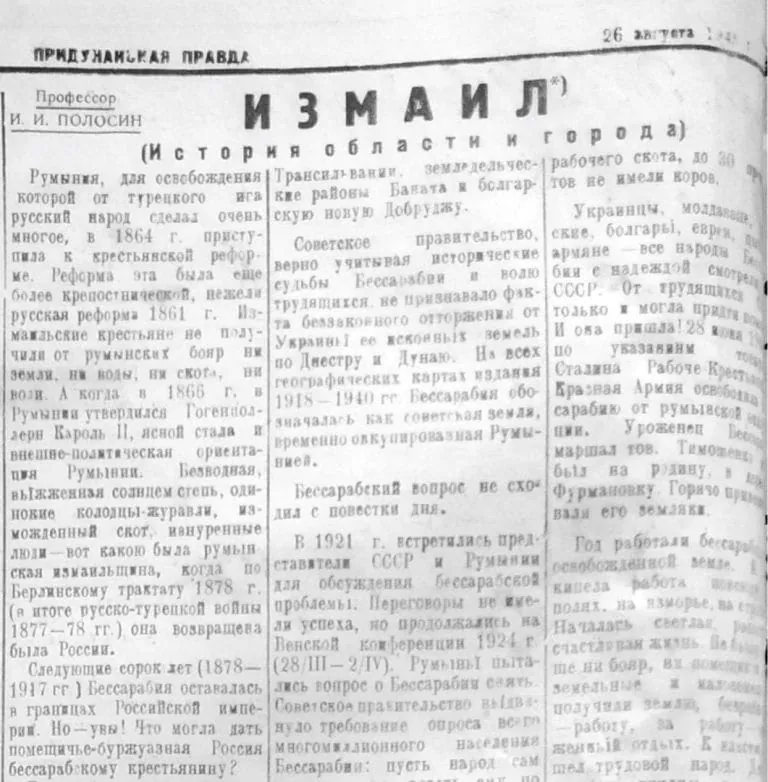

The document presented here is a valuable source for studying the Soviet authorities’ memory policy in the Izmail Oblast during the early postwar years. The report details the activities of the newly established museum during its first year of operation and contains information typical of such administrative records—covering exhibition development, collection management, research, display, and propaganda work—while also outlining the institution’s priorities for the coming year. At the same time, the source allows us to trace how the heroic image of the Russian military commander Suvorov was constructed in the region—an image that became a central component of the official Soviet historical narrative.
To establish the Izmail Suvorov Historical Museum, Soviet authorities enlisted historians, museum professionals, and artists from across the USSR. Its opening on a symbolic date—the 30th anniversary of the October Revolution—underscored the link between Russia’s military-historical heritage and the Soviet political presence in the region. The Soviet authorities presented themselves as heirs to “Suvorov’s glory” and as continuators of Russia’s historical mission on the Danube, blending an imperial military narrative with the Soviet discourse of “liberation.”
This narrative was reflected in the museum’s exhibition, which began with Stalin’s words about Russian military commanders, continued by highlighting the key stages of Suvorov’s life, military career, and victories, and concluded by showcasing his commemoration within the Soviet memorial legacy. The report emphasized the exhibition’s main objective: to demonstrate the “heroic struggle of the Russian people” to visitors, using the 1790 storming of the Izmail fortress as a prime example. As a result, the region’s historical past was presented through the lens of Russian military glory and the ongoing struggle for the territory, culminating in the Soviet “liberation” of 1944. This is further illustrated by plans for an exhibition titled The Historical Past of the Izmail Oblast, intended to cover the period from 1800 to the present day.
The Izmail Suvorov Historical Museum played a leading role in promoting the official Soviet version of the region’s history. Its scholarly and public outreach activities focused on more than just Suvorov himself; the report also highlights other key themes the museum addressed, such as the 1924 Tatarbunary Uprising, the Great Patriotic War, and the postwar era. The document describes activities typical of Soviet museums that were aimed at spreading official narratives among the public: developing exhibitions, organizing special displays, conducting guided tours, delivering thematic lectures, and publishing articles in the local press. Visitor feedback cited in the report shows that military personnel were among the museum’s target audiences. The museum placed particular emphasis on engaging schoolchildren and youth through tours organized during summer recreation programs, lectures for Pioneer leaders, support for local history clubs, and collaboration with teachers.
At the same time, the report lists the challenges the museum faced during its first year of operation—primarily the lack of suitable premises for storing collections, establishing laboratories and auxiliary workshops, and setting up a classroom.