Donate
Quote
Viktor Drozdov, The Izmail Region in the Soviet Collective Memory (1944–1953): Myths, Heroes, and Symbols, Reesources.Rerhinking Eastern Europe, Center for Urban History, 02.11.2026
copied

The Izmail Region in the Soviet Collective Memory (1944–1953): Myths, Heroes, and Symbols

Publication date 02.11.2026

In this module, Viktor Drozdov analyzes the formation of the historical myth surrounding the Izmail region within Soviet memory politics and calls for a contemporary reexamination of these now-established concepts.

The Soviet Union’s annexation of Ukrainian territories during World War II was carried out under the banners of “liberation” and “reunification.” To legitimize these territorial changes, Soviet authorities crafted a unified model for interpreting the past of regions newly incorporated into the Ukrainian SSR. This model relied on mythological narratives about the ancient unity of Slavic lands, the “long-suffering fate” of the population under foreign rule, the continuous struggle against national and social oppression, historical and cultural ties with Russia, the Ukrainian people’s aspiration for unity with the “brotherly” Russian people, the “liberation mission” of the Red Army in 1939–1940 and the start of a “new life” under the Soviet system, as well as the final “reunification of the Ukrainian people” following the victory over the “fascist threat” [1]. It was precisely around the concept of “reunification” that Soviet memory politics constructed historical narratives, memorial landscapes, and commemorative practices designed to integrate the new territories into the all-Soviet historical discourse and memory space. However, Bessarabia—particularly its southern part, which was incorporated into the Ukrainian SSR—became an exception to this model [2]. The creation of a new version of the past for the Izmail region, along with corresponding commemorative practices, led to the gradual displacement of the Ukrainian historical narrative and the integration of these lands into the Russian imperial-Soviet memory space.

The Soviet Annexation of Bessarabia and the First Attempts to Interpret the History of the Izmail Region

Unlike the lands of Western Ukraine, the Stalinist regime regarded the annexation of Bessarabia in 1940 as the lawful recovery of its own territories as part of resolving the so-called “Bessarabian question” [3]. To briefly outline its historical context: under the terms of the 1812 Treaty of Bucharest, the Russian Empire annexed the Ottoman lands between the Prut and Dniester rivers. This territory was highly heterogeneous in historical development and ethnic composition, with three regions that can be tentatively distinguished: the south—Budzak (Budjak), which included the former domains of the Nogai Tatars, Ottoman fortresses, and the adjacent territories; the center—a part of the Principality of Moldavia with a predominantly Romanian-speaking population, cut off from the processes of Romanian nation-building; and the north—the Khotyn region, inhabited mainly by Ukrainians. The tsarist government united them into a single administrative unit—the Bessarabian Oblast, which later became a governorate. As a result of the Crimean (Eastern) War, the Danube region of Bessarabia was ceded to the Principality of Moldavia (and, after its unification with Wallachia, to Romania); however, after the Russo-Turkish War of 1877–1878, it was returned to Russia. After the empire’s collapse, Bessarabia became a subject of dispute among various states. In 1918, Romania took control of the region and later secured partial international recognition from the Entente powers. Meanwhile, Soviet Russia, and later the USSR, categorically refused to recognize Bessarabia’s annexation by Romania, viewing it as an illegal occupation. The USSR’s territorial interest in Bessarabia on the eve of World War II was explicitly outlined in a secret supplementary protocol to the non-aggression pact between Germany and the Soviet Union, known as the Molotov–Ribbentrop Pact.

On June 26, 1940, the USSR issued an ultimatum to Romania demanding the return of Bessarabia and the transfer of Northern Bukovina [4]. The territorial claim over Bessarabia rested on several controversial assertions. First, it was claimed that in 1918, Romania had forcibly seized this territory as an integral part of the “Soviet Union (Russia).” In other words, the document emphasized a claim to the imperial legacy, even though the USSR was established de jure by the treaty of December 20, 1922. Second, it highlighted the supposed violation of “the centuries-old unity of Bessarabia, which was predominantly inhabited by Ukrainians, with Soviet Ukraine.” However, by the end of the 19th century, Ukrainians made up slightly less than 20% of the Bessarabian Governorate’s population, while Moldovans accounted for 47.6%. Ukrainians were in the majority only in Khotyn County [ukr. Povit], whereas in southern Bessarabia (the Akkerman and Izmail counties) they made up 20–25% of the population [5]. Facing diplomatic isolation and fearing military conflict, Romania agreed to withdraw its troops. During the military operation, from June 28 to July 3, the Soviet Army occupied the territories of Bessarabia and Northern Bukovyna.

Some Soviet historians attempted to depict the annexation of Bessarabia through the lens of the “reunification of the Ukrainian people.” In particular, Naum Nartsov described Ukrainians and Rusyns (considering the latter descendants of East Slavic tribes) as the indigenous population of the Prut-Danube interfluve, claiming they had lived there before the establishment of the Moldavian Principality. Conversely, he characterized Moldovans as “a largely assimilated Ukrainian population that had lived here since time immemorial” [6]. Nartsov’s version of Bessarabian history was intended to substantiate the direct ethnic kinship of the Bessarabian population with Ukrainians; however, it did not gain traction in Soviet historical discourse.

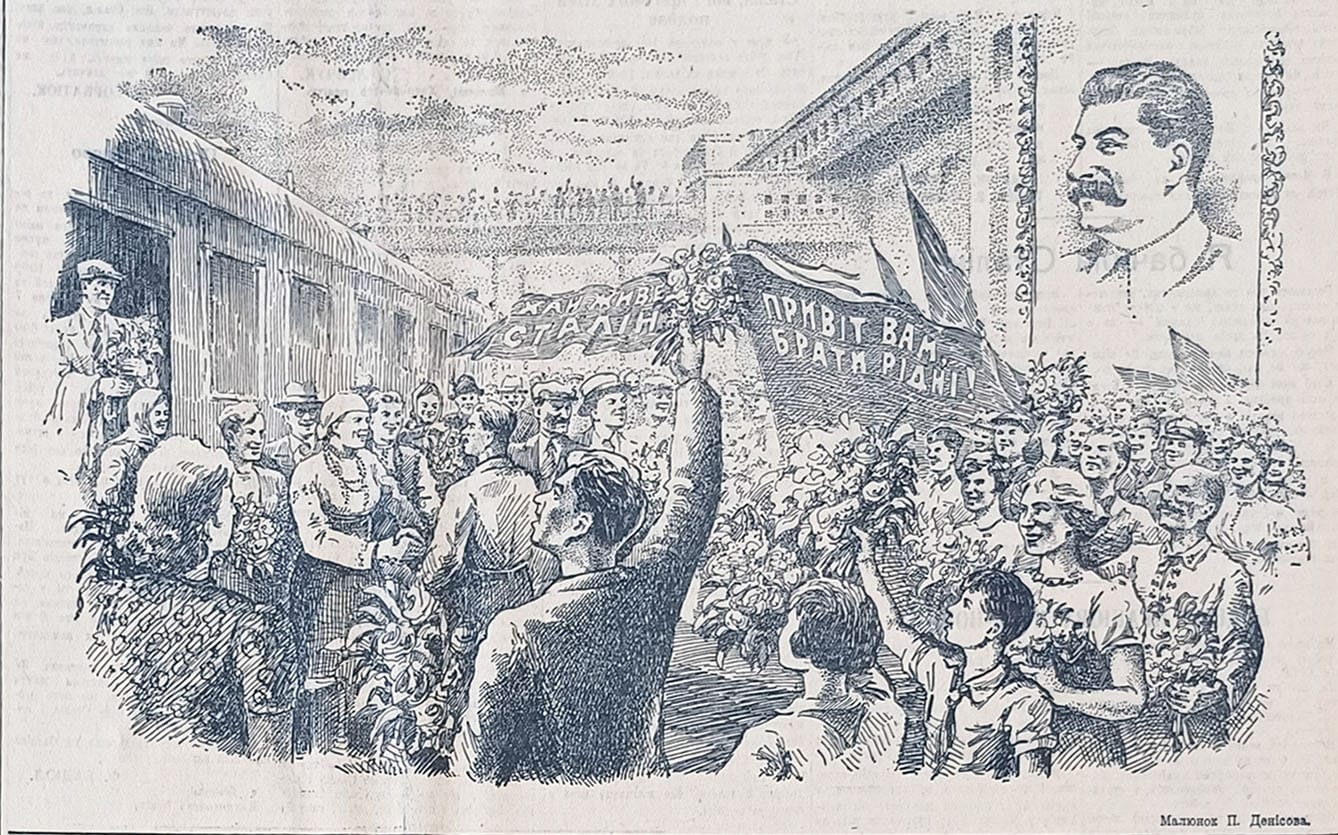
On August 2, 1940, the USSR parliament determined the administrative status of the annexed territories. The laws it passed provided for the creation of the Moldavian Soviet Socialist Republic, as well as the incorporation of Northern Bukovyna and the Khotyn, Akkerman, and Izmail counties into the Ukrainian SSR. During the discussion of the draft laws, it was emphasized that this administrative division ensured the “reunification” of the Moldovan and Ukrainian peoples within the Soviet state and reflected the aspirations of the population of the “liberated territories.” To legitimize these decisions, a delegation of representatives from Bessarabia and Northern Bukovyna was invited to a session of the Supreme Soviet of the USSR; in their speeches, delivered in their native languages, they expressed unqualified support for the new administrative division [7]. Thus, Bessarabia—which Soviet leadership had regarded as a single historical and geographical region until 1940—was divided along ethnic lines into three parts: the Moldavian SSR [8]; Khotyn County, which became part of Chernivtsi Oblast [9]; and Akkerman and Izmail counties, from which Akkerman Oblast was formed.

A meeting in Kyiv of a delegation representing the peoples of Bessarabia and Northern Bukovyna. Illustration by P. Denisov. Source: Kommunist. 1940. August 13. p. 1.

Although the Soviet leadership incorporated the oblast with its center in Akkerman (renamed Bilhorod-Dnistrovskyi in August 1944) into the Ukrainian SSR, citing primarily national considerations, by the end of 1940 it had already begun to implement a Russia-centric model of official memory in the area. One reason for this shift was the region’s limited symbolic potential for building a Ukrainian Soviet narrative. Notably, in the new edition of the Institute of History of the Academy of Sciences of the Ukrainian SSR’s History of Ukraine. A Short Course (1940), only a few sentences were devoted to Bessarabia’s history [10]. At the same time, the region offered a powerful symbolic resource linked to Russian imperial history, primarily the figure of Alexander Suvorov and the storming of the Izmail Fortress on December 22, 1790. By then, Suvorov already held a prominent place in Stalin’s pantheon of heroes, and the cult of Suvorov was actively spreading throughout the Soviet Union. Locally, authorities constructed a narrative of historical continuity by venerating the Russian commander, citing unrealized plans to erect a monument to Suvorov in Izmail on the eve of World War I [11].

Until the end of 1940, historical accounts of Bessarabia only mentioned the capture of the Izmail Fortress in passing. The turning point came with the commemoration of the 150th anniversary of this event in December 1940, which marked a new interpretation of the region’s past. At that time, the Akkerman Oblast was renamed the Izmail Oblast, and its administrative center was moved to Izmail. The city’s main avenue was named after Suvorov, and in January 1941, his name was also given to a village, a collective farm, and one of the oblast’s districts. Simultaneously, the authorities considered relocating the Suvorov monument from Odesa to Izmail. In preparation for the anniversary celebrations of Bessarabia’s annexation, the newspaper Pridunayskaya Pravda published a brief historical sketch of Izmail, highlighting the storming of the fortress in 1790 as the city’s main historical event. When describing the city’s 19th-century history, the author noted that “of all the cities in reunified Bessarabia, Izmail had the most Ukrainian-Russian character” [12].

After the advance of German and Romanian troops in June 1941, Bessarabia once again became part of Romania. In August 1944, the Soviet Union regained control over the Izmail territories, after which Sovietization resumed, along with the ongoing policy of constructing historical memory.

The Formulation of the Official Soviet Version of the History of the Izmail Region

In early 1944, even before Nazi troops had been fully expelled from Ukrainian territory, Mykola Petrovskyi, director of the Institute of History of the Academy of Sciences of the Ukrainian SSR, published a work that thoroughly outlined the concept of the “reunification of the Ukrainian people” [13]. The following year, he prepared separate historical reports on each of the “reunited” territories—except for Bessarabia. This omission was no accident. The history of the Izmail Oblast, as part of Bessarabia, had not been integrated into the Ukrainian historical narrative and remained primarily the domain of Moldovan and Russian historians. A telling example is Adolf Dolnik’s work Bessarabia Under the Rule of Romanian Boyars (1918–1940) (1945), where the Izmail region was regarded not as a separate Ukrainian region but as part of the broader historical space of Bessarabia [14].

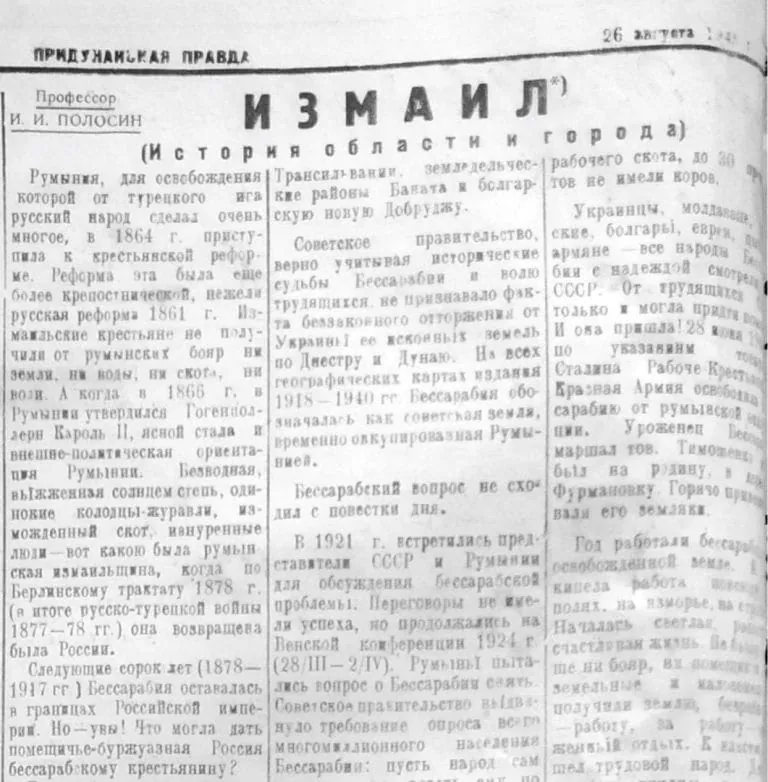
On the eve of the first anniversary of the “liberation” of the Izmail Oblast from the “German-Romanian invaders,” Soviet authorities commissioned Moscow historian Ivan Polosin to write an essay on its history. The article, titled “Izmail (History of the Oblast and the City),” was published in the local newspaper Pridunayskaya Pravda [15]. Written according to the canons of Soviet historical propaganda, the article blended numerous fabrications, ideological clichés, and selective interpretations of historical events. Its aim was not only to introduce the local population to the official version of the region’s history but also to standardize its teaching: shortly after publication, a special seminar was organized for history teachers in the Izmail Oblast, where the article’s author served as one of the lecturers [16].

Polosin began his essay with lines by Pushkin about Bessarabia, immediately situating the region’s past within the Russian cultural sphere and consistently emphasizing its historical ties to Russia. The region’s history was depicted as a continuous struggle against foreign oppressors—from the Scythian era to the Great Patriotic War. In this narrative, Ottoman and Romanian rule were presented solely as periods of national and social oppression, while the Russian Empire—and later the Soviet Union—were portrayed as the only forces capable of liberating the local population.

Polosin regarded the lands along the Danube as a distinct historical and cultural region. He referenced the historical toponym “Budjak,” explaining it as the Turkic name for the steppe region of Bessarabia during the Ottoman Empire. Notably, this name was subsequently seldom used in Soviet historical discourse, aligning with the broader policy of symbolically erasing most foreign-origin place names from the region [17]. At the same time, Polosin referred to these territories as “Ukrainian Bessarabia.” He described the region’s multinational population as the “peoples of Bessarabia,” listing Ukrainians first among the major ethnic groups. This interpretation aligned with the Soviet concept of “reunification,” but in later years it was ultimately replaced by a Russia-centric model of memory, in which the region’s history was increasingly centered around the myth of the “glory of Russian arms” and the figure of Suvorov.

The Myth of the “City of the Glory of Russian Arms” and the Commemoration of Suvorov

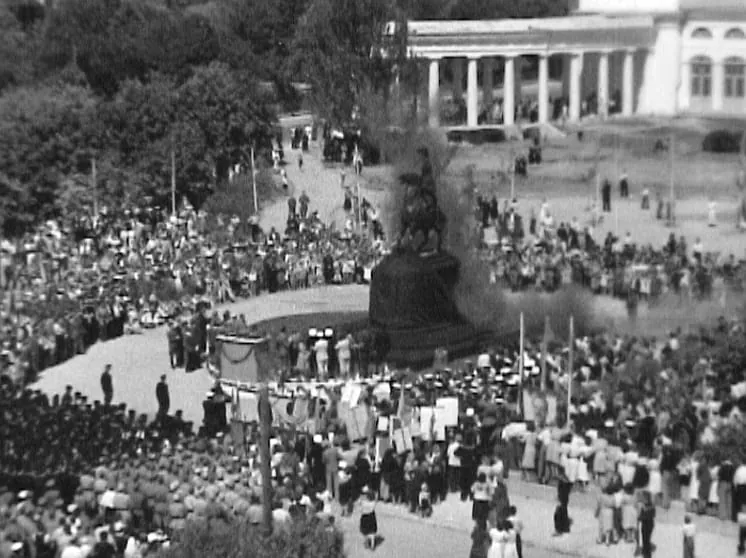
One of the central episodes in Polosin’s essay was the storming of the Izmail Fortress by Suvorov’s troops in 1790. The publication of this section coincided with an announcement about the completion of the Suvorov monument in Izmail, whose grand opening took place on the anniversary of the region’s “liberation” by Soviet troops—August 26, 1945. The monument’s construction firmly established the image of Izmail as the “city of the glory of Russian arms” in official Soviet discourse. Moreover, unveiling the monument on this specific day symbolically linked two events—the storming of the fortress in 1790 and the Red Army’s entry into Izmail in 1944—presenting them as parts of a single historical tradition of Russian military glory. Thus, the monument to Suvorov became not only a memorial to the Russian commander but also a central symbol of the new official Soviet narrative.

The unveiling of the monument was an event of unprecedented scale in Izmail’s postwar history. Leonid Korniets, Deputy Chairman of the Council of People’s Commissars of the Ukrainian SSR, participated in the celebrations, highlighting the event’s significance across the republic. To heighten the emotional impact, the ceremony featured special pyrotechnic effects and an artillery salute [18]. The event was filmed and included in the newsreel On the Banks of the Soviet Danube (1945) [19]. The Soviet press portrayed the unveiling as “a universal celebration of the peoples of the Soviet Union” and “the fulfillment of the cherished dream of Izmail’s citizens,” emphasizing the inseparable link between the city’s history and “the unsurpassed might of Russian arms” [20]. In the early postwar years, the central square with the Suvorov monument became the primary venue for official ceremonies and commemorative events. Notably, during the late Stalinist period, no monument to Lenin—the traditional symbolic center of Soviet urban space—was ever erected in Izmail. Instead, Suvorov’s figure assumed this role, becoming the region’s main symbolic marker and securing its integration into the all-Union historical narrative.

Unveiling of the monument to A. Suvorov. Still from the documentary film On the Banks of the Soviet Danube (1945). Source: From the collections of the Central State Audiovisual and Electronic Archive (item no. 525)

The commemoration of the Suvorov myth continued in December 1945, with the celebration of the 155th anniversary of the storming of the Izmail Fortress. Although no large-scale festivities were organized, the anniversary featured a widespread agitation and propaganda campaign. The local press regularly published articles glorifying the storming of Izmail as one of the greatest victories in Russian military history and drawing symbolic parallels between the events of 1790 and 1944. A telling example of such myth-making was the editorial “The Immortal Glory of Russian Arms,” published in Pridunayskaya Pravda on December 22, 1945. The author included the storming of Izmail among Russia’s most significant military victories and also attributed the Khmelnytskyi Uprising to Russian history:

“From generation to generation, the memory of the Battle of the Neva and the Battle on the Ice, of the battles of Zhovti Vody and at Kulikovo Field, of the storming of Izmail and the rout of the Swedes at Poltava, of the Battle of Borodino and the Defense of Sevastopol will be sacredly preserved. The people’s memory will forever preserve the names of the great commanders and ardent patriots of the Russian land: Alexander Nevsky, Dmitry Donskoy, Kuzma Minin and Dmitry Pozharsky, Bohdan Khmelnytskyi, Alexander Suvorov, and Mikhail Kutuzov” [21]. 

Furthermore, the Red Army was proclaimed the “worthy heir to the glorious traditions of Russian arms,” and the victory over the “fascist invaders” was presented as a natural continuation of Russia’s centuries-old military glory. This idea was particularly evident in the assertion that “the soldiers of the Red Army, who liberated Izmail from the German-Romanian invaders, proved themselves to be worthy descendants of Suvorov’s mighty warriors who stormed the Izmail fortress in 1790” [22].

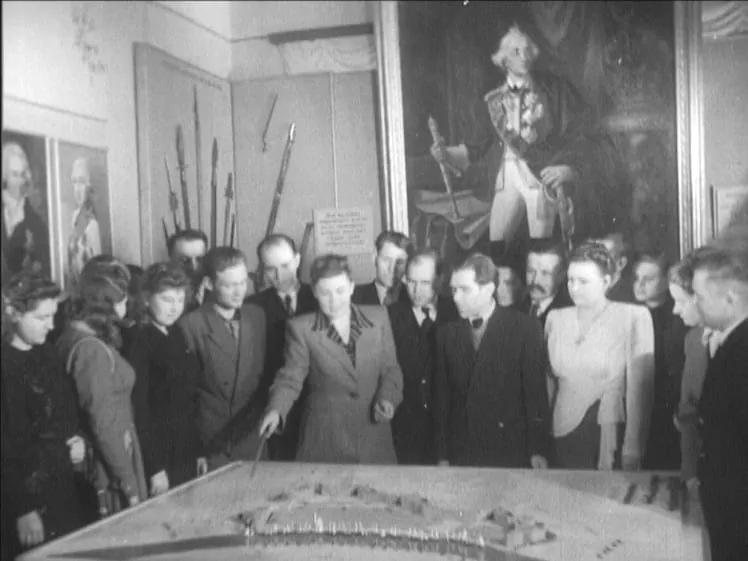
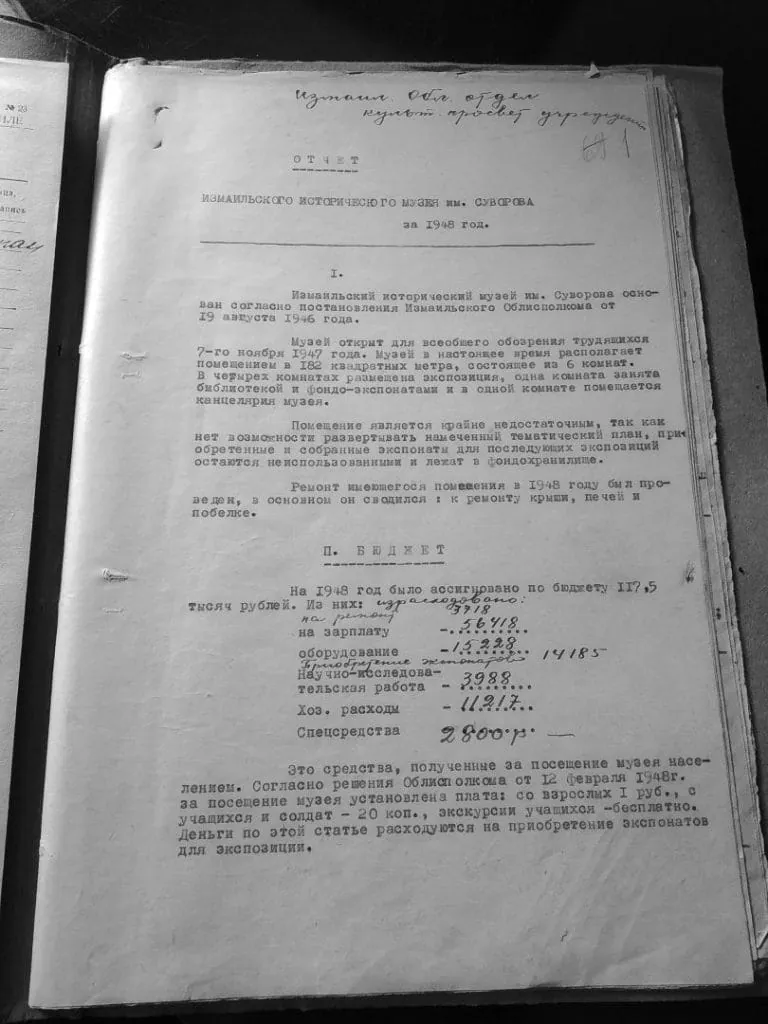
The next stage in institutionalizing the myth of the “glory of Russian arms” was the opening of the Izmail Suvorov Historical Museum on November 7, 1947—the 30th anniversary of the October Revolution. Preparations for the museum began soon after the unveiling of the Suvorov monument. The Soviet authorities enlisted the country’s leading museums, as well as prominent historians, artists, writers, actors, and sculptors, to help form the museum’s collection. According to a decision by the Izmail Oblast Executive Committee, the museum’s main purpose was “to promote the historical past of our Motherland, the glory of Russian arms, and the military exploits of the great commander” [23]. 

During its first six months, the museum organized an exhibition with 14 thematic sections dedicated to Suvorov’s life and military career. The exhibition was housed in three halls: the first focused on the commander’s childhood and early military career, the second on the storming of the Izmail Fortress, and the third on Suvorov’s later life, military campaigns, and posthumous honors. One section, ideological in nature, was titled J. V. Stalin on Russian Commanders. At the same time, the museum’s activities extended beyond commemorating Suvorov. In 1949, a thematic exhibition plan dedicated to the history of the Izmail Oblast was developed, interpreting the region’s past in line with the official Soviet historical narrative. By 1951, the exhibition included 24 thematic sections, a significant portion of which focused on the Soviet period [24].

A tour of the Izmail Suvorov Historical Museum (1950). Source: From the collections of the Central State Audiovisual and Electronic Archive (item no. 706). Soviet Ukraine [Radianska Ukraiina]. Newsreel. 1950. No. 25. Segment 3. In Memory of the Great Commander.

Another major commemorative event that further institutionalized the cult of Suvorov and spread the myth of the “glory of Russian arms” was the celebration of the 150th anniversary of the commander’s death, held at the all-Union level in May 1950. The plan for these anniversary celebrations, developed by the republican committee, encompassed a wide range of commemorative, cultural, educational, and propaganda activities. Izmail received special prominence as a key symbolic center of the commander’s military glory. The plan called for the city’s solemn rally—alongside gatherings in Kyiv and rallies in Tulchyn and Ochakiv—to be filmed for newsreels. A dedicated segment on Izmail, featuring both the monument and the museum, was also to be included in the newsreel. Furthermore, commemorative plaques were to be installed at sites associated with Suvorov’s military activities. Among these was the Turbaiivskyi Barrow, located 5 km from Izmail, where Suvorov was believed to have planned the assault on the fortress in 1790; an obelisk with a commemorative plaque was erected there. Additionally, one of Izmail’s schools was named after the commander [25].

Izmail Suvorov Historical Museum played a significant role in the anniversary celebrations. During preparations, its collection was expanded by more than 400 new exhibits. Museum staff organized a photo exhibition, prepared lecture materials, and wrote newspaper articles highlighting the commander’s life and military victories [26]. City and district committees of the Communist Party of Ukraine (Bolsheviks) reported on the implementation of the approved anniversary events, which encompassed virtually all segments of the population.

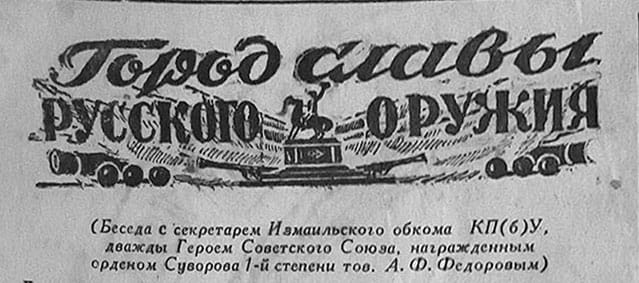
The image of Izmail as the “city of the glory of Russian arms” became central to official Soviet discourse, as shown in a series of press publications marking the 150th anniversary of the commander’s death. A comprehensive interpretation of this image appeared in an interview published in Pridunayskaya Pravda with O. Fedorov, secretary of the Izmail Oblast Committee of the Communist Party of Ukraine (Bolsheviks), titled “The City of the Glory of Russian Arms” [27]. The publication combined a heroic account of the storming of the Izmail Fortress with contemporary displays of reverence for the Russian commander. Notably, the city’s history omitted events other than the storming of the fortress and the “Great Patriotic War,” between which parallels were traditionally drawn. The narrative emphasized that Suvorov’s “noble image” inspired Soviet soldiers during the defense and “liberation” of the city, and that they were heirs to the traditions of “Suvorov’s mighty bogatyrs.” Particular attention was given to the Suvorov monument, presented as a symbol of patriotism and invincibility, as well as an expression of the local population’s “respect and love” for the commander. The Suvorov Museum was considered equally important, highlighted as a center for promoting the “combat traditions of the Russian people.” The publication also listed sites named in honor of the commander: the city’s main avenue, one of the oblast’s districts, eleven agricultural artels, and a new movie theater planned to be named after Suvorov.

The article’s headline featured a decorative composition that visually represented the Soviet image of Izmail. Source: Pridunayskaya Pravda. 1950. May 18. p. 2

In the new Soviet interpretation, the Izmail region lost any symbolic connection to the Ukrainian SSR. Although the Izmail region was defined as a “young Soviet oblast of Ukraine,” its historical memory was built not around the Ukrainian past but around the cult of Suvorov and the myth of the “glory of Russian arms.” This is most clearly evident in the following passage from the publication: “Socialist Izmail Region, bathed in the glory of Russian arms, surrounded by the daily care of the Party, the government, and Comrade Stalin himself, is steadily growing and flourishing in its march toward communism” [28].

It should be noted that local authorities failed to implement all projects aimed at monumentalizing the myth of the “glory of Russian arms.” The newspaper Pridunayskaya Pravda reported that in 1945, plans were made to create a historical and memorial complex in the area of the former fortress, which was to include a panorama of the 1790 assault, a museum, the Suvorov Military School, and monuments to Kutuzov, the participants in the assault, and the heroes of the Great Patriotic War [29]. Like many other postwar initiatives, this project was never realized due to a lack of funding. In 1950, to mark the 160th anniversary of the assault, local authorities proposed erecting an obelisk on the site of the former fortress. Officials justified the need by pointing to a Romanian monument erected in 1937 in honor of those who died in the Russo-Turkish War of 1877–1878 and World War I. In their view, this monument confused the public, as residents laid flowers at it during commemorations of events related to Suvorov’s assault. Although the Committee on Arts of the Ukrainian SSR supported the project and approved the cost estimate for its construction, the Council of Ministers of the Ukrainian SSR refused to allocate the necessary funding, so the obelisk was never erected [30]. Much later, in 1973, the Soviet authorities implemented another large-scale memorial project, opening a diorama titled The Storming of the Izmail Fortress by Russian Troops in 1790 in the building of the 16th-century Small Mosque. Its creation completed the process of establishing a cohesive memorial space in the city dedicated to the myth of the “glory of Russian arms.”

The Russia-centric model of memory politics involved not only forming a cult of Suvorov and the myth of the “glory of Russian arms,” but also integrating the region into the Russian imperial narrative by highlighting its connections to prominent figures in Russian culture. In this context, Alexander Pushkin was particularly significant: he visited Akkerman in 1821 and 1822 during his exile in the south. Excerpts from his poem To Baratynsky. From Bessarabia (1821) became an integral part of official Soviet discourse on the region and were repeatedly used in historical essays, journalistic writings, and documentary films to confirm the historical and cultural ties between the Izmail region and Russia. The creation of Pushkin memorial sites in Bilhorod-Dnistrovskyi was timed to coincide with the 150th anniversary of the poet’s birth. In 1949, two commemorative plaques were installed in the city at sites associated with his stay—on the building where he stayed in 1821 and on one of the towers of the Akkerman Fortress [31]. Later, in 1952, a bust of Pushkin was erected [32], completing a local memorial space dedicated to the poet.

Memorialization of the “Great Patriotic War”

By combining the narratives of Suvorov’s assault and the “liberation” of the Izmail region by Soviet troops, the authorities were in no hurry to memorialize those who died in the Great Patriotic War. In the early postwar years, local authorities and townspeople led most initiatives to commemorate fallen soldiers, though not all were carried out. The first monument in Izmail—an obelisk to local heroes—was erected at the expense of residents of the Kopan Balka suburb. The newspaper Pridunayskaya Pravda reported that the cornerstone was laid on June 12, 1945, and that over 200 people participated in its construction [33]. The obelisk was unveiled on the same day as the Suvorov monument. However, while the Suvorov celebrations were attended by republic-level leadership, the obelisk’s unveiling ceremony was attended only by the secretary of the Izmail City Committee of the Communist Party of Ukraine (Bolsheviks), underscoring the ceremony’s significantly lower symbolic status. 

In other cities of the oblast, requests to build memorials honoring those who died in the war were denied. For example, in 1946, local authorities in Kiliya proposed erecting an obelisk in honor of the paratroopers who died near the village of Galilești. However, the regional executive committee rejected the project, citing not only its insufficient architectural value but also that it “did not reflect the heroic epic of the Great Patriotic War” [34]. Memorial initiatives in Bolhrad met a similar fate: despite permission to erect a monument in one of the city’s parks, plans to install a monument to fallen soldiers in the city center—and even a monument to Lenin—were never realized [35].

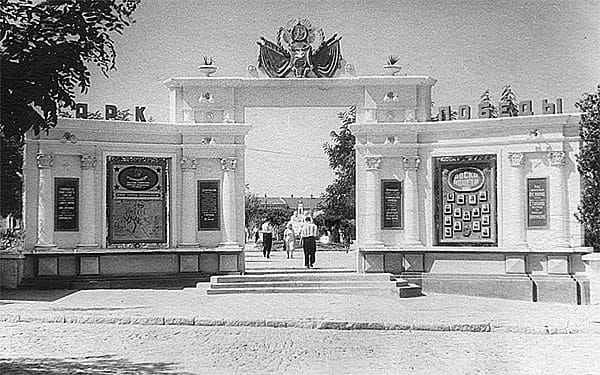
In the late 1940s, cities across the Izmail Oblast erected the first large military monuments. In particular, in 1948, Bilhorod-Dnistrovskyi unveiled a monument commemorating the victory over Nazi Germany. In 1951, the Arch of Peace was erected at the entrance to Victory Park, which gradually emerged as the city’s main memorial space.

The central entrance to Victory Park in Bilhorod-Dnistrovskyi (1952) Source: Bilhorod-Dnistrovskyi Local History Museum, a municipal institution of the Bilhorod-Dnistrovskyi City Council

One characteristic trend in Soviet memorialization of war dead was relocating military graves to the center of a settlement, followed by creating a mass grave and erecting a standard monument. In Izmail, the creation of such a sacred site coincided with the construction of a new administrative center at the intersection of Suvorov Avenue (now Nezalezhnosti Avenue) and Lenin Avenue (now Myru Avenue). In line with Soviet urban planning practices, the compositional foundation consisted of the new buildings of the oblast executive committee and the teachers’ institute, between which a spacious square was designed in honor of the victory in the Great Patriotic War. In 1949, the city executive committee decided to create a mass grave and a monument to soldiers who died in the Great Patriotic War on the square, which was unveiled in 1952 [36]. Thus, the city’s central commemorative space gradually shifted from the square with the Suvorov monument to the newly created Victory Square, which has since become the main venue for official ceremonies.

Overall, the process of memorializing the Great Patriotic War in the Izmail Oblast followed a model typical of late Stalinism. At the same time, sites associated with other key Soviet mythological themes continued to occupy prominent positions in the regional memorial landscape. Alongside the myth of the “glory of Russian arms,” the myth of the “struggle to establish Soviet power”—whose central event was the so-called “Tatarbunary Uprising”—occupied an important place.

The Tatarbunary Uprising as a Symbol of the Revolutionary Struggle for Soviet Power

After the fruitless conclusion of the Soviet-Romanian negotiations in Vienna in March–April 1924 over the status of Bessarabia, the Soviet leadership tried to destabilize Romania by organizing an armed uprising. Its goal was not only to establish Soviet power in Bessarabia and annex it to the USSR, but also to spread the revolutionary situation throughout Romania, with the prospect of establishing a communist regime in the country [37]. To carry out this plan, Soviet agents were sent to Bessarabia to coordinate preparations for the armed uprising. In September 1924, unrest broke out in several villages in the southern counties of Bessarabia, with the village of Tatar-Bunar (now the city of Tatarbunary) at its center. The Romanian authorities suppressed the uprising within a few days and brought its participants and organizers to justice. At the same time, the Soviet Union launched a large-scale international propaganda campaign, portraying the events as a heroic struggle of Bessarabia’s working people against the Romanian “boyar regime” and accusing the Romanian authorities of brutal repression against the participants in the uprising. 

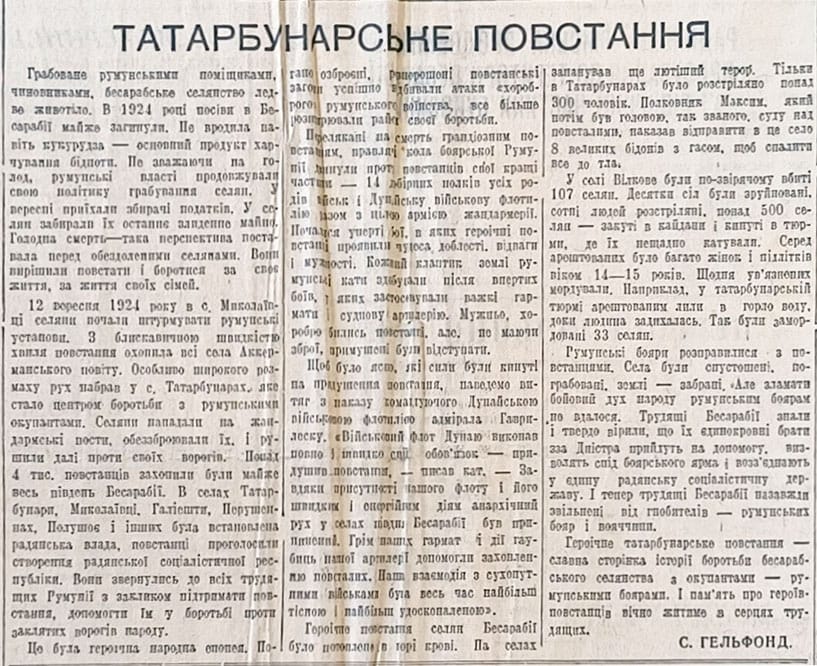
Soviet propaganda actively used the narrative of the Tatarbunary Uprising to legitimize the 1940 annexation. In the first days after the Red Army entered the region, Soviet authorities began commemorating the event [38]. At the same time, they launched an information and propaganda campaign. As early as June 30, 1940, the republican Soviet newspaper Communist published an article about the “Tatarbunary Uprising,” presenting it as a heroic uprising by the peasants of Bessarabia [39].

An article in the republican newspaper Communist, published two days after Soviet troops entered Bessarabia. Source: Communist. 1940. June 30. p. 2

Despite the peasant nature of the uprising, the process of memorializing its participants demonstrated the Soviet authorities’ desire to frame it within the broader context of the revolutionary struggle to establish Soviet power. The idea of erecting a monument in the village of Tatarbunary was first raised in 1947 at a meeting of the Oblast Architectural Commission during the review of the master plan [40]. The Izmail Oblast Executive Committee adopted the decision to erect a monument at the mass grave in August 1949, in connection with the commemoration of the 25th anniversary of the uprising [41]. In fact, the decision was made at the highest level. In June 1949, Nikita Khrushchev, in a letter to Georgy Malenkov, Secretary of the Central Committee of the All-Union Communist Party (Bolsheviks), requested permission to erect the monument. In an explanatory note, he justified commemorating the uprising because of its ideological significance as evidence of the struggle of the workers and peasants of the Izmail region to establish Soviet power [42]. After the proposal to erect the monument was approved by the top party leadership of the USSR on August 15, 1949, the Council of Ministers of the Ukrainian SSR and the Central Committee of the Communist Party of Ukraine (Bolsheviks) adopted a corresponding resolution, but in it they referred to the initiative of local authorities [43]. Local authorities were also tasked with maintaining the graves of the uprising participants in the settlements of the Tatarbunary, Sarat, and Kiliya districts. In some of these settlements, grave markers were erected (Vylkove, Vasylivka, Mykhailivka, Nerushay, Pshenychne, Spaske, Strumok, and Shevchenkove) [44].

In December 1949, the Oblast Architectural Commission rejected the first design for the monument, deeming it inconsistent with ideological requirements [45]. In the design, the artist depicted the peasant character of the uprising (a peasant figure wearing a Bulgarian cap), the desire for reunification with the Soviet state (the peasant’s hand raised toward Moscow), and mourning for the fallen (the presence of an urn at the monument’s entrance and two young women laying wreaths). In the commission’s view, this concept did not sufficiently convey the revolutionary nature of the event and did not meet the objective of glorifying the struggle to establish Soviet power. Based on the commission’s decision, the Izmail Oblast Executive Committee rejected the design, recommending, in particular, that the central figure be made more dynamic and that a sculptural group be created instead of a single figure [46]. 

In September 1950, the commission reviewed a second design for the monument, whose ideological focus differed significantly from the previous one. The new composition consisted of three sculptural figures. The central symbolic position was no longer reserved for a peasant but for a worker holding a flag, who personified the revolutionary struggle to establish Soviet power. Thus, the uprising was interpreted not only as a peasant protest against Romanian rule and social exploitation, but first and foremost as part of the general revolutionary struggle led by the working class. The commission generally approved the new design but recommended further strengthening its ideological message. In particular, it proposed replacing the bas-relief Peasant with a Scythe with a panel titled The Reunification of Bessarabia with Soviet Ukraine, and depicting the peasant figure holding a weapon to give the composition a more pronounced revolutionary character [47]. Thus, the final concept of the monument was intended not only to glorify the Tatarbunary Uprising but also to integrate it into the Soviet narrative of “reunification,” presenting the events of 1924 as the initial stage of a protracted struggle that culminated in the establishment of Soviet power in Bessarabia in 1940.

It is worth noting that the construction of the monument was delayed due to bureaucratic procedures and an excessively high project budget. Following an appeal by Vasyl Syrota, a deputy of the Supreme Soviet of the USSR, in February 1952, consideration of the issue of the monument’s construction was expedited. In May 1952, the Committee on Arts approved the project with certain modifications, which, in particular, reduced its cost by a factor of three [48]. Stalin Prize laureates sculptors Makar Vronskyi and Oleksii Oliinyk, along with architect Ivan Shevchenko, created it. Based on this design, the monument was erected in 1953 (other sources say construction was completed in 1956 [49]).

Conclusions

The Izmail example convincingly shows that the concept of the “reunification of the Ukrainian people” served primarily to provide political legitimacy for the Soviet annexation of new territories during World War II. Although the incorporation of southern Bessarabia into the Ukrainian SSR was officially justified on national grounds, Stalin’s politics of memory soon began to remove the region from the Ukrainian historical narrative, linking it instead to Russian military history and culture. In this regard, the Izmail region became part of a broader model of memory politics in southern Ukraine. Within this Russia-centric model, the multinational Izmail region lost its own historical and cultural distinctiveness, as its past was effectively integrated into the myth of the “glory of Russian arms.” At the same time, official Soviet memory linked together, in a single chain of events, episodes that portrayed the region exclusively through the prism of revolutionary struggle and liberation. The glorification of the Suvorov cult, the heroization of participants in the Tatarbunary Uprising, and the memorialization of Soviet “liberators” shaped a new memorial space in the Izmail region, which remained dominant not only throughout the entire Soviet period but also after Ukraine’s declaration of independence. Only after the Russian Federation’s full-scale invasion, and with the onset of decolonization processes, did it become the subject of systematic reevaluation.

Notes:

[1] Vasylchuk, H., & Drozdov, V. (2023). Soviet Mythmaking in the Stalin Era: Constructing the Myth of “the Ukrainian People’s Reunification”. East European Historical Bulletin, (28), 170–186. 

[2] In contemporary historical discourse, several toponyms refer to this territory. The most common is Budzhak/Budjak (Turkish: Bucak—“corner”), a Turkic term that originally described the steppe lands of the Budzhak (Belgorod) Horde, a confederation of semi-nomadic Nogai tribes. At the same time, on 17th–18th century historical maps, another name—Bessarabia—also appeared. Researchers note that the toponym “Bessarabia” predates “Budjak” (see: Eșanu, A., & Eșanu, V. (2023). Dimitrie Cantemir and Bessarabia. Anuarul Institutului de Istorie “George Bariţiu”. Series Historica, 62, 303–323), first appearing on Western European maps in the late 1540s in connection with the Ottoman conquest of the southern lands of the Principality of Moldavia. From that point, it became necessary to distinguish between the territory that remained under the principality’s rule and the lands conquered by the Ottoman Empire, to which a separate name gradually became attached. Originally, Bessarabia referred to the area around Kiliya, the Black Sea coast up to Akkerman, and the Bender region. Later, in the 17th century, the Ottomans called the newly conquered lands “Budjak,” a name reflected on maps. After the Russian Empire annexed the Prut-Dniester Interfluve, “Bessarabia” came to denote the entire region; as a result, the term “Southern Bessarabia” is commonly used to refer to its Ukrainian part. Additionally, historical studies sometimes use the name “Ukrainian Danube Region” [ukr. Українське Подунав’я] (or Prydunaviya [ukr. Придунав’я]), though geographically this does not include territories adjacent to the Dniester. This essay uses the term “Izmail Region,” which the author associates with the Izmail Oblast as part of the Ukrainian SSR from 1940 to 1954, as this most accurately corresponds to the subject of this study.

[3] For details on the “Bessarabian question,” see: Ponomariov, O. (2007). Bessarabske pyttania v ukraiinsko-rumuskhyh vidnosynakh u 1917–1918 rokah [The Bessarabian Question in Ukrainian-Romanian Relations in 1917–1918]. Visnyk Kyivskoho natsionalnoho universytetu imeni Tarasa Shevchenka. Istoriia, 89–90, 44–49; Popenko, Ya. (2018). “Bessarabske pytannia” na Paryzkii myrnii konferentsii (osin–zyma 1919 r.) [“The Bessarabian Question” at the Paris Peace Conference (Fall–Winter 1919)]. Skhid, 4, 56–60; Snigir, M. (2024). “Nechego vynimat iz rumynskoy nogi bessarabskuyu zanozu”: bessarabske pytannia u radiansko-rumunskykh vidnosynakh mizhvoiennoho periodu [“There Is No Need to Remove the Bessarabian Thorn from the Romanian Foot”: The Bessarabian Question in Soviet-Romanian Relations During the Interwar Period]. Acta de Historia & Politica: Saeculum XXI, 7, 25–33; Sokyrska, V. (2019). Utvorennia Moldavskoi ASRR: heopolitychnyi kontekst rosiiskoi radianskoi polityky shchodo USRR [The Formation of the Moldavian ASSR: The Geopolitical Context of Soviet Russian Policy Toward the Ukrainian SSR]. Vcheni zapysky Tavriiskoho natsionalnoho universytetu imeni V. I. Vernadskoho. Seriia: Istorychni nauky, 30 (1), 63–70; Tuchynskyi, V. (2015). “Bessarabske pytannia” u mizhnarodnykh vidnosynakh na zavershalnomu etapi Pershoi svitovoi viyny ta u pershi povoienni roky [“The Bessarabian Question” in International Relations during the Final Stage of World War I and in the Early Postwar Years]. In Yu. Zinko (ed.). Narody svitu i Velyka viyna 1914–1918 rr.: Proceedings of the All-Ukrainian Scientific Conference, April 3–4, 2015 (pp. 101–108). Vinnytsia: Nilan-LTD LLC; Shpakovskyi, L. V. (2017). Radianska Ukraina yak instrument eksportu bilshovytskoi revoliutsii v Rumuniiu (pochatok 1920-kh rr.) [Soviet Ukraine as a Tool for Exporting the Bolshevik Revolution to Romania (early 1920s)]. Storinky istorii, 44, 91–106. 

[4] Myrne rozviazannia radiansko-rumunskoho konfliktu v pytanni pro Besarabiiu i pivnichnu chastynu Bukovyny (Povidomlennia TARS) [Peaceful Resolution of the Soviet-Romanian Conflict Over Bessarabia and Northern Bukovina (TASS Report)]. (June 29, 1940). Communist, 1.

[5] Berg, L. (1923). Naselenie Bessarabii. Etnograficheskiy sostav i chislennost (S 0-verstnoy etnograficheskoy kartoy) [The Population of Bessarabia: Ethnographic Composition and Numbers (With a 0-verst ethnographic map)]. Petrograd: Russian Academy of Sciences. pp. 42–45.

[6] Nartsov, N. (1940). Istoricheskie sudby Bessarabii i Moldavii [The Historical Fate of Bessarabia and Moldova]. Istorik-marksist, 9(85), 85–98.

[7] Seventh Session of the Supreme Soviet of the USSR [1st Convocation], (August 1–7, 1940): Verbatim Report. (1940). Moscow: OGIZ. pp. 49–53.

[8] One prerequisite for forming the Moldavian SSR was the creation, in October 1924, of the Moldavian Autonomous Soviet Socialist Republic as part of the Ukrainian SSR. This artificially established administrative entity, which included certain districts from the Odesa and Podillia governorates, was meant to demonstrate the existence of a separate “Moldovan” Soviet statehood and to foster the perception of “Moldovans” as a nation distinct from Romanians—one that had exercised its right to autonomy within the USSR. In reality, however, the creation of the Moldavian Autonomous Soviet Socialist Republic was primarily motivated by foreign policy objectives: to uphold the Soviet Union’s territorial claims to Bessarabia, intensify diplomatic pressure on Romania, and exert propaganda influence on the region’s population. After the annexation of Bessarabia in 1940 and the creation of the Moldavian SSR, the Transnistrian part of the autonomous region became part of the new republic, while the remaining districts stayed within the Ukrainian SSR.

[9] Soviet ideologues effectively integrated the Khotyn region into a single ethnocultural region with Northern Bukovyna. See: Frunchak, S. (2014). The making of Soviet Chernivtsi: National “reunification,” World War II, and the fate of Jewish Czernowitz in postwar Ukraine (Vol. 3666597) [University of Toronto (Canada)]. Pp. 125–126.

[10] Bielousov, S., Huslystyi, K., Ohloblin, O., Petrovskyi, M., Suprunenko, M., & Yastrebov, F. (Eds.). (1940). Istoriia Ukrainy: korotkyi kurs [History of Ukraine: A Short Course]. Kyiv: Publishing House of the Academy of Sciences of the Ukrainian SSR.

[11] Drozdov, V. (2022). Soviet Politics of Memory in Southern Bessarabia and Northern Bukovyna: Representation of the Past and Mythmaking during World War II. Plural. History. Culture. Society, 10(2), 85–102. https://doi.org/10.37710/plural.v10i2_4

[12] Kravchenko, I. (June 17, 1941). Izmail. Kratkiy istoricheskiy ocherk [Izmail. A Brief Historical Essay]. Pridunayskaya Pravda, 2.

[13] Petrovskyi, N. (1944). Vossoedinenie ukrainskogo naroda v edinom ukrainskom sovetskom gosudarstve [The Reunification of the Ukrainian People in a Single Ukrainian Soviet State]. Moscow: OGIZ – Gospolitizdat.

[14] Dolnik, A. (1945). Bessarabiya pod vlastyu rumynskih boyar (1918–1940 gg.) [Bessarabia Under the Rule of Romanian Boyars (1918–1940)]. Moscow: OGIZ – Gospolitizdat.

[15] Polosin, I. (1945). Izmail (istoriya oblasti i goroda) [Izmail (History of the Oblast and the City)]. Pridunayskaya Pravda, August 12, 3; August 14, 3; August 21, 3; August 24, 3; August 26, 4.

[16] Seminar uchiteley – istorikov [Seminar for History Teachers] (August 12, 1945). Pridunayskaya Pravda, 3.

[17] Drozdov, V. (2024). Masove pereimenuvannia naselenykh punktiv Izmailskoi oblasti v 1945 r. yak metod orhanizovanoho zabuttia [The Mass Renaming of Settlements in the Izmail Oblast in 1945 as a Method of Organized Forgetting]. Naukovyi visnyk Izmailskoho derzhavnoho humanitarnoho universytetu. Seriia: Istorychni nauky, 67, 112–121.

[18] Drozdov, V. (2021). Stvorennia radianskoho mifu pro Izmail yak “misto rosiiskoi boiovoi slavy” v povoiennyi period [The creation of the Soviet myth of Izmail as the “city of Russian military glory” in the postwar period]. Naukovyi visnyk Izmailskoho derzhavnoho humanitarnoho universytetu. Seriia: Istorychni nauky, 52, 54–64.

[19] Drozdov, V. (2023). Izmail u radianskii kinodokumentalistytsi 1940-kh – pochatku 1950-kh rr. [Izmail in Soviet Documentary Film of the 1940s–Early 1950s]. Naukovyi visnyk Izmailskoho derzhavnoho humanitarnoho universytetu. Seriia: Istorychni nauky, 63, 41–52. 

[20] Torzhestvo osvobozhdennogo naroda [The Triumph of the Liberated People] (August 29, 1945). Pridunayskaya Pravda, 3–4.

[21] Bessmertnaya slava russkogo oruzhiya [The Immortal Glory of Russian Arms] (December 22, 1945). Pridunayskaya Pravda, 1.

[22] Ibid.

[23] Resolution No. 566 of the Izmail Oblast Executive Committee dated August 19, 1946, “On the Organization of the Suvorov Oblast Historical Museum in the City of Izmail.” Izmail Archive Municipal Institution. Fond Р-470. Inventory 1. Case 107. Sheet 11.

[24] Drozdov, V. (2022). Muzei Izmailskoi oblasti yak instrumenty formuvannia i poshyrennia radianskoi ofitsiinoi pamyati v povoiennyi period [Museums of the Izmail Oblast as Instruments for Shaping and Disseminating Official Soviet Memory in the Postwar Period]. Naukovyi visnyk Izmailskoho derzhavnoho humanitarnoho universytetu, 59, 49–59. 

[25] Action Plan of the Committee of the Ukrainian Soviet Socialist Republic for the Commemoration of the 150th Anniversary of the Death of the Great Russian Commander A. V. Suvorov. The Central State Archives of Supreme Bodies of Power and Government of Ukraine. Fond 2. Inventory 8. Case 2042. Sheets 79–111.

[26] Report “On the Preparation and Conduct of the 150th Anniversary of the Death of the Great Russian Commander A. V. Suvorov”. State Archives of the Odesa Oblast. Fond П-4980. Inventory 2. Case 377. Sheets 29–31.

[27] “The City of the Glory of Russian Arms” (Conversation with Comrade A. F. Fedorov, Secretary of the Izmail Oblast Committee of the Communist Party of Ukraine (Bolsheviks), twice Hero of the Soviet Union, and recipient of the Order of Suvorov, 1st Class) (May 18, 1950). Pridunayskaya Pravda, 2.

[28] Ibid.

[29] Na meste kreposti Izmail [At the Site of the Izmail Fortress] (September 19, 1945). Pridunayskaya Pravda, 4.

[30] Drozdov V. (2021). The Soviet Places of Memory of the Postwar Period in the Symbolic Space of the Southern Bessarabian Cities. Analele Universităţii Dunărea de Jos din Galaţi. Seria Istorie, 20, 205–217. 

[31] Drozdov, V. (2023). Obraz rosiiskoho narodu v radianskykh komemoratyvnykh praktykakh na aneksovanoho ukrainskykh terytoriiakh (1939–1953) [The Image of the Russian People in Soviet Commemorative Practices in the Annexed Ukrainian Territories (1939–1953)].  Naukovi zapysky Vinnytskoho derzhavnoho pedahohichnoho universytetu imeni Mykhaila Kotsiubynskoho. Seriia: Istoriia, (44), 62–71. 

[32] Pushkinizatsiia Akkermana [The Pushkinization of Akkerman]. (August 17, 2024). Akkermanika.  

[33] Grishin, I. (August 29, 1945). Pamyatnik geroyam-zemlyakam [Monument to Local Heroes].  Pridunayskaya Pravda, 4.

[34] Izmail Oblast Department of Architecture to the Chairman of the Izmail Oblast Executive Committee, Comrade K. P. Ananko, November 12, 1945. Izmail Archive Municipal Institution. Fond Р-419. Inventory 1. Case 5. Sheet 17.

[35] Minutes No. 4 of the meeting of the Executive Committee of the Bolhrad City Council of Workers’ Deputies, dated January 30, 1948. Izmail Archive Municipal Institution. Fond Р-881. Inventory 1. Case 20. Sheets 40–42.

[36] Resolution of the restricted meeting of the Executive Committee of the Izmail City Council of Workers’ Deputies dated July 30, 1949. No. 11 “On Measures for the Maintenance of Graves and the Commemoration of Soldiers of the Soviet Army and Partisans Who Died in Battle During the Great Patriotic War of 1941–1945.” Archive of the Executive Committee of the Izmail City Council. Fond 56. Inventory 2. Case 5. Sheet 9.

[37] For a critical reexamination of the events of the 1924 Tatarbunary Uprising, see: Ponomariov, V. (2019). Considerații privind implicarea serviciilor secrete sovietice și a Cominternului în organizarea rebeliunii de la Tatar-Bunar. Plural. History, Culture, Society, 7(1), 43–59; Novosiolov, O. (2024). Radianska spetsoperatsiia v Pivdenniy Bessarabii u veresni 1924 r.: sproba demifolohizatsii “Tatarbunarskoho povstannia” [The Soviet Special Operation in Southern Bessarabia in September 1924: An Attempt to Demystify the Tatarbunary Uprising]. Ukrainskyi istorychnyi zhurnal, 5, 174–189. 

[38] Na Dunaye [On the Danube]. Film, in 7 parts. Editing sheet. (1940). Central State Audiovisual and Electronic Archive. Unit No. 132. Sheet 30.

[39] Helfond, S. (June 30, 1940). Tatarbunarske povstannia [The Tatarbunar Uprising]. Communist, 2.

[40] Transcript of the meeting of the Oblast Architectural Commission under the Oblast Department of Architecture, September 11, 1947. Izmail Archive Municipal Institution. Fond Р-419. Inventory 1. Case 16. Sheets 4–24.

[41] Resolution No. 111 of the Executive Committee of the Izmail Oblast Council of Workers’ Deputies and the Bureau of the Oblast Committee of the Communist Party (Bolsheviks) of Ukraine, dated August 25, 1949, “On the Construction of a Monument at the Mass Grave of the Heroes of the Tatarbunary Uprising.” Izmail Archive Municipal Institution. Fond R-470. Inventory 1. Case 223. Sheets 135–141.

[42] Central Committee of the All-Union Communist Party (Bolsheviks). N. Khrushchev to Comrade G. M. Malenkov, June 20, 1949. Central State Archives of Public Organizations of Ukraine. Fond 1. Inventory 23. Case 5656. Sheets 1–3.

[43] Kylymnyk, O., Butych, I., & Huseva, L. (Eds.). (1961). Kulturne budivnytstvo v Ukrainskii RSR. Naivazhlyvishi rishennia komunistychnoi partii i radianskoho uriadu 1917–1960 rr. [Cultural Development in the Ukrainian SSR. The Most Important Decisions of the Communist Party and the Soviet Government, 1917–1960] (Vol. 2). Kyiv: Derzhavne vydavnytstvo politychnoi literatury URSR. p. 206

[44] Tronko, P. (Ed.). (1987). Pamyatniki istorii i kultury Ukrainskoy SSR: Katalog-spravochnik [Historical and Cultural Monuments of the Ukrainian SSR: A Catalog and Reference Guide]. Kyiv: Naukova Dumka. pp. 380–395.

[45] Minutes of the meeting of the Oblast Architectural Commission dated December 28, 1949. Izmail Archive Municipal Institution. Fond Р-419. Inventory 1. Case 28. Sheets 135–141.

[46] Resolution No. 17 of the Executive Committee of the Izmail Oblast Council of Workers’ Deputies and the Bureau of the Oblast Committee of the Communist Party (Bolsheviks) of Ukraine, dated January 30, 1950, “On the Preliminary Design of a Monument to the Heroes of the Tatarbunary Uprising in the District Center of the Village of Tatarbunary.” The Central State Archives of Supreme Bodies of Power and Government of Ukraine. Fond 2. Inventory 8. Case 2040. Sheets 110–111.

[47] Minutes No. 9 of the meeting of the Oblast Architectural Commission under the Oblast Department of Architecture, dated September 14, 1950. The Central State Archives of Supreme Bodies of Power and Government of Ukraine. Fond 2. Inventory 8. Case 2041. Sheets 147–153.

[48] Committee on Arts of the Ukrainian SSR to the Deputy Chairman of the Council of Ministers of the Ukrainian SSR. August 27, 1952. The Central State Archives of Supreme Bodies of Power and Government of Ukraine. Fond 2. Inventory 8. Case 7119. Sheet 77.

[49] Naidionova-Kiriyak, I. Istoriia memorialu uchasnykam Tatarbunarskoho povstannia [History of the Memorial to Participants in the Tatarbunary Uprising]. Tatarbunarskyi visnyk.

Periods

Primary Sources

Documents (5)

Image for Commemoration of the Tatarbunary Uprising: Resolution of the Izmail City Executive Committee of the Communist Party of Ukraine (Bolsheviks) in 1949
Commemoration of the Tatarbunary Uprising: Resolution of the Izmail City Executive Committee of the Communist Party of Ukraine (Bolsheviks) in 1949
The Tatarbunary Uprising—a peasant uprising organized by the Bolsheviks from September 15 to 18, 1924, in several villages in the Budzhak region, centered in Tatarbunary and aimed at destabilizing Romania’s domestic political situation—became one of the key themes in the Stalinist regime’s construction of official memory in the region. Commemoration of the event began in the early days of Soviet power. The 25th anniversary celebration became one of the most significant local political and ideological campaigns of 1949, marked by large-scale memorial, cultural, educational, and propaganda events. The proposed document is a local regulatory act that sets out measures to commemorate the Tatarbunary Uprising on its 25th anniversary. The joint resolution of the...
Image for “The Tatarbunary Uprising” in the Context of Soviet Memory Politics: From the Minutes of the Izmail Oblast Architectural Commission Meeting of December 28, 1949
“The Tatarbunary Uprising” in the Context of Soviet Memory Politics: From the Minutes of the Izmail Oblast Architectural Commission Meeting of December 28, 1949
The minutes of the Izmail Oblast Architectural Commission meeting on December 28, 1949, record the discussion of the initial design for a monument to the “heroes of the Tatarbunary Uprising” in the village of Tatarbunary. A joint resolution of the Izmail Oblast Executive Committee and the Oblast Committee of the Communist Party of Ukraine (Bolsheviks) mandated its construction to commemorate the 25th anniversary of the event. The monument was placed in the village center during a solemn rally on September 18, 1949, at a grave prepared by Soviet authorities for the reburial of the fallen insurgents. This document exemplifies the practical application of Soviet monumental propaganda principles in the postwar era. The criticism...
Image for A Soviet-Style Commemoration: Celebrations Marking the 150th Anniversary of Alexander Suvorov’s Death in the Izmail Oblast, 1950
A Soviet-Style Commemoration: Celebrations Marking the 150th Anniversary of Alexander Suvorov’s Death in the Izmail Oblast, 1950
The source presented here is an internal party report on preparing and executing celebrations marking the 150th anniversary of Alexander Suvorov’s death—a large-scale commemorative event held across the Soviet Union on May 18, 1950. In addition to all-Union and republic-level festivities, local ceremonies honoring the Russian commander’s victories against the Ottoman Empire also played an important role in commemorating him. In this context, the Izmail Oblast occupied a special place in the celebrations, particularly the city of Izmail, which Soviet discourse of the time described as the “city of glory of Russian arms.” The commemoration practices in the Suvorov District deserve special attention; the district’s association with the general led local party and...
Image for The First Soviet History of the Ukrainian Part of Bessarabia, 1945
The First Soviet History of the Ukrainian Part of Bessarabia, 1945
The article “Izmail (History of the Oblast and the City)” offers the first comprehensive account of the Ukrainian part of Bessarabia, or Budzhak, from the official Soviet perspective. Published in August 1945 as a series of installments in the newspaper Pridunayskaya Pravda, the article coincided with the first anniversary of the “liberation” of the Izmail Oblast by Soviet troops. The final installment appeared on August 26, the day of the official celebrations, which included the unveiling of a monument to Russian commander Alexander Suvorov in Izmail. Notably, the Soviet authorities entrusted the preparation of the historical material on the Izmail Oblast to Ivan Ivanovich Polosin, a professor at V. I. Lenin Moscow State...
Image for Post-war Soviet memory policy: from the 1948 report of the Izmail Suvorov Historical Museum
Post-war Soviet memory policy: from the 1948 report of the Izmail Suvorov Historical Museum
The document presented here is a valuable source for studying the Soviet authorities’ memory policy in the Izmail Oblast during the early postwar years. The report details the activities of the newly established museum during its first year of operation and contains information typical of such administrative records—covering exhibition development, collection management, research, display, and propaganda work—while also outlining the institution’s priorities for the coming year. At the same time, the source allows us to trace how the heroic image of the Russian military commander Suvorov was constructed in the region—an image that became a central component of the official Soviet historical narrative. To establish the Izmail Suvorov Historical Museum, Soviet authorities enlisted...
Show more Collapse all

Images (0)

Show more Collapse all

Videos (0)

Show more Collapse all

Audio (0)

Show more Collapse all

Recommended literature

The Politics of Memory (Theoretical Approaches):

  • Ashplant, T. G., Dawson, G., & Roper, M. (2000). The Politics of War Memory and Commemoration: Contexts, Structures and Dynamics. In T. G. Ashplant, G. Dawson, & M. Roper (Eds.), The Politics of War Memory and Commemoration (pp. 3–85). Routledge.
  • Assmann, A. (2008). Canon and Archive. In A. Erll & A. Nünning (Eds.), Cultural Memory Studies: An International and Interdisciplinary Handbook (pp. 97–107). De Gruyter.  
  • Bottici, C., & Challand, B. (2013). Imagining Europe: Myth, Memory, and Identity. Cambridge University Press. 
  • Connerton, Paul (1989). How Societies Remember. Cambridge University Press.
  • Feuchtwang, S. (2010). Ritual and Memory. In S. Radstone & B. Schwarz (Eds.), Memory: Histories, Theories, Debates (pp. 281–298). Fordham University Press.
  • Huyssen, A. (2003). Present Pasts: Urban Palimpsests and the Politics of Memory. Stanford University Press. 
  • Kubik, J., & Bernhard, M. (2014). A Theory of the Politics of Memory. In M. Bernhard & J. Kubik (Eds.), Twenty Years After Communism (pp. 7–34). Oxford University Press.  
  • Kudryachenko, A., Soloshenko, V., & Rozumyuk, V. (Eds.). (2021). Problema istorychnoyi pamyati u vsesvitno-istorychnomu dyskursi (1945–2015 rr.): monohrafiya [The Problem of Historical Memory in World-Historical Discourse (1945–2015): Monograph]. Kyiv: DU “Instytut vsesvitnoyi istoriyi Natsionalnoyi akademiyi nauk Ukrayiny”.
  • Kyrydon, A. (2016). Heterotopiyi pamyati: Teoretyko-metodolohichni problemy studiy pamyati [Heterotopias of Memory: Theoretical and Methodological Problems of Memory Studies]. Kyiv: Nika-Tsentr.
  • Kyrydon, A. (2020). Potentsial komemoratyvnykh praktyk u konstruyuvanni natsionalnoyi identychnosti: kontseptualizatsiya problemy [The Potential of Commemorative Practices in Constructing National Identity: Conceptualizing the Problem]. Istorychna pamyat: naukovyi zhurnal, 42, 7–19.
  • Lebow, R. N. (2020). The Memory of Politics in Postwar Europe. In R. N. Lebow, W. Kansteiner, & C. Fogu (Eds.), The Politics of Memory in Postwar Europe (pp. 1–39). Duke University Press. 
  • Mälksoo, M. (2023). Politics of memory: a conceptual introduction. In M. Mälksoo (Ed.), Handbook on the Politics of Memory (pp. 1–16). Edward Elgar Publishing. 
  • Misztal, B. A. (2003). Theories of Social Remembering. Open University Press.
  • Müller, J.-W. (2002). Introduction: The Power of Memory, the Memory of Power and the Power over Memory. In J.-W. Müller (Ed.), Memory and Power in Post-War Europe (pp. 1–35). Cambridge University Press.
  • Nahorna, L. P. (2012). Istorychna pamyat: teoriyi, dyskursy, refleksiyi [Historical Memory: Theories, Discourses, Reflections]. Kyiv: IPiEND im. I. F. Kurasa NAN Ukrayiny.
  • Nora, Pierre. (2011). Présent, Nation, Mémoire. Paris: Gallimard.
  • Winter, J. (2008). Sites of Memory and the Shadow of War. In A. Erll & A. Nünning (Eds.), Cultural Memory Studies: An International and Interdisciplinary Handbook (pp. 61–74). De Gruyter.  
  • Shapoval, Yu., Nahorna, L., & Boyko, O. (2013). Kultura istorychnoyi pamyati: yevropeyskyi ta ukrayinskyi dosvid [The Culture of Historical Memory: European and Ukrainian Experience] (Yu. Shapoval, ed.). Kyiv: IPiEND im. I. F. Kurasa NAN Ukrayiny.
  • Szacka, Barbara. (2006). Czas przeszły, pamięć, mit. Warszawa: Wydawnictwo Naukowe “Scholar”.

Soviet Memory Politics:

The Regional Context of Soviet Memory Politics:

  • Drozdov, V. (2023). Problemy radyanskoyi monumentalnoyi propahandy na zakhidnoukrayinskykh zemlyakh u 1944–1953 rr. [Problems of Soviet Monumental Propaganda in Western Ukrainian Lands in 1944–1953]. Naukovyi visnyk Uzhhorodskoho universytetu. Seriya: Istoriya, 2(49), 39–48.
  • Frunchak, S. (2010). Commemorating the Future in Post-War Chernivtsi. East European Politics and Societies, 24(3), 435–463. 
  • Hayday, O. (2018). Kamyanyi hist. Lenin u Tsentralniy Ukrayini [The Stone Guest: Lenin in Central Ukraine] (2nd ed.). Kyiv: K.I.S.
  • Henega, R. (2014). Formuvannya radyanskoho sotsialnoho prostoru u Lzovi (1944–1953 rr.) [Formation of the Soviet Social Space in Lviv (1944–1953)]. Ukrayinskyi istorychnyi zhurnal, (6), 77–91.
  • Hrytsenko, O. (2014). Pamyat mistsevoho vyrobnytstva. Transformatsiya symvolichnoho prostoru ta istorychnoyi pamyati v malykh mistakh Ukrayiny [Locally Produced Memory: Transformation of Symbolic Space and Historical Memory in Small Towns of Ukraine]. Kyiv: K.I.S.
  • Leno, P. (2021). Memorializatsiya “vyzvolyteliv” u period preventyvnoyi radyanizatsiyi Zakarpattya (1944–1946 rr.) [Memorialization of the “Liberators” During the Period of Preventive Sovietization of Transcarpathia (1944–1946)]. Naukovyi visnyk Uzhhorodskoho universytetu. Seriya: Istoriya, 2(45), 142–150.
  • Lytvyn, M. (2019). Zakhidnoukrayinskyi veresen 1939 r.: markery polityky pamyati [Western Ukrainian September 1939: Markers of the Politics of Memory]. Ukrayinskyi istorychnyi zhurnal, (5), 25–35.
  • Narvselius, E., & Bernsand, N. (2014). Lviv and Chernivtsi: Two Memory Cultures at the Western Ukrainian Borderland. East/West: Journal of Ukrainian Studies, 1(1), 59–83.
  • Risch, W. J. (2011). The Ukrainian West: Culture and the Fate of Empire in Soviet Lviv. Harvard University Press.
  • Sereda, V. V. (2008). Misto yak lieu de memoire: spilna chy podilena pamyat? Pryklad Lvova [The City as a Lieu de Mémoire: Shared or Divided Memory? The Example of Lviv]. Visnyk Lvivskoho universytetu. Seriya Sotsiolohichna, 2, 73–99.
  • Sklokina, I. (2013). Peretvorennya materialnoho prostoru yak chynnyk polityky pamyati pro natsystsku okupatsiyu Kharkivshchyny (1943–1953 rr.) [Transformation of Material Space as a Factor in the Politics of Memory Regarding the Nazi Occupation of the Kharkiv Region (1943–1953)]. Natsionalna ta istorychna pamyat, (6), 174–186.
  • Vasylchuk, H., & Drozdov, V. (2023). Radyanskyi mif pro “vozzyednannya ukrayinskoho narodu” yak ideolohichna zbroya proty ukrayinskoho vyzvolnoho rukhu [The Soviet Myth of the “Reunification of the Ukrainian People” as an Ideological Weapon Against the Ukrainian Liberation Movement]. Novitnya doba, (11), 39–54.
  • Yekelchyk, S. (2014). Stalin’s citizens: Everyday politics in the wake of total war. Oxford University Press.
Comments and discussions