
Professor
I. POLOSIN
IZMAIL*
(History of the Oblast and the City)
* Continued. See Nos. 156, 157, 162, and 164 for the beginning.
Romania, whose liberation from Turkish rule had greatly benefited from Russian efforts, implemented a peasant reform in 1864. This reform proved even more restrictive than the Russian reform of 1861. The peasants of Izmail gained neither land, water, livestock, nor freedom from the Romanian boyars. When Carol II of the House of Hohenzollern ascended the Romanian throne in 1866, the country’s foreign policy orientation became evident. A waterless, sun-scorched steppe, lonely shadoofs, emaciated livestock, and exhausted people—such was the state of the Romanian part of Izmail when, under the Treaty of Berlin in 1878 (after the Russo-Turkish War of 1877–78), it was returned to Russia.
For the next forty years (1878–1917), Bessarabia remained within the borders of the Russian Empire. Yet what could a landlord-bourgeois Russia offer the Bessarabian peasant?
The Bessarabian peasantry, even more than their Russian counterparts, bore the full weight of feudal remnants in the national economy and of underdeveloped capitalism. Capitalist elements in Bessarabian village life were indeed very weak. It was here, in Bessarabia, that staunch serf-owners like Purishkevich emerged. But it was also here that loyal revolutionaries such as Grigory Ivanovich Kotovsky grew up.
The bond with the Russian people was unbreakable. During those years, as Russian military-feudal imperialism took shape, the Russian proletariat also grew stronger. Fifty years ago, the dawn of liberation began to break for the working people of the world. Through Lenin’s efforts, the Russian revolutionary workers’ movement united with socialism, and Lenin revealed the historical path for the working people. The Great October Revolution also stirred the people of Bessarabia.
The Soviets were growing, and Soviet power was strengthening. However, on November 21, 1917, the sham national parliament, the Sfatul Țării, after proclaiming Bessarabia part of the Russian Democratic Republic, placed it under the protection of Romanian troops.
Armed, the working people of Bessarabia defended their freedom and their right to a happy life. In 1918, fishermen from Vilkovo held off Romanian invaders for two weeks. In January 1919, during the Khotyn Uprising against the occupiers, up to 11,000 people were killed, and hundreds more were shot or exiled to penal colonies. Many villages were burned by Romanian punitive detachments.
But boyar-bourgeois Romania, supported by the Entente, held Ukrainian Bessarabia in its grip, just as it did with Slavic Bukovina, the industrial regions of Hungarian Transylvania, the agricultural areas of Banat, and Bulgarian New Dobruja.
Taking into account Bessarabia’s historical fate and the will of its working people, the Soviet government did not recognize the unlawful severance of Ukraine’s ancestral lands along the Dniester and Danube rivers. On all geographical maps published from 1918 to 1940, Bessarabia was marked as Soviet territory temporarily occupied by Romania.
The Bessarabian question remained on the agenda.
In 1921, representatives of the USSR and Romania met to discuss the Bessarabian issue. The negotiations failed but continued at the Vienna Conference of 1924 (March 28–April 2). The Romanians tried to remove the Bessarabian question from the agenda. The Soviet government demanded a referendum among Bessarabia’s multi-million population, letting the people decide whether they preferred the authority of the Romanian boyars or that of the USSR’s working people. Romania rejected the referendum, fearing a verdict that would be fatal for it, and was aware of the growing hatred against the occupiers. Romanian General Rudeanu suppressed peasant uprisings with brutal cruelty.
On September 15, 1924, 100 Romanian soldiers led by two officers arrived in Tatarbunary to suppress the rebels. An underground revolutionary committee, headed by Comrade Batishchev (later elected deputy to the Supreme Soviet of the USSR), called on the people to rise up. On the night of September 16, the insurgents seized the mayor’s office, gendarmerie headquarters, prison, post office, and telegraph office. The next morning, at a rally of 5,000 people, the working people of Tatarbunary proclaimed Soviet power. They were supported by the villages of Chichma, Akmangit, and others. However, regular Romanian troops were closing in on the insurgents.
On September 17, the insurgents retreated toward Vilkovo, at the mouth of the Danube. Near Zhabriyany on the Volchek Spit, they were surrounded, disarmed, shot, and drowned. Survivors were tortured and tormented. Up to 500 people were brought to trial. The chairman of the Revolutionary Committee, Comrade Batishchev, was sentenced to life in a penal colony.
According to Romanian Securitate (security service) data, 153 uprisings took place in Bessarabia between 1918 and 1924. Tens of thousands of insurgents were killed. Approximately 300,000 Bessarabian workers emigrated. The country was becoming a wasteland. Terrible poverty gripped Bessarabian villages. This fabulously fertile land was dying. Lonely shadoofs stood desolate in the waterless steppe, scorched by the sun and Romanian occupiers. By 1935, about 19 percent of peasants had no draft animals, and up to 30 percent had no cows,
Ukrainians, Moldovans, Russians, Bulgarians, Jews, Gypsies, Armenians—all the peoples of Bessarabia looked to the USSR with hope. Only the working people of the USSR could provide help—and they did. On June 28, 1940, following Comrade Stalin’s orders, the Workers’ and Peasants’ Red Army liberated Bessarabia from Romanian occupation. Marshal Comrade Timoshenko, a native of Bessarabia, returned to his homeland, the village of Furmanovka, where his fellow villagers warmly welcomed him.
For a year, the people of Bessarabia worked their liberated land. Work was in full swing everywhere—in the fields, along the coast, and on construction sites. A bright, joyful, and happy life began. There were no more boyars or landowners; landless and smallholder peasants received land, the unemployed found work, and laborers earned well-deserved rest. The working people came to power. Children studied in their native language at school. At the 7th session of the Supreme Soviet of the USSR, Bessarabia was admitted to the Union of Soviet Socialist Republics.
But this joyful, happy life came to an abrupt end. On June 22, 1941, a fierce and treacherous enemy attacked the homeland. It became a matter of life or death for the USSR. Leninist-Stalinist historical theory faced yet another great test, and Stalin’s science of victory once again proved its indomitable strength.
History works in favor of the working people, leading them to power and consolidating their hold on it. “Time is on our side,” Comrade Stalin often told us. Victory does not come on its own; it must be prepared for and secured. Comrade Stalin, Generalissimo of the Soviet Union, organized the USSR’s victory over the fascist scourge. Fascism has been thrown into the abyss, into the dustbin of history. Peaceful, creative, and productive labor has returned in all its Soviet might…
The peoples of Bessarabia, united as a Soviet family, celebrate the happiest day of their lives—August 26. On this day a year ago, in 1944, the valiant Red Army once again liberated Bessarabia from grueling captivity. It has put an end to the suffering of the Bessarabian people. The sun of the Soviet Constitution shines upon us. Great Stalin has returned the peoples of Bessarabia to their beloved and loving Motherland.
Valiant border guards, Red Army soldiers, sailors, and scouts vigilantly guard the sacred borders.
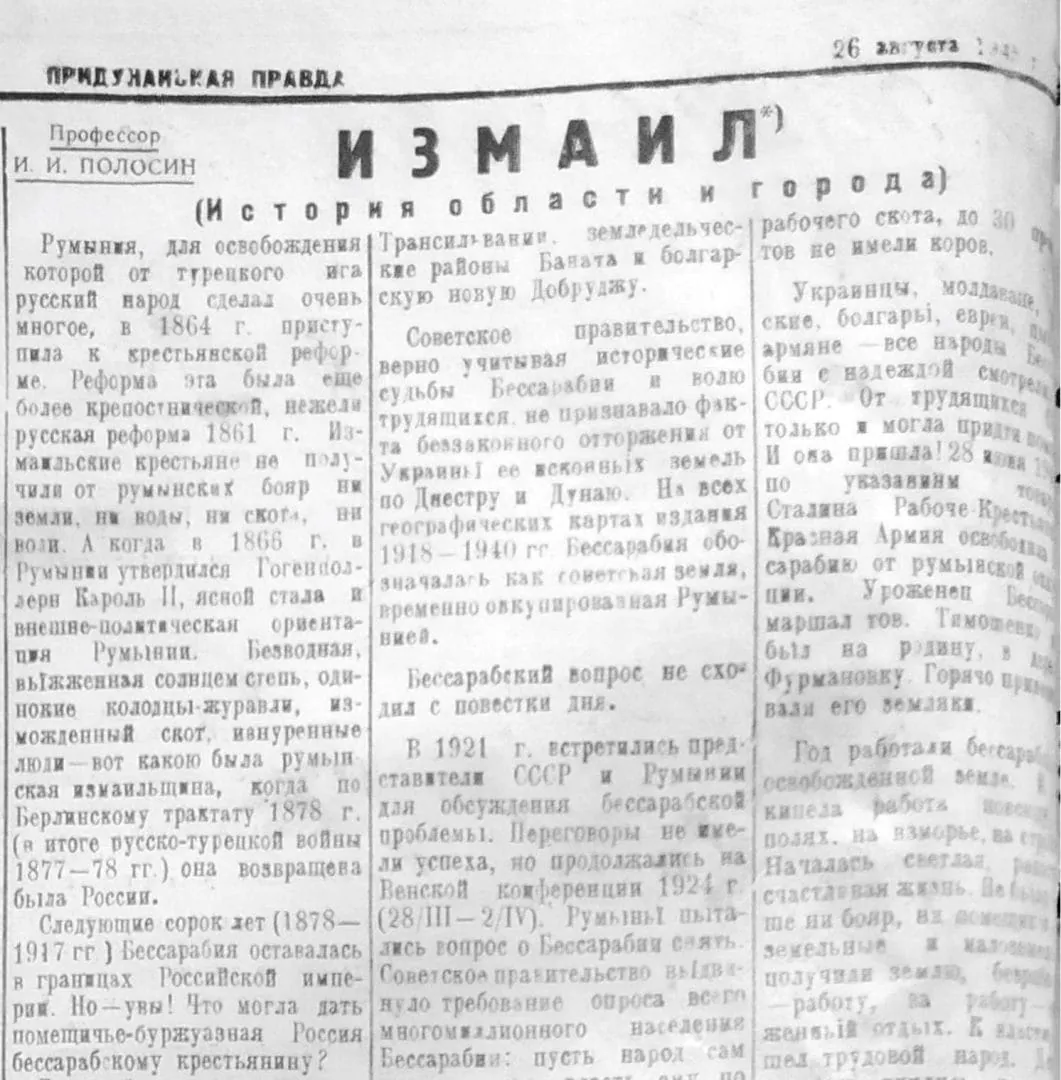
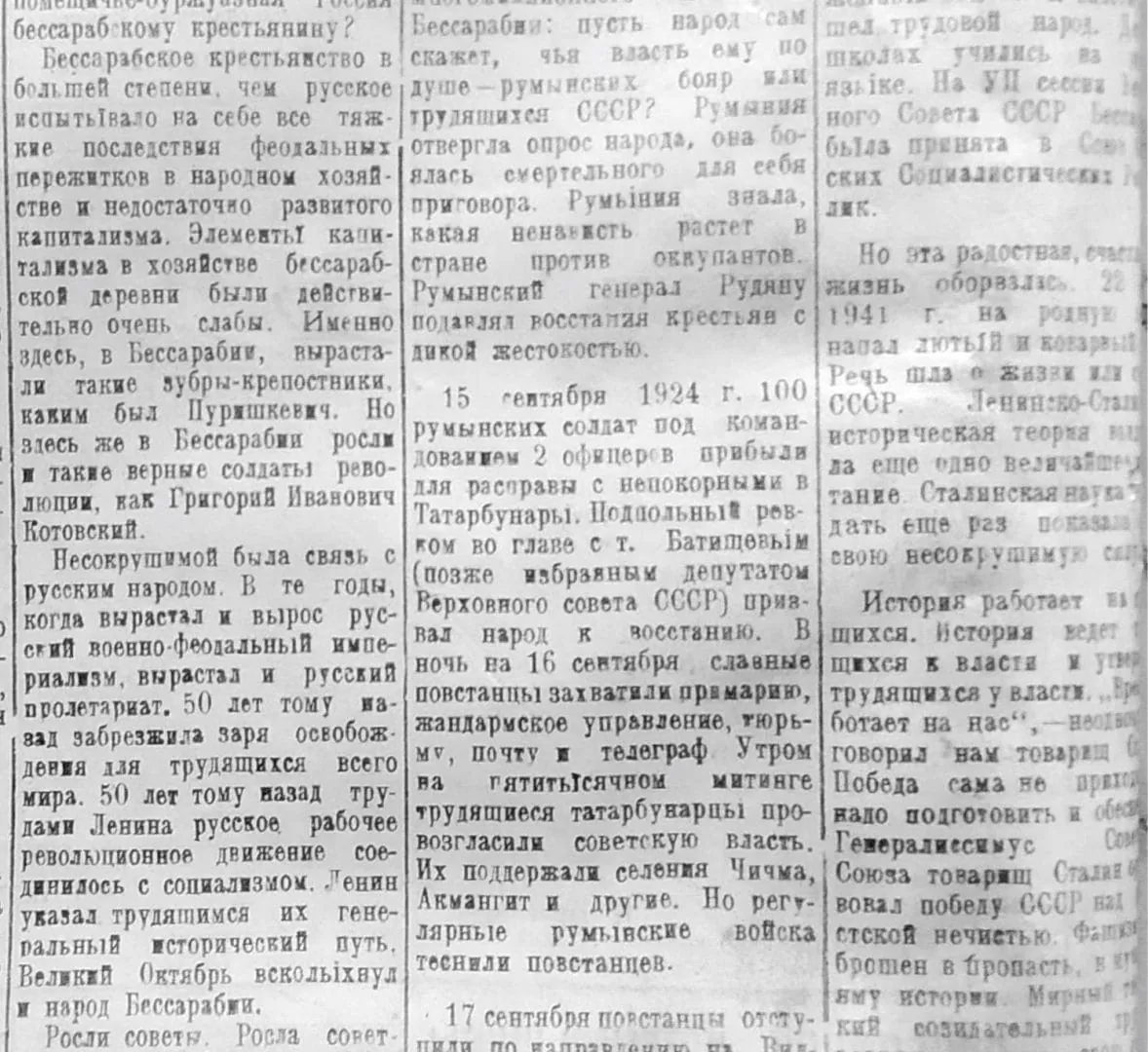
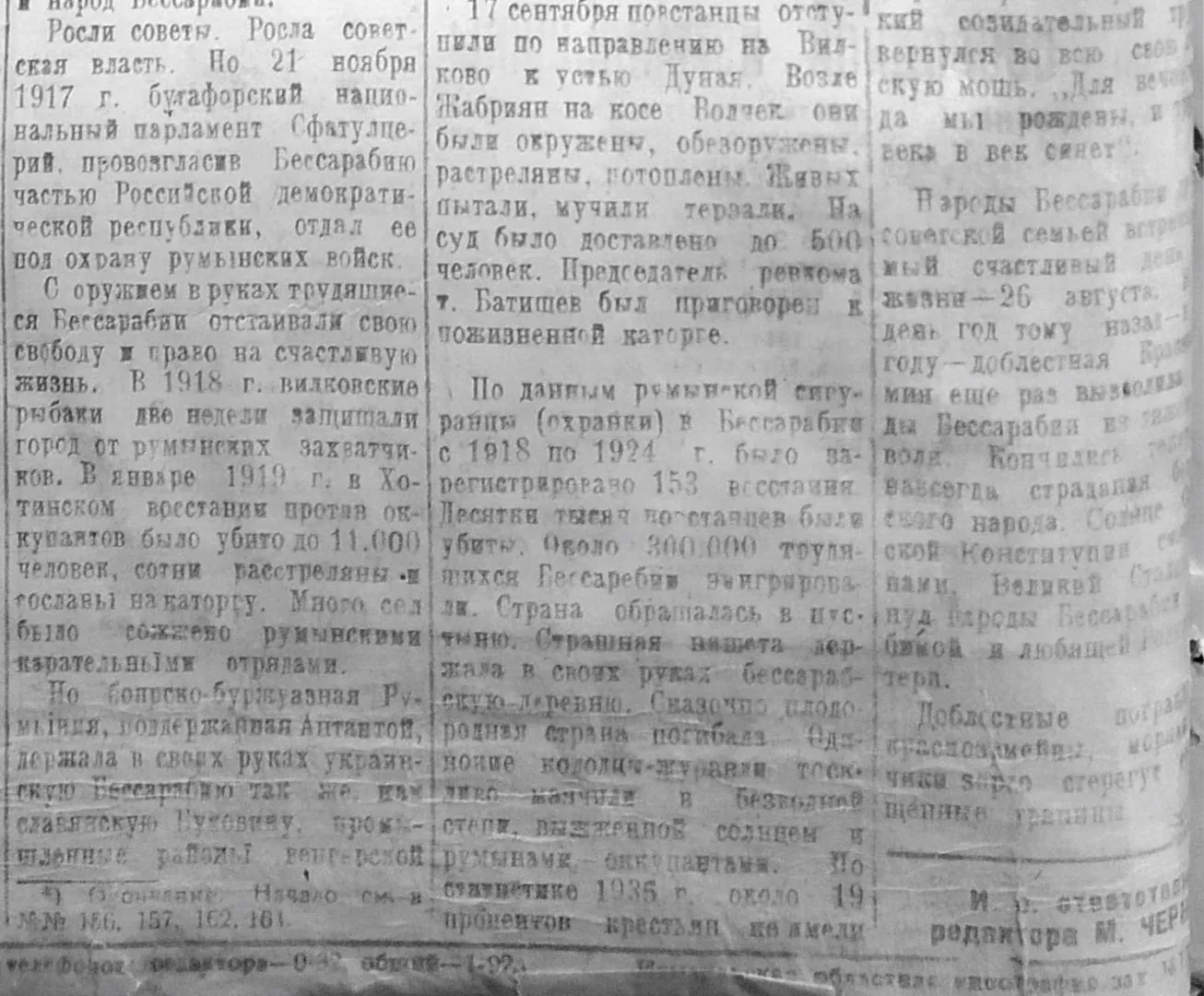


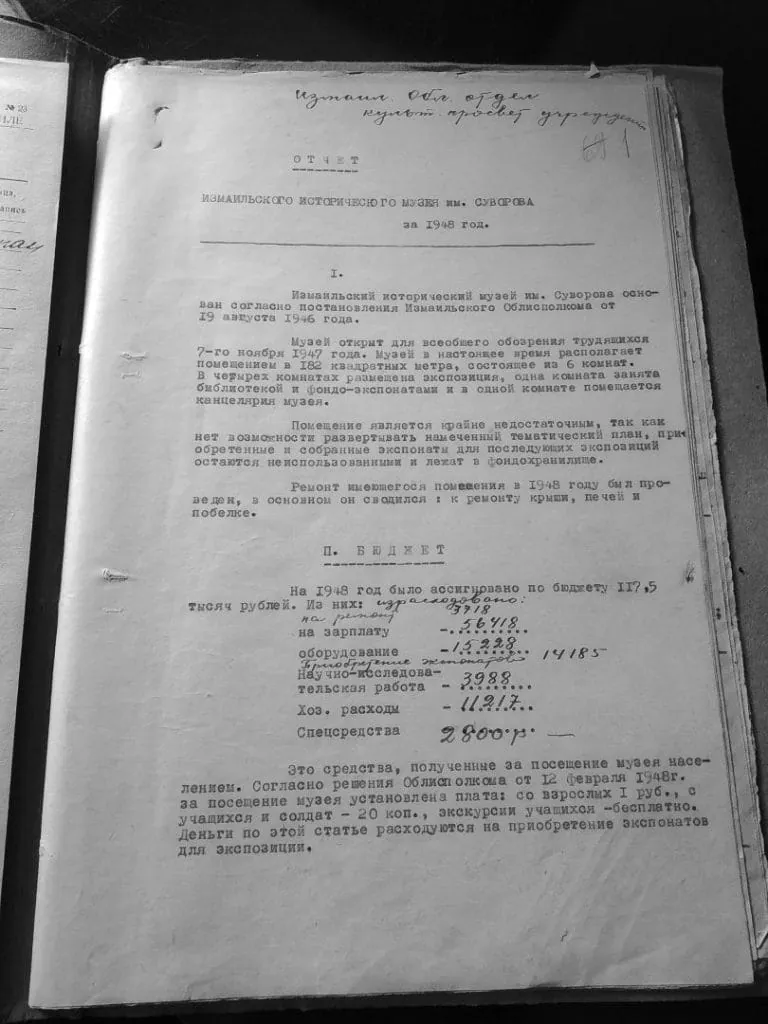

The article “Izmail (History of the Oblast and the City)” offers the first comprehensive account of the Ukrainian part of Bessarabia, or Budzhak, from the official Soviet perspective. Published in August 1945 as a series of installments in the newspaper Pridunayskaya Pravda, the article coincided with the first anniversary of the “liberation” of the Izmail Oblast by Soviet troops. The final installment appeared on August 26, the day of the official celebrations, which included the unveiling of a monument to Russian commander Alexander Suvorov in Izmail.
Notably, the Soviet authorities entrusted the preparation of the historical material on the Izmail Oblast to Ivan Ivanovich Polosin, a professor at V. I. Lenin Moscow State University and an expert in Russian history. This choice reflected a desire to interpret the region’s past not only through the lens of Leninist-Stalinist ideology, but also within a broader pan-Russian imperial narrative that emphasized Russia’s “liberation mission” on its southwestern border and sought to legitimize the Soviet annexation of Bessarabia as a natural process of “returning historical lands.”
The article served political and propaganda purposes and contained numerous historical falsifications, manipulations, and ideological clichés. The author crafted an ideological narrative typical of the Stalinist historical canon, focusing on the centuries of suffering endured by the region’s population under “foreign oppressors” and their subsequent “liberation” by Russia and the USSR. This logic was particularly evident in the article’s introduction, especially in the statement: “The peoples of Bessarabia have endured great historical calamities. All the more magnificent, then, is their glorious victory in the Great Patriotic War, in alliance with the mighty Russian people and all the fraternal peoples of the USSR” (No. 156). At the same time, one of the publication’s main aims was to emphasize the Izmail region’s historical ties to both Russia and Ukraine.
Polosin began the history of the Dniester-Danube interfluve with its earliest periods, devoting considerable attention to the Scythian era and antiquity. The second installment (No. 157) traced the region’s history from the Hunnic conquest through the 16th century, discussing invasions by Turkic tribes, the area’s inclusion in Kyivan Rus’ and the Principality of Galicia-Volhynia, and later its incorporation into the Principality of Moldavia and the Ottoman Empire. In the third part (No. 162), the author analyzed the region’s history through the lens of the Russo-Turkish conflict. The fourth and longest section (No. 164) focused on the core theme of the new Soviet historical narrative: the storming of the Izmail Fortress by Suvorov’s troops. The author then briefly described Bessarabia’s annexation to the Russian Empire following the Russo-Turkish War of 1806–1812 and the region’s status until the end of the Crimean War of 1853–1856. Under the terms of that conflict, the Danube-side part of Bessarabia, including Izmail, became part of the Principality of Moldavia, and after the unification of Moldavia and Wallachia, part of Romania.
The final section of the article, presented here for review, covers several periods in the history of the Izmail region, each corresponding to its membership in different states: the Principality of Romania (1856–1878), the Russian Empire (1878–1917), the Kingdom of Romania (1918–1940), the USSR (1940–1941), Romania (1941–1944), and again the USSR (from 1944 onward). Polosin portrayed the incorporation into the Russian Empire as a “return,” while characterizing the Romanian periods as occupations.
The narrative included myths typical of Soviet propaganda, which the ideology also applied to other annexed territories, notably:
1) the myth of the “long-suffering land” (the Romanian periods were portrayed through the lens of economic decline and the suffering of the population, especially during the interwar period; the region’s situation under the rule of the Russian Empire was viewed in the context of the “lesser evil” concept);
2) the myth of the “heroic struggle” (emphasis was placed on uprisings against the Romanian “invaders,” with the “Tatarbunary Uprising” taking center stage; Soviet heroic figures from the region were also highlighted, notably Kotovsky and Batishchev);
3) the myth of “liberation” (emphasis was placed on the Soviet Union’s non-recognition of Bessarabia’s annexation by Romania; the “Bessarabian campaign” of 1940 was interpreted as “liberation from Romanian occupation,” while the Soviet military operation of 1944 was portrayed as “liberation from grueling captivity” and “an end to the suffering of the Bessarabian people”);
4) the myth of “socialist construction” (the region’s year under Soviet rule was presented as a time of “bright, joyful, and happy life” for the working people).
It is also notable how the region was depicted as part of Ukraine (for example: “boyar-bourgeois Romania, supported by the Entente, held Ukrainian Bessarabia in its grip,” and “the Soviet government… did not recognize the unlawful severance of Ukraine’s ancestral lands along the Dniester and Danube rivers”), as well as the ambiguity in describing the region’s ethno-national reality. The author used the phrase “peoples of Bessarabia” as a synonym for the region’s various ethnic groups, among which Ukrainians were given primary importance (“Ukrainians, Moldovans, Russians, Bulgarians, Jews, Gypsies, Armenians—all the peoples of Bessarabia looked to the USSR with hope”). The term “the Bessarabian people” referred to a specific supra-ethnic local community. This suggests that, as of 1945, the Soviet authorities had not yet developed a fully formed model for interpreting the region’s ethno-national characteristics.