
I
TO THE IZMAIL OBLAST COMMITTEE OF THE CP(b)U
/Department of Propaganda and Agitation/
Suvorov District Committee of the CP(b)U
INFORMATION
Regarding the 150th anniversary of the death of A.V. Suvorov.
Following the decision of the Bureau of the Oblast Committee of the Communist Party (Bolsheviks) of Ukraine dated 4/IV-1950, “On the Preparation and Conduct of the 150th Anniversary of the Death of A.V. Suvorov,” the District Committee developed and adopted a detailed resolution and plan of events to mark the anniversary at its Bureau meeting on 12/IV-1950.
As part of the planned activities, 327 talks and newspaper readings about the life of the renowned Russian military commander were held at collective farms, field camps, tractor brigades, enterprises, institutions, and schools, reaching a total of 10,112 people. In addition, 89 lectures and presentations were delivered to 11,683 people. All speakers and lecturers received the texts for their lectures and presentations.
The Party office created a photo montage, organized a literature exhibition, and compiled a recommended reading list for speakers and discussion leaders. Additionally, 24 individual consultations were held to help prepare talks and presentations for the 150th anniversary of A.V. Suvorov’s death. One instructional presentation was delivered on the topic “150 Years Since the Death of A.V. Suvorov.” Furthermore, 23 photo montages illustrating Suvorov’s life and military career were created and displayed in district and rural libraries, schools, and the district cultural center.
Literature exhibitions were held in all rural libraries to assist speakers and presenters in discussing the remarkable military commander A.V. Suvorov.
Children’s matinees dedicated to the 150th anniversary were organized in all orphanages, kindergartens, and schools.
Wall newspapers dedicated to the memory of A.V. Suvorov were published in collective farms, enterprises, institutions, and schools. To provide cultural entertainment during the spring fieldwork season, the district cultural center organized a propaganda and cultural brigade, which, during preparations for the 150th anniversary of A.V. Suvorov’s death, gave 12 concerts at collective farms and field camps. For example, on 16/V-1950, at the Dimitrov Collective Farm’s field camp, a lecture titled “A.V. Suvorov—the Great Russian Commander” was delivered during the lunch break, followed by a concert from the propaganda and cultural brigade. They performed chastushkas and Bulgarian folk songs and dances, and all the collective farm workers—men and women alike—warmly thanked the brigade members.
The propaganda and cultural brigade from the Utkonosovsky Rural Club gave concerts at several collective farms. The play Beztalanna at the district cultural center was particularly well received.
On May 18, 1950, all rural clubs held solemn anniversary meetings of the Party and public organizations of collective farm workers, tractor drivers, and the intelligentsia, dedicated to the 150th anniversary. After the reports, amateur talent shows were held.
On May 18, 1950, the Executive Committee of the District Council of Workers’ Deputies held a solemn anniversary meeting at the district cultural center, together with representatives of the party, trade union, Komsomol, and public organizations. Major Khrutsky delivered a report, after which a concert featured amateur performers from the district cultural center and Suvorov Secondary School.
SECRETARY OF THE SUVOROV
District Committee of the CP(b)U /ANDRIENKO/
II
TO THE IZMAIL OBLAST COMMITTEE OF THE CP(b)U
/Department of Propaganda and Agitation/
Suvorov District Committee of the CP(b)U
INFORMATION
On the progress of preparations for the 150th anniversary of the death of Alexander Vasilyevich SUVOROV.
Following the decision of the Bureau of the Oblast Committee of the Communist Party of Ukraine (Bolsheviks) dated 4/IV-1950, “On the Preparation and Conduct of the 150th Anniversary of the Death of A.V. Suvorov,” the District Committee developed and adopted a detailed resolution and plan of events for preparations at its bureau meeting on 12/IV-1950.
As part of the planned activities, collective farms, tractor brigades, enterprises, and institutions are holding discussions, newspaper and literature readings about the life of the renowned military commander A.V. Suvorov and his role in liberating the city of Izmail from Turkish rule in 1790.
Libraries have organized exhibitions of literature and photo montages on the life and work of A.V. Suvorov. The Party Committee of the District Committee has also prepared a report on Suvorov’s life and compiled a recommended reading list for speakers and discussion leaders marking the 150th anniversary of his death.
Special newspaper editions are being prepared for the 150th anniversary in collective farms, enterprises, institutions, and schools. To suitably commemorate the anniversary of A.V. Suvorov’s death, workers in the district center of the village of Suvorov held several “sunday work days” dedicated to improving the district center.
As a result, fruit and ornamental trees were planted; a culture and recreation park was established in the village center, along with a large flower garden on the square along Stalin Street. The central square near the district cultural center was paved, and houses and trees were whitewashed and building facades painted.
All schools, orphanages, and kindergartens will host children’s matinees dedicated to the 150th anniversary. On May 18, general meetings of workers will be held at all rural clubs, with presentations on the life of the renowned Russian military commander A.V. Suvorov.
On May 18, 1950, a meeting of party, Soviet, and public organizations will be held at the district cultural center to mark the 150th anniversary of A.V. Suvorov’s death, followed by a concert featuring amateur performers.
SECRETARY OF THE SUVOROV
District Committee of the CP(b)U /ANDRIENKO/
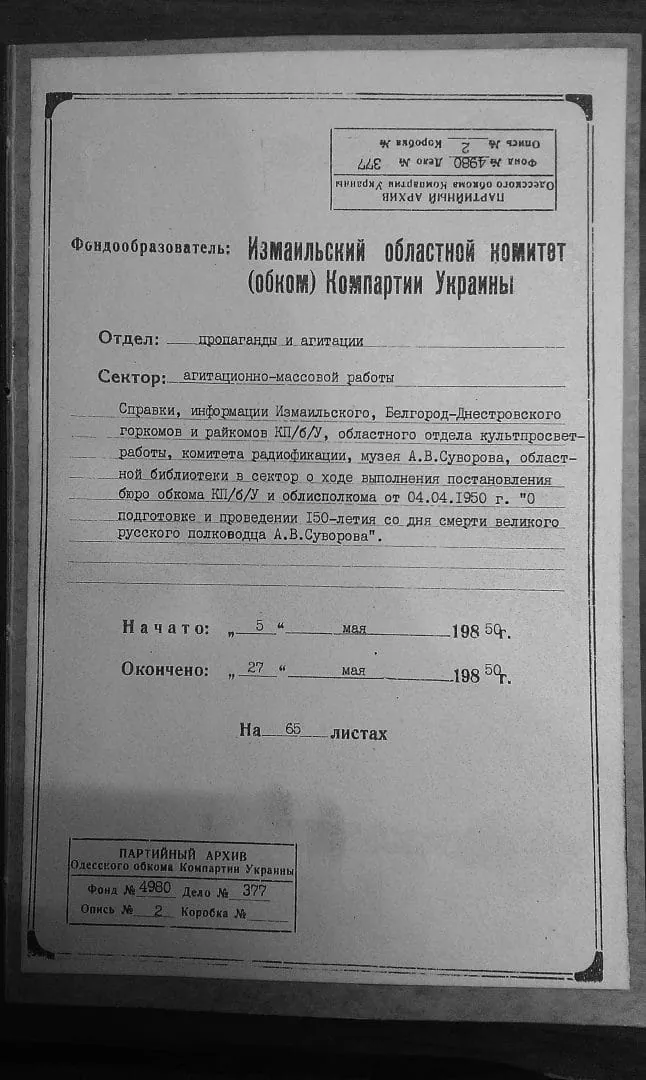

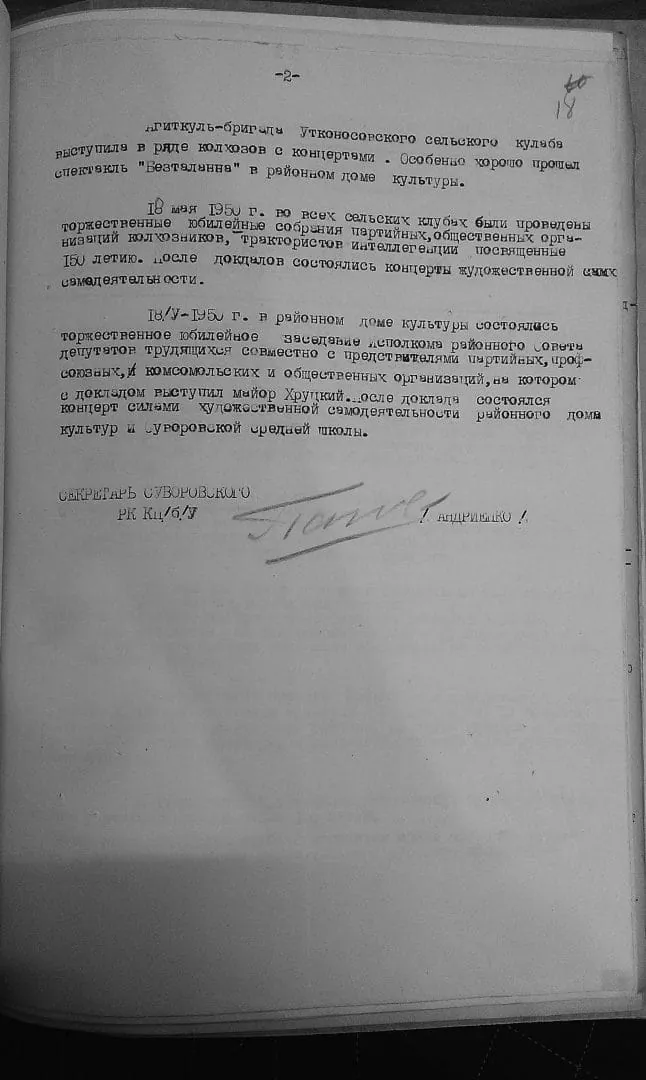

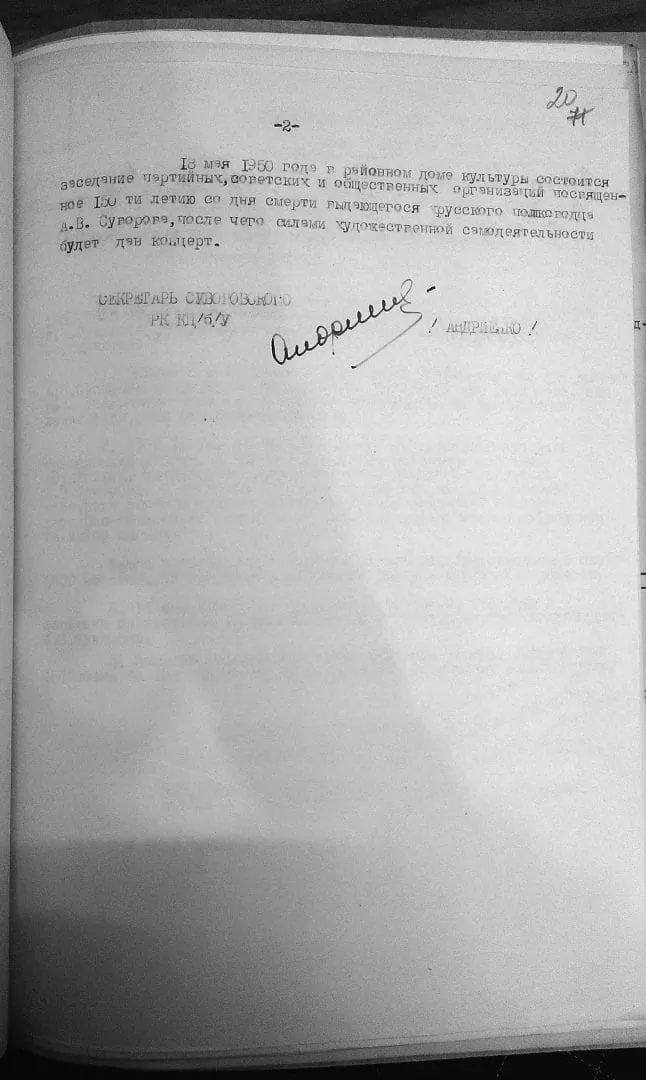

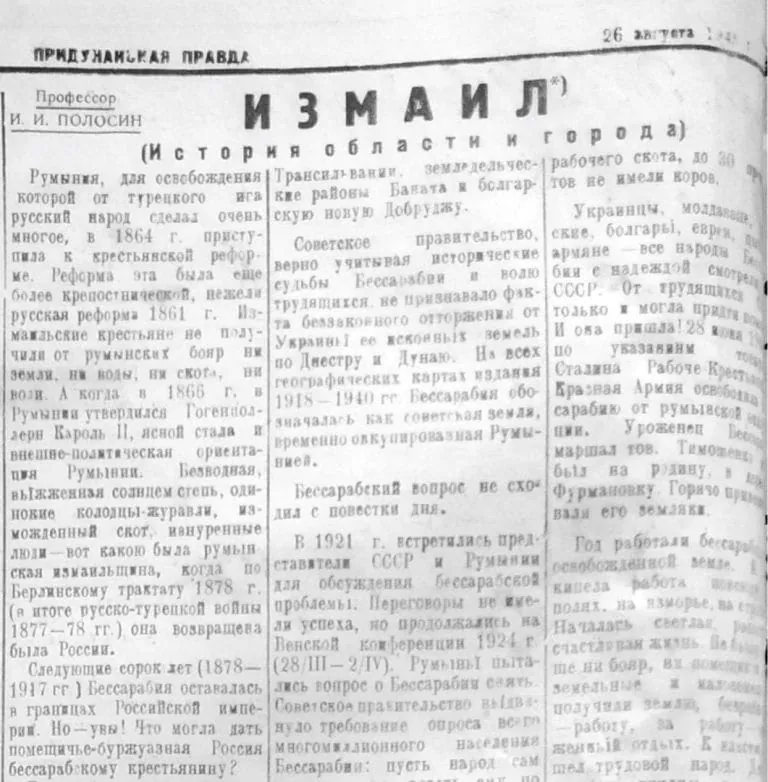
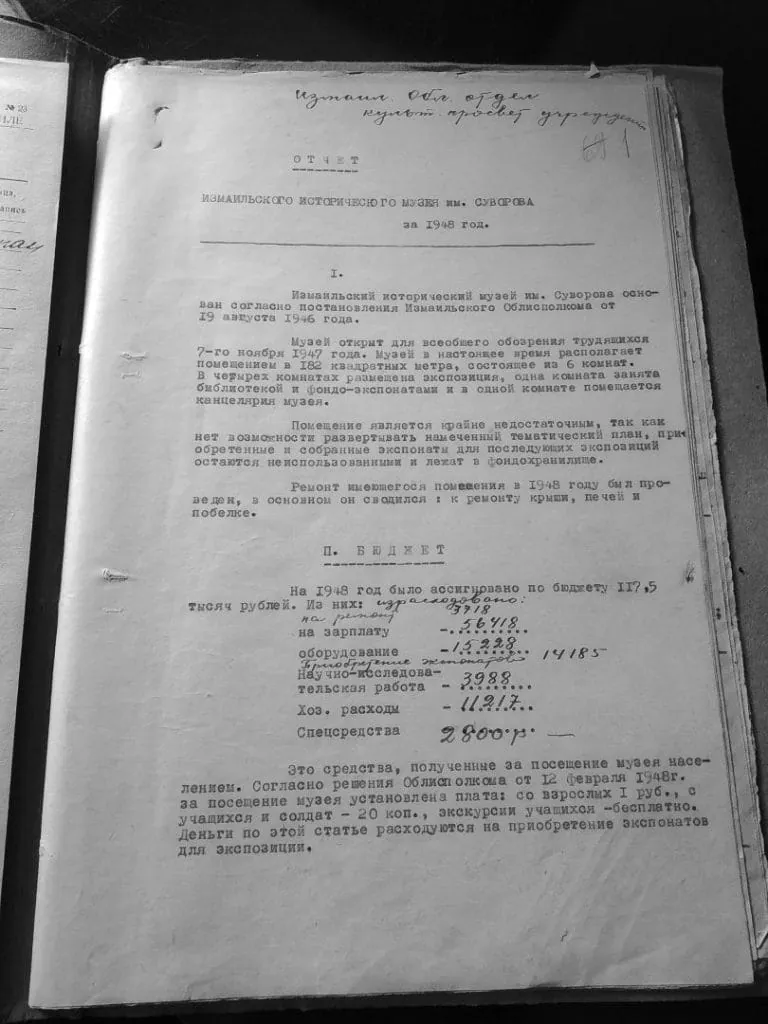

The source presented here is an internal party report on preparing and executing celebrations marking the 150th anniversary of Alexander Suvorov’s death—a large-scale commemorative event held across the Soviet Union on May 18, 1950. In addition to all-Union and republic-level festivities, local ceremonies honoring the Russian commander’s victories against the Ottoman Empire also played an important role in commemorating him. In this context, the Izmail Oblast occupied a special place in the celebrations, particularly the city of Izmail, which Soviet discourse of the time described as the “city of glory of Russian arms.” The commemoration practices in the Suvorov District deserve special attention; the district’s association with the general led local party and administrative bodies to focus even more on organizing the festivities.
These reports allow us to reconstruct the mechanisms of Soviet commemorative culture at the local level. Its typical functions—mobilization, legitimation, and ideology—were also evident at the district level. Notably, anniversary events provided an opportunity to improve local community infrastructure. The celebrations focused not only on Suvorov himself but also on the storming of the Izmail Fortress in 1790, which was presented as the “liberation of the city from Turkish oppression.”
Documentation on the preparation and conduct of the celebrations is relatively standardized, but it lacks information on fulfilling socialist competition plans, which were typically required in Soviet holiday reporting. The report begins with a description of the Party committee’s preparatory work, followed by details of the activities of cultural and educational institutions. Information about work with children and youth was also required.
The anniversary events generally followed the typical model of Soviet festive rituals, including a solemn rally and concerts featuring local amateur performances. However, the document shows that at the local level, these cultural practices did not always fully align with ideological guidelines and often reflected the unique character of the local community. This is seen, for example, in collective farm workers performing chastushkas and Bulgarian songs, and in the staging of Ivan Karpenko-Karyi’s play Beztalanna (eng. The Fortuneless Maiden) at the district cultural center.
Thus, this source enables us not only to reconstruct the organizational mechanisms behind the anniversary’s preparation, but also to identify differences between standardized commemorative rituals and their local implementation—an important aspect for understanding how Soviet memory politics functioned.