
Donate
Quote
Ana Bărbulescu, Visual Antisemitism in Interwar Romania: The Case of “Porunca Vremii”, Reesources.Rerhinking Eastern Europe, Center for Urban History, 09.09.2026
copied

Visual Antisemitism in Interwar Romania: The Case of “Porunca Vremii”

Publication date 09.09.2026

Unlike the anti-Semitic texts of any period, the caricatures — as images — allow us to grasp a particular, and due to their post-factum character, ungraspable knowledge of the past. In this module Ana Bărbulescu reassess the portrayal of the Jewish community through caricatures published in interwar Romanian press, focusing on Porunca Vremii, a notable journal of the far-right political frame that frequently employed this visual tool. Given the unique nature of these caricatures and their ability to evoke shared attitudes and stereotypes among their audience, this module examines how these images reflect and influence societal perceptions.

Unlike the anti-Semitic texts of any period, the caricatures — as images — allow us to grasp a particular, and due to their post-factum character, ungraspable knowledge of the past. An image is never intelligible on its own but is deciphered by the onlooker only through the actualization of already stable categories. In other words, “we can grasp in an image only what is already known,”[1] as humans always apply previous knowledge to what they see.[2] As Petăr Petrov emphasized, the caricatures serve as a source for studying the mental images shared by an epoch, providing a tool to identify the attitudes and perceptions specific to the historical period in question.[3] To understand the image proposed by the caricaturist, the public must be familiar with the symbols used.[4] Equally important, to gain the public’s attention, the artist should be familiar with the symbols shared by the target audience, as caricatures often lean against existing stereotypes and representations.[5] 

By using symbols shared by the public, the caricatures provide access to a form of basic social knowledge specific to the time. To identify the character of a caricature as Jewish, the public must see the said character as circumscribing the normative fit socially ascribed to the category of the Jew. In other words, the public must have some knowledge regarding the content of this category. In Allport’s terms, to recognize a form as a tree, you need to know what a tree is. Following Allport, we will define the category as “a cluster of associated ideas” that engender meaning in the world.[6] Categorization is intrinsic to our cognitive life, enabling us to organize and make sense of the world. However, one must acknowledge that after categorization, any visual input has psychological significance.[7] The cognitive structure that contains the information associated with the category, as well as what we expect from it, represents the stereotype, which encompasses all the knowledge, beliefs, and expectations that individuals link to a category.[8] We always select and interpret. Still, these processes do not work independently, as what we sense, perceive, and think about the items circumscribed to the same category becomes blended into “one knowledgeful act of cognition”.[9]  

This study aims to reassess the portrayal of the Jewish community through caricatures published in interwar Romanian press, focusing on Porunca Vremii, a notable journal of the far-right political frame that frequently employed this visual tool. Given the unique nature of these caricatures and their ability to evoke shared attitudes and stereotypes among their audience, this research examines how these images reflect and influence societal perceptions.

The author of all caricatures discussed in this paper is Petrică Lazăr. Most of the caricatures discussed are accompanied by a lyrical text.

Building on this theoretical approach, we will examine how Jewishness and Judaism are portrayed in these caricatures. What insights do the caricatures offer regarding the anti-Jewish stereotypes held by the public? Equally important, what new perspectives do they contribute to the understanding developed from written sources?

Markers of Jewishness: scope, allegiances, and tools

I will start with an image that, in my opinion, represents the generic frame used to define Jewishness in the analyzed materials (see Figure 1). 

In the foreground, we see a man hanging from a tree, a small bag of money tumbling to the ground beneath him. In the background, three crosses stand silhouetted on a hill. This image instantly evokes strong associations for a Christian audience, immediately recalling the crucifixion of Christ and the subsequent suicide of Judas. It captures three potent symbols from this narrative: the hanged man, the thirty pieces of silver, and the three crosses.

The text added to the drawing helps the reader to put this story of the past in a presentist perspective: just like Judas betrayed and killed Christ, the Romanian nation is now destroyed by its own Judas (Iude), traitors sold to Israel.
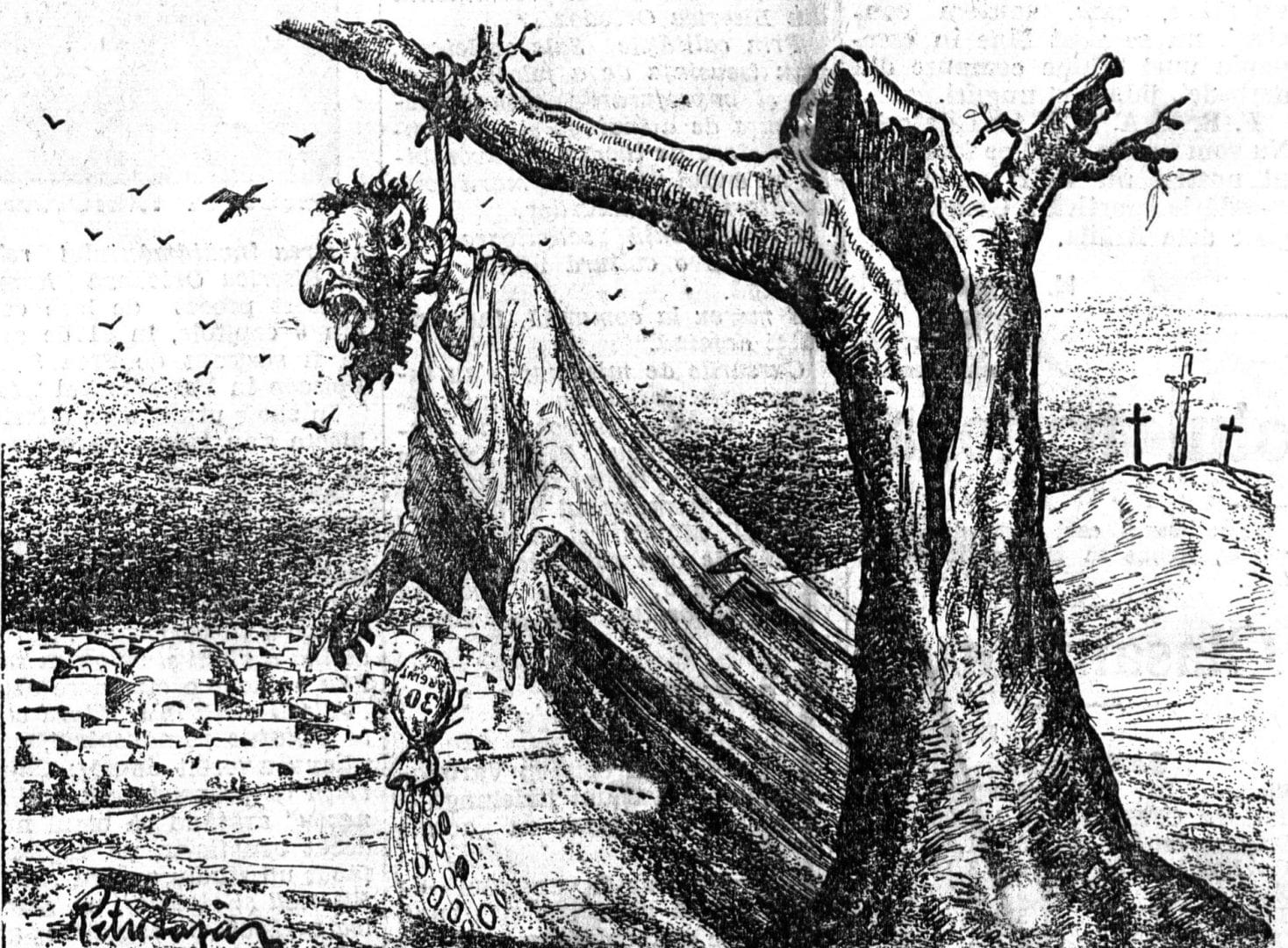
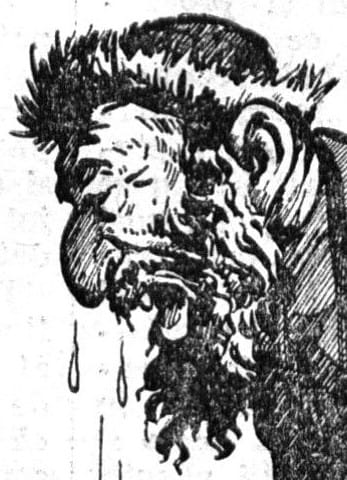
Figure 1. (Author: Petrică Lazăr, published in Porunca Vremii)

In this caricature, Judas from the New Testament stands both for Israel as a whole and as the ideal type of the trans-historical traitor. The Judas from the present, meaning the corrupt politicians accused of following Jewish interests instead of national ones, sold the Romanian nation to those who killed Christ. 

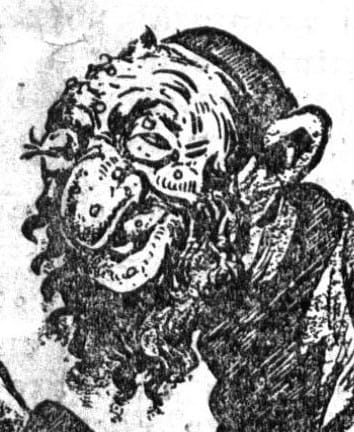
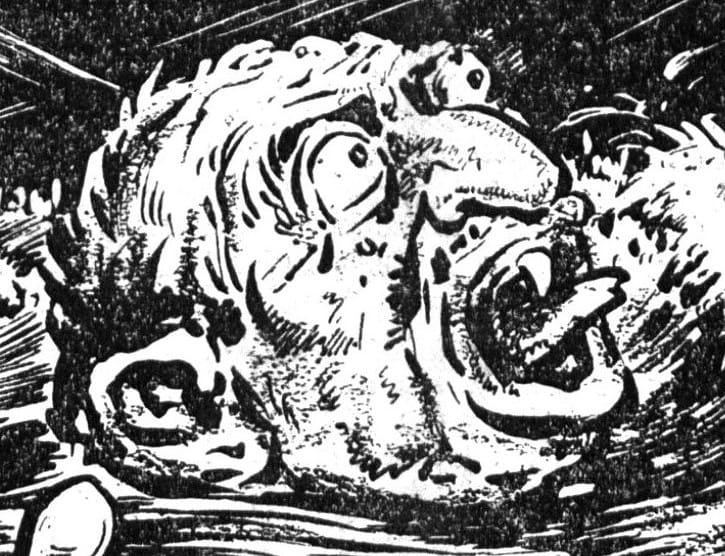
Independent of the crucifixion story, but at the same time powerfully linked to it, the image contains a fourth symbol, Judas’ physiognomy: bulging eyes, long and hooked nose, bearded, fleshy lips, black and curly hair (see Figure 2). It is the visual code for the Jew, as we shall see used time and again in the caricatures and easily deciphered by the reader.[10]

This stereotypical Jewish physiognomy repeats a common image that defines individuality within a generic framework, providing readers with a highly visual and immediately understandable way to interpret the picture. The figure from the past — Judas — is generalized and serves as a visual shorthand for the Jewish people. This way, a single personality is amplified and used to assign meaning to an entire group, creating different instances of a singular “Other”. The Jew becomes interchangeable with the Christ killer stereotype, whose evil influence is imagined as still threatening the nations.

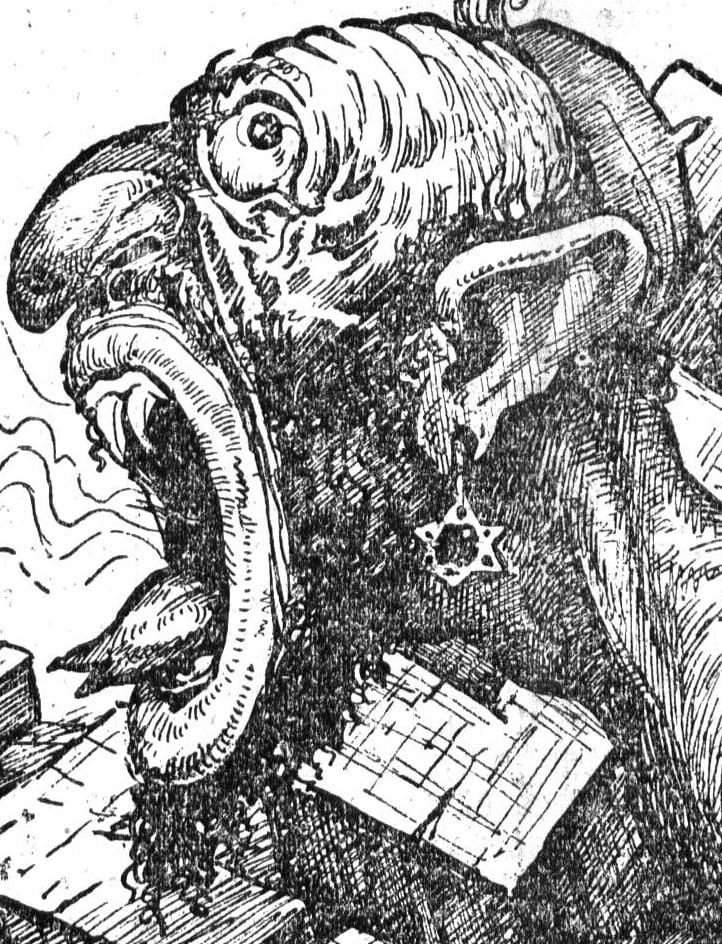
Also related to the ascribed Jewish physiognomy, another element needs to be emphasized. There are many caricatures where the Jewish characters are depicted as having serpent teeth and tongue (see Figure 3). 

To grasp the depiction of the Jew with serpent teeth and tongue, one must interpret several interconnected elements: the events in Genesis 3, the identification of the serpent from the Garden of Eden as the Devil, and the Christian theological view that later equates Israel with the Devil. 

At times, the symbolic equivalence between the generic Jew and the malevolent serpent becomes even more straightforward. In these instances, the caricatures do not depict humans with distinct Jewish features and serpent traits, but instead show serpents with Jewish characteristics. Two examples will illustrate this approach.

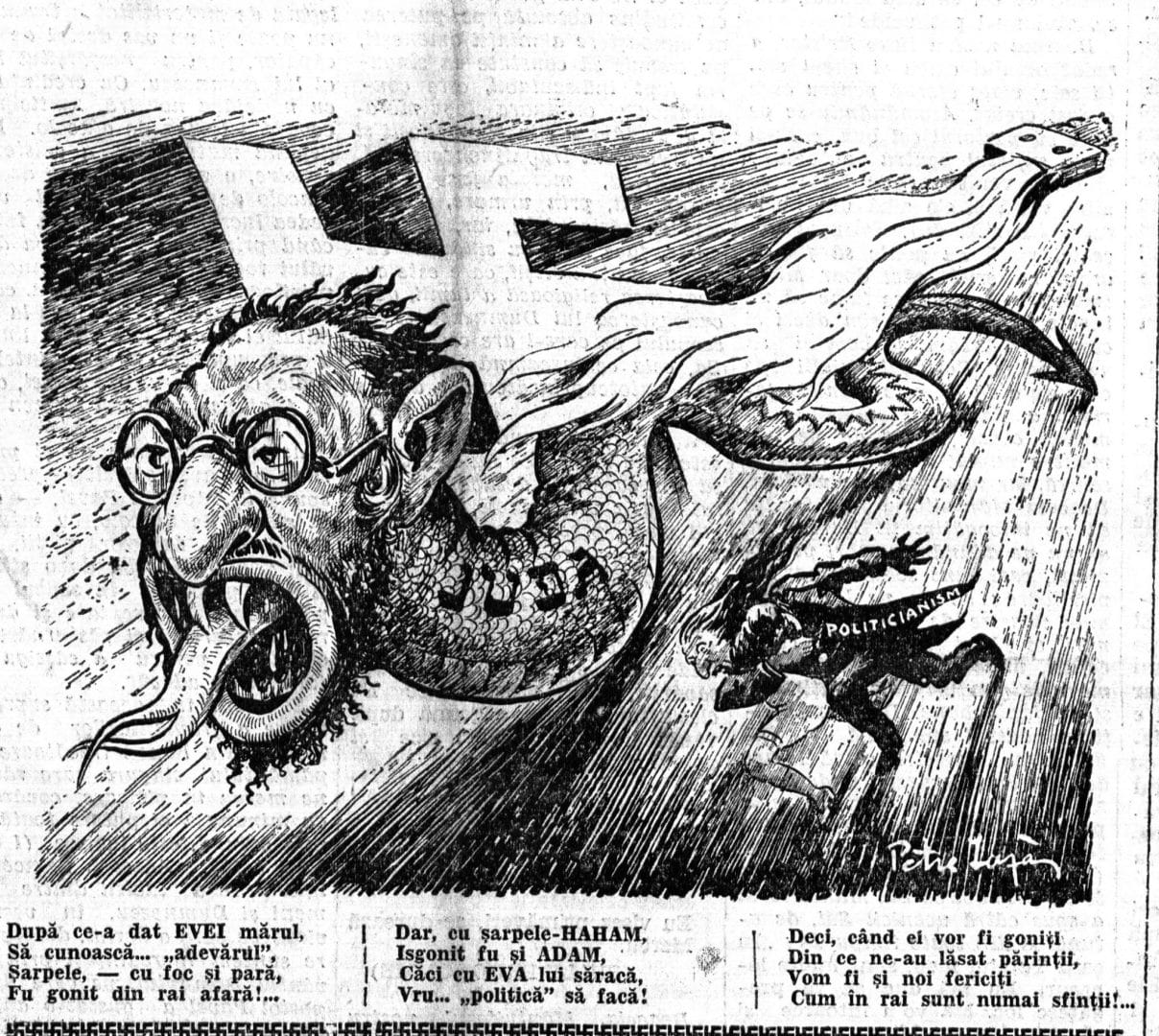
The first is from November 1937.[11] The caricature depicts a flying serpent with an angry Jewish face (see Figure 4). Two elements capture the reader’s attention: first, the serpent’s body features letters from the Latin alphabet presented in a style that mimics quadratic Hebrew characters, spelling out IUDA (Judas); second, the serpent’s tail does not resemble any found in zoological atlases; rather, it resembles the tail commonly associated with the Devil in religious symbolism. The use of quadratic Hebrew letters points to Biblical Hebrew and allegedly reflects the Judaic interpretation of the Scripture. The two elements, the symbols pointing to the Devil and the hint to the Jewish scripture, must be regarded as interconnected, suggesting to the reader that Judaism is intimately associated with the Devil. 

Figure 4. (Author: Petrică Lazăr, published in Porunca Vremii, November 1937)

The caricaturist adopts an optimistic tone, illustrating Satan (Judas) being expelled from Heaven — a symbol of a positive outcome. The drawing shows a large swastika high in the sky overseeing the event, with fire chasing away the serpent. Significantly, the text frames the story locally, equating Heaven with the Romanian land, where the expelled humans (Adam and Eve) symbolize politicians sold to the Jews.[12]

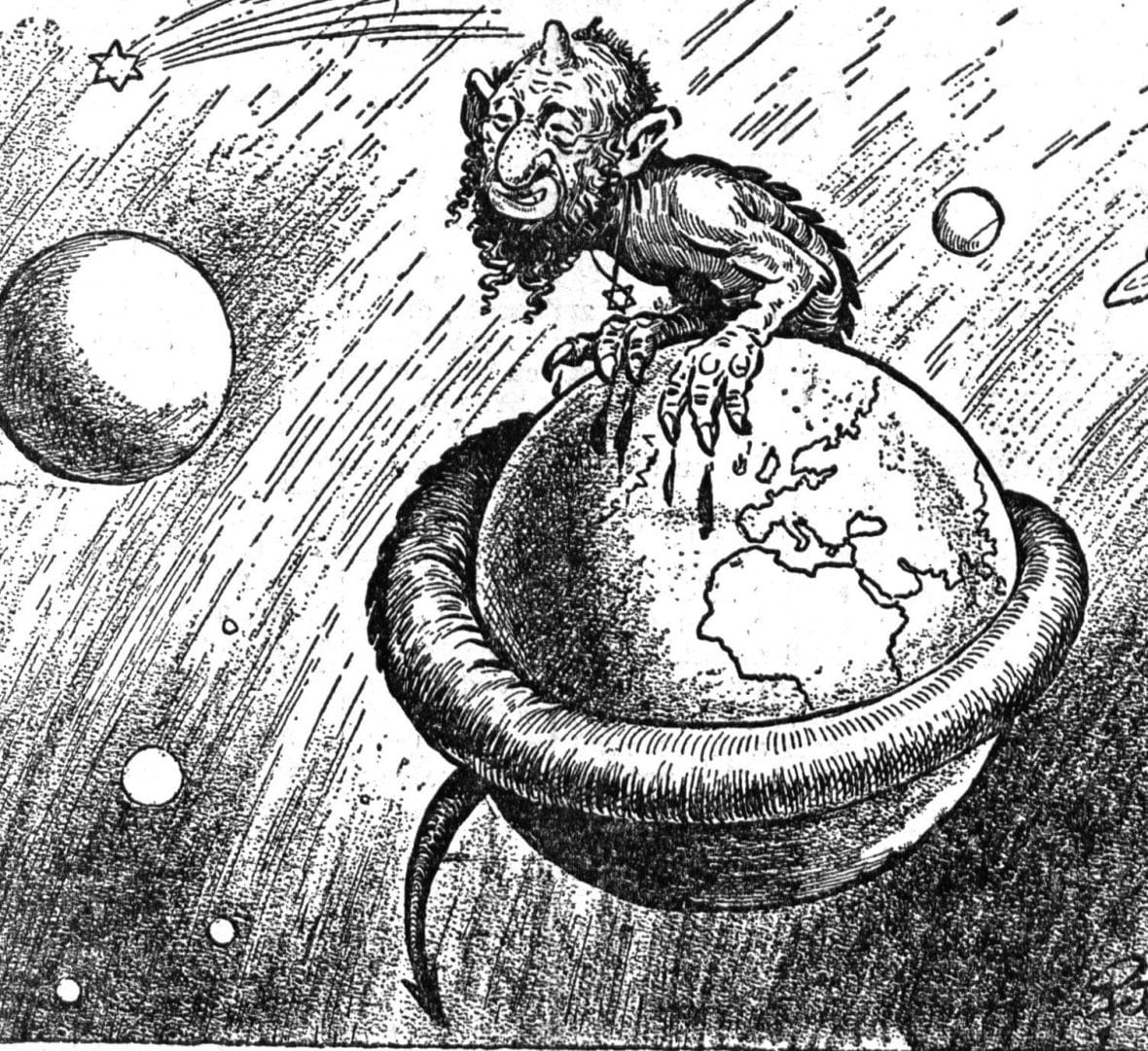
The second example transports the narrative beyond the natural boundaries of our world. In this depiction, we encounter a colossal snake-lizard figure bearing the same Jewish physiognomy, complemented by a Devil’s tail. Notably, a single horn has been added to this character’s likeness. To eliminate any potential confusion, he wears a necklace adorned with the Star of David (see Figure 5). This character’s ambitions extend far beyond Earth. He is illustrated coiled around the globe, blood dripping from his palms, while he gazes toward the stars. In the foreground, amidst the planets of our solar system, a six-pointed star descends from the sky.

Figure 5. (Author: Petrică Lazăr, published in Porunca Vremii)

This image features four symbols associating Jewishness with the Devil: the snake-lizard figure, the Devil tail, the horn, and the falling star. The text accompanying the caricature conveys the merged symbolism in a narrative format, illustrating how IUDA (Judas) is depicted as soaking the Earth in blood while attempting to bring God down from Heaven. This ambition aligns with Lucifer’s goal, as outlined in Christian theology in Isaiah 14:13–14, a dream shared with his primary ally, the Jew. 

However, Jewish identity is not always constructed by linking it to the Devil. In many instances, Jewishness is pushed beyond the borders of humanity in an infra-humanizing manner, with the illustrator pointing both to the dangerous nature of the Jews and to the legitimacy of their removal.

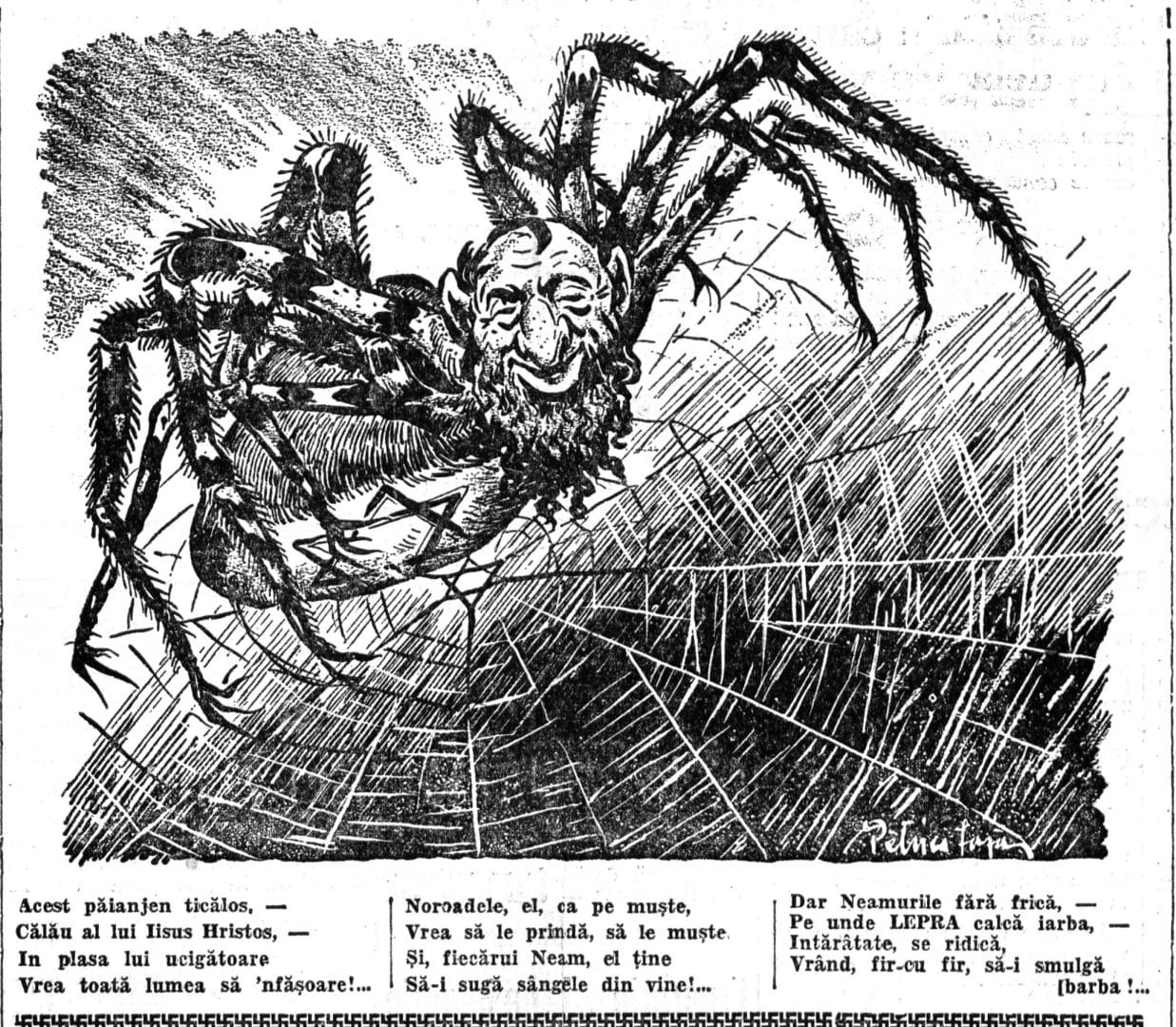
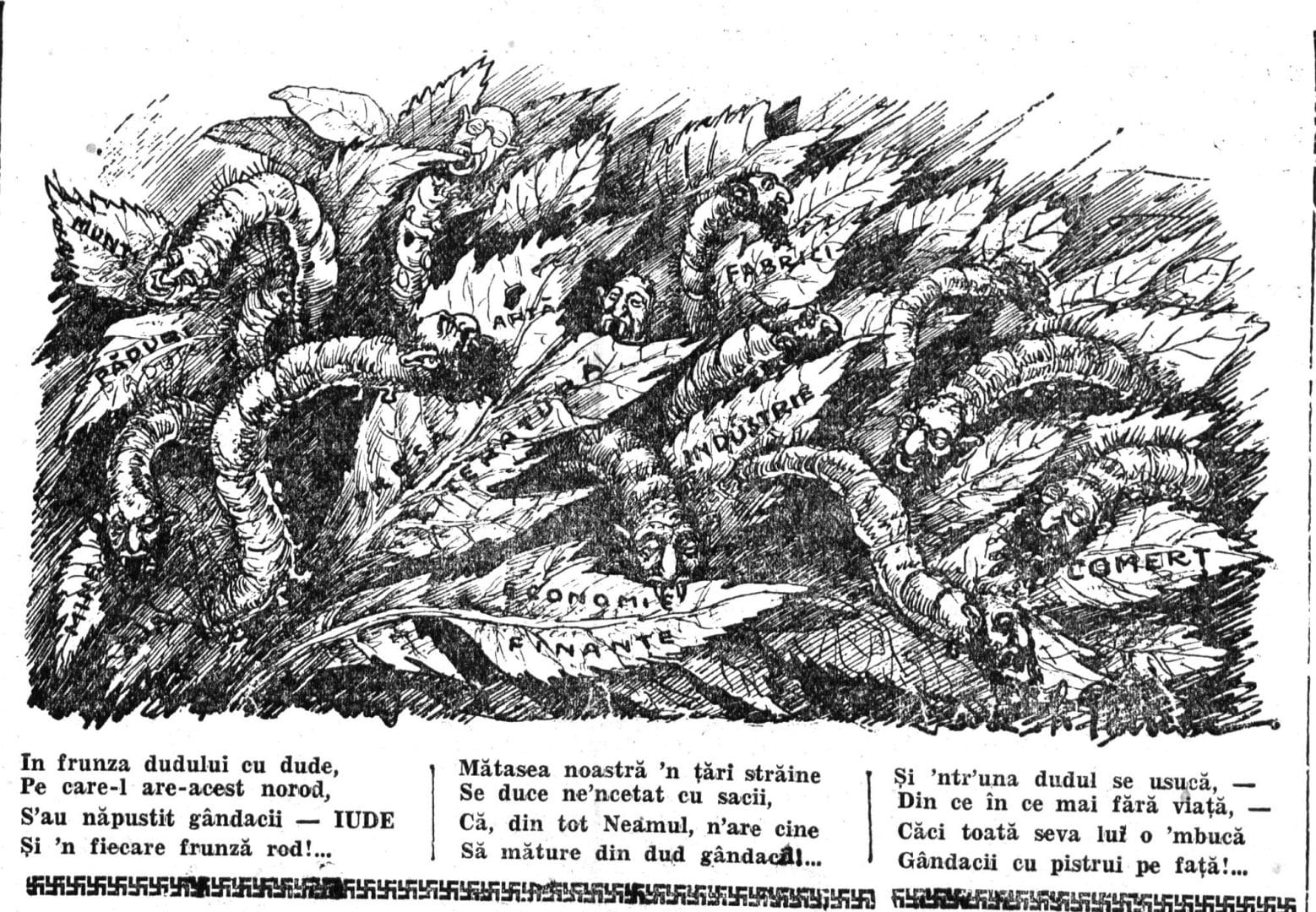
A huge spider with Jewish physiognomy grins relaxed from its web. On its belly one can see the Star of David, the same symbol covering the center of the web. It is the killing web used by the Jews to suffocate the world, says the text, and no nation is safe as the killer of Christ aims to ruin the world.[13] A similar caricature from 1937 also depicts the Jews as no longer fully human: twelve caterpillars, each with typical Jewish features, feed from leaves (see Figure 6). This time, their playground is Romania, not the entire world. On the leaves, one reads in capital letters: mines, forests, mountains, gold, art, press, literature, economy, finance, fabrics, industry, and commerce. They act as parasites, and their plan is always to destroy.

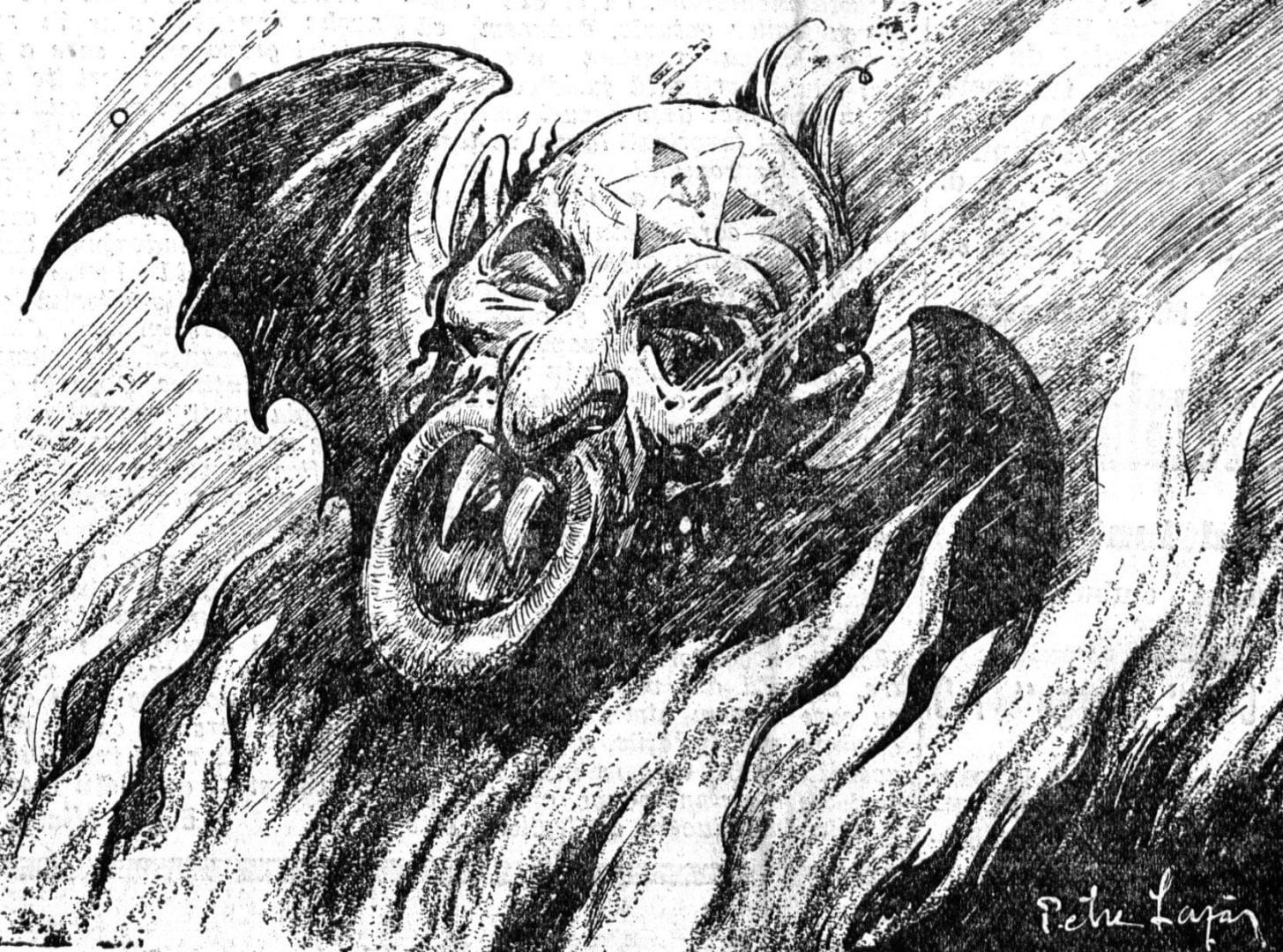
However, in the caricatures from Porunca vremii, the lack of humanity ascribed to the Jew is most of the time circumscribed to an evil superhuman nature, an evil spirit, or a beast. The most expressive caricature that depicts the Jew in a non-human form comes from late October 1937 (see Figure 7). This depiction shows a non-human figure with supposed Jewish features, including a large head, serpent-like teeth, horned hair, and bat wings. On its forehead, there’s a Star of David combined with a communist hammer and sickle. The figure is simultaneously set ablaze and struck by a large lightning bolt from the sky. 

Figure 7. (Author: Petrică Lazăr, published in Porunca Vremii, October 1937)

The text accompanying the image identifies IUDA (Judas) with Lucifer and points to the goal of the latter to destroy the Cross. This goal, adds the author, followed throughout history by Lucifer/Judas brought upon the latter the curse of the Holy Spirit. Not less important, the text offers an image of a “blessed” future, a future in which all Jews are eliminated: “When the whole flock of Judas/ The last of them will die, — /The whole world will be reborn/ Like a meadow on Easter day.”[14]

In all these examples, the Jew is not a mere human with evil intentions but an evil being with a different and non-human nature. The shift is relevant as dehumanization of the out-groups represents a specific and most dangerous way of Othering and is identified as one of the main factors to explain genocidal thinking.

The Evil will be defeated

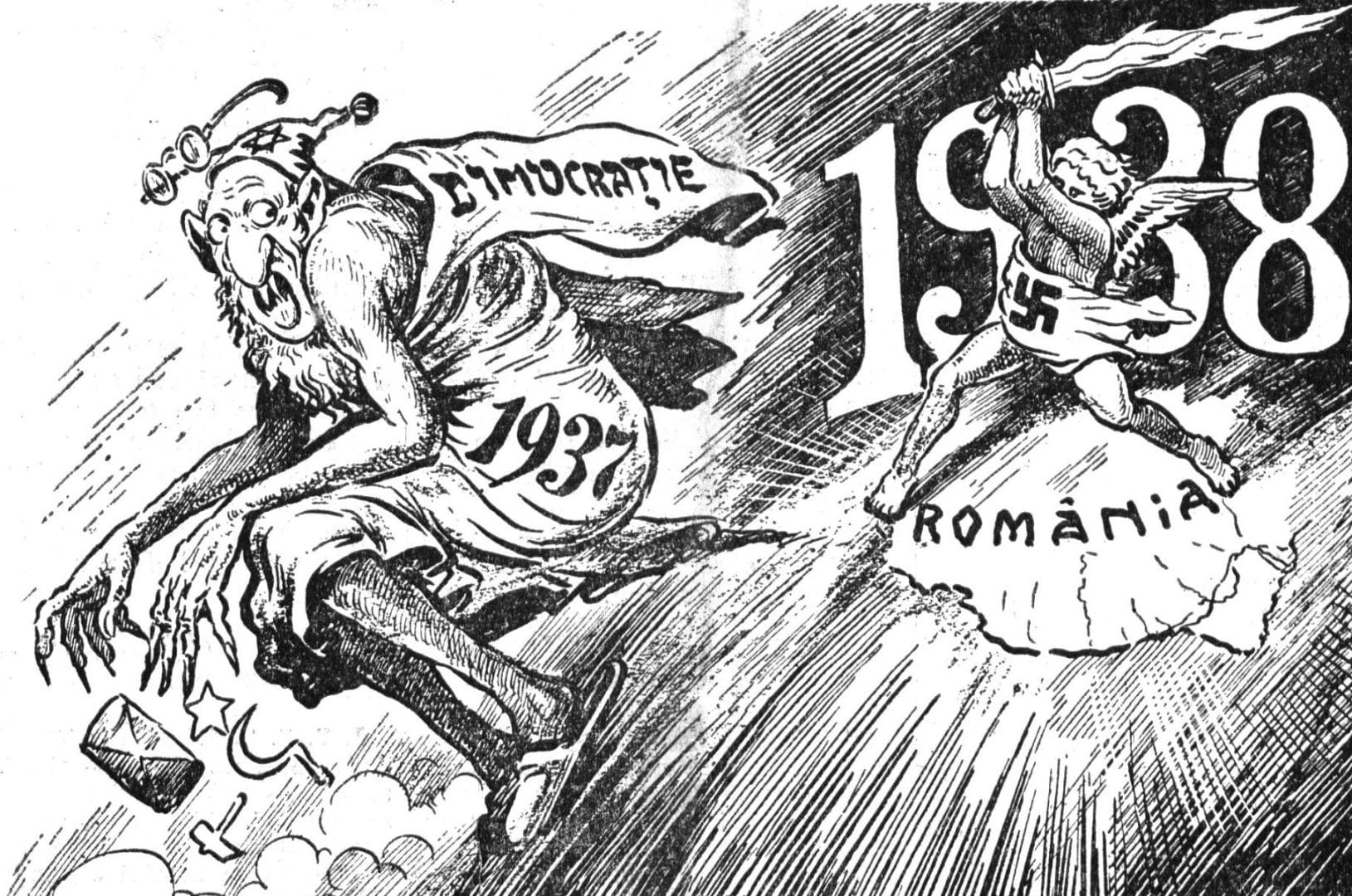
A caricature published during the Goga-Cuza government, on the 1st of January 1938 depicts a fleeing Jewish figure cast out of the country and fleeing in the sky. He appears to have been removed from the country by an angel with a flaming sword, which now guards Romania (see Figure 8).

Figure 8. (Author: Petrică Lazăr, published in Porunca Vremii, January 1938)

The serpent teeth of the Jew, the weapon of the angel, and his implied task evoke the cherubim with the flaming sword guarding the Garden of Eden in Genesis 3:24. However, now the angel guards the Romanian soil, and he is wrapped in a cloth with a swastika. 

According to this rhetoric, under the sign of the swastika, the Jew was expelled from the country, a removal synonymous with an act of God, a fulfillment of the divine will.

It’s early 1938, and Petrică Lazăr’s proposed solution to “the Jewish problem” still remains a promise for the future. Nevertheless, it is crucial to highlight that this exclusion of the Jewish community is framed as aligning with divine will. 

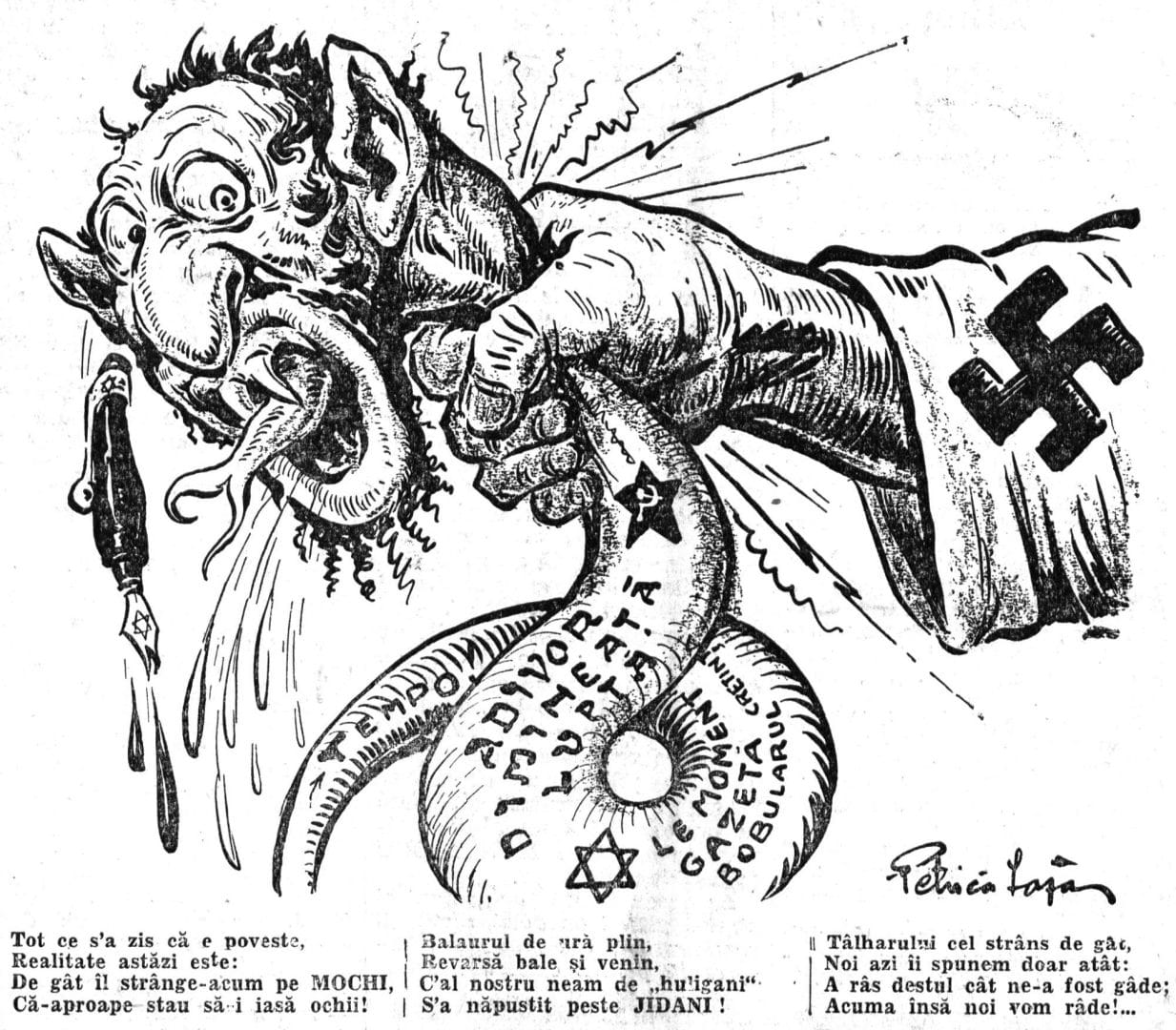
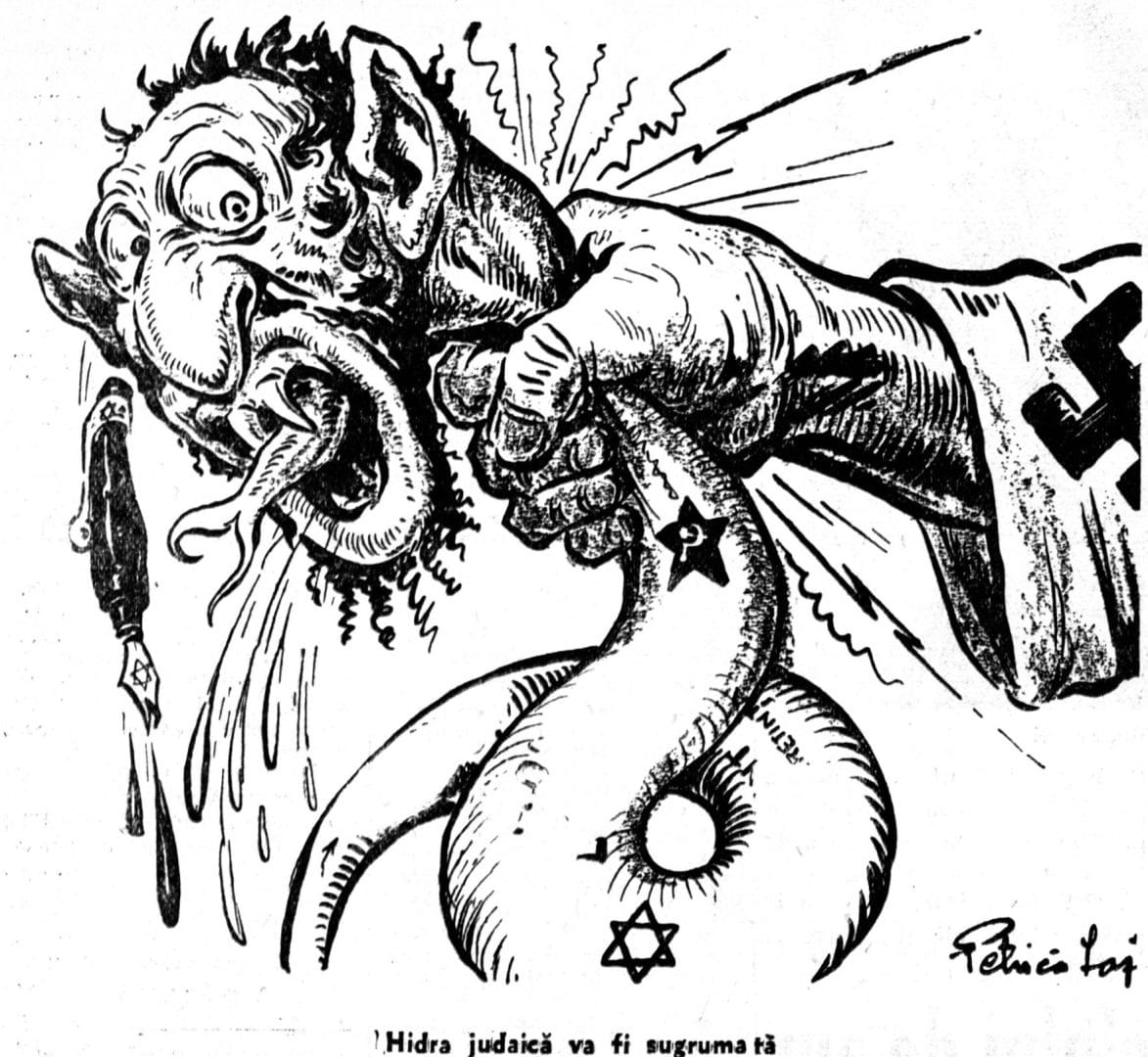
A snake-like character appears in a caricature first published in early 1938.[16] This time, the Jewish-snake figure is strangled by a strong hand wearing a swastika on his cuff (see Figure 9 below). On the snake’s body are written the titles of several alleged Jewish newspapers, with the Romanian ones being just banned by the Goga-Cuza government. The Star of David and the Communist one are also found on its body. The grip is so firm that he is screaming with googled eyes, drooling his poison (says the text). A pen, a symbol of the Jewish press, is falling, most probably from behind his ear. The text describes this figure as a hydra full of hate who has a message sent in his name:

“(…) To the strangled robber,

Today, we will tell him only one thing:

He laughed enough while he was our executioner;

Now is our turn to laugh.”[17]

Figure 9. (Author: Petrică Lazăr, published in Porunca Vremii, 1938)
Figure 9. (Author: Petrică Lazăr, published in Porunca Vremii, 1942)

The same caricature is republished on Christmas Day, 1942 (on the right in the figure above). This time, the newspapers’ titles are erased from the body of the Jewish-snake figure; we are four years after all Jewish press was forbidden. More than one year after the massive deportations of the Romanian Jews in Transnistria and their ghettoization there, together with the local Ukrainian Jews. More than one year after the massacre in Odessa and the terrible crimes perpetrated by the Romanian Army in the Golta District in the winter of 1941. The text added to the caricature is much shorter and renders concisely the political and social project supported and implemented by the Romanian state: “The Judaic hydra will be strangled.”[18]

In many of the caricatures published in Porunca vremii, the agent of justice belongs to the supernatural realm. Whether this character is an angel, the impersonal Sky, the Holy Cross, the Holy Spirit, Christ, or God himself, the agent of retribution is part of the divine order.

A caricature from mid-December 1937, for example, depicts a massive, stereotypical Jewish figure with the Talmud at his side, set against a backdrop of a field of crosses, the pyramids, and the ruins of lost civilizations. The image points to the alleged long-time goal of Jewry to bring the destruction of the world and sow death.

The text puts these “historical” facts in a presentist and more “optimistic” perspective:

“Today, in his fight with the whole world –

And despite his wretched soul,

Israel started to understand

That he will perish by the slap of Christ.”[19]

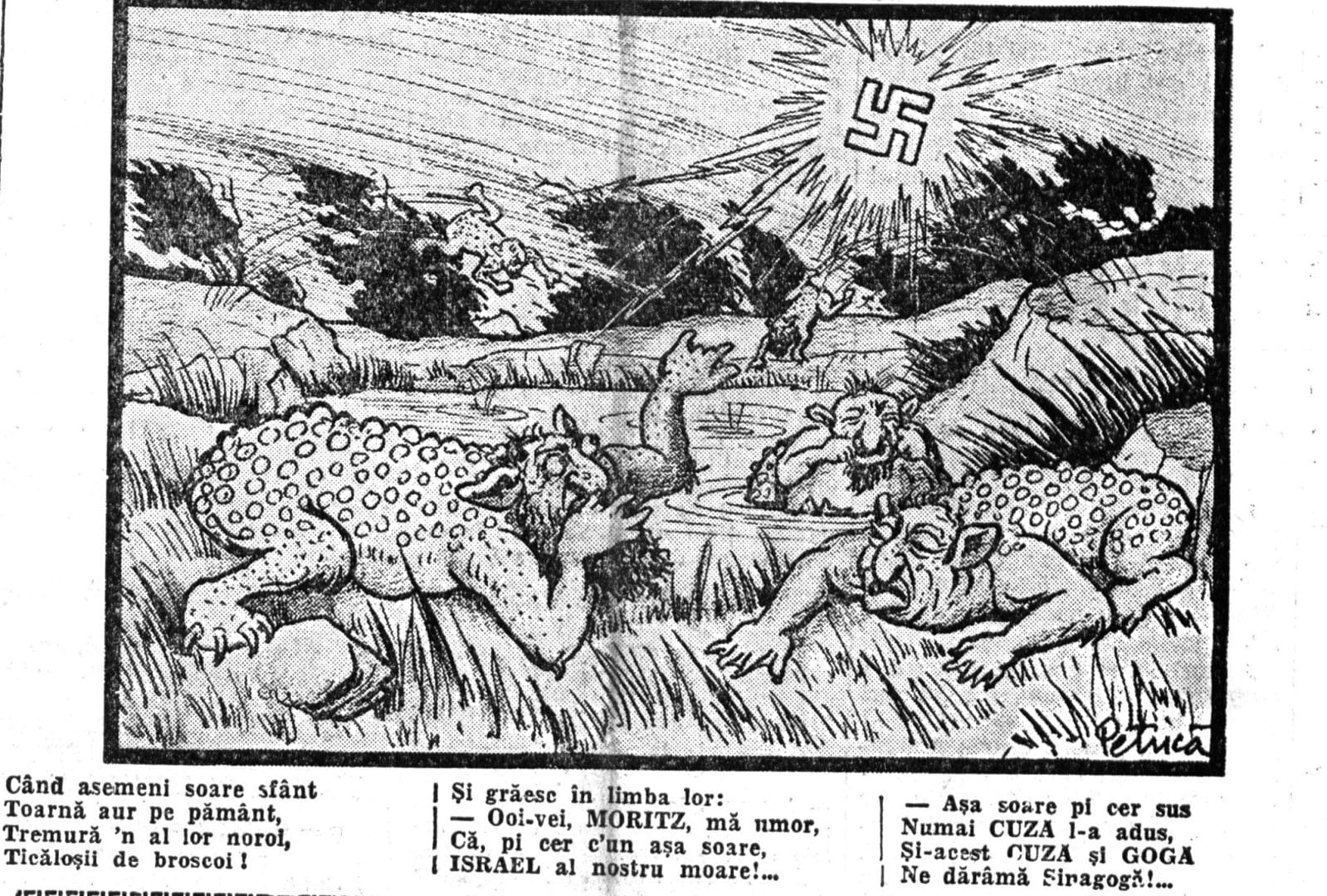
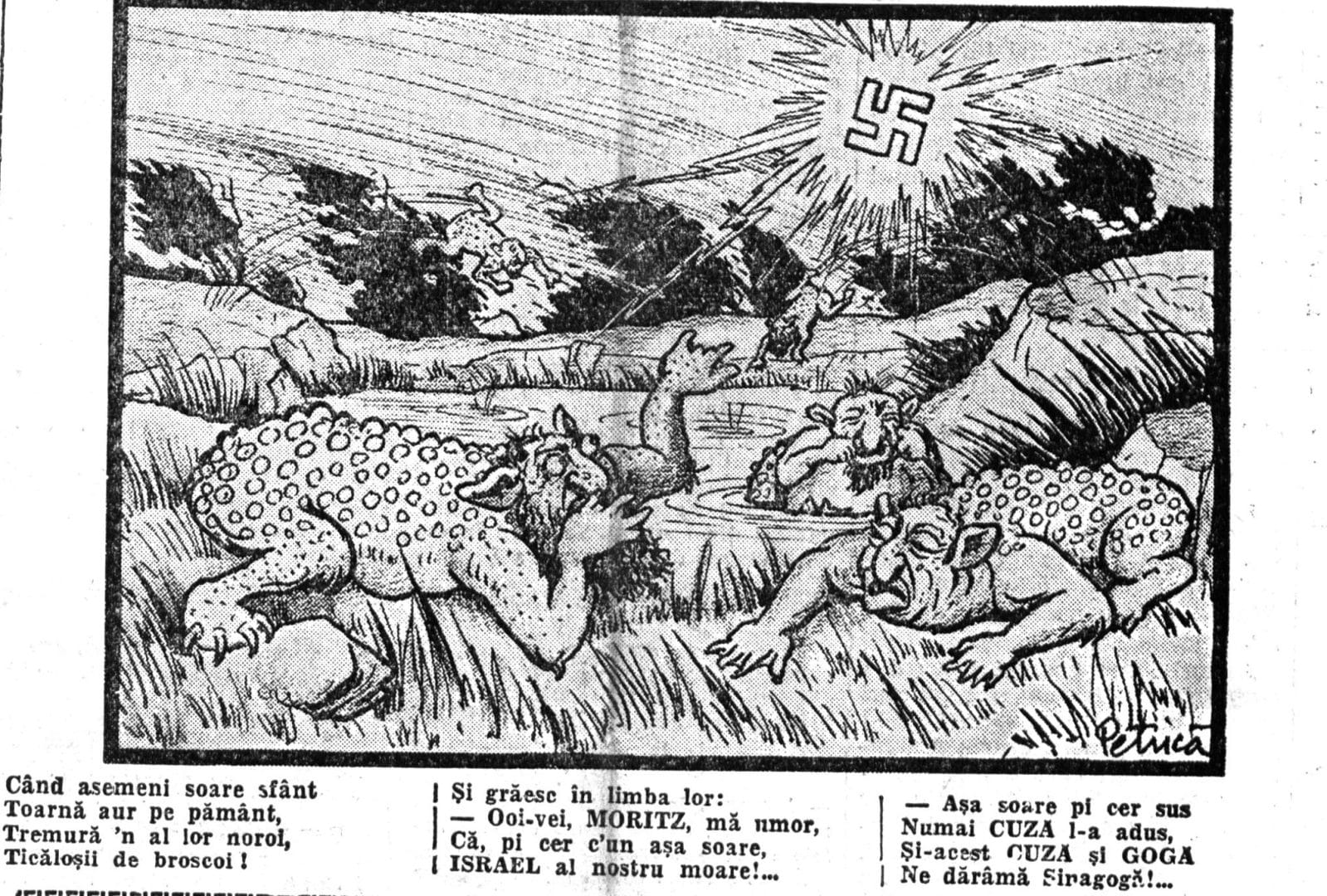
But it is not only God that works against the Jews. In a caricature from early February 1937,[20] three big toads with typical Jewish features are frightened that they will be killed by the bright sun rising in the sky. Two others try to find cover in the water. The sun, sending lethal arrows from the sky, has a swastika shining in its center (see Figure 10).

Figure 10. (Author: Petrică Lazăr, published in Porunca Vremii, 1937)

Goga and Cuza are the two politicians mentioned in the accompanying text as the figures who put this “holy sun” in the sky. Because of it, “these wretched frogs are trembling in their mud.” This sun, says the author of the text, will pour gold on Earth and will bring the death of Israel. 

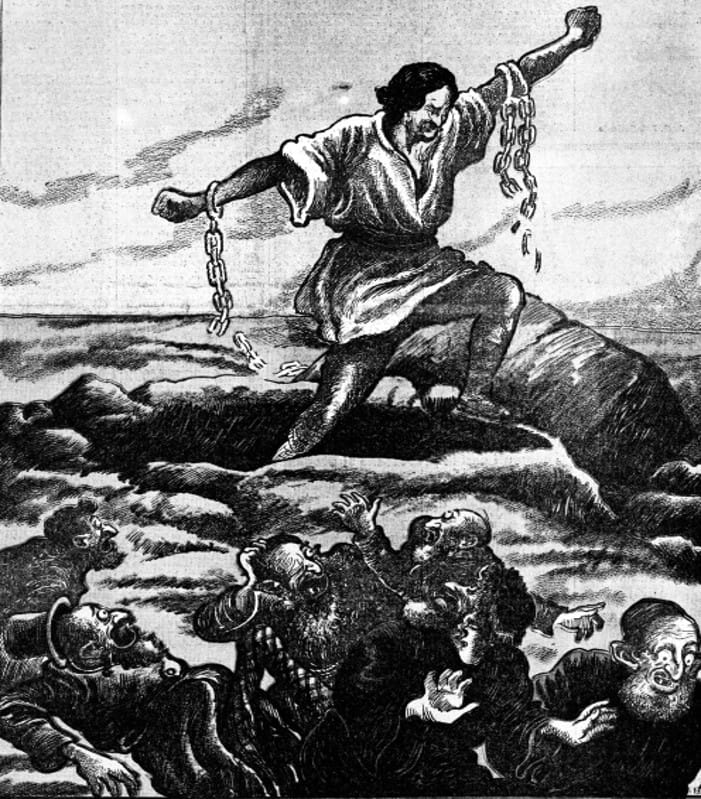
When the “problem” is solved by actors in the mundane realm, several scenarios could be proposed by the illustrator. In a caricature published on Easter of 1935 (see Figure 11), we have six frightened Jewish men terrorized by the image of the Romanian peasant breaking his chains and rising victoriously from the grave. The Jewish origin of the six is easy to guess given the typical physiognomy used by the illustrator. The explanatory text presents the image from a presentist perspective: the Romanian people are likened to Christ. In the past, the latter was hated and condemned by the Jews for his divine love for humanity. Today, the Romanian people are enslaved, exploited, tormented, and crucified by the same enemies of the human race. Tormented by the Jews, the Romanian nation has a similar messianic mission: to edify the entire Christian community through its suffering.[21] The ideal type of the Romanian nation is the peasant, and the latter will get to be victorious against the Jews.

Figure 11. (Author: Petrică Lazăr, published in Porunca Vremii, 1935)

Some other times, political actors are those pointed out to exact revenge and solve “the Jewish problem”. In a caricature from 1938 (see Figure 12), the Jewish character asks Moses to save him from the terrible fate ascribed to him by Cuza and Goga. He is meant to die, and not even Moses is able to elude his destiny. This time, the agents of change are political actors and their position in regard to the Jewish problem will fundamentally influence the fate of the Jewish people found under the authority of the Romanian state.

Figure 12. (Author: Petrică Lazăr, published in Porunca Vremii, 1938)

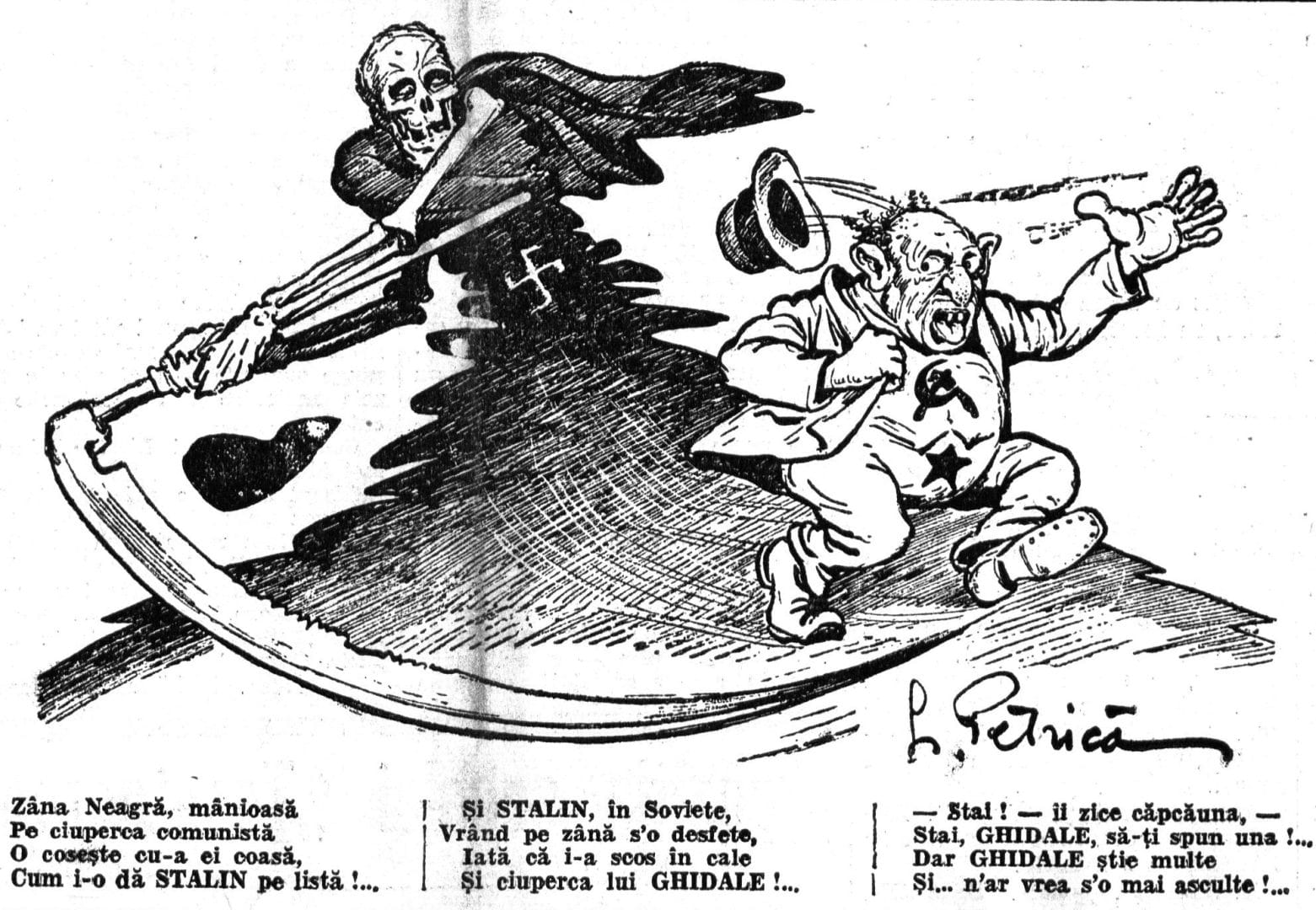
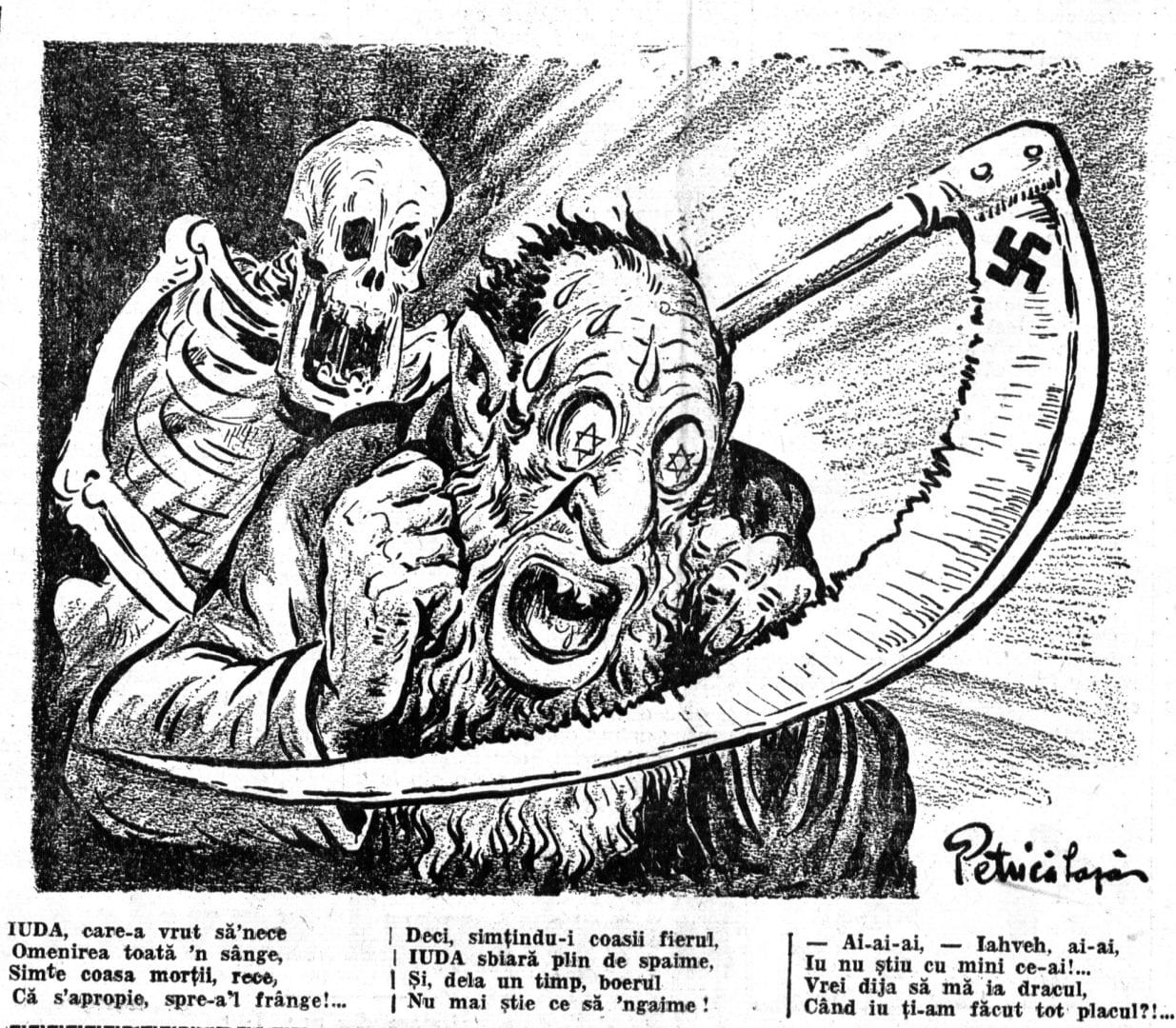
Like the elements of nature — the sun from the caricature discussed above — death is also ideologically oriented. In many caricatures published in Porunca Vremii, the image of Death is used to point to the immediate and inescapable end of the Jews (see Figure 13). 

Death is “the Black fairy” (Zâna neagră) that puts down the communist mushroom (in the right image) while, on the left, the rhetoric is religiously framed, the Jewish figure being generically addressed as JUDAS and being condemned to death because he wanted to drown all humanity in blood. In both cases, Death operates under the sign of the swastika. 

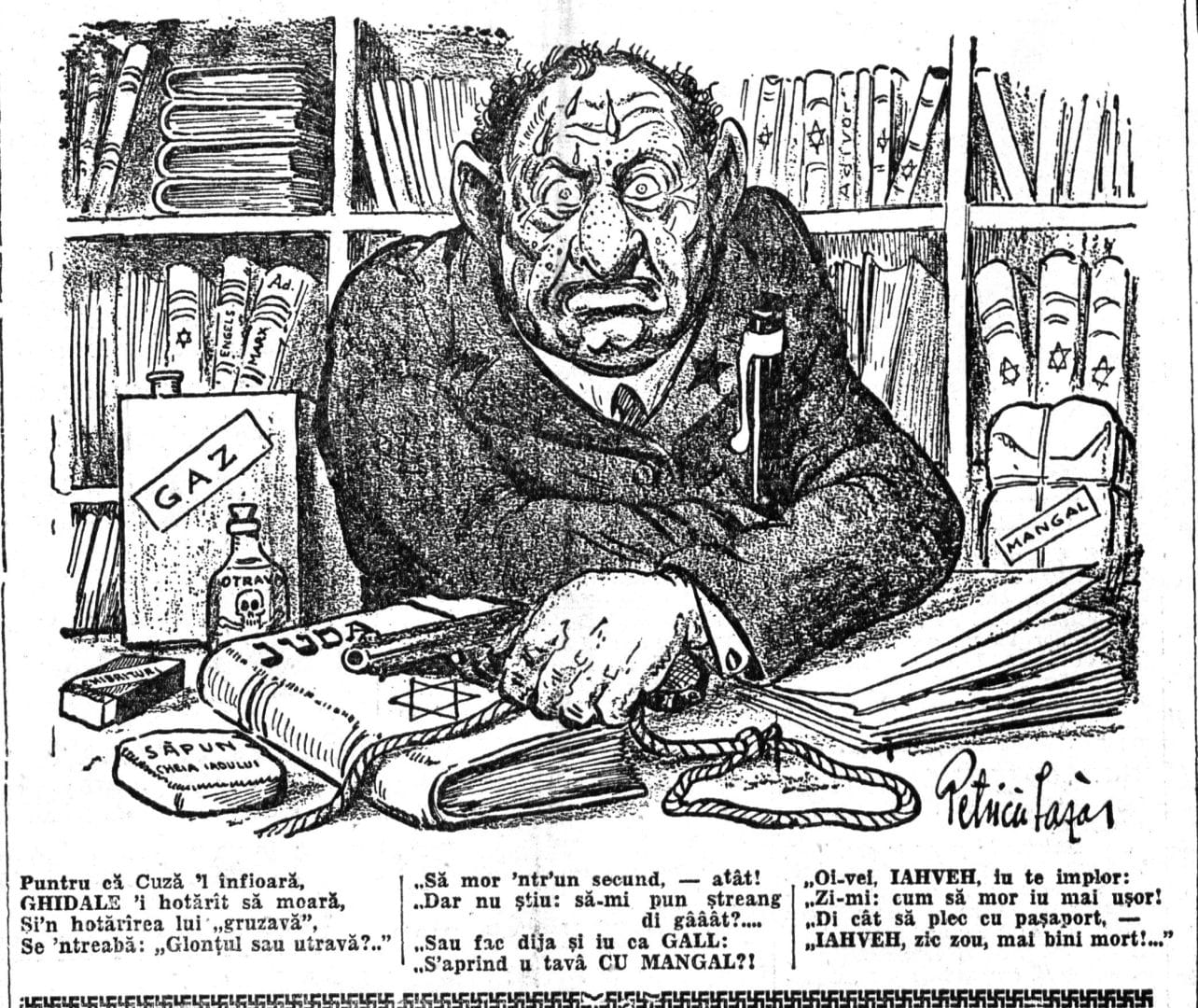
In the last example I want to discuss, death is not brought about by a third party but is sought by the Jew himself (see Figure 14). The caricature features a Jewish man seated at a desk. Behind him on the bookshelf are various editions of Adevărul (Adivor)[22] alongside a volume of Marx and Engels’ writings. The Soviet star on his right lapel and these books indicate the man’s supposed communist connections. His distinct facial features and the book on his desk unmistakably reveal his identity to anyone viewing the illustration. In his right hand, he has a huge pen, a typical symbol of the “perverse” Jewish press. He appears frightened and uncertain. The items scattered around the area could be potential sources for suicide: a gun, a bottle of poison, a gas canister with matches, a package of charcoal, a rope for hanging, and a bar of soap. To clarify the character’s ultimate destination, the soap is referred to as “The Key to Hell” (Cheia Iadului).

Figure 14. (Author: Petrică Lazăr, published in Porunca Vremii, January 1938)

The caricature appeared in late January 1938. It attributes A. C. Cuza as the cause of the character’s fears and his decision to take his own life. Ultimately, he faces the critical decision of how to die.  The text humorously portrays this dilemma, emphasizing the protagonist’s inadequate Romanian and the unavoidable choice he faces.  

Conclusion 

Using caricatures to analyze antisemitic rhetoric in interwar Romania allowed us to recover not only the messages conveyed by various authors to the public but also the shared symbolic knowledge between the authors and their audience. By following this path, we reconstructed the culturally shaped image of the Jew and gained insight into the mental concepts attributed to Jews at that time, shedding light on the dominant attitudes and perceptions of that historical era. 

As observed, the caricaturist’s focus is sometimes political, but he consistently employs potent religious symbols to support his argument. The depicted alliance between Israel and Satan acts as a clear line that justifies any accusations against the Jews. Old religious symbols such as the serpent, horns, Devil’s tail, and crucifixion are utilized to highlight and confirm this ongoing alliance. The portrayal of the Jew as the killer of Christ functions like what Allport describes as a “label of primary potency” — a dominant label that overshadows all others and hinders alternative interpretations.[23] By becoming constructed as a label of primary potency, this belief is removed from the realm of history and placed in the realm of nature. All Jews, irrespective of their year and place of birth, are equally seen as Christ killers, and all do the work of Satan. 

All other symbols ascribed to the Jews in the caricatures derive from this label of primary potency and together create a set of antisemitic slanders that encapsulates the portrait ascribed to the Jew in a coherent cluster: because they are the people of Satan, they killed Christ and ever since then aim to destroy the people of Christ. Their scopes are never spiritual but material: the destroying of civilization, of Christianity, of the world. Like Lucifer, they aim to take the place of God. In Romania, they follow the same malevolent scope, and if not removed, they will bring the destruction of the Romanian nation.

Their exclusion goes hand in hand with God’s will and is part of an apocalyptic battle that will make possible the defeat of Satan.

As Allport explained, once functional, categorization engenders meaning upon the world. Consequently, once we have access to how the category of the Jew was constructed in interwar Romania and how this symbolic construction was shared by the epoch, it becomes easier to understand both the enthusiastic participation of the civilian population in the violence perpetrated against the Jews and/or the lack of reaction of the same civilian population faced with the aggressiveness perpetrated against the Jews starting with 1940. 

Notes: 

[1] Demski, Dagnoslaw, Baraniecka Olszwaska, Kamila, “Introduction. Encountering Images of the Others” in Dagnoslaw Demski, Kamila Baraniecka-Olszewska (eds.), Images of the Other in Ethnic Caricatures of Central and Eastern Europe (Warsaw: Institute of Archaeology and Ethnology, Polish Academy of Science, 2010), 16.

[2] Dotsch, Ron,  Pictures in Our Heads: Visual Stereotypes Affect Social Categorization (Optime, 2011), 1.

[3] Petrov, Petăr, “Caricature as a Source in the Study of Mental Images: A Bulgarian Example” in Dagnoslaw Demski, Kamila Baraniecka-Olszewska (eds.), Images of the Other in Ethnic Caricatures of Central and Eastern Europe (Warsaw: Institute of Archaeology and Ethnology, Polish Academy of Science, 2010), 81.

[4] Ibidem.

[5] Golubev, V., Aleksander, “Images of the Eastern Europe in the Soviet caricature of the 1920s and 1930s (in the Published Material of Krokodil)” in Dagnoslaw Demski, Kamila Baraniecka-Olszewska (eds.), Images of the Other in Ethnic Caricatures of Central and Eastern Europe (Warsaw: Institute of Archaeology and Ethnology, Polish Academy of Science, 2010), 214.

[6] Allport, Gordon, The Nature of Prejudice (Reading: Addison-Weasley Publishing Company, 1966), 171, 176.

[7] Dotsch, Pictures in Our Heads: Visual Stereotypes Affect Social Categorization, 8. 

[8]Ibidem, 3.

[9]Allport, The Nature of Prejudice, 165.

[10]See for example Janáčová, “Spa Antisemitism in Bohemia and Moravia”, 63, Karlíček, “Antisemitic Caricatures in the Protectorate Press (1939-1945) and Their Authors”, 171.

[11]Porunca vremii, 1937, year VI, no. 933, 1.

[12]Ibidem.

[13]Porunca vremii, 1938, year VII, no. 979, 1.

[14]Porunca vremii, 1937, year VI, no. 902, 1. In Romanian: “Când întreaga IUDEI turmă/ Și-o da duhul cel din urmă, -/Lumea toată va renaște/ Ca o luncă ‘n zi de Paște.”

[15]See for example Fein, Accounting for Genocide: National Responses and Jewish Victimization During the Holocaust, De Swaan, The Killing Compartments: The Mentality of Mass Murderer, Mariot, “On the role of dehumanization of victims in the perpetration of mass killings: Research notes” in Violence: An International Journal, vol I (I), 2020.

[16]Porunca Vremii, year VII, no. 964, 6 January 1938.

[17]Ibidem. In Romanian: “(…) Tâlharului cel strâns de gât,/ Noi azi îi spunem doar atât:/ A râs destul cât ne-a fost gâde;/ Acuma însă noi vom râde!…”

[18]Porunca Vremii, year XI, no. 2409, 25 December 1942.

[19]Porunca Vremii, year VI, no. 950, 15 December 1937, p. 1.

[20]Porunca Vremii, year VII, no. 988, 1 February 1938, p. 1.

[21]Porunca Vremii, “Învierea României creștine”, year IV, no. 105, 28 April 1935, p. 1. 

[22]During Romania’s interwar period, the far-right movement, which included extremist publications such as Porunca Vremii and Sfarmă-Piatră, as well as fascist groups like the Iron Guard and the National Christian Defense League (LANC), launched aggressive campaigns against the prominent left-leaning, independent newspaper Adevărul, accusing it of serving Jewish interests. 

[23]Allport, The Nature of Prejudice, 179.

Periods

Recommended literature

Allport, Gordon, The Nature of Prejudice (Reading: Addison-Weasley Publishing Company, 1966).

Demski, Dagnoslaw, Baraniecka Olszwaska, Kamila, “Introduction. Encountering Images of the Others” in Dagnoslaw Demski, Kamila Baraniecka-Olszewska (eds.), Images of the Other in Ethnic Caricatures of Central and Eastern Europe (Warsaw: Institute of Archaeology and Ethnology, Polish Academy of Science, 2010). 

De Swaan, Abram, The Killing Compartments: The Mentality of Mass Murderer (New Haven: Yale University Press, 2015).

Dotsch, Ron,  Pictures in Our Heads: Visual Stereotypes Affect Social Categorization (Optime, 2011).

Fein, Helen, Accounting for Genocide: National Responses and Jewish Victimization During the Holocaust (Chicago: Chicago University Press, 1979.

Golubev, V., Aleksander, “Images of the Eastern Europe in the Soviet caricature of the 1920s and 1930s (in the Published Material of Krokodil)” in Dagnoslaw Demski, Kamila Baraniecka-Olszewska (eds.), Images of the Other in Ethnic Caricatures of Central and Eastern Europe (Warsaw: Institute of Archaeology and Ethnology, Polish Academy of Science, 2010).

Janáčová, Eva, “Spa Antisemitism in Bohemia and Moravia” in Jakub Hauser, Eva Janáčová, (eds.), Visual Antisemitism in Central-Europe. Imagery of Hatred (Berlin/Boston: De Gruyter, 2021). 

Karlíček, Petr, “Antisemitic Caricatures in the Protectorate Press (1939-1945) and Their Authors” in Jakub Hauser, Eva Janáčová, (eds.), Visual Antisemitism in Central-Europe. Imagery of Hatred (Berlin/Boston: De Gruyter, 2021).

Mariot, Nicolas, “On the role of dehumanization of victims in the perpetration of mass killings: Research notes” in Violence: An International Journal, vol I (I), 2020.  

Petrov, Petăr, “Caricature as a Source in the Study of Mental Images: A Bulgarian Example” in Dagnoslaw Demski, Kamila Baraniecka-Olszewska (eds.), Images of the Other in Ethnic Caricatures of Central and Eastern Europe (Warsaw: Institute of Archaeology and Ethnology, Polish Academy of Science, 2010).

Comments and discussions