Notes:
[1] Vasylchuk, H., & Drozdov, V. (2023). Soviet Mythmaking in the Stalin Era: Constructing the Myth of “the Ukrainian People’s Reunification”. East European Historical Bulletin, (28), 170–186.
[2] In contemporary historical discourse, several toponyms refer to this territory. The most common is Budzhak/Budjak (Turkish: Bucak—“corner”), a Turkic term that originally described the steppe lands of the Budzhak (Belgorod) Horde, a confederation of semi-nomadic Nogai tribes. At the same time, on 17th–18th century historical maps, another name—Bessarabia—also appeared. Researchers note that the toponym “Bessarabia” predates “Budjak” (see: Eșanu, A., & Eșanu, V. (2023). Dimitrie Cantemir and Bessarabia. Anuarul Institutului de Istorie “George Bariţiu”. Series Historica, 62, 303–323), first appearing on Western European maps in the late 1540s in connection with the Ottoman conquest of the southern lands of the Principality of Moldavia. From that point, it became necessary to distinguish between the territory that remained under the principality’s rule and the lands conquered by the Ottoman Empire, to which a separate name gradually became attached. Originally, Bessarabia referred to the area around Kiliya, the Black Sea coast up to Akkerman, and the Bender region. Later, in the 17th century, the Ottomans called the newly conquered lands “Budjak,” a name reflected on maps. After the Russian Empire annexed the Prut-Dniester Interfluve, “Bessarabia” came to denote the entire region; as a result, the term “Southern Bessarabia” is commonly used to refer to its Ukrainian part. Additionally, historical studies sometimes use the name “Ukrainian Danube Region” [ukr. Українське Подунав’я] (or Prydunaviya [ukr. Придунав’я]), though geographically this does not include territories adjacent to the Dniester. This essay uses the term “Izmail Region,” which the author associates with the Izmail Oblast as part of the Ukrainian SSR from 1940 to 1954, as this most accurately corresponds to the subject of this study.
[3] For details on the “Bessarabian question,” see: Ponomariov, O. (2007). Bessarabske pyttania v ukraiinsko-rumuskhyh vidnosynakh u 1917–1918 rokah [The Bessarabian Question in Ukrainian-Romanian Relations in 1917–1918]. Visnyk Kyivskoho natsionalnoho universytetu imeni Tarasa Shevchenka. Istoriia, 89–90, 44–49; Popenko, Ya. (2018). “Bessarabske pytannia” na Paryzkii myrnii konferentsii (osin–zyma 1919 r.) [“The Bessarabian Question” at the Paris Peace Conference (Fall–Winter 1919)]. Skhid, 4, 56–60; Snigir, M. (2024). “Nechego vynimat iz rumynskoy nogi bessarabskuyu zanozu”: bessarabske pytannia u radiansko-rumunskykh vidnosynakh mizhvoiennoho periodu [“There Is No Need to Remove the Bessarabian Thorn from the Romanian Foot”: The Bessarabian Question in Soviet-Romanian Relations During the Interwar Period]. Acta de Historia & Politica: Saeculum XXI, 7, 25–33; Sokyrska, V. (2019). Utvorennia Moldavskoi ASRR: heopolitychnyi kontekst rosiiskoi radianskoi polityky shchodo USRR [The Formation of the Moldavian ASSR: The Geopolitical Context of Soviet Russian Policy Toward the Ukrainian SSR]. Vcheni zapysky Tavriiskoho natsionalnoho universytetu imeni V. I. Vernadskoho. Seriia: Istorychni nauky, 30 (1), 63–70; Tuchynskyi, V. (2015). “Bessarabske pytannia” u mizhnarodnykh vidnosynakh na zavershalnomu etapi Pershoi svitovoi viyny ta u pershi povoienni roky [“The Bessarabian Question” in International Relations during the Final Stage of World War I and in the Early Postwar Years]. In Yu. Zinko (ed.). Narody svitu i Velyka viyna 1914–1918 rr.: Proceedings of the All-Ukrainian Scientific Conference, April 3–4, 2015 (pp. 101–108). Vinnytsia: Nilan-LTD LLC; Shpakovskyi, L. V. (2017). Radianska Ukraina yak instrument eksportu bilshovytskoi revoliutsii v Rumuniiu (pochatok 1920-kh rr.) [Soviet Ukraine as a Tool for Exporting the Bolshevik Revolution to Romania (early 1920s)]. Storinky istorii, 44, 91–106.
[4] Myrne rozviazannia radiansko-rumunskoho konfliktu v pytanni pro Besarabiiu i pivnichnu chastynu Bukovyny (Povidomlennia TARS) [Peaceful Resolution of the Soviet-Romanian Conflict Over Bessarabia and Northern Bukovina (TASS Report)]. (June 29, 1940). Communist, 1.
[5] Berg, L. (1923). Naselenie Bessarabii. Etnograficheskiy sostav i chislennost (S 0-verstnoy etnograficheskoy kartoy) [The Population of Bessarabia: Ethnographic Composition and Numbers (With a 0-verst ethnographic map)]. Petrograd: Russian Academy of Sciences. pp. 42–45.
[6] Nartsov, N. (1940). Istoricheskie sudby Bessarabii i Moldavii [The Historical Fate of Bessarabia and Moldova]. Istorik-marksist, 9(85), 85–98.
[7] Seventh Session of the Supreme Soviet of the USSR [1st Convocation], (August 1–7, 1940): Verbatim Report. (1940). Moscow: OGIZ. pp. 49–53.
[8] One prerequisite for forming the Moldavian SSR was the creation, in October 1924, of the Moldavian Autonomous Soviet Socialist Republic as part of the Ukrainian SSR. This artificially established administrative entity, which included certain districts from the Odesa and Podillia governorates, was meant to demonstrate the existence of a separate “Moldovan” Soviet statehood and to foster the perception of “Moldovans” as a nation distinct from Romanians—one that had exercised its right to autonomy within the USSR. In reality, however, the creation of the Moldavian Autonomous Soviet Socialist Republic was primarily motivated by foreign policy objectives: to uphold the Soviet Union’s territorial claims to Bessarabia, intensify diplomatic pressure on Romania, and exert propaganda influence on the region’s population. After the annexation of Bessarabia in 1940 and the creation of the Moldavian SSR, the Transnistrian part of the autonomous region became part of the new republic, while the remaining districts stayed within the Ukrainian SSR.
[9] Soviet ideologues effectively integrated the Khotyn region into a single ethnocultural region with Northern Bukovyna. See: Frunchak, S. (2014). The making of Soviet Chernivtsi: National “reunification,” World War II, and the fate of Jewish Czernowitz in postwar Ukraine (Vol. 3666597) [University of Toronto (Canada)]. Pp. 125–126.
[10] Bielousov, S., Huslystyi, K., Ohloblin, O., Petrovskyi, M., Suprunenko, M., & Yastrebov, F. (Eds.). (1940). Istoriia Ukrainy: korotkyi kurs [History of Ukraine: A Short Course]. Kyiv: Publishing House of the Academy of Sciences of the Ukrainian SSR.
[11] Drozdov, V. (2022). Soviet Politics of Memory in Southern Bessarabia and Northern Bukovyna: Representation of the Past and Mythmaking during World War II. Plural. History. Culture. Society, 10(2), 85–102. https://doi.org/10.37710/plural.v10i2_4
[12] Kravchenko, I. (June 17, 1941). Izmail. Kratkiy istoricheskiy ocherk [Izmail. A Brief Historical Essay]. Pridunayskaya Pravda, 2.
[13] Petrovskyi, N. (1944). Vossoedinenie ukrainskogo naroda v edinom ukrainskom sovetskom gosudarstve [The Reunification of the Ukrainian People in a Single Ukrainian Soviet State]. Moscow: OGIZ – Gospolitizdat.
[14] Dolnik, A. (1945). Bessarabiya pod vlastyu rumynskih boyar (1918–1940 gg.) [Bessarabia Under the Rule of Romanian Boyars (1918–1940)]. Moscow: OGIZ – Gospolitizdat.
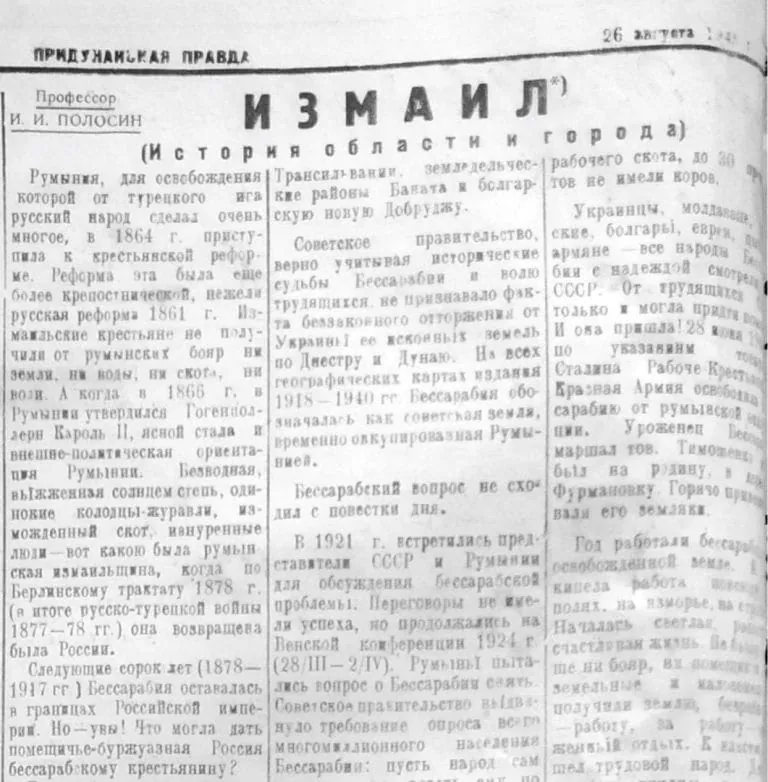
[15] Polosin, I. (1945). Izmail (istoriya oblasti i goroda) [Izmail (History of the Oblast and the City)]. Pridunayskaya Pravda, August 12, 3; August 14, 3; August 21, 3; August 24, 3; August 26, 4.
[16] Seminar uchiteley – istorikov [Seminar for History Teachers] (August 12, 1945). Pridunayskaya Pravda, 3.
[17] Drozdov, V. (2024). Masove pereimenuvannia naselenykh punktiv Izmailskoi oblasti v 1945 r. yak metod orhanizovanoho zabuttia [The Mass Renaming of Settlements in the Izmail Oblast in 1945 as a Method of Organized Forgetting]. Naukovyi visnyk Izmailskoho derzhavnoho humanitarnoho universytetu. Seriia: Istorychni nauky, 67, 112–121.
[18] Drozdov, V. (2021). Stvorennia radianskoho mifu pro Izmail yak “misto rosiiskoi boiovoi slavy” v povoiennyi period [The creation of the Soviet myth of Izmail as the “city of Russian military glory” in the postwar period]. Naukovyi visnyk Izmailskoho derzhavnoho humanitarnoho universytetu. Seriia: Istorychni nauky, 52, 54–64.
[19] Drozdov, V. (2023). Izmail u radianskii kinodokumentalistytsi 1940-kh – pochatku 1950-kh rr. [Izmail in Soviet Documentary Film of the 1940s–Early 1950s]. Naukovyi visnyk Izmailskoho derzhavnoho humanitarnoho universytetu. Seriia: Istorychni nauky, 63, 41–52.
[20] Torzhestvo osvobozhdennogo naroda [The Triumph of the Liberated People] (August 29, 1945). Pridunayskaya Pravda, 3–4.
[21] Bessmertnaya slava russkogo oruzhiya [The Immortal Glory of Russian Arms] (December 22, 1945). Pridunayskaya Pravda, 1.
[22] Ibid.
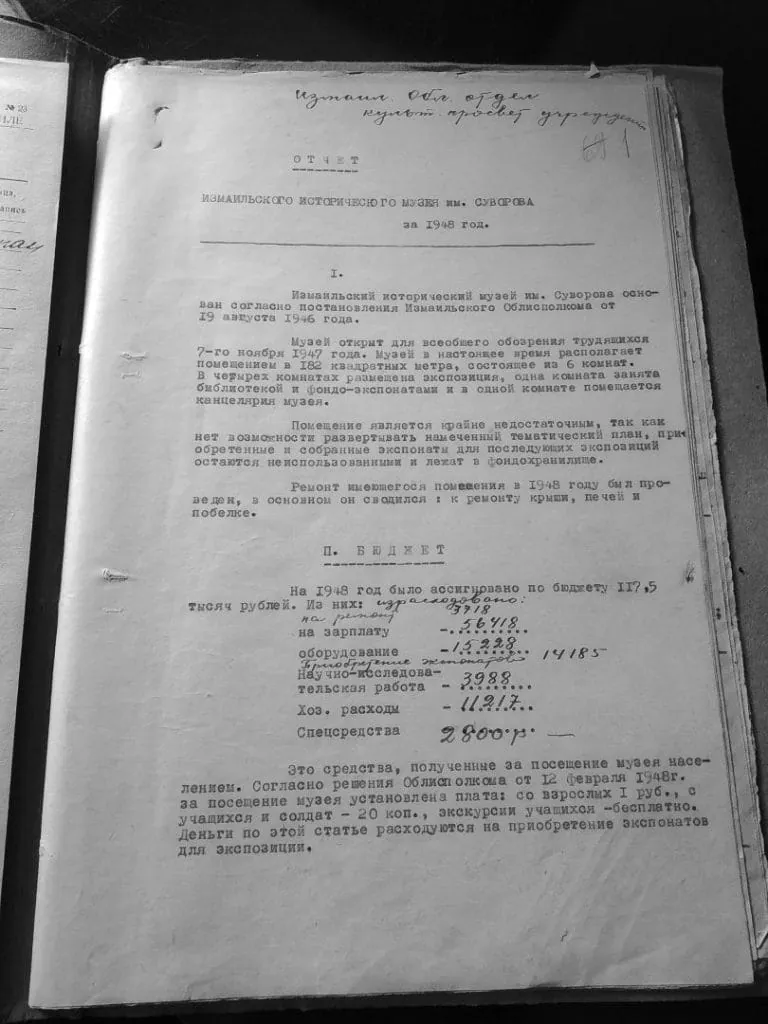
[23] Resolution No. 566 of the Izmail Oblast Executive Committee dated August 19, 1946, “On the Organization of the Suvorov Oblast Historical Museum in the City of Izmail.” Izmail Archive Municipal Institution. Fond Р-470. Inventory 1. Case 107. Sheet 11.
[24] Drozdov, V. (2022). Muzei Izmailskoi oblasti yak instrumenty formuvannia i poshyrennia radianskoi ofitsiinoi pamyati v povoiennyi period [Museums of the Izmail Oblast as Instruments for Shaping and Disseminating Official Soviet Memory in the Postwar Period]. Naukovyi visnyk Izmailskoho derzhavnoho humanitarnoho universytetu, 59, 49–59.
[25] Action Plan of the Committee of the Ukrainian Soviet Socialist Republic for the Commemoration of the 150th Anniversary of the Death of the Great Russian Commander A. V. Suvorov. The Central State Archives of Supreme Bodies of Power and Government of Ukraine. Fond 2. Inventory 8. Case 2042. Sheets 79–111.
[26] Report “On the Preparation and Conduct of the 150th Anniversary of the Death of the Great Russian Commander A. V. Suvorov”. State Archives of the Odesa Oblast. Fond П-4980. Inventory 2. Case 377. Sheets 29–31.
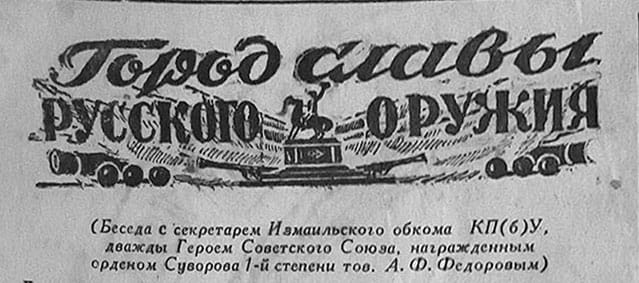
[27] “The City of the Glory of Russian Arms” (Conversation with Comrade A. F. Fedorov, Secretary of the Izmail Oblast Committee of the Communist Party of Ukraine (Bolsheviks), twice Hero of the Soviet Union, and recipient of the Order of Suvorov, 1st Class) (May 18, 1950). Pridunayskaya Pravda, 2.
[28] Ibid.
[29] Na meste kreposti Izmail [At the Site of the Izmail Fortress] (September 19, 1945). Pridunayskaya Pravda, 4.
[30] Drozdov V. (2021). The Soviet Places of Memory of the Postwar Period in the Symbolic Space of the Southern Bessarabian Cities. Analele Universităţii Dunărea de Jos din Galaţi. Seria Istorie, 20, 205–217.
[31] Drozdov, V. (2023). Obraz rosiiskoho narodu v radianskykh komemoratyvnykh praktykakh na aneksovanoho ukrainskykh terytoriiakh (1939–1953) [The Image of the Russian People in Soviet Commemorative Practices in the Annexed Ukrainian Territories (1939–1953)]. Naukovi zapysky Vinnytskoho derzhavnoho pedahohichnoho universytetu imeni Mykhaila Kotsiubynskoho. Seriia: Istoriia, (44), 62–71.
[32] Pushkinizatsiia Akkermana [The Pushkinization of Akkerman]. (August 17, 2024). Akkermanika.
[33] Grishin, I. (August 29, 1945). Pamyatnik geroyam-zemlyakam [Monument to Local Heroes]. Pridunayskaya Pravda, 4.
[34] Izmail Oblast Department of Architecture to the Chairman of the Izmail Oblast Executive Committee, Comrade K. P. Ananko, November 12, 1945. Izmail Archive Municipal Institution. Fond Р-419. Inventory 1. Case 5. Sheet 17.
[35] Minutes No. 4 of the meeting of the Executive Committee of the Bolhrad City Council of Workers’ Deputies, dated January 30, 1948. Izmail Archive Municipal Institution. Fond Р-881. Inventory 1. Case 20. Sheets 40–42.
[36] Resolution of the restricted meeting of the Executive Committee of the Izmail City Council of Workers’ Deputies dated July 30, 1949. No. 11 “On Measures for the Maintenance of Graves and the Commemoration of Soldiers of the Soviet Army and Partisans Who Died in Battle During the Great Patriotic War of 1941–1945.” Archive of the Executive Committee of the Izmail City Council. Fond 56. Inventory 2. Case 5. Sheet 9.
[37] For a critical reexamination of the events of the 1924 Tatarbunary Uprising, see: Ponomariov, V. (2019). Considerații privind implicarea serviciilor secrete sovietice și a Cominternului în organizarea rebeliunii de la Tatar-Bunar. Plural. History, Culture, Society, 7(1), 43–59; Novosiolov, O. (2024). Radianska spetsoperatsiia v Pivdenniy Bessarabii u veresni 1924 r.: sproba demifolohizatsii “Tatarbunarskoho povstannia” [The Soviet Special Operation in Southern Bessarabia in September 1924: An Attempt to Demystify the Tatarbunary Uprising]. Ukrainskyi istorychnyi zhurnal, 5, 174–189.
[38] Na Dunaye [On the Danube]. Film, in 7 parts. Editing sheet. (1940). Central State Audiovisual and Electronic Archive. Unit No. 132. Sheet 30.
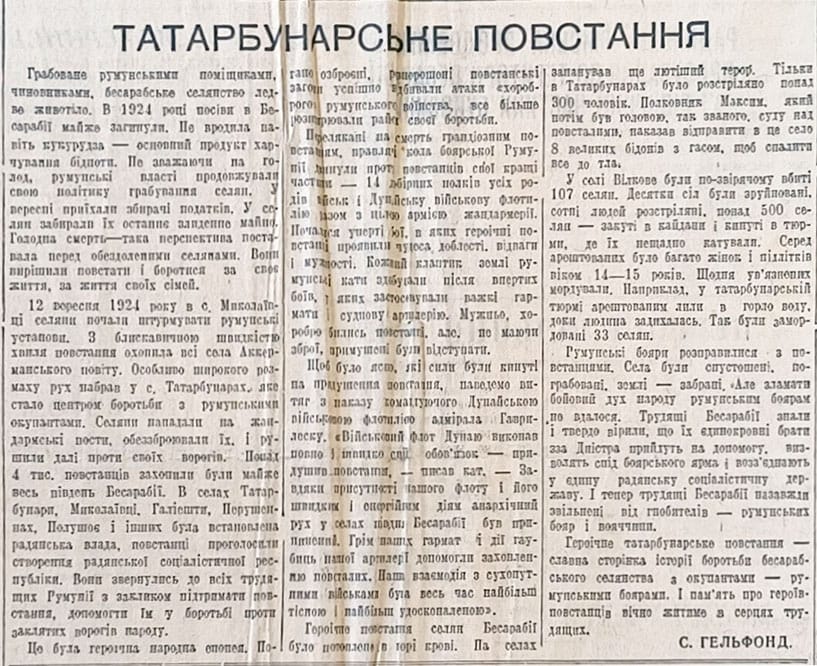
[39] Helfond, S. (June 30, 1940). Tatarbunarske povstannia [The Tatarbunar Uprising]. Communist, 2.
[40] Transcript of the meeting of the Oblast Architectural Commission under the Oblast Department of Architecture, September 11, 1947. Izmail Archive Municipal Institution. Fond Р-419. Inventory 1. Case 16. Sheets 4–24.
[41] Resolution No. 111 of the Executive Committee of the Izmail Oblast Council of Workers’ Deputies and the Bureau of the Oblast Committee of the Communist Party (Bolsheviks) of Ukraine, dated August 25, 1949, “On the Construction of a Monument at the Mass Grave of the Heroes of the Tatarbunary Uprising.” Izmail Archive Municipal Institution. Fond R-470. Inventory 1. Case 223. Sheets 135–141.
[42] Central Committee of the All-Union Communist Party (Bolsheviks). N. Khrushchev to Comrade G. M. Malenkov, June 20, 1949. Central State Archives of Public Organizations of Ukraine. Fond 1. Inventory 23. Case 5656. Sheets 1–3.
[43] Kylymnyk, O., Butych, I., & Huseva, L. (Eds.). (1961). Kulturne budivnytstvo v Ukrainskii RSR. Naivazhlyvishi rishennia komunistychnoi partii i radianskoho uriadu 1917–1960 rr. [Cultural Development in the Ukrainian SSR. The Most Important Decisions of the Communist Party and the Soviet Government, 1917–1960] (Vol. 2). Kyiv: Derzhavne vydavnytstvo politychnoi literatury URSR. p. 206
[44] Tronko, P. (Ed.). (1987). Pamyatniki istorii i kultury Ukrainskoy SSR: Katalog-spravochnik [Historical and Cultural Monuments of the Ukrainian SSR: A Catalog and Reference Guide]. Kyiv: Naukova Dumka. pp. 380–395.
[45] Minutes of the meeting of the Oblast Architectural Commission dated December 28, 1949. Izmail Archive Municipal Institution. Fond Р-419. Inventory 1. Case 28. Sheets 135–141.
[46] Resolution No. 17 of the Executive Committee of the Izmail Oblast Council of Workers’ Deputies and the Bureau of the Oblast Committee of the Communist Party (Bolsheviks) of Ukraine, dated January 30, 1950, “On the Preliminary Design of a Monument to the Heroes of the Tatarbunary Uprising in the District Center of the Village of Tatarbunary.” The Central State Archives of Supreme Bodies of Power and Government of Ukraine. Fond 2. Inventory 8. Case 2040. Sheets 110–111.
[47] Minutes No. 9 of the meeting of the Oblast Architectural Commission under the Oblast Department of Architecture, dated September 14, 1950. The Central State Archives of Supreme Bodies of Power and Government of Ukraine. Fond 2. Inventory 8. Case 2041. Sheets 147–153.
[48] Committee on Arts of the Ukrainian SSR to the Deputy Chairman of the Council of Ministers of the Ukrainian SSR. August 27, 1952. The Central State Archives of Supreme Bodies of Power and Government of Ukraine. Fond 2. Inventory 8. Case 7119. Sheet 77.
[49] Naidionova-Kiriyak, I. Istoriia memorialu uchasnykam Tatarbunarskoho povstannia [History of the Memorial to Participants in the Tatarbunary Uprising]. Tatarbunarskyi visnyk.