
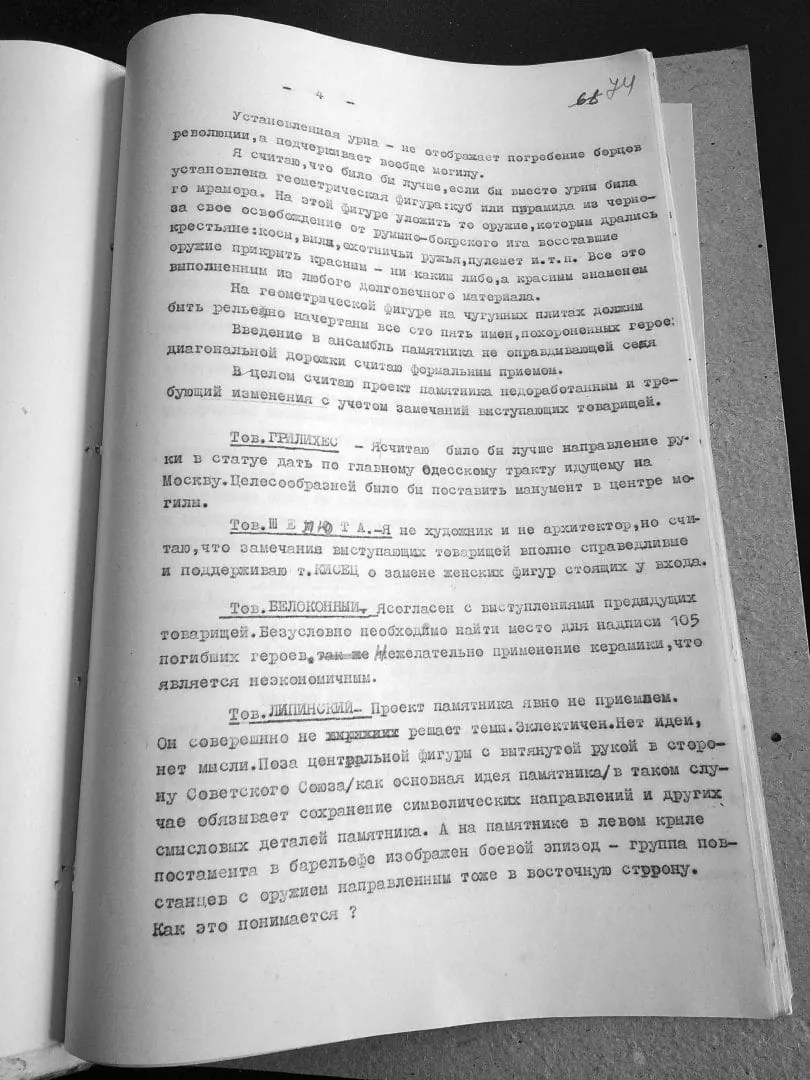
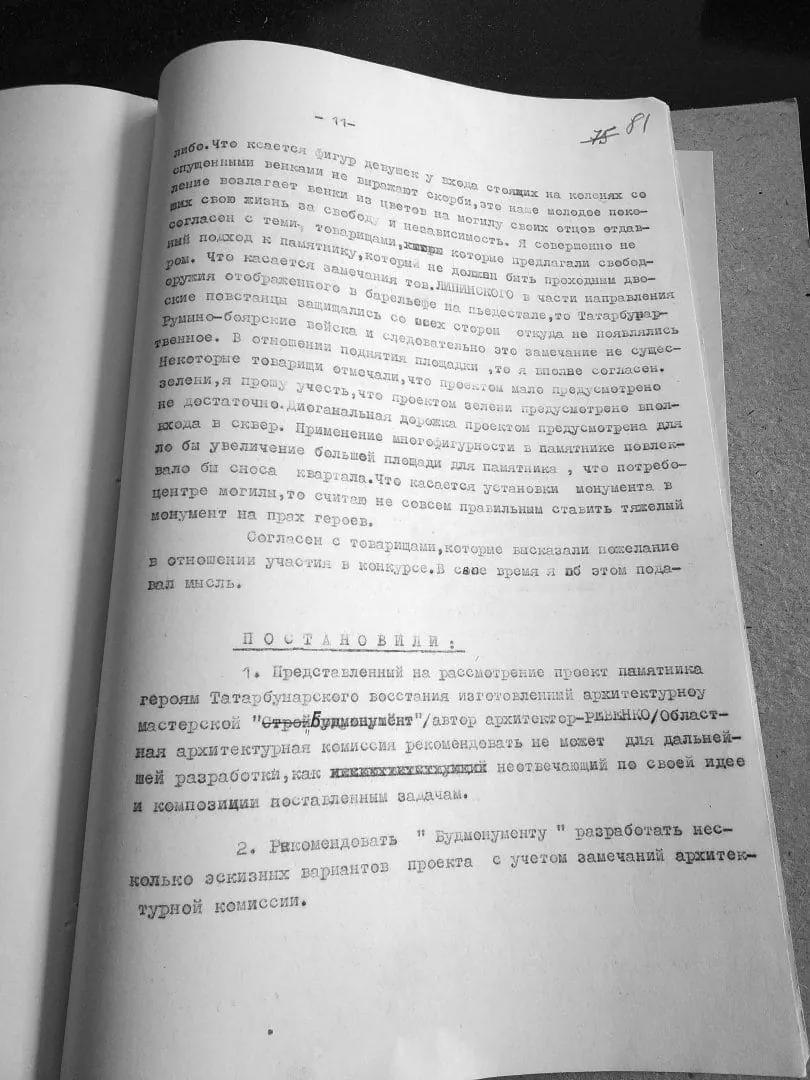
Izmail Archive Municipal Institution [Комунальна установа «Ізмаїльський архів»]. Fond Р–419. Izmail Oblast Department of Architecture. Inventory 1. Case 28. Minutes of the meetings of the Oblast Architectural Commission and conclusions of the expert commission on projects for 1949 (August 13, 1949 – December 28, 1949). Sheets 71–82.
MINUTES
OF THE MEETING OF THE OBLAST ARCHITECTURAL COMMISSION
Izmail, December 28, 1949
AGENDA:
- Review of the design for a monument to the heroes of the Tatarbunary Uprising in the Tatarbunary district.
ATTENDEES:
1/ Engineer G.D. PIVOVAROV, Deputy Head of the Oblast Department of Architecture.
2/ Director KISETS, Oblast Department of Arts.
3/ Shcheliuta, Oblast Department of Cultural and Educational Institutions.
4/ Engineer – Starovertsev, Oblast Department of Public Utilities.
5/ Artists – Comrades Lipinsky and Brevnov.
6/ Architects: Comrade GORCHAKOV—Head of “Obltproekt,”
Comrades BELOKONNY, SIVOKON, and TKACHENKO—Chief Architect of Izmail.
7/ Comrade GRILIKHES—Inspector of the State Architectural and Construction Supervision Authority of Izmail.
8/ Architect – REVENKO, project designer.
CHAIRMAN: Engineer G.D. PIVOVAROV
SCIENTIFIC SECRETARY: Architect B.A. TKACHENKO
The following materials are submitted for review: the site master plan, facades on two sheets, a perspective drawing, a fence detail, a plaster sculpture of the statue at 1/20 scale, nine model photographs, an explanatory note, and a preliminary cost estimate.
HEARD: Information from the project’s designer, Comrade REVENKO, regarding the monument to the heroes of the Tatarbunary Uprising, who outlined the project’s concept, structure, and details of the monument.
The following spoke during the debate:
Comrade KISETS – /Arts Department/: “I generally like the monument design,” said Comrade KISETS, “but I see the main drawback as the presence of an urn and two kneeling female figures at the entrance, holding wreaths that symbolize grief and sorrow—elements that do not reflect Soviet reality. An urn on a grave is a clichéd motif and, for a monument to the heroes of the Tatarbunary Uprising, is unoriginal and out of place. I would prefer something more majestic and unique—something intended to capture the full depth and true political significance of the Tatarbunary Uprising and the 105 heroes who died. The two grieving young women at the entrance, kneeling with their wreaths lowered, have nothing in common with our modern youth, who are actively building socialism and confidently moving toward communism. The women’s costumes are artificial and outdated. It is also unclear why two women were chosen rather than a young man and a girl; it would clearly be better if the wreaths on the heroes’ graves had ribbons with inscriptions”.
<…>
Comrade SIVOKON: “The monument design, presented in a single version, has significant shortcomings, namely:
- The figures of the young women at the entrance are supposed to express grief, but they fail to reflect modernity and are poorly conceived. Their placement does not clearly convey their intended message—why were they put there?
- The remains of 105 heroes are buried at the monument’s site. When asked, ‘How will the names of the fallen heroes be made known to future generations, and where will they be displayed?’ the designer replied rather casually: ‘There will be an inspirational inscription on the front of the pedestal, and the heroes’ names can be placed on the back.’ Yet the designer also admitted he still does not know these names. I believe the absence of the names, and the designer’s lack of knowledge about them, is simply unacceptable. This must be addressed.
I consider it unacceptable to inscribe the names on the back of the monument, where they would be completely inaccessible.
Placing an urn at the center of the grave as a grave marker is clichéd and a simplistic solution.
The urn does not symbolize the burial of the revolution’s fighters; it simply emphasizes the grave.
I believe it would be better to install a geometric shape—a cube or a pyramid made of black marble—instead of the urn. On top of this, the weapons the rebelling peasants used to fight for liberation from the Romanian-boyar yoke should be displayed: scythes, pitchforks, hunting rifles, a machine gun, and so on. All these weapons should be draped with a red banner—not just any red banner, but one made of durable material,
All 105 names of the buried heroes should be inscribed in relief on cast-iron slabs attached to the geometric figure.
Including a diagonal path in the monument complex—which serves no purpose—is merely a formalistic device.
Overall, I find the monument design underdeveloped and in need of revision, taking into account the comrades’ comments.”
<…>
Comrade LIPINSKY: “The monument design is clearly unacceptable. It fails to address the theme entirely. It is eclectic, with no concept and no idea. The central figure’s pose, with an outstretched arm toward the Soviet Union—as the monument’s main theme—requires the preservation of symbolic directions and other meaningful details. Yet, on the bas-relief on the left wing of the pedestal, a battle scene is depicted—a group of insurgents with their weapons also pointed eastward. How should this be interpreted?
To me, this seems incompatible, suggesting a lack of thought on the artist’s part.
The insurgent figure, wearing a Bulgarian cap and striking a ballet-like pose, resembles a dancer. The symbolic depiction of ‘grateful youth’—two kneeling women with bronze wreaths in the foreground at the entrance to the monument’s plaza—is overly conventional and abstract, and fails to reflect the image of our collective farm women.
Regarding layout, the monument’s site is designed in an overly isolated manner. It should be neither a pantheon nor an intimate interior. Any architectural and sculptural structure, as a work of art, must vividly express the central idea and match its form to its content—something this monument lacks.
Nor does it possess any life-affirming power; on the contrary, the young women’s figures evoke only sorrow.
Given the enormous costs (about 1.5 million rubles) allocated for the monument’s construction, this matter should be treated more seriously, with several design options presented. It would be preferable to involve more architects and sculptors and, if possible, to organize a public competition, which would be far more beneficial”.
<…>
Comrade TKACHENKO: “Our generation is erecting a monument to the heroes of the Tatarbunary Uprising at a time when our country is confidently marching toward communism, when our Soviet Army has victoriously ended the war against fascist Germany and liberated millions of toilers—fighters for freedom and revolution—and when the peoples of former fascist Romania, Hungary, Bulgaria, Germany, and other nations have achieved their liberation; at a time when the dream of revolution has become the passion of life; and when these people—who had been under the yoke of the executioners of the Romanian dynasty—have attained freedom and are building their own socialist state.
The proposed design for the monument to the heroes of the Tatarbunary Uprising, created by Budmonument (designer: REVENKO), does not meet the stated objectives.
If we regard the design simply as a colorful illustration, without considering its deeper meaning and content, it is well executed in terms of color palette. The colors are tastefully chosen and the artist’s skill is clear; however, there is a certain carelessness in the execution, which I attribute to haste.
As presented, this version clearly does not meet the set objectives.
It lacks a central idea and does not embody the revolutionary spirit of the insurgent movement, which has long been present in the lives of our people, whether expressed in labor, creative work, or the theoretical sciences—where we always establish the theoretical foundation of Marxism–Leninism. This monument does not convey the revolutionary struggle for freedom and independence.
If we examine the monument in detail, we can say the following:
The monument should not be enclosed—it should be freely accessible and visible from all sides.
A comprehensive approach was taken when selecting and preparing the site for the monument, which is why entire city blocks were demolished.
The monument should be a monumental sculpture in the square. However, in the proposed design, all approaches are blocked; the monument is set on the edge of a circle, facing only one direction and placed in a depression. In the foreground are women kneeling with wreaths lowered, and in the center is an urn—altogether resembling a pantheon with interior decoration. As a whole, it looks more like a mausoleum than a monument to heroes. The kneeling women in long dresses with wreaths at the entrance are overly archaic—a mythical allegory of grief. They do not, as the author claimed, represent our younger generation, our youth, laying wreaths for their fathers who died for the revolution.
The urn in the center, set on a ceramic rug, is more reminiscent of a traditional Moldovan wine vessel used for memorial feasts.
Using a ceramic rug for such a monument does not convey a sense of solemnity.
Placing the monument at the edge of the circle, rather than on or at the center of the grave itself, is ill-advised.
We know from ancient history that pyramids were erected on graves and large burial mounds were built. We also have many examples of monuments and entire structures being erected on graves.
The sculpture’s pedestal is made of gray labradorite, which is appropriate and lends a sense of monumentality and massiveness; however, its form and placement in the plan do not meet the stated objectives.
The panel depicting the facade gives a general impression of monumentality, but the master plan tells a different story: the pedestal sits at the edge of a circle, shaped like a concave plate, and resembles a cheap decorative trinket. There is no space on the pedestal for the names of the fallen heroes—all 105 of them.
The sculptural depiction of the Tatarbunary Uprising—a statue of a peasant in a Bulgarian cap, one arm raised and pointing toward Moscow, the other holding a banner, with an expressionless face—conveys nothing.
I fully agree with previous speakers that this figure looks more like a dancing Transcarpathian Ukrainian than a dynamic freedom fighter. I do not wish to impose any ideas on the artist, but I would have approached this task differently. The monument, with the statue, should stand on the grave, at the center of the square, on elevated ground, with unobstructed access. A sculptural group should rise from a tall granite pedestal, with a central figure of a Russian man in everyday work clothes, bareheaded, with wind-tousled hair, holding a banner to his chest with one hand, and the other hand extended forward, calling for victory—the people’s freedom. The facial expression and movement should convey the pride, strength, and confidence of the Russian people, who triumphed in Russia in 1917 and are moving forward toward new conquests. The other figures should be compositionally integrated with the central figure. This concept should be the basis for the monument to the heroes of the Tatarbunary Uprising. Of course, for such a significant work involving such great expense, it would have been more appropriate to announce an open competition. However, since this is an individual commission, I believe the sculptural part should have been entrusted to Academician and sculptor M.G. LYSENKO.”
Comrade PIVOVAROV: “The comrades who spoke have rightly identified serious shortcomings in the proposed design for the monument to the Tatarbunary Uprising. Given the exceptional political significance of the 1924 events in Tatarbunary and in honor of the heroes who died for freedom and independence, our expectations for this project must be especially high.
This design lacks a clear concept.
It lacks cohesion. The peasant sculpture lacks dynamism and grandeur. The revolutionary struggle of the oppressed people for liberation is poorly depicted, and there is no connection to our contemporary Soviet reality.
Placing an urn on the grave of the fallen heroes is an overly hackneyed and trite motif; it would be better to abandon this idea in favor of a geometric figure—a pyramid—made of black marble, on which cast-iron slabs with the names of the fallen heroes in relief could be placed.
In my opinion, the monument is very poorly situated and not easily accessible for a comprehensive view. It would be much better to place the monument at the center of the grave. I fully agree with Comrade TKACHENKO’S proposal to create a monument with a sculptural group depicting the Tatarbunary Uprising.
The figure of a peasant wearing a Bulgarian cap in the proposed design is too pale and lacks dynamism—there is no sense of muscle tension or the struggle of the rebelling people for liberation. Inscriptions honoring the fallen heroes should be included, but not on the back of the monument—where they are out of sight—and there is no space on the front to place them. The designer should address this issue. Regarding the figures at the entrance—mourning women kneeling with wreaths—it seems the designer has strayed too far into the past, forgetting our present-day Soviet reality. The intention was for these two kneeling women to represent our younger generation honoring the memory of their fathers; unfortunately, the designer has not achieved this. The figures are too archaic and have nothing in common with our youth. The costumes are outdated.
It is regrettable that only one version has been submitted for our consideration, making it difficult for us to propose alternatives. However, the remarks from our comrades clearly indicate that this design must be revised to address all comments.
It would have been useful to announce an open competition for the monument’s design, but by resolution of the Council of Ministers of the Ukrainian SSR, the project was entrusted to the Budmonument architectural studio, which should have provided at least several preliminary sketches.”
<…>
CLOSING REMARKS BY THE PROJECT’S AUTHOR
Architect – REVENKO.
In his closing remarks, the project’s author, Comrade REVENKO, thanked the comrades for their sharp and fair criticism. He acknowledged that the comments regarding the placement of the urn were entirely justified and that it could be replaced with something else. Regarding the figures of the young women at the entrance, kneeling with wreaths lowered—he explained they do not express grief but rather represent our younger generation laying wreaths on the graves of their fathers who gave their lives for freedom and independence. He completely disagreed with those who proposed a free-access approach to the monument, stating it should not become a thoroughfare. On Comrade LIPINSKY’s comment about the direction of the weapons depicted in the bas-relief, he argued that the Tatarbunary rebels defended themselves from all directions, regardless of where the Romanian-boyar troops appeared, so this criticism was irrelevant. He fully agreed with the suggestion to raise the platform. In response to concerns about insufficient greenery, he clarified that the design actually provides for a sufficient amount. The diagonal path is included as the entrance to the park. Incorporating multiple figures into the monument would require a larger area, which would mean demolishing a city block. As for placing the monument in the center of the grave, he did not consider it appropriate to place a heavy monument on the heroes’ remains.
I agree with the comrades who expressed a desire to participate in the competition. I had previously suggested this idea.
RESOLVED:
- The design for a monument to the heroes of the Tatarbunary Uprising, submitted by the Budmonument architectural studio (architect: REVENKO), cannot be recommended by the Oblast Architectural Commission for further development, as it fails to meet the set objectives in both concept and composition.
- We recommend that Budmonument develop several preliminary design options, taking into account the Commission’s comments.
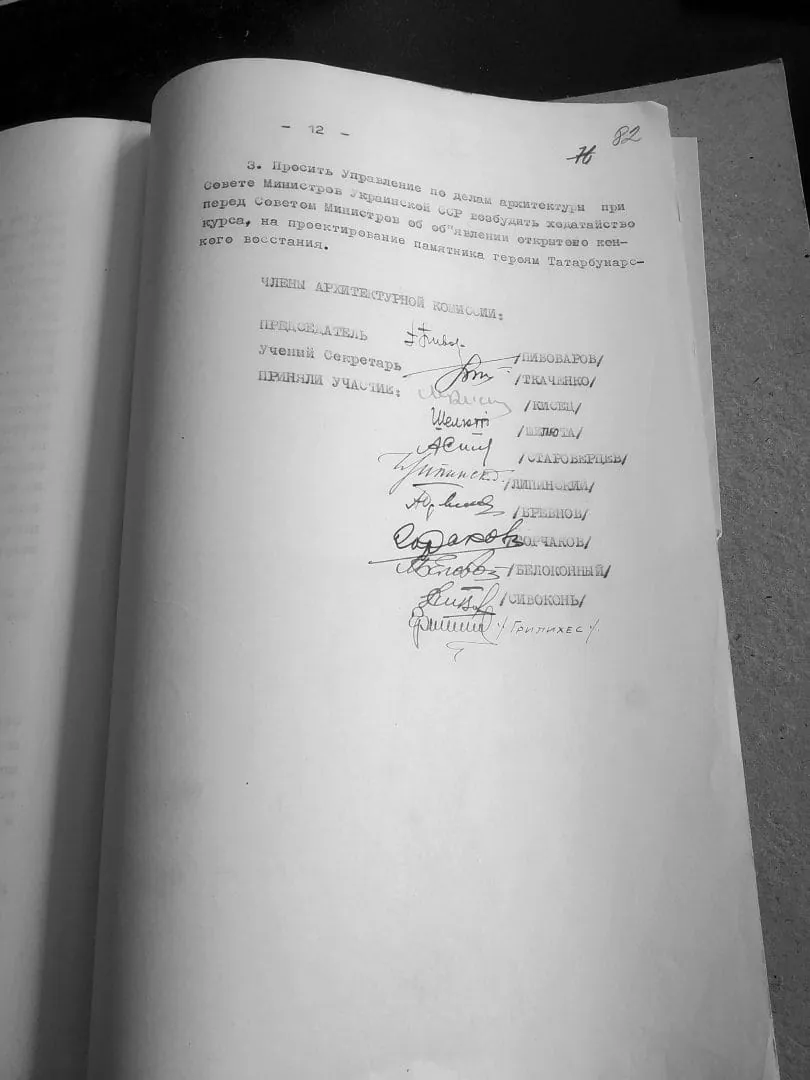
- We request that the Department of Architectural Affairs under the Council of Ministers of the Ukrainian SSR petition the Council of Ministers to announce an open competition for the monument’s design.
MEMBERS OF THE ARCHITECTURAL COMMISSION:
CHAIRMAN /PIVOVAROV/
Scientific Secretary /TKACHENKO/
ATTENDEES:
/KISETS/
/SHELIUTA/
/STAROVERTSEV/
/LIPINSKY/
/BREVNOV/
/GORCHAKOV/
/BELOKONNYI/
/SIVOKON/
/GRILIKHES/






The minutes of the Izmail Oblast Architectural Commission meeting on December 28, 1949, record the discussion of the initial design for a monument to the “heroes of the Tatarbunary Uprising” in the village of Tatarbunary. A joint resolution of the Izmail Oblast Executive Committee and the Oblast Committee of the Communist Party of Ukraine (Bolsheviks) mandated its construction to commemorate the 25th anniversary of the event. The monument was placed in the village center during a solemn rally on September 18, 1949, at a grave prepared by Soviet authorities for the reburial of the fallen insurgents.
This document exemplifies the practical application of Soviet monumental propaganda principles in the postwar era. The criticism of the monument’s design reveals that the true aim of commemorating the Tatarbunary Uprising was to create a heroic narrative of the struggle to establish Soviet power, rather than simply to honor the fallen. Notably, the commission criticized the proposed symbols of mourning, such as the urn and women with wreaths, as well as the depiction of the peasant uprising—a peasant with his hand pointing toward Moscow. According to commission members, these elements did not align with the event’s ideological and political message, failed to capture its revolutionary character, and did not present an appropriate image of the workers’ heroic struggle. Their comments show that, in evaluating the memorial project, the decisive factors were not artistic or aesthetic merit, but the monument’s ability to convey the official historical interpretation.
The value of this source lies in how it illustrates the role of the local party-state nomenclature and intelligentsia in shaping Soviet memorial space. The local Soviet elite acted not only as executors of central and republican decisions but also as active agents of memory. This document, in particular, highlights their direct participation in selecting and interpreting symbols to adapt official narratives to the local context.
The source also offers further details about the monument’s construction, specifically the allocation of 1.5 million karbovanets for its design and building. This significant funding demonstrates the high priority placed on commemorating the Tatarbunary Uprising within Soviet memory politics in the region.
While criticizing the monument’s design, Izmail’s chief architect, Tkachenko, proposed a sculptural group, featuring a “Russian man in everyday work clothes” at its center. This figure symbolized “the pride, strength, and confidence of the Russian people, who triumphed in Russia in 1917 and are moving forward toward new conquests.” This proposal minimized the local character of the Tatarbunary Uprising and relegated its participants to the background. Instead, the event was reframed as part of a larger revolutionary movement led by the Russian people. Notably, this concept was implemented in a new monument design the following year and approved at both the local and republican levels.
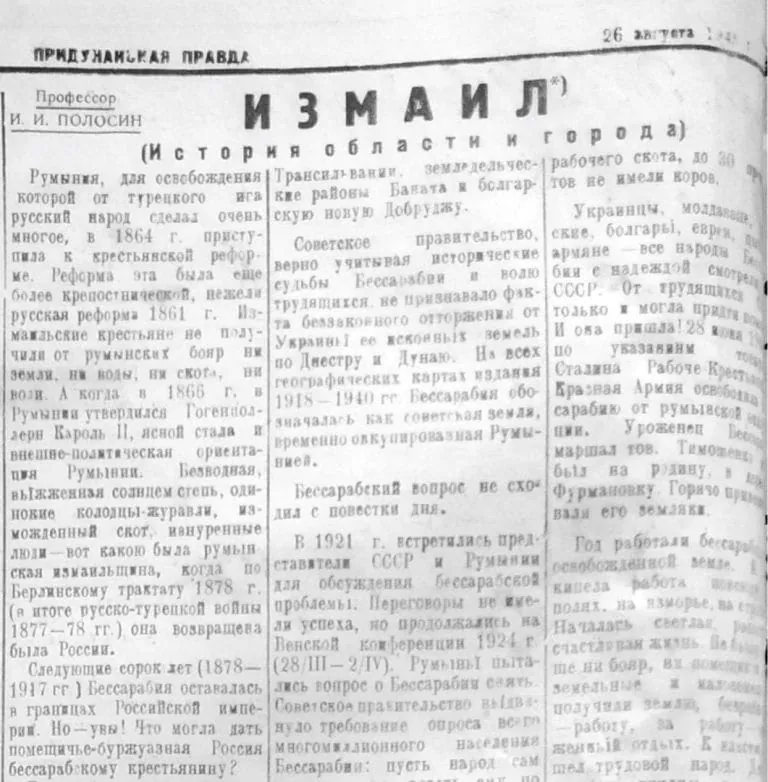
On October 1, 1950, the design for the new monument was published in a local newspaper (a clipping of the article is included in the archival file), which described the sculptural composition as follows: “The total height of the monument is over 13 meters. The bronze sculptural group at the top of the column will be about 6 meters tall. It consists of three figures. The central figure depicts a worker striding forward. Inspired by the great ideas of the Lenin–Stalin Party, he raises high the flag of past and future victories, fluttering in the air, in the struggle for communism and the liberation of oppressed peoples worldwide. This image embodies a call to struggle, determination and courage, strength, and confidence in victory. On the left is the figure of a sailor with a rifle at the ready, standing composed and alert. On the right is the figure of a peasant rising to the struggle.”
Ultimately, limited funds cut the monument’s construction budget to 334,500 karbovanets, leading to design changes. The monument was not completed until 1953, and it was restored in 1974 to mark the uprising’s 50th anniversary. Despite the reinterpretation of the Tatarbunary Uprising, the monument remains the city’s main memorial site.