Donate

Body

Filter by periods:

Primary Sources
Documents (16)

icon
Sofia Rusova’s Memories on Ukrainian People’s Republic
Sofia Rusova's book “My Memories” was published in Lviv in 1937. The extract presented below covers the period of her participation in the Ukrainian Central Rada (representative institution of the political, social, cultural, and professional organizations, later to be the Revolutionary Parliament of Ukraine, that run the Ukrainian National Movement) with a wide range of political life in Ukraine at that time.
Image for Marko Cheremshyna, Short Story “The Invalid”
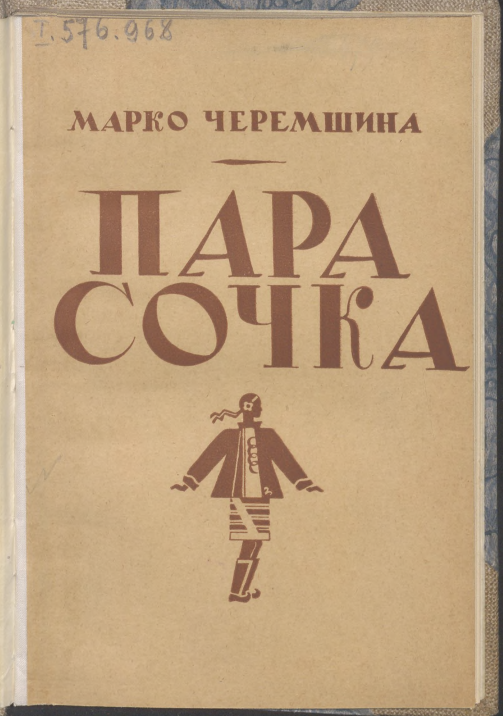
Marko Cheremshyna, Short Story “The Invalid”
This short story by Mark Cheremshyna (real name Ivan Semaniuk; 1874–1927), a Ukrainian writer, lawyer, and Doctor of Law, explores the aftermath of the First World War and the struggles faced by its veterans, all set against the vivid backdrop of Hutsul culture.
icon
Yevhen Ivanychuk’s “Cold Northern Sky”: The Example of Gulag Prose
While research on Gulag memoirs and prose in the West mainly and conventionally focuses on Russian experiences (for instance, 2024 “Gulag Fiction. Labour Camp Literature from Stalin to Putin” by Polly Jones), it generally omits the representation of other experiences connected to the case of nations that were enslaved by Russians. Some of these experiences were represented by Ukrainians, and they could elucidate certain blind spots that the Russian mentality avoids to confess. In this regard, the memoirs by Yevhen Ivanychuk (1927-2003) Kholodne Nebo Pivnochi [“Cold Northern Sky”], which will be analyzed below,  clearly stand out. First published in the journal Dzvin [“Bell”] in 1989, the full text of Ivanychuk’s memoirs first appeared...
Image for Kateryna Biletska’s memoir of life in Lviv in 1943
Kateryna Biletska’s memoir of life in Lviv in 1943
Kateryna Biletska (Kandyba by her first husband), the wife of Oleh Kandyba (known by the literary pseudonym Oleh Olzhych), a poet and member of the Ukrainian nationalist underground, head of the cultural and educational department of the Provid (Leadership) of Ukrainian Nationalists (PUN) and the Revolutionary Tribunal of the Organization of Ukrainian Nationalists (OUN) (1939-1941), wrote her memoirs for decades. She first mentions the idea of writing a memoir in letters to a mutual friend of the Kandybas since the 1950s, Oleh Lashchenko. One of the last surviving memoirs is dated May 1994. She sent some of her memoirs to Lashchenko and wrote that she had more. These memoirs mainly cover the years...
icon
Child maintenance in the Russian Empire
This source concerns a case that was brought to a district court in Veisenshtein (now Paide in Estonia) in the late nineteenth century. The complainant, Lena Izup, was an illiterate Estonian-speaking peasant who worked as a domestic servant. Her complaint lay with Mart Tambok, another Estonian-speaking peasant who she claimed was the father of her child. Lena Izup asked Revel’ District Court to ‘make an order’ against Tambok, which meant force him to acknowledge paternity and pay financial maintenance for the child’s upbringing. The case was heard in September 1890 and Mart was ordered by the court to pay Lena a one-off sum of 15 rubles, plus 10 rubles per year of child...
Image for Attitudes towards “Leninopad” in interview responses of Euromaidan’ participants, 2013-2014
Attitudes towards “Leninopad” in interview responses of Euromaidan’ participants, 2013-2014
The quotes from the interview published here are part of the project "The Voices of Euromaidan in Global Protest and Solidarity Studies". The project focuses on the edited and thematically organized materials from the collection of oral history interviews called "Voices of Resistance and Hope," that were recorded in two stages, the first in December 2013 and the second in February 2014 (more then 100 interviews). They were gathered in the base "Intimate Chronologies of the Euromaidan", which is available on Urban Media Archive website. This collection includes 17 themetical categories. “Leninopad” is one of them. The answers given in this category indicate the attitudes towards Lenin's monuments, to specific forms of urban...
Show more Collapse all

Images (7)

Image for Olha Maria Zhydacek and her husband Hryhoriy Bandurka, Lviv, spring 1939
Olha Maria Zhydacek and her husband Hryhoriy Bandurka, Lviv, spring 1939
This photo is a testimony to a photographic practice popular in the 1930s. It was about making portraits of passers-by on the city streets. Such photos often recorded people in motion in the middle of a large street, and seemed to emphasize the belonging of those depicted characters to urban culture. In view of this, the genre of such photography can be called street portrait, the street and commercial photography. The photo shows the great-grandmother and great-grandfather of Bozhena Pelenska — Olha-Maria Zhydacek and her husband Hryhoriy Bandurka (b. 1899). Based on the Bozhena's memories, the story was recorded of the photograph and of the people in it. The photo was taken on...
Image for Photo of the physical exercises, Lviv, 1927
Photo of the physical exercises, Lviv, 1927
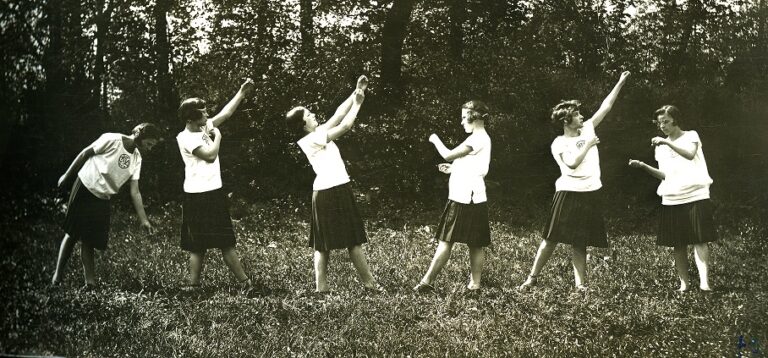
The photo is from Stepan Haiduchok collection. It is one of the series of photos of physical exercises. The format is adjusted to the composition: five women stand in one row and demonstrate the body positions as part of dynamic exercises (bending forward, arm stretching, steps). The static vertical lines of the trees in the background contrast with the movements of women. The expressiveness of the composition is built on tonal and texture contrast. The composition is divided in half by the horizon line. The background of the photos' lower part (grass) has a neutral tone, so the dark skirts and light legs are distinctly presented. Conversely, the background of the upper part...
Image for “Jewish Grandmother”, photo by Lewis Hine
“Jewish Grandmother”, photo by Lewis Hine
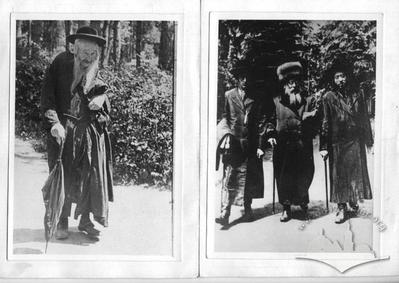
Lewis Hine (1874-1940) was an American photographer who tried to draw attention to social issues such as migration or child labor. He took two series of photos on Ellis Island, an island near New York City that was the first stop and gateway for new arrivals. Photos of Lewis Hine are trying to show the identity of migrants, who were often exoticized and othered in the American press. The Jewish woman in the photo is dressed in clothes that do not distinguish her from other migrants from Eastern Europe. However, although Jewish migration was often also motivated by economic motives, in the public discourse and historiography of the early twentieth century, it was...
Image for “Slavic Mother”, photo by Lewis Hine
“Slavic Mother”, photo by Lewis Hine
Lewis Hine (1874-1940) was an American photographer who tried to draw attention to social issues such as migration or child labor. He took two series of photos on Ellis Island, an island near New York City that was the first stop and gateway for new arrivals. Photos of Lewis Hine are trying to show the identity of migrants, who were often exoticized and othered in the American press. The name of the photo "Slavic Mother" shows that Eastern Europe for Americans was still a space, which differences and nuances they hardly noticed. Hine perceives the woman in the photo as a person who left Europe forever, taking along all her posessions, and having...
Image for Galician Migrants, Quebec, about 1911
Galician Migrants, Quebec, about 1911
The photo shows a group of migrants from Galicia, probably Ukrainians in Canada. Despite the information that before emigration, peasants bought urban clothes, in this photo we see people in traditional attire, which is different from the Canadian environment. Attitude towards Eastern European migrants was arrogant. In particular, clothing would often become the basis for otherness. Thus, the process of successful integration involved “dressing up” in Western clothes. In the photo, we can see a large family, because often the first migrants who were young men and women, later transported their children or older parents.
Image for Advertising leaflet of Zofia Biesiadetska’s bureau
Advertising leaflet of Zofia Biesiadetska’s bureau
Zofia Biesiadetska's office in Oswiecim in Western Galicia was organizing transportation to America. The promotional leaflet offers tickets for steamboats to America and Canada. The transport revolution in the 19th century proved to be one of the most important factors that enabled mass intercontinental migration. Transport was relatively convenient and fast, as well as relatively inexpensive. With the beginning of mass migration, networks of agents developed, like Zofia Biesiedetska's bureau, who helped with the organization of the trip. This facilitated the migration of people from villages or small towns. At the same time, agents were often accused of lack of integrity and profiteering on migrants. Biesiadetska Bureau was one of the most respectable...
Show more Collapse all

Videos (0)

Show more Collapse all

Audio (2)

icon
“Goldene land” (Golden land), song about emigration, 1889
The song was written by a Lithuanian Jewish poet, Eliakum Zunser (1840-1913) based on his own experience of emigrating to the United States. The song "Golden Land" touches on the issue of new migrants, whose high expectations fail. The American city turns out to be a space full of dirt, noise, and poverty. Although jobs are available, they are poorly paid and dangerous to health. America is also not a place of social equality, because like in Europe, there is a disproportion in the distribution of wealth. This is an urban experience that was shared by many Jewish migrants who found work in the textile industry, or like Zunser himself, in the printing...
Image for Song of the Communist Labor Brigades
Song of the Communist Labor Brigades
"Song of Communist Labor Brigades" was written in 1956 by the composer Arkady Filipenko (1912-1983), who, in addition to academic music, wrote works for operettas and films. The verses to the song were written by another outstanding figure of Soviet culture of the Ukrainian SSR, Oleksa Novitsky (1914-1992), who was a military correspondent during the war, and later became a Shevchenko scholar. Both authors had the "right" biographies for writing the anthem of the communist labor brigades, which was performed at official events in the Ukrainian SSR, and was also published in large numbers for performance by professional and amateur groups. The song has a solemn mood and asserts that the communist labor...
Show more Collapse all

Modules (7)

In addressing the causes of unlawful actions committed by high-ranking officials in the 1940s and 1960s, the authorities often attributed them to the lingering influence of pre-revolutionary capitalist mentalities among certain managers. This explanation lost credibility over time, as by the 1970s and 1980s, the leadership consisted largely of individuals born and fully socialized within the Soviet Union, supposedly free from the flaws of other, non-communist societies. In this module, Viktor Krupyna uses unpublished archival materials and available source collections to examine the widespread abuse of power by Soviet officials in the Ukrainian SSR in 1945-1991,  its causes, scope, and consequences.  
The Soviet Union positioned itself as a society of social equality, where the elimination of human exploitation was said to have achieved harmony in class relations. The eradication of social contradictions between the “top” and “bottom” (in Soviet terminology, the “exploiters” and “exploited”) was widely promoted as an indisputable and irreversible achievement of the Soviet state. Yet, this created a paradox: while this ideal was publicly championed, the significant social gap between the people and the so-called “people's power” was a reality that remained unacknowledged. This module by Viktor Krupyna focuses on the financial privileges of the Ukrainian Soviet nomenklatura.
This module by literary scholar Olha Petrenko-Tseunova tells the story of Kateryna Biletska-Kandyba, the wife of Oleh Kandyba (known by the literary pseudonym Oleh Olzhych), a poet and member of the Ukrainian nationalist underground, head of the cultural and educational department of the Leadership of Ukrainian Nationalists (PUN) and the Revolutionary Tribunal of the Organization of Ukrainian Nationalists (OUN) (1939-1941), and her WWII experience and post-war emigration.
The early vision of amateur filmmaking in the Soviet Union was characterized by the pragmatic idea of using the new media not only for entertainment but also to involve a wide range of citizens in the production of newsreels and to create a network of correspondents across the country to cover the construction of socialism. However, despite sporadic attempts, this idea was not immediately implemented on a large scale. The lack of technology and sufficient equipment, and later the political climate of the 1930s, hindered this. It was only after liberalization and Khrushchev's reforms that the idea reappeared on the agenda.
The end of the 19th century through the beginning of the 20th century is known as the period of mass migration from Europe to other continents, when more than 55 million people changed their place of residence. In particular, this process captured the Russian and Austro-Hungarian empires, where a difficult economic situation, job shortages, and persecutions stirred various groups of the population to leave. Such groups included both Ukrainian and Polish peasants, and Jews from urban centers who were small-scale craftsmen or workers. Most often, they moved to the United States, Canada, Argentina, and Brazil, where labor was needed at factories or farms.
The founders of the Soviet Union believed that the basis for new forms of labor was to be an amateur initiative and talents, of which the people have an endless source, managed by “nationwide accounting and control”. The method of introducing new forms of industry management was the widest propaganda of labor achievements. Soviet ideologists habitually cited Lenin who believed that labor could change a human being under socialism and advised how to organize socialist competition. This module by historian Bohdan Shumylovych is devoted to the topic of labor in communist propaganda, using the example of the 1960s.
In the 19th century, the gender pact dividing public and private spheres, as man-owned and women-inhabited, found its most solid reasoning. In this vision, the city as the most obvious embodiment of public life, seemed to be male by default. Women in the city were taken as potentially threatened. This was evidenced by a number of prohibitions, which could include not only certain places inaccessible to women, such as universities in Lviv until the late 1890s, but also ordinary everyday experiences that they could claim only at the cost of their own reputation. In this module, historian Ivanna Cherchovych will try to look at the city from its women's experiences.

Digital stories (1)

У 1950–1960-х роках на підприємствах Радянської України поширилися практики, скеровані на удосконалення праці. Двигуном цього процесу були так звані передовики – учасники руху трудящих СРСР за комуністичне ставлення до праці та за виховання людини комуністичного суспільства.

Reflections

Texts (1)

Image for Verka Serdiuchka and Ukrainian National Identity at Eurovision 2007
Verka Serdiuchka and Ukrainian National Identity at Eurovision 2007
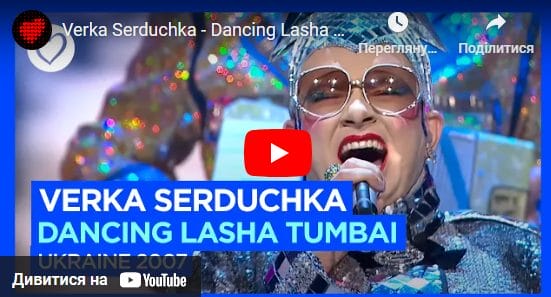
This video is a recording of Verka Serdiuchka’s representation of Ukraine in the Eurovision Song Contest 2007 with the song “Dancing Lasha Tumbai.” Verka Serdiuchka is a drag persona performed by a male Ukrainian comedian, actor and singer Andriy Danylko. The character of Serdiuchka embodies a unique cultural archetype: a strong yet simple post-Soviet woman with Ukrainian rural origins. This is usually reflected in the lyrics, her costume designs and her use of “Surzhyk,” a mixed language combining Ukrainian and Russian elements. Danylko’s persona is often labelled as a "jester", both by nationalist-leaning audiences and in some academic circles (Yekelchyk 2010). Some others refer to it as "drinking songs" with heavy use of...
Show more Collapse all

Podcasts (0)

Show more Collapse all

Videos (0)

Show more Collapse all

Syllabi (19)

The course aims to engage students in a dialogue with different disciplinary frameworks that explore the concepts of sexuality and decoloniality, and their intersection with other epistemic categories. These frameworks, which include anthropology, sociology, gender, queer, and trans* studies, are introduced with attention to and focus on the “decolonial option” as a method and source of knowledge.
This Lesson/Unit plan was developed within the Curriculum Development Project: On Ukraine, organized by the Davis Center, Harvard University in partnership with Alexander Langstaff (New York University), and the Center for Urban History in 2024. The project was intended for middle, high school, or community college educators, living and working in the U.S. The author: Paul R. Huard, Ashland High School (Oregon, USA).
The course invites to explore East-European History of mid XIX - late XX cent. through the concept of mobility, which encompasses movement of people, goods and ideas. Students will deal with a corpus of texts on social history of transportation, as well as with a rich array of visual materials. Of special interest will be cases, specific to the region, for example cultures of Christian and Muslim pilgrimage, Socialist rallies, trolleybus infrastructures or “destalinization” of metro stations. Cases of imported western technologies will provide ground for interregional comparisons, not only in aspects of introduction of transport system, but also in aspects of their exploitation and disintegration. The course is built on a premise...
East-Central Europe played a vital role in the global history of mass migration and experienced an enormous variety of mobility processes in the long 19th and short 20th centuries. For instance, mass emigration from the Russian and Austro-Hungarian Empires and the Soviet Union, human trafficking, labor migration, forced migration during WWI and WWII, refugee crises and asylum, travel, and professional mobility. The voluminous scholarship on this chapter of migration history has lots of gaps and, notably, is almost absent from history curricula. This introductory course broadens our lens to examine the role of migration and mobility for the places where it occurred as well as the experiences of migrants, displaced persons, refugees, and...
The field of social history has achieved the edge of its popularity in 1950-1980s. It was strongly connected with other disciplines, such as economics, demography, sociology, and allowed historians to reach a much wider range of research themes. Since the 1960s, the social history of the Jewish people became important and influential part of the studies. Historians were exploring the possibilities to study Jewish community with new tools and integrating different representatives of Jewish community – workers, women, immigrants, criminals - in a research. Since 1990s historians of Jewish past shifted their interest to cultural studies. However, in the last years, we can see an economic turn, which signifies the search for a...
This course forms a part of Jewish History and Culture of East Central Europe in the 19th-20th Centuries summer school. The syllabus is availible only in Polish.
This course was a part of Jewish History and Culture of East Central Europe in the 19th-20th Centuries summer school. The syllabus is written in Polish.
The course intends to show the possibilities afforded by applying the gender (cultural sex) perspective in the study of Jewish culture. Proceeding from the analysis of the role of the woman and man in traditional Jewish society, we will present gender difference in the process of modernization among Jewish women and men. In looking at autobiographical materials, we will trace characteristic stages and stories, as well as life’s choices of Jewish maskilim (advocates of Haskalah, the Jewish Enlightenment). We will use the examples of the life and work of Pua Rakowska (known as "the Grandmother of Zionism") and Sara Szenirer (reformer of the traditional education system of Jewish girls) to analyze the problem...
This short course looks at Jewish history in the context of two multinational empires: the Russian and the Habsburg. Both of these states must be understood as fundamentally pre-modern, non-national (even anti-national) political structures, a fact that is crucial for understanding Jewish history here. In the mid-19th century, the great majority of world Jewry made its home in this region and even at the end of the First World War, after the great wave of emigration to the Americas, western Europe, Erets Israel / Palestine, and South Africa, the Jewish presence here was considerable. In 1918 even antisemites could hardly imagine a Warsaw, Wilno, Lwów, Odesa (etc.) without Jews.
This course was a part of Jewish History, Multiethnic Past, and Common Heritage: Urban Experience in Eastern Europe summer school (July 13 – August 7, 2015. Center for Urban History. Lviv, Ukraine).
This course was a part of Jewish History, Multiethnic Past, and Common Heritage: Urban Experience in Eastern Europe summer school.
This course forms a part of Jewish History, Multiethnic Past, and Common Heritage: Urban Experience in Eastern Europe summer school. The syllabus is available only in Polish.
This course forms a part of Jewish History, Multiethnic Past, and Common Heritage: Urban Experience in Eastern Europe summer school.
This intensive 5-lecture mini-course (12 academic hours) takes a close look at various urban centers (sometimes the shtetl-like and sometimes the city-like) that shaped Jewish-Polish-Ukrainian cultural encounters that inspired the rising literary figures to explore East European multi-cultural urban legacy and make this legacy central in their creative writing. Students will explore various forms of East European urban culture—a shtetl (Chortkiv and Berdychiv), a provincial center (Chernivtsi and Ternopil), a city (Kyiv), a metropolis with a strong East European diaspora presence (Montreal and New York). This course will provide students with methodological tools at the intersection of the literary and cultural studies, urban studies, and social history.
At the end of the eighteenth century the Russian Empire acquired the largest Jewish population in the world. Although Jews and Christians had lived side by side with one another for over three hundred years in the Polish-Lithuanian Commonwealth, their life-worlds were distinct. The Great War, the Russian Revolution, and the Holocaust radically transformed the Jews of Russia, however, and the distinct culture of Russian-Jewry remains a crucial part of Jewish heritage today.
The course will cover the major development of the East European Jewry from the mid-eighteenth century till the present. More specifically, it will focus on the apparently largest category of modern Jewish history, i.e. modernity itself. The course will start with the discussion of what modernity means in contemporary scholarly discourse, and—more specifically—how it is applied today in historiography of East European Jewry. This introduction will provide a frame for the focus of the course: the analysis of the changing life patters and differing strategies of adopting, rejecting, or negotiating modernity in every-day lives of East European Jews.
This intensive 5-lecture mini-course (12 academic hours) introduces key broad themes that explore modernization and anti-modernization, urbanization and migration, secularization and acculturation and a new stratification of the Jewish society in East Europe. While it looks at the Russian empire and its western borderlands and Austrian Empire and its eastern borderlands, it focuses on Ukraine in its to-date geographical boundaries that include Galicia and Bukovina. The course does not have any prerequisites and provides broad contextualization of the selfimposed and empire-orchestrated reforms within the Jewish society against the backdrop of the Late Imperial Russia and the "long nineteenth century."
The course offers a short introduction to some of the key concepts and literary and cultural practices that shaped the represenations of modern Jewish spaces in Eastern Europe as well as their contemporary reconstructions and exhibitions. While focusing on (Jewish) Poland and Yiddish culture, this course introduces critical tools for understanding and interpreting modern (Jewish) contructions and experiences of space and place.
In 1939, on the eve of the Holocaust, east European Jewry constituted the most important and culturally influential Jewish community in the world. As a result of half a century of mass migration, up to 90% of world Jewry either lived in Eastern Europe or were children of immigrants from there. Jews were particularly prominent in East European cities. In Galicia, for example, Jews constituted a plurality or majority of nearly every major city. (L’viv was an exception, where they made up “only” a quarter of the population.) This course will survey the modern history of this once vital community – social, economic, political, religious and cultural – from the Polish partitions until...