Donate
Quote
Petro Dolhanov, Everyday Life and Violence: The History of the Volhynian Village of Zelenyi Dub During World War II, Reesources.Rerhinking Eastern Europe, Center for Urban History, 29.10.2026
copied

Everyday Life and Violence: The History of the Volhynian Village of Zelenyi Dub During World War II

Publication date 29.10.2026

This module by Petro Dolhanov recounts the events of World War II in the Volyn village of Zelenyi Dub. The author analyzes the testimony of his grandmother, Antonina Huk, contextualizing it and cross-referencing it with other available source materials.

As of 1897, the village of Zelenyi Dub had 17 houses and 130 residents [1]. In the 1930s, this Ukrainian-Polish village was home to 119 Poles and possibly more than 100 Ukrainians [2]. The settlement of Spirnyi Kut and the khutirs of Vertepy, Pasika, and Sadova Hora were adjacent to the village. In Ukrainian and Polish memoirs, these settlements were referred to by different names, though the term “colony” appeared only in Polish residents’ memoirs [3]. During the interwar period, in administrative-territorial terms, the village belonged to the Buderazh gmina in Zdolbuniv powiat, Volhynia voivodeship. It was one of the smallest villages within one of the smallest, entirely rural gminas in one of the smallest counties of the peripheral Volhynian voivodeship [4]. The concept of a “double periphery,” sometimes used in the study of Eastern European history, suggests that these regions were peripheries of states that themselves were on the periphery of Europe. If there were a notion of a five-dimensional periphery, it would certainly apply to the village of Zelenyi Dub: it was on the periphery of the Buderazh gmina, which lay on the periphery of Zdolbuniv powiat, which was on the periphery of Volhynian voivodeship—one of the least developed regions in interwar Poland—which was itself on the periphery of the Second Polish-Lithuanian Commonwealth in Europe.

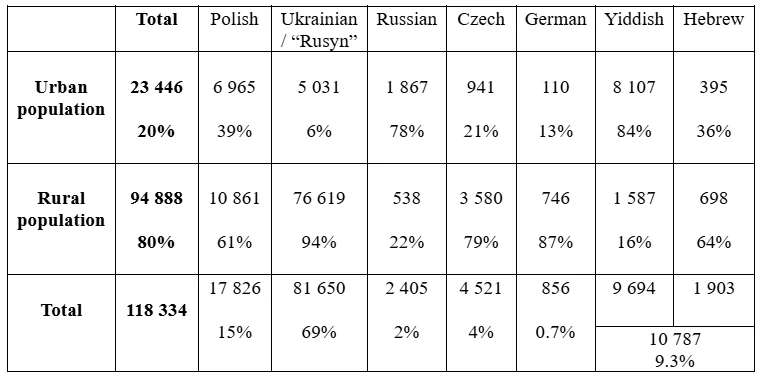
The ethno-demographic structure of Zdolbuniv powiat fully fit the concept of a traditional ethnic borderland. The demographic situation here is best illustrated by data from the 1931 census based on language:


Table 1. Residents of Zdolbuniv powiat by language reported as their native language (based on the 1931 census)[5].

Thus, this was an entirely rural area, predominantly inhabited by Ukrainian peasants. However, there were also Ukrainian-Polish, entirely Polish, and Czech villages. Ethnic Germans lived there at times, but they did not form compact settlements in this area. Neighboring the village of Zelenyi Dub were the Polish or Ukrainian-Polish villages of Hurby, Vilkhava, Kudryn, and Baliarnia. None of these villages exist on the map today—most (except for the remnants of Kudryn) did not survive World War II. A little further away were the Ukrainian villages of Mosty, Borshchivka (Czech), Borshchivka (Ukrainian), and Buderazh (Czech and Ukrainian). Zelenyi Dub was located on the border with the Shumsk gmina of Kremenets powiat, where it neighbored the Ukrainian villages of Peremorivka, Andrushivka, and Ruska Huta. Nearby were also the Polish villages of Stara Huta, Stavchyny, Polske Hutysko, and, a bit further away, the large Polish village of Kuty. The Polish population of Zelenyi Dub attended church in the latter village. Nevertheless, mono-ethnic settlements were almost nonexistent—Ukrainian villages might have had several Polish, Czech, or Jewish families living in them, while Polish, Czech, or Jewish people could be found in Ukrainian villages.

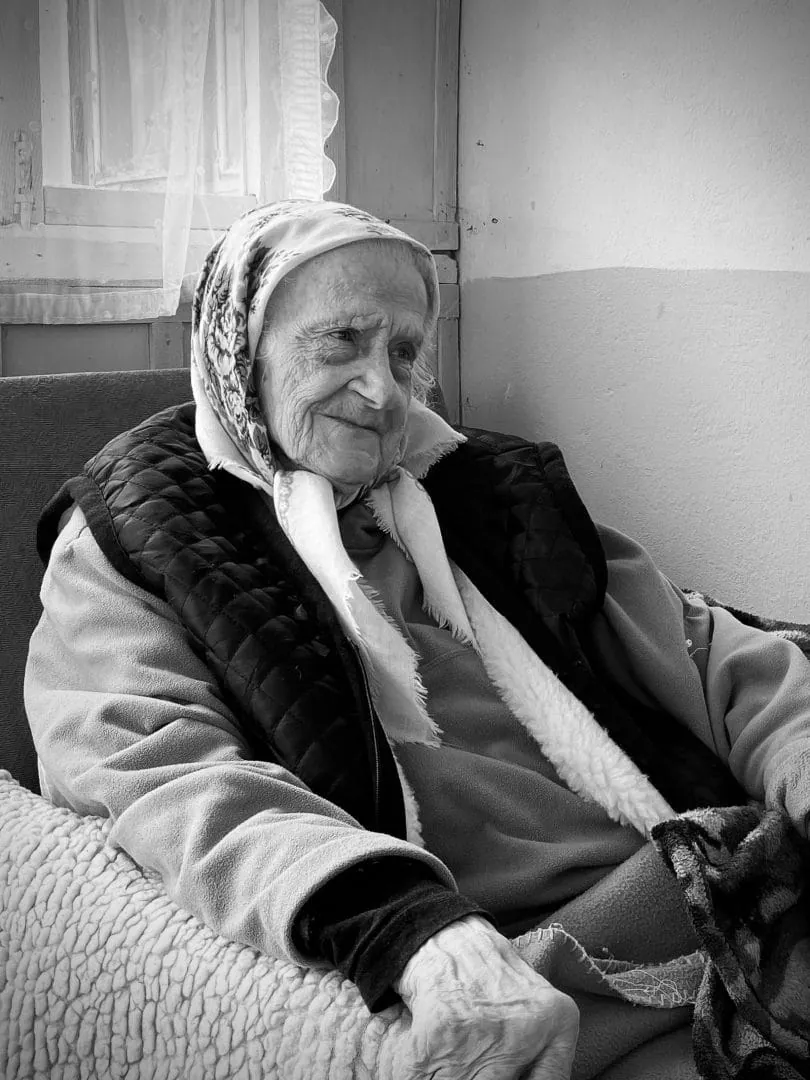
The author of the testimonies analyzed in this text—my grandmother, Antonina Huk (née Antonina Vozniuk)—was born in this area on December 1, 1931. Although she was born in the neighboring village of Ruska Huta rather than Zelenyi Dub, her parents moved to Zelenyi Dub quite early.

A Woman Who Lived Through Four Eras

Antonina Huk lived through four distinct eras: life in a traditional Ukrainian village in interwar Poland, the extreme violence of World War II, the Soviet Era, and independent Ukraine. She never attended school and remained illiterate throughout her life. In this respect, she was no exception but rather a typical representative of many women of her generation. While men in interwar Volhynian villages were already receiving at least a basic education, peasant families often paid little attention to women’s education. According to established gender roles in the traditional rural world, women were expected to be good homemakers. Unfortunately, even interwar Poland could not provide schools for the entire population, so education remained a privilege rather than an obligation.

Nevertheless, Antonina Huk was “literate” in the context of her traditional rural community: she learned all the necessary skills for working the land, caring for livestock, and performing other essential farm tasks from her parents. She acquired this knowledge through what modern schools call the “project-based approach”—absorbing her parents’ experience by working directly in the fields to complete practical tasks. The “scholastic” atmosphere of formal education, detached from reality, was utterly foreign and distant to her.

At that time, children were enlisted as “labor” from a very young age. Because of their importance on the farm and the lack of contraception—even with high infant mortality rates—birth rates were high. Antonina Huk was the youngest of four children: her brothers Pavlo (the eldest) and Mykola, and her older sister Hanna. For rural Volhynia in that era, this was a very small family. By comparison, Antonina Huk’s maternal grandparents—Ivan and Maria Stelmashchuk—had 14 children. Only four survived to adulthood: Kalyna (Antonina’s mother), Kharytyna, Marko, and Khtodon (Teodosii) [6]. The others died of various illnesses in early childhood.

Antonina Huk never knew any language other than Ukrainian. Her experience debunks the myth of absolute multilingualism in the ethnic borderlands. Not all residents knew Ukrainian, Polish, and Yiddish—the languages of the main ethnic groups living nearby. Instead, they knew certain words that allowed for basic communication. Antonina could converse with her Polish neighbors in her Ukrainian-Polish village. According to her, her Polish peers spoke the Ukrainian vernacular well, so she had no need to know Polish. As a child, Antonina also played with Polish children. They had no toys; instead, they played near the forest, built huts from branches, and so on. “We didn’t have those toys; we made our own toys,” Antonina Huk recalled [7]. However, according to her, the adults did not get along very well with the Poles: “The Poles lived next door, so we knew them. Children being children—we played [together]; we didn’t fight. But the older folks, the parents, didn’t get along well with them, with those Poles” [8]. This suggests that interethnic relations in the borderlands may not have been as idyllic as sometimes portrayed. In any community—especially complex, multi-ethnic ones—there is always both cooperation and conflict.

The Nature of Testimonies and Their Character

In this text, I would like to offer several observations on my grandmother’s testimonies, presented here as a source recounting events in Volhynia during World War II and placing them in context with other available sources. I will structure my analysis in three parts: which aspects of Zelenyi Dub’s local history are reflected in these testimonies, which significant events are missing (but actually took place in the village or nearby during World War II), and what may contradict established narratives or information from other sources, as well as why such contradictions exist.

Overall, Antonina Huk’s account of the past does not unfold in a linear fashion. This reflects how memory works: our brains do not recall past events by arranging them chronologically (especially if the narrator never studied such a timeline in school), but rather by forming associations that highlight different aspects in turn. Thus, the testimony opens with stories of first loves and encounters with young men after World War II. The narrator then returns to wartime events, jumps forward again to a later era, and eventually circles back to the war. These recurring returns to the war appear to serve as a metaphor for the trauma of the cataclysm she experienced.

While recording this interview, I initially tried not to influence the flow of the narrative. Later, through follow-up questions, I guided the narrator back to important historical events to gain her perspective. Between 2021 and 2023, I recorded six interviews with my grandmother Antonina. Here, readers are presented with the transcript of the very first and most detailed audio recording. In some cases, the footnotes reference other versions not included in this publication. These references help clarify certain events and details that were omitted or not elaborated upon in the initial recording, either because the narrator forgot to mention them or I, as the interviewer, failed to ask the necessary questions.

I have heard my grandmother’s stories about the war for as long as I can remember, as she often told them. Because of this, the questions I asked during the interview were largely shaped by the dynamics of our shared memories: my post-memory, combined with certain professional knowledge, and my grandmother’s vivid recollections.

The horrors of World War II were forever etched into Antonina Huk’s consciousness and caused deep, lasting trauma. Throughout her life, she expected another war and often repeated: “It’s been a long time since there was a war; surely there will be one soon.” In 1991, as the Soviet Union was collapsing, half a bag of matches and several bags of salt and sugar—the scarcest commodities during World War II—suddenly appeared in Antonina Huk’s home. Fortunately, her fears of a new military catastrophe did not come true at that time. However, the outbreak of the Russo-Ukrainian war did not surprise her; instead, it felt like an unpleasant but inevitable sign that the world had returned to its usual course, where periodic wars are an integral part.

Antonina Huk’s testimony focuses primarily on the events of World War II. It should therefore be read with an awareness of the trauma caused by the violence she endured. It is also important to remember that this period coincided with her childhood (she was nine years old when the “first Soviets” arrived), which gradually transitioned into early adolescence during the war. As a result, she may not have been aware of everything adults said and did at the time. Parents, especially in traditional societies, did not always share their plans and fears with their children. During the war, life-altering dramas unfolded in the forests surrounding the village—events that did not always come to Antonina Huk’s attention but are documented in other sources. I will therefore attempt to briefly reconstruct them to place my grandmother’s testimony in the context of local history.

Another important factor: due to her young age and lack of education, the narrator remained almost entirely uninvolved with any political movements for a long time—including the Ukrainian nationalist movement, which vied for control over the region’s territory and inhabitants. As a result, her testimony reveals very little loyalty to modern political ideologies. Her exposure to Ukrainian nationalism did not involve studying literary Ukrainian, reading political or literary works, forming networks of like-minded people, or nurturing romantic dreams about Ukraine’s national future. This was precisely the path that her peers and slightly older youth in Zdolbuniv powiat often followed to adopt nationalist convictions. Antonina Huk first fully encountered this ideology when she witnessed the mass murder of her Polish neighbors by its adherents. During the burning of Polish houses in Zelenyi Dub, the fire partially spread to the Ukrainian part of the village, destroying the property of Syla Huk—Antonina’s future father-in-law. This is likely why her testimony shows little loyalty to the OUN(b) and the UPA, which, incidentally, she never distinguished between because of her lack of formal education. Her knowledge of history came from lived experience, not from textbooks. She also disliked the Soviet regime, primarily because it took more from people than it gave. Immediately after the war, she saw many people suffering from starvation, and rumors circulated among the villagers blaming the Soviet regime for this.

One of my grandmother’s uncles, Khodon, was drafted into the Red Army during World War II and died in German captivity: “They drove them through the vegetable gardens, and they were so hungry they pulled up beets. They ate them, gnawed on them. They said that the poor guy pulled up a beet, gnawed on it, and when a German hit him, he fell right there with that beet in his hand” [9]. This was yet another trauma of the war that Antonina often spoke about in family conversations. She also “remembered” (which ultimately turned out to be a mistaken assumption) that the Germans killed her brother in the UPA and burned Ukrainian villages. Thus, the Germans and Nazism, as the narrator’s experience suggested, brought nothing good—only violence and hatred: “The Germans destroyed a lot of people; they burned and beat Ukrainians—they didn’t like them” [10]. Consequently, Ukrainian nationalism, communism, and Nazism are all viewed with roughly equal disdain in Antonina Huk’s memory. This is the result of her life experiences, socialization, and exposure to modern ideologies and regimes.

Life in Interwar Poland

Antonina’s parents, Matvii and Kalyna Vozniuk, lived in Ruska Huta, a predominantly Ukrainian village neighboring Zelenyi Dub. During the interwar period, population growth, combined with the region’s underdevelopment and outdated farming methods, led to a shortage of arable land. To feed a single family, at least 3 hectares of land were necessary, though the exact need depended on family size. This shortage was also exacerbated by the uneven redistribution of farmland, which often fueled resentment—especially when a larger share of land was concentrated in Polish hands, giving the issue an interethnic dimension.

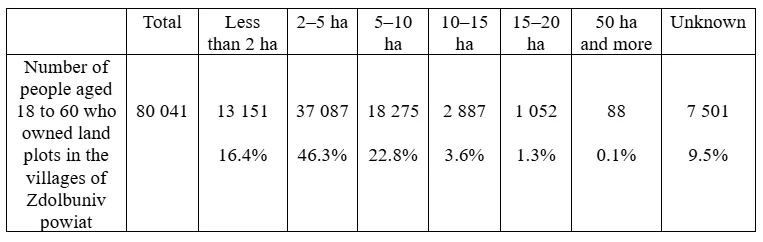
It was likely due to this lack of land that the narrator’s family relocated from Ruska Huta to the smaller village of Zelenyi Dub, which was surrounded by forests and offered more available farmland. Their fellow villager, Hryhorii Valchuk, did the same: after acquiring 3 hectares in Zelenyi Dub, he was able to run a farm, something he could not do in the overpopulated Ruska Huta [11]. The structure of land ownership in Zdolbuniv powiat, according to the 1931 census, is presented in the table below and sheds light on land distribution.

Table 2. Area of land owned by rural residents of Zdolbuniv powiat (results of the 1931 census) [12]

Jan Vereshchynskyi, a Polish resident of Zelenyi Dub, recalled in his memoirs that his family owned 13.5 hectares of land, placing them among the 3.6% of Zdolbuniv powiat residents who held large tracts of 10 to 15 hectares. He emphasized that cultivating such a large area required significant effort: “…with the agricultural technology of the time, it demanded grueling labor from our parents, in which the older children also actively participated” [13]. In other words, no one lived a noble lifestyle here—even the wealthier peasants had to work hard. Feliks Jasinski, from the village of Kuty, wrote in his memoirs that “the residents of this village (that is, Zelenyi Dub, P.D.) were wealthier than others” [14]. This likely explains why some residents of overpopulated neighboring villages sought a better life in Zelenyi Dub.

Some Ukrainians in Zelenyi Dub also lived “wealthier.” After World War II, Antonina Vozniuk married Petro Huk from a significantly wealthier Ukrainian family in Zelenyi Dub, which, before the war, had even owned its own oil mill and several hectares of arable land. This family lived next to the Vereshchynskyis’ estate. Residents of neighboring villages would come to Syla Huk’s home to have oil pressed—one of the key products that substituted for animal fats during Christian fasts, which were observed more strictly in those days. Syla Huk’s family lost most of their property in 1943. 

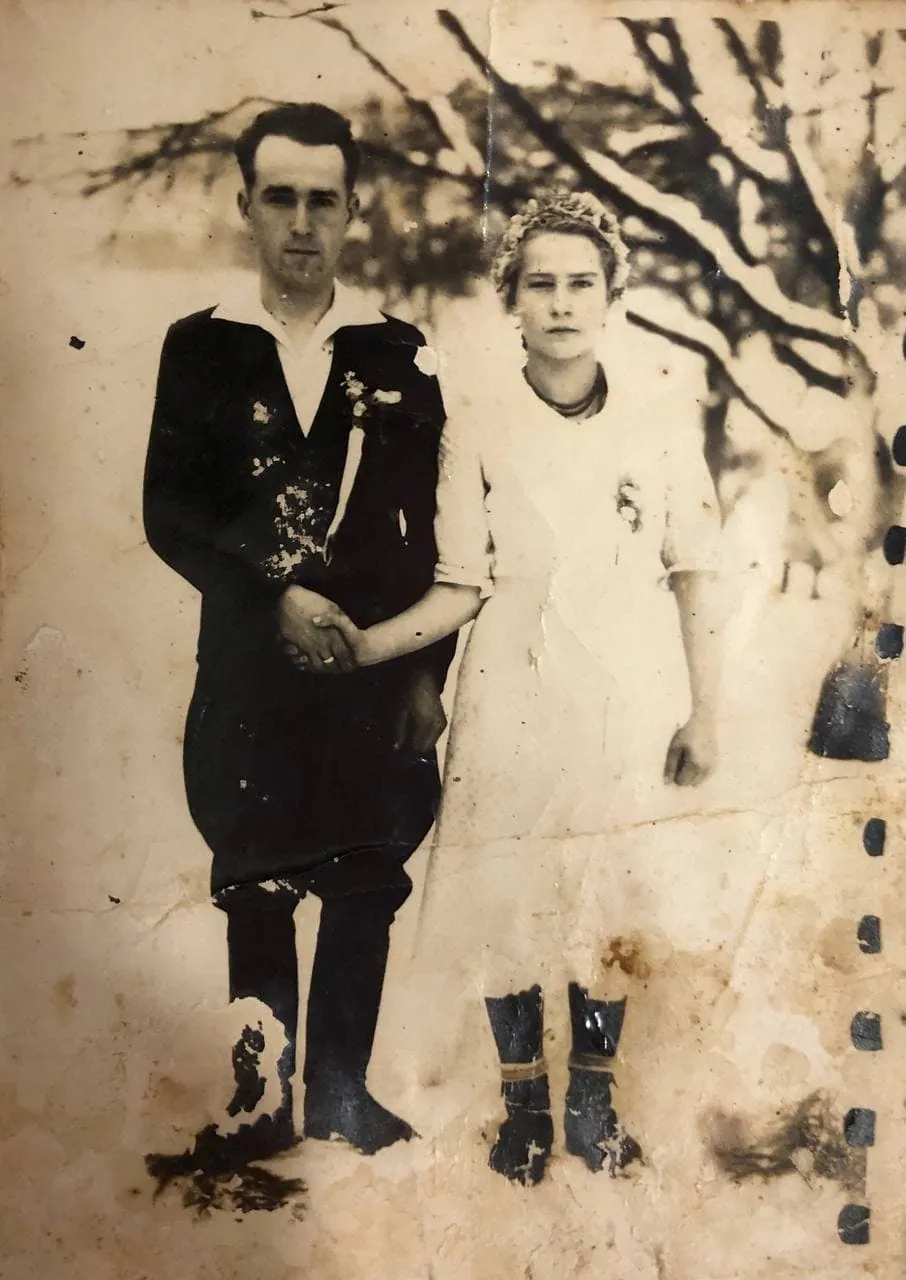
When the UPA was killing Polish villagers and burning their houses, the fire—apparently carried by the wind—spread to the Ukrainian part of the village. As a result, Syla’s three sons—Petro, Anastasii, and Savatii—had to find wives who already owned homes. Was the marriage between Antonina Vozniuk and Petro Huk dictated by rational calculation? Perhaps, in part. Throughout her life, Antonina Huk often recalled how Petro Huk had initially courted her sister Hanna, who, in her words, was more attractive. Nevertheless, he chose Antonina, who demonstrated far greater domestic skills and diligence. He needed a good “housewife,” and she needed a husband with the right skills and experience in farming. That is how they found each other. This does not mean there was no love at all, but in a traditional world where people had to work hard, love took on a unique character. It is striking that these young people chose each other on their own, rather than marrying at their parents’ behest—a significant innovation in the rural world compared to the previous century.

Historical Eras Reflected in the Testimonies. “The First Soviets.”

I will briefly focus on my grandmother’s recollections of the different historical periods she lived through. Because she was so young at the time, Antonina Huk remembers very little about interwar Poland. She recalls playing with neighborhood children but does not remember anything specific about the country itself. Having never attended school, she was poorly socialized with the Second Polish Republic and knew almost nothing about it from personal experience. Nor does she remember the “first Soviets”—the arrival of Soviet rule and its policies in 1939–1941. At that time, the Buderazh and Mizoch gminas were merged into a single Mizoch district within Rivne oblast. These administrative and territorial changes would remain in place, at least in part, throughout World War II.

Another resident of Zelenyi Dub, Ambrozy Vereshchynskyi, recalls this period: “…Ukrainians and Jews enthusiastically welcomed the Red Army’s entry into our territory. As it later turned out, they were mostly spies and informants working against the Poles. They compiled lists for the NKVD of which Poles were to be sent into exile” [15]. Such memories are typical among members of various ethnic groups who, when faced with totalitarian violence, withdrew into themselves and their own suffering. Both Jews and Ukrainians also suffered greatly under Soviet rule. Ukrainian memoirs often state that they were, in fact, the primary victims of Soviet policies.

Ambrozy recalls that his family was saved from dispossession and deportation to Siberia thanks to a bribe the Vereshchynskyis gave to the Soviet authorities through the village headman, For Huk—the brother of Syla Huk (the father of the narrator’s future husband). The fact that For Huk served as the village head is confirmed in one of Antonina Huk’s later testimonies [16]. However, she knows nothing about his ability to influence who was included on lists of those subject to dispossession.

The Beginning of the German Occupation and the Holocaust

The testimonies presented here contain perhaps the most information about the period of the German occupation. Paradoxically, Antonina Huk states that she hardly ever encountered Germans in person—she only saw them from several kilometers away while watching German troops move through the village of Andrushivka:

I only ever saw the Germans when they were passing by. They’d ride these big motorcycles—the ones with guns. So we’d run out to this little hill—where Sergei lived, and there was a girl named Nastia, they called her “Doysykha” because she was from Moshchanytsia. We’d run out there and watch as the Germans rode from Peremorivka to Andrushivka [17].

Jan Vereshchynskyi also described these events from a Polish perspective:

On June 25, in the town of Andrushivka, about 3 km from Zelenyi Dub, German troops were moving toward Surazh and on to Ostroh on the Horyn, toward the former Polish border. Ukrainians from all directions gathered to greet their allies…

They traveled at regular intervals, maintaining the established order. First came a group of motorcyclists, followed by small vehicles carrying soldiers armed with machine guns, who continued to tow heavy vehicles with machine guns mounted on their cabs… Ukrainian girls presented the soldiers with flowers; joy and euphoria reigned [18].

In general, in the villages of Volhynia, the Germans were often greeted with flowers, bread, and salt. Special wooden structures were even erected for official welcoming ceremonies. Later, Antonina Huk learned about German policies mainly through hearsay, as she did not see representatives of the occupying authorities in person. Under German occupation, the village of Zelenyi Dub remained part of the Mizoch district. However, the German authorities abolished Rivne oblast, which had been established by the Soviet regime, and incorporated the Mizoch district into Zdolbuniv gebiet (district), which became part of Rivne gebiet in 1943. Interestingly, news of German policy specifics reached Zelenyi Dub much more quickly from the neighboring town of Shumsk (about 18 km away) than from the more distant Mizoch (about 25 km), which served as the administrative center. Zelenyi Dub would remain closely tied to events in Shumsk well into the 1990s, even though it continued to fall under the administrative jurisdiction of Mizoch and Zdolbuniv.

Because of these ties to Shumsk, Antonina Huk recalls in her testimony that the events of the Holocaust took place there, rather than in Mizoch: “And when the war was going on, they said, they set up these ghettos for the Jews [zhydy—tr.note] in Shumsk. They set up these ghettos, and they herded them there—those poor Jews. They herded them into those ghettos, herded them. That’s what my parents told me. Then they dug a trench and lined them up over that trench, mowed them down with a machine gun—they all fell into it. And they covered them with earth. After they were buried under the earth, the ground kept moving for three or four days… I don’t know exactly who was shooting. Ukrainians, they said. Ukrainians were shooting Jews. They were exterminating Jews and Poles” [19].

The narrator uses the word “Zhydy” rather than “Jews,” as was common in the interwar Polish discourse she knew. At that time, this term (still used in modern Polish) was not considered discriminatory. The claim that “the ground kept moving for three or four days” is a widespread folkloric motif found in many regions of Ukraine. In this way, villagers often dramatized the events of the mass murder of the Jewish population in their stories. Moreover, in some cases, individuals—especially children—may indeed have been buried alive, as documented in many records.

One analytical comment should be added to Antonina Huk’s testimony: the narrator erroneously claims that “Ukrainians shot Jews.” While Ukrainians serving in the auxiliary police did participate in some shootings of Jews, the events described by Antonina Huk took place on August 13, 1942, when the Germans liquidated the Shumsk ghetto. The shootings were carried out by Germans from an SD unit based in Rivne, with the assistance of the German Shumsk gendarmerie and officers of the Shumsk District Auxiliary Police [20]. In other words, this violence was initiated by the Nazi occupation authorities. Why, then, did the narrator believe Ukrainians committed these murders? Several explanations are possible, though it is unclear which is most plausible. One factor may be the popular Soviet narrative about “Ukrainian-German nationalists” as accomplices in these crimes—a view widespread in the postwar years, which Antonina Huk may have heard from others, since she did not watch much television or read newspapers. This narrative could have overlapped with her own experiences related to the Ukrainian nationalist underground, which unfolded before her eyes. She may also have heard about or encountered the auxiliary police, which in the Mizoch district until March 1943 consisted almost exclusively of ethnic Ukrainians. At the same time, Antonina Huk practically never encountered Germans throughout the war. From her perspective, their crimes and policies may have seemed distant and intangible. The face of occupation policy was the local people working in district administrations and village police forces.

Antonina Huk would return once more to the story of the liquidation of the Shumsk ghetto at the end of her testimony:

– And you were talking about Shumsk. After the war, where they shot those Jews—was there anything there? Did they put up a monument or something?

– I don’t know. There were monuments there, because when I used to walk with Nadia—when I went to visit her—we’d walk from work past the Jewish graves, right there, and there were monuments…

– Graves.

– …for Jews, on Jewish graves.

– Mm-hmm.

– There were some.

– Where they shot people?

– What?

– Well, [those graves were] where they were shot.

– Yes. Well, there, where they were shot [21].

These words reveal confusion between the Jewish cemetery in Shumsk and the actual site where the town’s Jews were shot during the ghetto’s liquidation. In reality, the shooting did not occur at the Jewish cemetery, but near one of the Christian cemeteries [22]. This confusion is common among the non-Jewish population today: people tend to conflate traditional cemeteries, where Jews were buried before the war, with the sites of mass shootings during the Holocaust. This conflation inadvertently erases centuries of coexistence with Jews, as evidenced by the preserved cemeteries. By transforming them into sites of mass murder, collective memory reduces the history of Ukrainian-Jewish relations to nothing more than their tragic culmination—the events of the Holocaust.

Volhynia ’43

In her testimony, Antonina Huk focused most on the killings of the Polish population. In Zelenyi Dub, this likely occurred in two waves: the first attack took place in early June 1943.

This was a reactive response by the UPA to an attack by the Germans and the Polish auxiliary police on the village of Derman, during which part of the village was burned down and dozens of Ukrainian residents were killed. At that time, UPA fighters burned down Hurby, Kudryn, Kamintsi, and part of Zelenyi Dub. Mykola Androshchuk, the former commandant of the Mizoch Auxiliary Police and then head of the UPA field gendarmerie, left the following account: “In retaliation against the Poles, who had acted so brazenly in Zaluzhzhia, both detachments burned down exclusively Polish settlements on their way back, including Hurby, Kudryn, Kamintsi, part of Zelenyi Dub, and the surrounding khutirs in the Mizoch district.” [23]. 

German documents confirm that the Polish Schutzmannschaft did indeed exceed its authority and committed acts of violence against the Ukrainian civilian population. Rumors among Polish police officers about violence against Poles in neighboring districts likely played a role. In response to this action, the UPA decided to punish the easiest targets—the Polish civilian population living in Hurby, Kudryn, Kamintsi, and Zelenyi Dub.

Of course, this served as a trigger that influenced the dynamics of the conflict, which had been unfolding throughout Volhynia since March 1943, but it was not the cause of these events. One of the direct perpetrators may have been a unit of the OUN Security Service led by district commander Trokhym Lukashyvech Lachman (born in 1920 in Derman 1). The operatives under his command were Mykola Kupriyanovych Martyniuk (born in 1918, from Derman 1), Oleksii Mykytovych Spychak (born in 1909, from Derman 1), and Mykola Naumovych Halaburda (born in 1923, from Derman 1) [24]. These names appear in historical documentary sources related to the burning of Hurby.

Mykola Androshchuk also wrote in his memoirs: “On May 29, the Germans concentrated a large number of troops and conducted a raid on the Verkhivskyi, Derman, and Novomalynskyi forests. At that time, Commander Eney was in the forest with a detachment led by Chornomorets and Zalizniak. Chornomorets already had three chotas [platoon—tr.note]—a full company of soldiers—while Zalizniak had two chotas” [25]. These memoirs indicate that during the German operation, the commander of the UPA’s southern group, “Bohun”—“Eney” (Petro Oliinyk)—was at the Zaluzhzhia khutir near Derman and had the authority to decide on a retaliatory operation. The memoirs also mention the lower-level commanders of two UPA units likely involved in the attack—the “Chornomorets” company (led by Yevhen Basiuk) and the “Zalizniak” company (led by Volodymyr Vynohorodskyi). The core of the latter unit consisted of members of the Mizoch district Schutzmannschaft, who on October 13, 1942, participated in the liquidation of the Mizoch ghetto. Their commander, Volodymyr Vynohorodskyi, was then the commandant of the Mizoch district Schutzmannschaft. Thus, these men already had experience with violence against civilian populations.

Jerzy Jelenkowski, citing the memoirs of Irena Hayovnychek, asserts that the attack on Hurby took place on June 4, 1943 [26]. Feliks Jasinski, citing other sources, mentions June 5, 1943 [27]. According to him, of all four settlements (Hurby, Kudryn, Kamintsi, and Zelenyi Dub), only Hurby had the potential to organize a self-defense unit, but the villagers never made use of it. In the 1930s, an organization called “Strilets” operated in Hurby, led by D. Lapinskyi [28]. However, some of their weapons had already been confiscated by the Soviet authorities in 1939–1941. Additionally, “Jew hunters”—local Germans (so-called “Volksdeutsche”) named Hreber and Ihnatovych—frequently visited Hurby from Mizoch. They were notorious for tracking down and killing surviving Jews hiding in the surrounding forests. Notably, they uncovered a hiding place in the “Bednarka” tract where several Jews stayed. Most were killed with the help of German gendarmes from Mizoch named Otto and Gustav Gille [29]. These thorough searches for Jews also led to constant raids among the Poles of Hurby, which literally disarmed them on the eve of the UPA attack. One of these local Germans or Polish residents informed the German gendarmerie in Mizoch that the Stankevych family from Hurby possessed a revolver: “A gendarme arrived, threatened Stankevych, who confessed and handed over the revolver, and the gendarme shot him on the spot” [30].

According to Jasinski, because they were under constant German pressure, former members of “Strilets” did not keep their weapons ready but hid them away. Therefore, we know nothing about any possible resistance from Hurby residents during the UPA attack in early June 1943. Another reason for the lack of resistance may have been a degree of trust in local Ukrainian residents, who had promised not to attack Hurby or Zelenyi Dub. Thus, the Holocaust became another indirect factor influencing the dynamics of violence by disarming the Polish residents of Hurby.

However, it is likely that not all Polish settlements in Zelenyi Dub were destroyed during the June attack. Ambrozy and Jan Vereshchynskyi provided accounts of the final burning of the Poles and the Polish part of Zelenyi Dub [31], citing the date of July 3, 1943. On that day, most residents of Polish origin were herded into the Vereshchynskyis’ barn and set on fire.

Antonina Huk recounts these same events from her perspective:

There was this barn—a Polish barn. They herded them inside and set it on fire. The Poles burned—they were buried right there behind the store. I ran over there with that Polish girl I mentioned earlier—the one with the little one, about my age—and someone yelled at us, “Get out of here, or the same thing will happen to you right now.” [32]

For a short time, Antonina’s family helped a Polish woman who had survived, whose name was also Antonina:

There was a woman whose house was near ours in Zelenyi Dub. Her name was Antoshka, just like mine. She was about my age and had a little girl who suffered from a terrible cough—they said it was whooping cough. She had nowhere to stay with her kid, nowhere to spend the night in Vyshky—no one would take them in, because whenever the little one coughed, people would hear.  Back then, the Soviets were patrolling through Verkhovtsi, and the banderites might hear them and kill them. So she was afraid, and she spent nights with us, with her little girl. [33]

The woman mentioned by the narrator could have been Antonina Yasinska, the cousin of Jan and Ambrozy Vereshchynskyi [34]. The child who had whooping cough was most likely not hers, but that of another Polish woman from the village of Zelenyi Dub named Krayevska. Antonina Yasinska probably helped care for the child, since Krayevska had two children, and both of them were fortunate enough to survive the attack that took place in July 1943.

Antonina Huk recalls witnessing the murder of one of the Polish men during this attack: “There was this one Pole, a man, out in our garden—back at home, in the garden—there was a linden tree, and the poor man climbed up thinking he could hide there. But they found him and killed him right up in that tree. He climbed up that linden tree… That’s how it was.” [35].

This was likely Lukash Vereshchynskyi. Ambrozy Vereshchynskyi, who managed to escape the attackers, also described his death: “For a moment, I glanced toward the gunfire and saw an older man—our cousin Lukash Vereshchynskyi—running away, with the banderites chasing him and shooting at him, and at me as well, because he was running in my direction. Fortunately, I had moved to a relatively safe distance and lay down in the stubble, as I was very tired. As it turned out later, that poor Lukash, utterly exhausted, collapsed, and the bandits killed him right there.” [36]

This attack on the Poles of Zelenyi Dub was the result of one of the most intense waves of UPA attacks on Polish villages in Volhynia, ongoing since late June. Mykola Androshchuk, the head of the UPA field gendarmerie, also left his recollections: “At that time, UPA commander Klym Savur was in the south. Following his orders, on the night of June 29–30—exactly two years after the proclamation of independence in Lviv—the UPA launched a large-scale operation against the remaining Polish settlements. Alongside UPA units, all local combat groups in the area participated. That night, commanders Savur and Eney were at the Bushchany khutirs, observing from a high mound as fires burned across the region—a sign of protest against all foreign invaders encroaching on Ukrainian freedom and land.” [37]

A significant number of Polish residents who survived fled to Shumsk, Mizoch, and Soviet partisan units. Feliks Jasinski testified: “Residents from Khynivka, Kurdyn, Mosty II, and partly from Stara Huta and Zelenyi Dub fled to this town (Mizoch—author’s note) and settled there in empty Jewish houses” [38]. Vinsentii Romanovskyi, who witnessed the attacks on Polish villages, also confirmed the flight of many Polish refugees to Mizoch and their settlement in former Jewish homes [39].

Other Polish residents fled to areas near the village of Teremne, where Anton Odukha’s Soviet partisan detachment was stationed. Quite a few of them also perished on July 25–26, 1943, as a result of an attack by UPA units on the Mykhailov Detachment. Maksym Skorupskyi participated in this attack on behalf of the UPA. He described the circumstances as follows: “After dinner, the sotnyks and chota commanders were called to a starshyna meeting. Kurin commander Osyp spread a detailed topographic map on the table and began outlining the planned operation for the next day. It was then that I learned the precise details. On a high point in the Surazh Forest, not far from the village of Teremne (Shumsk District), there was a camp of Soviet partisans. The garrison consisted of 200 Bolsheviks and about 300 Poles with their families, who had fled from nearby villages. The Soviets and some Poles were well-armed, with rifle positions dug around the camp. By their presence, the Soviet partisans had paralyzed UPA communications and plagued the surrounding villages.” [40] In this testimony, Skorupskyi acknowledged that the Soviet partisan detachment included not only Polish fighters but also many families who had fled the surrounding villages.

The murder of the Poles affected the fate of surviving Jews, who had received help from them while living near Zelenyi Dub. Antonina Huk knew practically nothing about these events, which is why she does not mention them in her memoirs. For example, Yona Oliker, a member of the local Jewish community who survived the liquidation of the Mizoch ghetto and was hiding in the forest near Zelenyi Dub, left some desperate recollections: “In Zelenyi Dub, Poles were burned in a barn. The Zelinskyi family, with whom I had been hiding for some time, fled into the forest. I saw them at the home of a Ukrainian family, where the Zelinskyis would come at night to bake bread. Once, they shared some bread with me, but I never saw them again after that. Our situation kept getting worse. Ukrainians were killing Jews, and we could no longer turn to the Poles for help, because they, too, were terrified by the banderites and hiding in the forests. No one was bringing us food anymore.” [41] 

To be fair, not only Ukrainians but also local Poles sometimes killed Jews: the Polish Omanskyi family in Baliarnia killed the parents of the partisan Itzhak Wasserman [42], and the Polish police in Mizoch killed a Jewish boy hiding from the Germans [43]. However, Jan [44] and Ambrozy Vereshchynskyi [45] recall in their memoirs how someone—presumably one of their Ukrainian fellow villagers—was involved in the deaths of 5–7 Jews hiding near Zelenyi Dub. This took place in a ravine near the dirt road leading to Andrushivka, which runs along the entrance to Zelenyi Dub from Kamintsi and Hurby. One of the many unmarked graves of countless Jewish victims is likely located somewhere there. Meir’s mother, Feiha Weltfreund, may be buried there. Meir often visited the Polish Petrovskyi family at their farmstead in Kamintsi, not far from the place the Vereshchynskyis described. Weltfreund described his mother’s death as follows: “They were sitting in a pit; the Ukrainians came, seized them in that pit, and killed them there. They drew their weapons and killed them in that pit, and the boy was wounded in that pit” [46]. He knew this story from the accounts of one of the surviving eyewitnesses. Weltfreund was a prisoner of the Mizoch ghetto who survived its liquidation. Unfortunately, for obvious reasons, he does not remember exactly where this happened. At the site of his mother’s death, Meir erected a makeshift memorial from a birch trunk, carving the name “Feiha” into it.

Antonina Huk never spoke of this story, and it is doubtful she even knew about it. Her house was on the outskirts of the village, in the Pasika khutir, and as a teenager, she was not always aware of all the rumors circulating there.

It is unlikely that most Ukrainians or Poles were involved in these murders of Jews. In fact, as the violence escalated, even fewer Poles and Ukrainians were willing to help Jews. As Polish residents went into hiding and fled to neighboring towns, Ukrainian villagers grew increasingly fearful of sheltering anyone from outside their community, prioritizing their own families and survival. No one benefited from such violence.

Antonina’s older brother, Mykola Vozniuk, was also caught up in these events. By the summer of 1943, mobilization efforts were underway throughout the Mizoch district and wider Volhynia, with the UPA calling up young men for service. Mykola Vozniuk was among those mobilized:

Still just a kid—so young. … We’d haul sheaves to the barn on a cart. Dad would be stacking them in the corner, I’d hand them up to him, and Mykola would unload them from the cart. … Then this fellow comes over … and says, “Mykola, the guys are calling for you.” So Mykola goes, since they called him. He comes back and says, “They told me to go with them. To go with them.” Dad started crying, Mom started crying: “Son, you’re done for. You’re already done for.” And Mykola says, “I’m done for either way. But if I don’t go, the whole family will be lost.” He said, “So, I have to go. I don’t have a choice.” [47].

The narrator noted that Mykola Vozniuk justified joining the UPA out of fear for his family’s safety. It is worth mentioning, however, that as of 1943, sources from this region do not record any cases of entire families being punished for evading military service. Such situations tended to involve coercion, but not the murder of all family members of those who refused to serve. It is possible that my grandmother’s memory was influenced by later recollections of punishments imposed by the OUN Security Service (SB) on families whose members collaborated with Soviet authorities. Numerous accounts of such actions by the OUN Security Service in the Mizoch district have been preserved in the sources.

Mykola Vozniuk did not serve long in the UPA. Throughout her life, my grandmother Antonina told how her brother Mykola was killed by the Germans near Zaluzhzhia, not far from Shumsk:

But when the banderites took my brother—after he’d been wounded by the Germans, when they were burning Zaluzhzhia—they took him to Shumsk. He dug his own grave, and they shot him and buried him there. That woman, she lived right next door and saw it all. She told the story—this was before cell phones, of course—she said: “Tell Matvii to come, to bring a netski, to bring a netski here and to come see me.” She wanted to say “bring a coffin,” but didn’t know the word, so she just said, “Let him bring the netski and come over, and I’ll tell him something.” 

The Germans were burning Zaluzhzhia, set up an ambush there, and that’s where my brother was wounded. That’s how he was killed in Shumsk [48].

According to her account, Antonina Yasinska, who had found refuge in Shumsk at that time, later tried to convey the news of Mykola’s death to the Vozniuk family: She wanted to say “bring a coffin,” but didn’t know the word, so she just said, “Let him bring the netski and come over, and I’ll tell him something.” [49]. “Nochvy,” the dialect term “netski,” referred to a trough carved from a solid piece of wood—rectangular or boat-shaped—used for bathing children, washing laundry, sifting flour, mixing dough, chopping vegetables and herbs, and winnowing grain and cereals. Given their shape, they could resemble a coffin, which is why Antonina, a Polish woman, used this word to convey a secret message to Matvii Vozniuk. However, the Vozniuk family did not immediately understand the code. In any case, they would not have dared to travel to Shumsk at that time. In 1943, travel to regional centers was extremely dangerous. The route ran through forests where the UPA and Soviet partisans clashed, and any traveler could have ended up caught in the crossfire or under suspicion.

As it turned out from the testimonies of Jan and Ambrozy Vereshchynskyi, who were in Shumsk at the time along with Antonina Yasinska, Mykola Vozniuk most likely did not die at the hands of the Germans. He was killed by Polish self-defense forces or auxiliary police from Shumsk during a UPA attack on the Polish part of Zaluzhzhia. Mykola Vozniuk was likely involved in this attack, where he was wounded and lost his life. Antonina Huk only learned this story from me after 2023, when I finished recording her testimonies. That was when I met Elzbieta Kwiecinska and received the Vereshchynskyis’ recollections, which clarified the circumstances of Mykola’s death. I don’t know if my grandmother was able to process these new facts or incorporate them into the narrative she had told all her life. Probably not—I never heard her reflect on this topic. By then, she was over 92 years old—likely too late to reconsider the past, which still haunted her.

Financial Compensation from the UPA

The Vozniuks received financial compensation from the UPA for their murdered family member. They were permitted to go to the Kaminets khutir and take some of the abandoned Polish property. This theme recurs in one of the later versions of the audio testimonies I recorded with my grandmother:

When the Poles were being driven out, Dad went over to Kamintsi [Kamyky—note by P.D.]. They said Polish property had been left behind because the Poles had fled and abandoned their pigs and chickens. Dad went with a cart and brought back two boars—so large they filled the whole cart—along with chickens and a cow, which he tied to the cart. The cow, named Sandal, was black with white stripes and huge. He brought them home, having taken some of their property, because he was entitled to do so—his son had joined the Bandera followers and died. So Dad already had access everywhere; he took things [50].

In this version of her testimony, Antonina Huk mentioned that their family had also received two Polish wardrobes, one of which she received as part of her dowry when she and her husband moved into their newly built house.

Antonina Huk does not recount specific stories about how the UPA used the property of killed Poles and fugitives, as she likely knew little about it. The UPA used the houses of former Polish owners that had not been burned for military purposes, quartering fighters there. In Zelenyi Dub, members of the UPA’s field gendarmerie lived in former Polish homes. One gendarmerie officer, Maksym Kruhlyk, left the following testimony: “…all four of us went to Zelenyi Dub to a house where Poles had previously lived; by the time we arrived, the Poles [had] been killed by a UPA gang. The next day, ‘Yastrub’ arrived and announced that, due to the influx of ‘Vlasivtsi’ and a shortage of gendarmes, we were to serve as gendarmes” [51]. Their role was to capture deserters and deliver them to the penal company. There may have been another function that Kruhlyk did not mention to Soviet investigators—executions of former employees of Soviet institutions. At least, such information regarding the functions of the UPA field gendarmerie in the Mizoch District appeared in quarterly reports from the district department of the NKVD [52].

According to Mykola Androshchuk, a UPA hospital was housed in the building of the Polish elementary school in Kudryn [53]. During the interwar period, Polish children from Hurby, Kamintsi, and Vilkhava attended this school [54].

Since the burning of the Polish part of Zelenyi Dub took place in July 1943, the harvest remained in the fields after the victims were killed. The UPA’s economic department decided to confiscate and gather it for military needs, mobilizing local villagers to participate in the harvest. The process was overseen by Fedir Markovych Halych (pseudonym “Nechai”), an economic officer from Derman 2 [55]. The harvest itself was directly overseen by Roman Semenovych Rudyi-Kravchuk (born 1915, a graduate of teachers’ college), a resident of Derman 1, who later worked as a statistician for the UPA’s economic department [56]. According to Rudyi-Kravchuk, in August and September 1943 alone, approximately 50 metric tons of former Polish grain were procured for the UPA [57]. It was transported to underground hideouts and later used to supply the UPA with food.

Under the Second Soviet Occupation

Part of the testimony focuses on the second Soviet occupation. In particular, the grandmother recounts a distant relative, Hryhorii Valchuk, who worked as a logistics officer for the UPA in the village of Zelenyi Dub:

… he was Grandpa Matvii’s brother-in-law, you know. He used to supply the banderites with food. … he had a Bandera hideout in his garden, with a secret passage that led right into his shed. Oh, yes, the passage went straight into the shed. So Ryhorko [short form for Hryhorii—tr.note] would bring them food. He’d go to the mill for flour, and for wild boars, too. Those banderites would go out at night, hunt wild boars, bring one back, and then Ryhorko’s wife—Kalyna, they called her Kalinka—she’d already be baking and cooking for them while the banderites sat in the hideout. [58].

This testimony is corroborated by materials from the Soviet criminal investigation file on Hryhorii Valchuk. On January 12, 1948, he was arrested by the NKVD for supporting the UPA. The investigation confirmed that he had transported flour for the UPA several times, obtaining it from Semen Holovai, the manager of a mill in the neighboring village of Mosty [59]. The Military Tribunal of the Ministry of Internal Affairs in Rivne oblast sentenced Hryhorii Valchuk to ten years of corrective labor with confiscation of property. He was released early in 1956.

Incidentally, in Zelenyi Dub, the Soviet authorities were unable to recruit a single informant for a long time. By May 1946, the NKVD had established networks of informants throughout the Mizoch District, except in remote villages such as Zelenyi Dub, Maidan, Bushcha, and Mosty [60]. In Zelenyi Dub and Maidan, the NKVD still had not recruited reliable informants as of March 1945 [61]. This was likely not just due to the villagers’ sympathies for the UPA. The village’s extreme remoteness and proximity to forests made people afraid to take either side in the conflict. Fear shaped the daily lives of Zelenyi Dub’s residents for several years after World War II ended. For them, the war did not end on May 8 or September 1, 1945—fighting between the UPA and NKVD suppression units continued until at least 1946–1947, gradually subsiding.

Antonina Huk also recalls numerous instances of violence by the UPA against fellow villagers who collaborated with the Soviet authorities from 1944 to 1946. She even recounts how her own family used their connections with the UPA to settle a score with a neighbor who collaborated with the Soviets.

The topic of the 1946 famine also emerges in her testimony:

When the famine hit—in Kaluga, or maybe it was the Briansk region, I think they said Briansk—people got so bloated from hunger, dying right and left. They begged for any kind of work, hoping someone would hire them, just so they could survive.  They’d scavenge around in the spring, looking for leftover potatoes—just that white starch left from the winter. 

[…]

– And where were they from?

– Well, somewhere in Russia. From Russia, wherever there was famine. I don’t know if it was Kaluga or maybe somewhere else—Kaluga or Briansk, perhaps.

– And what language did they speak?

– They spoke just like us! Our language, no different. (Short pause.) They talked to us in our own language. [62].

They spoke Ukrainian because they were actually from central and southern Ukraine. However, in Volhynia, a tradition developed of calling these people “Briansk beggars.” Perhaps this name arose because of surzhyk—a distinctive dialect interspersed with Russianisms—or because they actually used elements of Russian. Local residents may have perceived these Ukrainians as coming from Russia. In cases where I was able to identify the “Briansk beggars” personally, they were from the Kyiv and Cherkasy Oblasts [63].

Many important postwar events are not mentioned in Antonina Huk’s testimony. For example, between 1944 and 1946, resettlers from Poland arrived in the Mizoch district as a result of population exchange policies. A memorandum by Captain Landyshev, Chief of the Mizoch district Department of the Ministry of Internal Affairs, noted that as of August 31, 1946, 195 resettler families had been identified and registered in the district [64]. Antonina Huk likely knew nothing about these resettlers, since they did not settle in remote villages like Zelenyi Dub.

At the same time, resettling Poles from the Mizoch District to Poland was no longer a priority of Soviet policy. After the events of summer 1943, almost no Poles remained in the district. Kravtsov, head of the Mizoch District Department of the NKVD, wrote in July 1944: “…there is no Polish population in the Mizoch District, since the former Polish villages were burned down by UPA bandits during the German occupation, and the population was exterminated. The surviving Poles fled to the cities of Rivne, Zdolbuniv, Ostroh, and Dubno; fearing the terror of UPA gangs, they are not returning to the Mizoch District” [65]. Another report indicates that as of November 21, 1944, the Mizoch District was home to 48 Poles, 36 Russians, 2 Belarusians, 6 Jews, 1,227 Czechs, and 21,707 Ukrainians [66]. Only the Czechs survived World War II. Their numbers in the early postwar years seem like a fragment of an era of ethnic liminality drawing to a close.

Instead of Conclusions

Antonina Huk’s testimony offers a micro-perspective on extremely complex historical events. It neither recreates nor explains everything, but it provides a compelling micro-focus on what was happening around her and how a single, isolated individual perceived and experienced the whirlwind of historical processes—processes that, like Walter Benjamin’s “angel of history,” swept away everything in their path [67].

The Spanish philosopher José Ortega y Gasset wrote: “…reality, like a landscape, has infinite perspectives, and all of them are equally true and authentic. The only false perspective is the one that claims to be unique” [68]. Antonina Huk’s testimony does not convey the full complexity of events and does not claim to be the sole truth; nevertheless, it enriches our understanding of those complex times. If we follow Ortega y Gasset’s line of thought, by challenging dominant narratives, these testimonies actually prove their authenticity and truthfulness, exposing the false nature of grand narratives.

Antonina Huk passed away recently—on December 4, 2025. Her body, hardened by life across four eras, refused to let her go, causing her further suffering. Sadly, her passing was as painful as her life’s journey, which was marked by a series of extreme forms of violence. Perhaps those who have endured so much hardship cannot pass away peacefully.

Notes:

[1] Oleksandr Tsynkalovskyi, Stara Volyn i Volynske Polissia (kraieznavchyi slovnyk – vid naidavnishykh chasiv do 1914 roku) [Old Volhynia and the Volhynian Polissya (A Local History Dictionary—From the Earliest Times to 1914)], vol. 1 (Winnipeg: Volhynia Society, 1984), 460.

[2] Władysław Siemaszko and Ewa Siemaszko, Ludobójstwo dokonane przez nacjonalistów ukraińskich na ludności polskiej Wołynia 1939–1945 [The Genocide Committed by Ukrainian Nationalists Against the Polish Population of Volhynia, 1939–1945], vol. 1 (Warsaw: Wydawnictwo von Borowiecky, 2000), 971. In his memoirs, Feliks Jasinski noted that the population of Zelenyi Dub consisted of roughly equal numbers of Poles and Ukrainians. For more details, see Feliks Jasiński, Kronika: Losy Polaków parafii Kąty, powiatu krzemienieckiego, województwa wołyńskiego w latach 1939–1945 [Chronicle: The Fate of Poles in the Parish of Kąty, Krzemieniec County, Volhynia Province, 1939–1945] (Biały Dunajec–Ostróg: Wołanie z Wołynia, 2012), 58.

[3] Ambrozy Wereszczynski, Tylko z woli Boga przezylem Rzez Wolynska. From the family archive of Elzbieta Kwiecinska.

[4] The administrative center of the gmina, the village of Buderazh, never aspired to the status of a “town,” even within Volhynia’s traditional social structure. It was inhabited mainly by Ukrainians and Czechs, which is why the village was divided into Ukrainian Buderazh and Czech Buderazh.

[5] The percentages of the population in towns and villages for each language group are calculated based on the number of members within that group, not the total population. Language groups with only a small number of people are not included in this table. The table is based on: Drugi Powszechny Spis Ludności. Z Dn. 9.XII 1931 R. Mieszkania i Gospodarstwa Domowe. Ludność. Stosunki Narodowe. Województwo Wołyńskie. Warszawa, 1938, 29.

[6] Antonina Matviivna Huk. Audio testimony, May 25, 2023. Private archive of Petro Dolhanov.

[7] Ibid.

[8] Antonina Matviivna Huk. Audio recording, May 7, 2023. Part 1. From the family archive of Petro Dolhanov.

[9] Antonina Matviivna Huk. Audio testimony, May 25, 2023. From the private archive of Petro Dolhanov.

[10] Antonina Matviivna Huk. Audio recording dated March 4, 2021. From the family archive of Petro Dolhanov.

[11] Archives of the SBU Office in Rivne Oblast, case No. 11087, file 97.

[12] The table was compiled based on: Drugi Powszechny Spis Ludności. Z Dn. 9.XII 1931 Mieszkania i gospodarstwa domowe. Ludność. Stosunki zawodowe: Województwo wołyńskie, Skorowidz gmin Rzeczypospolitej Polskiej (Warszawa: Nakładem Głównego Urzędu Statystycznego, 1938), 83.

[13] Ambrozy Wereszczynski, Tylko z woli Boga przezylem Rzez Wolynska. From the family archive of Elzbieta Kwiecinska.

[14] Feliks Jasinski, Losy Polaków parafii Kąty…, 58.

[15] Ambrozy Wereszczynski, Tylko z woli Boga przezylem Rzez Wolynska. From the family archive of Elzbieta Kwiecinska.

[16] Antonina Matviivna Huk. Audio testimony, May 25, 2023. From the private archive of Petro Dolhanov.

[17] Antonina Matviivna Huk. Audio recording, March 4, 2021. From the family archive of Petro Dolhanov.

[18] Relacja Jana Wereszczyńskiego, byłego mieszkańca wsi Zielony Dąb. From the family archive of Elzbieta Kwiecinska, 4.

[19] Antonina Matviivna Huk. Audio recording dated March 4, 2021. From the family archive of Petro Dolhanov.

[20] For more details, see: Alexander Kruglov and Martin Dean, “Szumsk,” in The United States Holocaust Memorial Museum Encyclopedia of Camps and Ghettos, 1933–1945, vol. 2, Ghettos in German-Occupied Eastern Europe, pt. B, ed. Geoffrey P. Megargee and Martin Dean (Bloomington: Indiana University Press, 2012), 1481.

[21] Antonina Matviivna Huk. Audio recording, March 4, 2021. From the family archive of Petro Dolhanov.

[22] Luba Szpak-Golub. Ghetto Experience, Szumsk – Memorial book of the Martyrs of Szumsk. Tel Aviv, 1968, 59–65.

[23] Mykola Androshchuk-“Voronyi,” Zapysky povstantsia [Notes of an Insurgent], Series “Podiï i liudy,” bk. 13 (Toronto – Lviv: Litopys UPA, 2011), 28.

[24] Archives of the SBU Office in Rivne Oblast, Fund 2 (Subfund 19). Case No. 3 containing reports and special communications from the Mizoch District Department of the NKVD in Rivne Oblast. Volume No. 1 (January 3, 1944–December 31, 1944). Sheets 141–142.

[25] Mykola Androshchuk-“Voronyi,” Zapysky povstantsia, 27.

[26] Jerzy Jeleńkowski, „Zagłada parafii Kąty, maj 1943”, Wołanie z Wołynia: Pismo religijno-społeczne Rzymskokatolickiej Diecezji Łuckiej, no. 3 (88) (maj–czerwiec 2009): 26.

[27] Feliks Jasinski, Losy Polaków parafii Kąty, 57.

[28] Strzelec, or Związek Strzelecki, was a Polish paramilitary, civic, and educational organization active during the interwar period. Associated with Józef Piłsudski’s camp, it focused on the military training of youth and the development of patriotic, state-oriented cadres for the Second Polish Republic.

[29] Yona Oliker, a Jewish survivor from Mizoch, also left his memoirs of these events. He mentions the surname of “the Volksdeutsch Ihnatovich” and the names of German gendarmes. Yad Vashem Archive, item ID 3556051, file number 2233, Testimony of Jona Oliker, Language – Polish/German, p. 13.

[30] Feliks Jasinski, Losy Polaków parafii Kąty, 57.

[31] For more on this, see Elzbieta Kwiecinska and Petro Dolhanov, “Polska shafa v ukraiinskii khati znaidena na Mazurakh: ukraiinsko-polski rodynni istorii na tli Volyni” [A Polish wardrobe in a Ukrainian house found in Mazurakh: Ukrainian-Polish family stories against the backdrop of Volhynia], part 1, Ukraïna Moderna, January 21, 2025.

[32] Antonina Matviivna Huk. Audio recording, March 4, 2021. From the family archive of Petro Dolhanov.

[33] Ibid.

[34] Relacja Jana Wereszczyńskiego, byłego mieszkańca wsi Zielony Dąb. From the family archive of Elzbieta Kwiecinska, 16, 20.

[35] Antonina Matviivna Huk. Audio recording, March 4, 2021. From the family archive of Petro Dolhanov.

[36] Elzbieta Kwiecinska and Petro Dolhanov, “Polska shafa v ukraiinskii khati znaidena na Mazurakh: ukraiinsko-polski rodynni istorii na tli Volyni”…

[37] Mykola Androshchuk-“Voronyi”, Zapysky povstantsia, 37.

[38] Feliks Jasinski, Losy Polaków parafii Kąty, 58.

[39] Wincenty Romanowski, Kainowe dni (Biały Dunajec – Ostróg: Wołanie z Wołynia, 2016), 49.

[40] Maksym Skorupskyi (Maks), U nastupakh i vidstupakh: Spohady [In advances and retreats: Memoirs] (Chicago: Ukrainian-American Publishing Co., 1961), 135.

[41] Yad Vashem Archive, item ID 3556051, file number 2233, Testimony of Jona Oliker, Language – Polish/German. P. 15.

[42] Roman Mykhalchuk, Mizoch: zhyttia ta zahybel ievreiskoï hromady [Mizoch: The life and destruction of the Jewish community] (Kyiv: Ukrainian Center for Holocaust Studies, 2023), 42.

[43] Video testimony of Vasyl Stepanovych Pryshchepa. Private archive of Andrii Usach.

[44] Relacja Jana Wereszczyńskiego, byłego mieszkańca wsi Zielony Dąb, p. 6–7. From the family archive of Elzbieta Kwiecinska.

[45] Wereszczynski Ambrozy, Tylko z woli Boga przezylem Rzez Wolynska, p. 19. From the family archive of Elzbieta Kwiecinska.

[46] Meir Velṭfroynd. Interview 38537. USC Shoah Foundation Visual History Archive. Hebrew. Jewish Survivor. 8 Parts. Part 4. The translation was carried out within the framework of Connecting Memory, a project funded by the German Foreign Office.

[47] Antonina Matviivna Huk. Audio recording dated March 4, 2021. From the family archive of Petro Dolhanov.

[48] Antonina Matviivna Huk. Audio recording dated March 4, 2021. From the family archive of Petro Dolhanov.

[49] Antonina Matviivna Huk. Audio recording dated March 4, 2021. From the family archive of Petro Dolhanov.

[50] Antonina Matviivna Huk. Repeat audio recording dated May 25, 2023. About the family. From the family archive of Petro Dolhanov.

[51] Archives of the SBU Office in Rivne Oblast, file 3396 (Maksym Myronovych Kruhlyk). Sheet 24.

[52] Archives of the SBU Office in Rivne Oblast, Fund 2 (Subfund 19). Case No. 3 containing reports and special communications from the Mizoch District Department of the NKVD in Rivne Oblast. Volume No. 1 (January 3, 1944–December 31, 1944). Sheet 29.

[53] Mykola Androshchuk-“Voronyi”, Zapysky povstantsia, 59.

[54] O. M. Romanchuk, Narys z istorii s. Kudryn kolyshnoho Ostrozkoho (Zdolbunivskoho) povitu [An essay on the history of the village of Kudryn of the former Ostroh (Zdolbuniv) powiat].

[55] Archives of the SBU Office in Rivne Oblast, Case No. 5050 (Pavlo Yustynovych Stetsiuk). Sheet 168.

[56] He may have been the son of Mark Halych, an OUN activist from the village of Derman, who was possibly a member of the organization since at least the Soviet occupation of western Volhynia. (Archives of the SBU Office in Rivne Oblast, funds R–2771, inventory 2, case No. 665 (Roman Fedorovych Moroziuk), sheet 29).

[57] Archives of the SBU Office in Rivne Oblast, Fund 2 (Subfund 19). Case No. 3 containing reports and special communications from the Mizoch District Department of the NKVD of Rivne Oblast. Volume No. 1 (January 3, 1944–December 31, 1944). Sheet 112. AUSBURO, Case P-11588 (Roman Semenovich Rudyi-Kravchuk), sheet 20.

[58] Antonina Matviivna Huk. Audio recording dated March 4, 2021. From the family archive of Petro Dolhanov.

[59] Semen Holovay is known not only for his ties to the UPA but also for helping several Jewish acquaintances survive the Holocaust. For these actions, he was awarded the title of Righteous Among the Nations of Ukraine. (Archives of the SBU Office in Rivne Oblast, Case No. 11087 (Fedora Pavlivna Bondarchuk, Lavren Pymonovych Dmytruk, Hryhorii Ivanovych Valchuk), sheets 145–146). Semen Karpovych Holovay is listed on the official website “Righteous Among the Nations of Ukraine.” His rescue efforts are also confirmed in the testimony of the Jewish survivor Semen Weilingher. This alone is sufficient grounds for conferring upon him not only the title of “Righteous Among the Nations of Ukraine,” but also the honor of “Righteous Among the Nations,” awarded by Yad Vashem. For more on Weilingher’s testimony, see: Roman Mykhalchuk, Mizoch: zhyttia ta zahybel ievreiskoï hromady, 48.

[60] Archives of the SBU Office in Rivne Oblast, Fund 2 (Subfund 19). Case containing reports and special communications from the Mizoch District Department of the NKVD of Rivne Oblast. Volume No. 3 (January 7, 1946–December 31, 1946). Sheet 81.

[61] Archives of the SBU Office in Rivne Oblast, Fund 2 (Subfund 19). Case No. 6 containing reports from the Mizoch District Department of the NKVD of Rivne Oblast. (December 6, 1944–December 31, 1945). Volume No. 1. Sheet 42.

[62] Antonina Matviivna Huk. Audio recording dated March 4, 2021. From the family archive of Petro Dolhanov.

[63] For example, Volodymyr Danyliuk from Zolochivka in Rivne Oblast testified that “Briansk beggars” from the Kyiv region had stayed with him. For more details: Volodymyr Fedorovych Danyliuk, Ukrainian farmer and driver, born May 1, 1933, in Zolochivka, Rivne Oblast. Date and place of recording: September 7, 2021, Lutsk. Video recording. Archive of the Holosy project. MCGBA.

[64] Archives of the SBU Office in Rivne Oblast, Fund 2 (Subfund 19). Case containing reports and special communications from the Mizoch District Department of the NKGB in Rivne Oblast, Volume No. 3 (January 7, 1946–December 31, 1946). Sheet 185.

[65] Archives of the SBU Office in Rivne Oblast, Fund 2 (Subfund 19). Case No. 3 containing reports and special communications of the Mizoch District Department of the NKVD of the Rivne Region. Volume No. 1 (January 3, 1944–December 31, 1944). Sheet 31

[66] Archives of the SBU Office in Rivne Oblast, Fund 2 (Subfund 19). Case No. 3 containing reports and special communications from the Mizoch District Department of the NKVD of the Rivne Oblast. Volume No. 1 (January 3, 1944–December 31, 1944). Sheet 129.

[67] The German philosopher Walter Benjamin wrote about the “angel of history”: “A Klee painting named Angelus Novus shows an angel looking as though he is about to move away from something he is fixedly contemplating. His eyes are staring, his mouth is open, his wings are spread. This is how one pictures the angel of history. His face is turned toward the past. Where we perceive a chain of events, he sees one single catastrophe which keeps piling wreckage upon wreckage and hurls it in front of his feet. The angel would like to stay, awaken the dead, and make whole what has been smashed. But a storm is blowing from Paradise; it has got caught in his wings with such violence that the angel can no longer close them. This storm irresistibly propels him into the future to which his back is turned, while the pile of debris before him grows skyward. This storm is what we call progress.” (Walter Benjamin, “Theses on the Philosophy of History,” in Illuminations: Essays and Reflections, ed. Hannah Arendt, trans. Harry Zohn (New York: Schocken Books, 1968), 257–58.)

[68] J. Ortega y Gasset, Selected Works (Kyiv: Osnovy, 1994), 367.

In writing this text, the author drew in part on documents and materials compiled in collaboration with his colleague, Andrii Usach. Together, they are currently working on a monograph dedicated to the local history of violence during World War II.

Photo for this module: The road to Andrushivka, near the village of Zelenyi Dub and the now-defunct khutir of Kamintsi. Next to this road lies a ravine hidden among pine and fir thickets. During the German occupation, Jan and Ambrozy Vereshchynskyi discovered a mass grave in this ravine containing unidentified Jews, who may have been killed by local villagers or possibly by members of an underground resistance group. There is no evidence of German gendarmes or auxiliary police being present in the village at that time. It is likely that one of the unmarked graves of Holocaust victims remains hidden within those thickets. Photo by Petro Dolhanov, July 28, 2025.

Periods

Primary Sources

Documents (4)

icon
Volhynia in 1943 in Mykola Androshchuk’s “Notes of an Insurgent”
These memoirs, written by one of the organizers of the UPA in the Mizoch district, were first published in 2011 as part of the Chronicle of the UPA series. Rivne-based researcher Ihor Marchuk, who edited the series, discovered the typescript in the Sectoral State Archive of the Security Service of Ukraine, where it was titled Notes of an Insurgent [1]. The author of the memoirs was born on December 8, 1913, in the village of Derman 1, Dubno powiat, Volhynia governorate. In the 1920s, after the village became part of Poland, it belonged to the Mizotch gmina in Zdolbuniv powiat, Volhynia voivodeship. In the 1930s, the Androshchuk family moved to the Ozery khutir...
icon
Memoirs of UPA Fighter Maksym Skorupskyi (“Maks”) on Volhynia in 1943
The source text presented here is an excerpt from the much larger memoirs of Maksym Skorupskyi, an active figure in the Ukrainian nationalist underground, born in Antonivtsi (now Kremenets district, Ternopil oblast). In these memoirs, he recounts his experiences in the underground, first with the OUN(m) and later with the UPA. The narrative begins in 1939 and ends in May 1944, when Skorupskyi, fearing he might fall victim to the OUN’s Security Service purges, decided to escape the UPA and head farther west. According to Skorupskyi, these memoirs were originally written in 1944, but he edited and published them in Chicago in 1961. By then, he likely had some temporal distance from the...
icon
Yona Oliker’s Testimony on the Holocaust in Volhynia
Another essential perspective for triangulating sources about World War II events in the village of Zelenyi Dub comes from the Jewish populations of Mizoch and Shumsk—the two largest shtetls situated equidistant from the village. In fact, no Jews lived in Zelenyi Dub itself. To understand how they came to be in the area during the German occupation, it's helpful to draw on Tim Cole’s interpretive approach. In his study of the Holocaust, Cole proposed examining it through the lens of landscapes: both the real and mental maps that Jews carried during the violence [1]. As German occupation policy evolved, these mental maps shifted in the perceptions of Jewish community members—some areas were seen...
icon
Women’s Accounts of Extreme Violence: Stanislawa Kwiecinska’s Memoirs of Volhynia in 1943
This excerpt from her memoirs is by Stanislawa Kwiecinska (née Jelenkowska), the grandmother of the author of this commentary. Stanislawa was born on June 18, 1929, on the Stavchyny khutir, situated between the Polish village of Stara Huta and the Ukrainian village of Ruska Huta in Volhynia during the Second Polish Republic. She wrote her memoirs with her many descendants in mind: 9 children, 24 grandchildren, and 5 great-grandchildren. Stanislawa made notes in a notebook in the 2000s, and her youngest daughter, Anna Sikora, later typed the text and arranged for its publication in 2018.  These memoirs serve as a testament to the life and values of traditional Polish communities in Volhynia before...
Show more Collapse all

Images (0)

Show more Collapse all

Videos (0)

Show more Collapse all

Audio (1)

icon
The Volhynia village of Zelenyi Dub during World War II: an interview with Antonina Huk
This testimony is from Antonina Huk, the grandmother of the author of this commentary. The interview, recorded in 2021, is one of six conversations with her about the events of World War II in Zelenyi Dub, Volhynia. During the interwar period, the village belonged to Buderazh gmina in Zdolbuniv powiat, Volhynia voivodeship of the Second Polish-Lithuanian Commonwealth, with a population made up of roughly equal numbers of Polish and Ukrainian residents. Antonina, born in 1931 in the neighboring village of Ruska Huta, moved to Zelenyi Dub as a young child and, by 1943—the height of the Polish-Ukrainian conflict in the region—was a 12-year-old girl. Antonina Huk’s account of the past does not unfold...
Show more Collapse all

Recommended literature

Literature on the events of World War II in the villages of western Volhynia:

  • Grzegorz Motyka. Vid volynskoyi rizanyny do operatsiyi “Visla”. Polsko-ukrayinskyi konflikt 1943–1947 rr. [From the Volhynian Massacre to Operation Vistula: The Polish-Ukrainian Conflict of 1943–1947] (Kyiv: DUKH I LITERA, 2013).
  • Jared Mcbride. Iz selyan u zlovmysnyky: OUN-UPA y etnichna chystka na Volyni v 1943–1944 rokakh [From Peasants to Perpetrators: OUN-UPA and Ethnic Cleansing in Volhynia in 1943–1944], Spilne, August 31, 2021.
  • Peasants into Perpetrators: The OUN-UPA and the Ethnic Cleansing in Volhynia, 1943–1944”. In: Slavic Review: 75 (3), 630–654.
  • Jared McBride, Contesting the Malyn Massacre: The Legacy of Inter-Ethnic Violence and the Second World War in Eastern Europe, The Carl Beck Papers in Russian and East European Studies, N 2405 (Pittsburgh: University of Pittsburgh, 2016). 
  • Jared McBride. The Tuchyn Pogrom: The Names and Faces Behind the Violence. Summer 1941, Holocaust and Genocide Studies 00, no 00 (2022): 1–19.
  • Shmuel Spector. The Holocaust of Volhynian Jews, 1941–1944. Jerusalem: Yad Vashem, Federation of Volhynian Jews, 1990.
  • Petro Dolhanov, Roman Mykhalchuk, “Yevreyu, my tebe zdamo, nam potriben tviy odyah: pohrabuvannya yevreyiv Mizocha pid chas Holokostu” [“Jew, We Will Turn You In, We Need Your Clothes”: The Robbery of the Jews of Mizoch During the Holocaust], Mizhnarodnyi intelektualnyi chasopys “Ukrayina Moderna”, no. 34 “Holokost v Ukrayini: yak (ne)pyshut istoriyu zlochynu” (2023): 141–196.  
  • Petro Dolhanov. “Everyone was connected to the Holocaust, either through family or some other means:” Testimonies of Ukrainian Witnesses About the Holocaust in Volhynia. EHRI Document Blog, March 2023. 
  • Zhyttya i zahybel yevreyskoyi hromady Zdolbunova [The Life and Destruction of the Jewish Community of Zdolbuniv] (Rivne: Volynski oberehy, 2024).
  • Еlżbieta Kwiecińska, Petro Dolhanov, “Polska shafa v ukrayinskiy khati, znaydena na Mazurakh: ukrayinsko-polski rodynni istoriyi na tli Volyni. Chastyna 1; Chastyna 2” [A Polish Wardrobe in an Ukrainian House Found in Masuria: Ukrainian-Polish Family Histories Against the Background of Volhynia. Part 1; Part 2].
  • John-Paul Himka. Ukrainian Nationalists and the Holocaust. OUN and UPA’s Participation in the Destruction of Ukrainian Jewry, 1941–1944. Stuttgart: Ibidem-Verlag, 2021. 508.

Literature on the events of World War II in the villages of occupied Eastern Europe:

  • Markus Eikel, and Valentina Sivaieva. City Mayors, Rayon Chiefs and Village Elders in Ukraine, 1941–4: How Local Administrators Co-operated with the German Occupation Authorities, Contemporary European History, Volume 23, Issue 03, August 2014, pp 405 – 428.
  • Tomasz Frydel. The Polish Countryside as a Gray Zone: Village Heads and the Meso Level of the General Government, 1939–1945,  East European Politics and Societies and Cultures, volume 37, number 1. February 2023. Pp. 202–228.
  • Jan Grabowski, Barbara Engelking. Night without End. The Fate of Jews in German-Occupied Poland. Bloomington: Indiana University Press, 2022.
  • Anna Wylegla. Doctors, Craftsmen and Landlords: How Vanishing Others Influenced the Galician Economy During and After the Second World War, No Neighbors’ Lands in Postwar Europe. London: Palgrave Macmillan. 2023. Pp. 129–153.
  • Anna Wylegała. Late Bystander Testimonies in East Galicia: Between Memory, Identity, and Loyalties, East European Politics and Societies and Cultures. Volume 37 Number 1. (2023): 272–297.
  • Anna Wylegała. Entangled Bystanders: Multidimensional Trauma of Ethnic Cleansing and Mass Violence in Eastern Galicia, Trauma, Experience and Narrative in Europe after World War II. Chapter 5. London: Palgrave Macmillan, 2022. Pp. 119–148.

Theoretical literature on the understanding of violence:

  • Timothy Williams, The Complexity of Evil. Perpetration and Genocide, New Brunswick, Camden, and Newark, New Jersey, and London: Rutgers University Press, 2020.
  • Timothy Williams. Thinking Beyond Perpetrators, Bystanders, Heroes. A typology of Action in Genocide, Perpetrators and Perpetration of Mass Violence Action, Motivations and Dynamics. London: Routledge, 2018.  P. 17–35.
  • Steven K. Baum. The Psychology of Genocide: Perpetrators, Bystanders and Rescuers. Cambridge, New York, Melbourne, Madrid, Cape Town, Singapore, São Paulo: Cambridge University Press, 2008. 255 p.
  • Bradley Campbell. The Geometry of Genocide. A Study in Pure Sociology. Charlottesville and London: University of Virginia Press, 2015. 

Theoretical literature on the interpretation of oral history accounts of World War II:

  • Thomas Trezise. Witnessing Witnessing. On the Reception of Holocaust Survivor Testimony. New York: Fordham University Press, 2013. 
  • After Testimony. The Ethics and Aesthetics of Holocaust Narrative for the Future, ed. by Jakob Lothe, Susan Rubin Suleiman, and James Phelan, Columbus: The Ohio State University Press, 2012, pp. 382.
  • Approaching an Auschwitz Survivor Holocaust Testimony and its Transformations, Edited by Jürgen Matthaus (Oxford: Oxford University Press, 2009), 212.
  • Philip Rosen, Nina Apfelbaum, Bearing witness a resource guide to literature, poetry, art, music, and videos by Holocaust victims and survivors, Westport: Greenwood Publishing Group, 2002, pp. 210.
  • Cristopher R. Browning, Collected Memories Holocaust History and Postwar Testimony, The Wisconsin: University of Wisconsin Press, 2003, 106.
  • Lawrence L. Langer, Holocaust Testimonies: The Ruins of Memory, New Haven and London: Yale University Press, 1991, 217.
  • Noah Shenker, Reframing Holocaust Testimony, Bloomington and Indianapolis: Indiana University Press, 2015, pp. 248.
  • Psychoanalysis and Holocaust Testimony. Unwanted Memories of Social Trauma. Edited by Dori Laub and Andreas Hamburger. London and New York: Routledge, 2017.
Comments and discussions