
To be published in Vedomosti, as well as in national and local newspapers
DECREE
OF THE PRESIDIUM OF THE SUPREME SOVIET OF THE USSR
Regarding Citizens of Tatar Nationality, who Resided in Crimea
After Crimea was liberated from Nazi occupation in 1944, facts of active collaboration with the German invaders by a certain portion of the Tatars who resided in Crimea were unjustly extended to the entire Tatar population. These blanket accusations against all citizens of Tatar ethnicity who resided in Crimea should now be rescinded, especially as a new generation of people has entered the labor and political life of society.
The Presidium of the Supreme Soviet of the USSR r e s o l v e s:
- To rescind the relevant decisions of state bodies that contained blanket accusations against citizens of Tatar nationality, who previously resided in Crimea.
- To recognize that Tatars who previously resided in Crimea have now settled in Uzbekistan and other Union republics, where they enjoy all the rights of Soviet citizens: participating in public and political life, being elected as deputies to the Supreme and local Councils of Workers’ Deputies, holding responsible roles in Soviet, economic, and party bodies, and benefiting from radio broadcasts, newspapers in their native language, and other cultural activities.
To further develop regions with a Tatar population, the Councils of Ministers of the Union Republics are instructed to continue supporting citizens of Tatar nationality in their economic and cultural development, taking into account their national interests and characteristics.
Chairman of the Presidium of the Supreme Soviet of the USSR
(N. Podgornyi) [signature]
Secretary of the Presidium of the Supreme Soviet of the USSR
(M. Georgadze) [signature]
Moscow, Kremlin.
September 5, 1967
No. 1861–VII
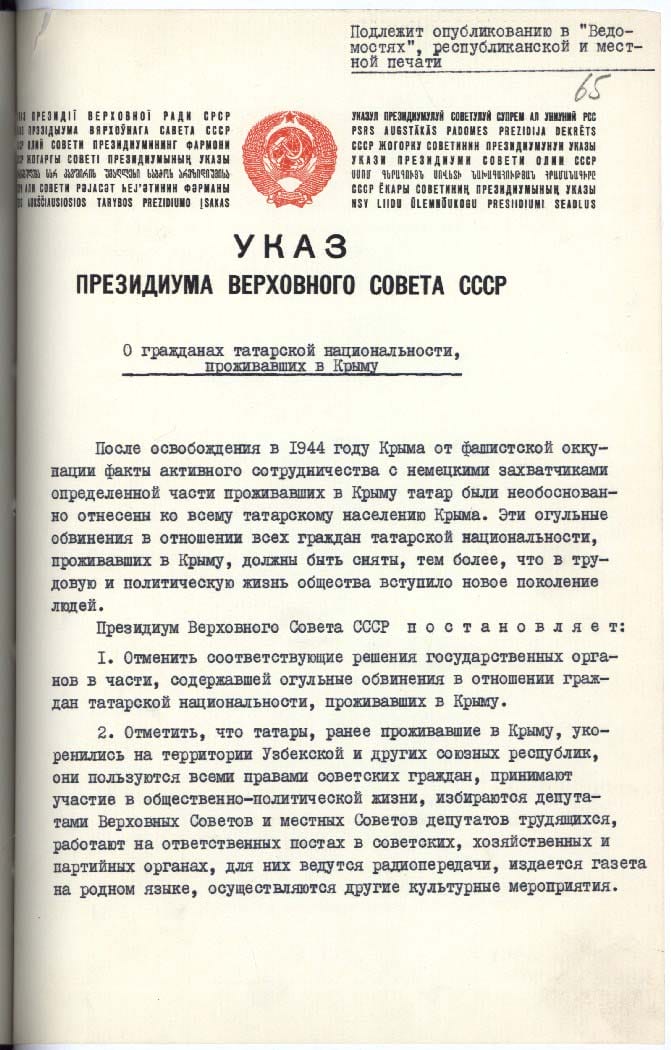
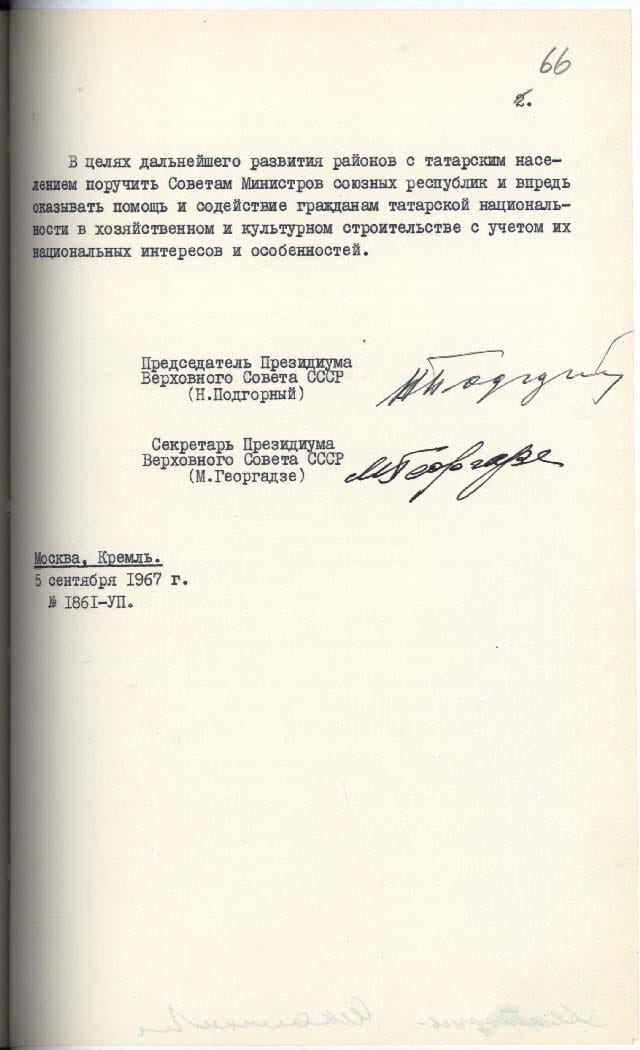


Decree No. 1861-VII of the Presidium of the Supreme Soviet of the USSR, signed by Mykola Pidhornyi and Mykhailo Georgadze on September 5, 1967, was a concise two-page document issued as the Kremlin’s compelled response to decades of nonviolent resistance by Crimean Tatars, mass petition campaigns, and the efforts of people’s delegates in Moscow. Archival records indicate that the Decree’s immediate political motivation was the upcoming 50th anniversary of the October Revolution, prompting Soviet leadership to quell protests and offer a superficial resolution to the national question.
When reading this document, pay close attention to its language: the text omits the ethnonym “Crimean Tatars”. Instead, it employs the bureaucratic euphemism “citizens of Tatar nationality who resided in Crimea”. This linguistic manipulation had a dual purpose: to dissolve a distinct people into the broader Tatar population of the USSR and to use past-tense participles (“who resided”, “who previously resided”) to confine their connection to Crimea to the past. The preamble and the first paragraph are particularly telling: while formally revoking the decisions of state bodies regarding “blanket accusations” against an entire people, the document simultaneously reiterates Stalin’s thesis about “facts of active collaboration with the German invaders by a certain portion of the Tatars who resided in Crimea”. The lifting of the accusations is justified not by recognizing the criminality of the 1944 deportation, but by the pragmatic argument that “a new generation of people has entered the labor and political life of society”.
The document’s main ideological trap is found in its second paragraph. Rather than restoring autonomy or granting the right to return, the Decree categorically claims that the deportees have “settled in Uzbekistan and other Soviet republics”. It presents an extensive list of supposed benefits enjoyed in exile — participation in public and political life, election as deputies, holding positions of responsibility, radio broadcasts, and a newspaper in their native language — alongside instructions to the Councils of Ministers of the union republics to continue supporting economic and cultural development. These measures were intended to solidify the consequences of deportation. Coupled with Resolution No. 1862-VII, adopted the same day — which allowed residence throughout the USSR only “in accordance with current legislation on employment and passport regulations” — the Decree created the illusion of rehabilitation while shifting the barrier to return onto the institution of residence registration [propyska].
The Decree takes on particular significance when read alongside other sources in this module, which reveal its paradoxical effects. Despite the Kremlin’s intention to lay the issue to rest, thousands of Crimean Tatars took the document as a long-awaited signal to return home. KGB reports document how the national movement quickly deconstructed the Decree: from teacher Suleimanova’s pointed remark (“This is just a handout to shut us up until the holiday”) to Yurii Osmanov’s detailed analysis of the authorities’ efforts to accelerate forced assimilation and ultimately seize the national homeland under the guise of “equality of rights”. Furthermore, although the stamp in the upper right corner of the first page explicitly ordered the Decree’s publication in the republican and local press, KGB reports show that Crimean newspapers (Krymskaya Pravda and Kurortnaya Gazeta) sabotaged this directive. As Alim’s oral account and Enver Ametov’s memoirs show, local authorities implemented the Decree’s wording: Simferopol police officers echoed the document’s logic, mockingly insisting that “there is no such people as the Crimean Tatars”.