

Martin-Oleksandr Kyslyi
Historian, lecturer, and Head of the Center for Crimean Studies at the National University of Kyiv-Mohyla Academy. His dissertation focused on the topic: “The Return of the Crimean Tatars to Their Homeland in 1956–1989”. His research interests include migration, memory, trauma, identities, and colonialism.
Related sources:
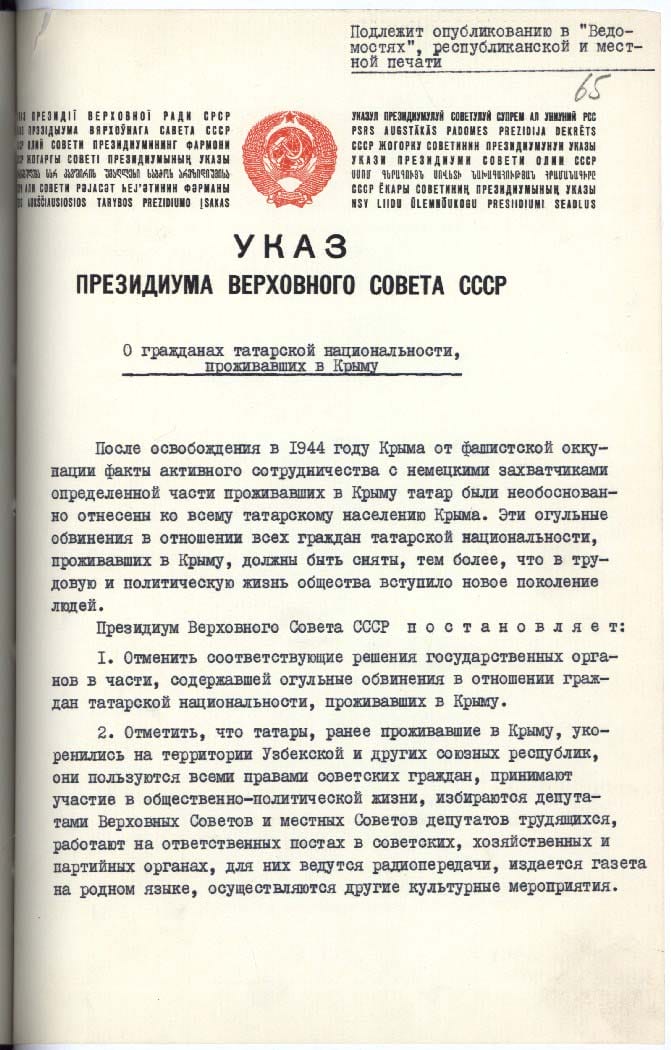
Decree of the Presidium of the Supreme Soviet of the USSR “On Citizens of Tatar Nationality Who Resided in Crimea” of 1967
Decree No. 1861-VII of the Presidium of the Supreme Soviet of the USSR, signed by Mykola Pidhornyi and Mykhailo Georgadze on September 5, 1967, was a concise two-page document issued as the Kremlin’s compelled response to decades of nonviolent resistance by Crimean Tatars, mass petition campaigns, and the efforts of people’s delegates in Moscow. Archival records indicate that the Decree’s immediate political motivation was the upcoming 50th anniversary of the October Revolution, prompting Soviet leadership to quell protests and offer a superficial resolution to the national question. When reading this document, pay close attention to its language: the text omits the ethnonym “Crimean Tatars”. Instead, it employs the bureaucratic euphemism “citizens of Tatar...

The Crimean Tatars’ Struggle to Return to Crimea in the 1960s, According to the Memoirs of Enver Ametov
The excerpt below comes from the memoir of Enver Ametov (born 1940, Aranchi village, Bakhchysarai District), an active participant in the Crimean Tatar national movement. Published in Simferopol in 2014, Ametov’s memoir stands apart from oral history interviews, which are shaped by dialogue with a researcher; instead, it offers a cohesive first-person narrative written 45 years later. Readers should note that Ametov’s account is shaped by an established tradition of national movement storytelling. Yet what makes his memoir distinctive is its documentary richness: Ametov checks his own memory against his personal archive, weaving into his story photocopies of arrival slips, Form No. 15 registration applications, official responses, newspaper clippings, and handwritten activist lists....