
Enver Ametov, Liubov k Otchizne vsemi nami dvizhet [Love for the Motherland Drives Us All], Simferopol: Millii Firka Publishing Project, 2014, 7–27:
… I joined the national movement in 1966, in Quvasoy, where Server Ismailov — a native of Teberti in the Crimean ASSR — led our efforts. In October 1967, defying the authorities, I returned from exile to my homeland. That first time, I managed to remain on Crimean soil for nearly a year, until August 1968, constantly facing fierce opposition from the authorities. This struggle unfolded after the Decree of September 5, 1967. By the time I returned, only a handful who had come on their own — “trusting in the Decree” — still remained. Our group of up to thirty people would gather in Treniyov Park in Akmesdzhit (Simferopol)…
Before the Decree of September 5, 1967, rural residents of Crimea had not been issued passports. In October 1967, this changed: passports were distributed in a hurry. The article “Vozvrashcheniye” [The Return], published in the newspaper Kyrym [rus. Къырым], No. 29, June 1, 2001, describes this process in detail.
By late October, three of us — Server Ismailov, Seithalil Aga (also from Quvasoy), and I — approached Zhuchkov, chairman of the Bakhchisarai District, to discuss registration and employment. He called in Captain Ginkula, head of the passport office. In front of us, Zhuchkov instructed Ginkula to register us if we could find living space equal to 13.65 m² per family member. This requirement, however, was unlawful: the 13.65 m² standard applied to state- or government-owned housing, not to private homes (Soviet Housing Law, 1967, pp. 77–78). Soviet legislation also restricted private construction, forbidding individuals from building houses larger than 60 m² (Legal Handbook on Soviet Legislation, Naukova Dumka, Kyiv, 1973, pp. 390–391). For a family of five, this meant 68.25 m² was needed for registration—exceeding the legal limit by 8.25 m². This rule took effect on January 1, 1964, but even before then, people rarely built homes larger than 35–40 m² because of poverty, taxes, compulsory loans, and wage deductions.
My friends quickly realized they couldn’t find such living space — they had families. But as a bachelor, I found a place in Bakhchisarai at 16 Staroselskaya Street. I filled out two Form No. 15s for an official stamp and went to the district executive committee. Knowing they might refuse to certify the forms for me personally, I went through an acquaintance and offered her half a kilo of chocolate candies for a favor. Soon, I had the certified forms. I hid one, then brought the other to Captain Ginkul at the passport office. He told me to leave my passport and Form No. 15 with him and return in ten days. Those ten days stretched into twenty. When I returned, Ginkul said I needed to go to the Ministry of Internal Affairs oblast office and handed back my passport. There, Major Yelkhov, head of the oblast passport office, told me they could not register me. Later, I found out they’d been requesting a character reference from all my previous places of residence for those twenty days.
I found suitable housing again and presented a certificate from the village council. But it made no difference. As a Crimean Tatar, they had no intention of registering me.
Some good friends helped me find a place to stay: Zinaida Ignatievna (my mother’s fellow villager from Ulu-Sala), Uncle Zhora (originally from Saki), and his wife Olga. Both Zinaida Ignatievna and Uncle Zhora were long-time Russian residents of Crimea and spoke Crimean Tatar fluently.
During this time, I lived in Bakhchisarai with Ivan Matveyevich Zhyvotenko and his wife, Zinaida Ignatievna. Because the police harassed them, I often had to change where I spent the night. Sometimes, I stayed in the village of Kovush (Shelkovichnoye) with Uncle Zhora Yarosh and Aunt Nadia. Other times, I stayed in Ulu-Sala with Uncle Grisha and Aunt Olia Ovlakhov, or with Uncle Yura Kanaki and his wife Olga. The Pogorelov family — Uncle Andrei and Aunt Tosia — also supported me. Occasionally, I spent the night at a barbershop near the Bakhchisarai train station, though I’ve forgotten the names of the employees there.
One day, Ibrahim, an activist from Kovush, arrived from Tashkent, and we visited the Yarosh couple. Aunt Nadia mentioned she planned to write a letter to the Central Committee in support of our people. Some time later, when I visited Uncle Zhora again, I learned that Aunt Nadia had already sent her letter and handed me a copy. I immediately sent a copy to activists in Uzbekistan… Soon after, Aunt Nadia began receiving summonses from the oblast KGB. She ran into trouble and was eventually fired from her job as kindergarten director…
At the end of December 1967, I traveled to Moscow and met with Muarram Aga Martynov and Yunus Aga Zaretdinov (whom I’d previously met in Bakhchisarai). While in Moscow, I visited the Ministry of Internal Affairs, where Colonel Sudin, head of the reception office, received me. I filed a complaint about the actions of the Crimean authorities and left my address for their response. From Moscow, I returned to Crimea, then went to the Akimovskyi District of Zaporizhzhia Oblast to await a reply. The response told me to report to the Ministry of Internal Affairs of the Crimean Oblast. I arrived in Akmesdzhit (Simferopol) on a Saturday in early January 1968.
It was sleeting, and I needed somewhere to spend the night. I tried the Simferopol and Yuzhnaya hotels — one on K. Marx Street near Victory Park and the old main post office, the other on Kirov Street near the round department store, in a building that used to be a collective farmer’s house.
I went to the hotel on K. Marx Street, fully expecting to be turned away — they refused to accept Crimean Tatars with departure stamps in their passports, even though the law required them to offer accommodations for up to three days. At the front desk, I asked for apartment addresses (they kept them on hand for when the hotel was full), but the clerk said rooms were available. I was skeptical, but she insisted: “We accept foreigners, too. Get in line”. When the receptionist took my passport, though, it was as if she’d been shocked — she dropped it and cried, “No-o-o!” I stepped aside, but when she was free again, I returned and asked why they were refusing me. “If you don’t tell me”, I warned, “the whole world will hear about this in a couple of days”. She explained that a lieutenant colonel had visited and forbidden them from accommodating Crimean Tatars, threatening them with dismissal if they disobeyed… Still, at their own risk, they let me stay the night — though they didn’t register me.
The next day, I was searching for a place to stay once again. At the hotel on Kirov Street — the former Kolkhoznik House of the ASSR [House of the Collective Farmer in an Autonomous Soviet Socialist Republic] — the story repeated itself. As I was about to leave, a hotel worker stopped me: “Don’t go anywhere. My daughter Lisa will be here soon. You can go home with her. We help our people however we can”. In our conversation, I discovered she was Zinaida Ignatievna’s cousin from Bakhchisarai. That’s also how I met her son-in-law, Anatolii Brizhan, a student at the Sevastopol Instrument-Making Institute.
Forty-five years have passed since then. I remain deeply grateful to those wonderful, kind, and selfless people who helped us during such difficult times — often at great personal risk.
In January 1968, armed with a referral from the Ministry of Internal Affairs in Moscow, I went to the Crimean Oblast Office to sort out my registration — but in vain. Still, I refused to leave Crimea and remained in Bakhchisarai.
By the end of 1967, a few young families and single men managed to register. Among them were Umer Sudji, Kadyr Sarametov, Mobein Zinetdinov, Fikret Khalilov, Mustafa Emiraliev (“Kokkoz”), and Mustafa Murtazaev (“Osetin”).
In Simferopol, near the train station, Osman Aga’s family (whose son Fikret had been a partisan) managed to register. In Beshterek village, Seyar Aga was also registered. But many others were not: I was in Bakhchisarai; the families of Akim Aga and Asan Aga Chobanov were in Kokkoz; Taliat Aga Tyncherov and Remzi from Chirchik were in Simferopol; and Seit-Nafe Aga was in Lozovoye (he’d returned as early as 1966). The families of Usein and Amet, and Fevzi Poska (who, after his family’s eviction, attempted suicide and was left with a scar on his throat), also struggled. In 1966, the Mirzoev family — Asatulla, a Tajik, and his wife, Khatidze Apte, a Stilia native — settled in the almost deserted village of Stilia with their six children (the oldest was 16, and the youngest was born in Stilia). Later, this large family was deported again and left at the Novoalekseevka station in Kherson Oblast’s Genicheskyi District.
In the late 1950s, Fatime Votiakina, a veteran of the Great Patriotic War originally from Ulu-Sala, returned to Simferopol with her Ukrainian husband. She endured years of persecution — even forced confinement in a psychiatric hospital — but never gave in. Eventually, the Votiakins registered as residents of Simferopol at 55 Pushkin Street, apartment 22.
After years of hardship, Liuba Lapshina finally registered her residence in 1961 — a one-room, semi-basement apartment at 7 Gogol Street. Originally from Gurzuf, her real name was Shemsibanu Amet khyzy (1922–2002). Her apartment became a welcoming gathering place for many compatriots.
You can read more about this remarkable woman in the article “Neispoviedimy puti vozvrashcheniya k rodnym ochagam” [eng. The Inexplicable Paths of Return to One’s Native Hearth], published in Kyrym on October 21, 1995.
In February 1968, Azam Lemanov — an activist in the national movement — arrived in Bakhchisarai from Kasansay village in the Namangan Oblast. When we met, we exchanged news and took a photo together as a keepsake.
At the end of February, I traveled to Moscow and joined our representatives from across the USSR. By March 1968, about forty Crimean Tatar delegates had gathered in Moscow. Ibrahim Aga Abibullaev from Chirchik was elected leader of the group. Each morning, we received our daily assignments — everyone knew their role.
On March 17, 1968, Alexei Evgrafovich Kosterin’s 72nd birthday was celebrated at a restaurant near the Altai Hotel. Kosterin couldn’t attend because of illness, but Petro Hryhorenko spoke on his behalf — and for himself. Among those present were the wives of Hryhorenko (Zinaida Mikhailovna) and Kosterin (Vera Ivanovna). After the celebration, I took the Hryhorenkos home by taxi and got to know them along the way. Through them, I later met P. Yakir, A. Sakharov, T. Velikanova, A. Lavut, and other human rights activists.
After March 25, 1968, I returned to Crimea to continue the struggle — against Party chauvinists and Ukrainian Party nationalists — for my right to live in my homeland and for the honor and dignity of my people.
From late March through early April 1968, more of our compatriots began arriving — activists like Mobein Yusupov, Homer Bayev, Ferat Useinov, Rustem Aga Khalilov, Ayder Zeytullaev, Shukri Azizov, Osman Mamutov, Zekki Muzhdabaev, and many others. Some came with their entire families: Karabash Rustem Aga (a war veteran and captain), Kubetdin Aga, Fevzi Seydaliev, Seytmemet Bekirov, Izzet Aga Yunusov, Seytjelil, Gulnara, Kurtseit Atamanov, Mustafa Iliasov, Dliaver Osmanov, and Reshat Aga Dzhemilev.
We used to gather at the oblast executive committee building, along the banks of the Salgir River behind the Simferopol movie theater, and later at Victory Park near the tank monument. People slept wherever they could — hotels turned us away, so we spent nights at the train station, airport, or in private apartments. We always left those apartments early in the morning to avoid drawing attention and to protect the owners from trouble.
At the end of April, our initiative group met at Shemsibanu Amet’s apartment to draft a statement to Chemodurov, chairman of the oblast executive committee, requesting a meeting. We outlined all the concerns facing our community. The committee informed us the meeting would be held on May 5, 1968. That morning, we gathered outside the Oblast Executive Committee building, and authorities asked us to elect our own representatives. We chose Homer Bayev, Enver Ametov, Taliat Aga Tenchirov, and two others (whose names I unfortunately don’t recall). At the meeting, we demanded an end to the persecution of Crimean Tatars and cited specific injustices. We pressed for solutions to residency registration and employment. Chemodurov promised no further persecution and suggested people disperse to seek housing and registration. Afterward, we relayed the conversation to our compatriots. Many were hopeful, but some doubted the authorities’ promises. In the end, most dispersed to various districts… Soon, however, the skeptics were proven right — Chemodurov had deceived us. Yet our people did not leave Crimea.
During the meeting, Chemodurov argued that Crimea was overpopulated. At that time, the peninsula’s population was 1.2 million. By 1987, officials used the same argument, even though the population had doubled to about 2.5 million. For those twenty years, Crimean Tatars were consistently barred from returning — facing mistreatment, deportation, imprisonment, fines, trials, and even seeing their purchased homes demolished by bulldozers — while nearly 1.3 million new settlers were brought into Crimea during the same period.
Back in early April, while spending the night at the train station, we noticed a group with children and belongings. We learned they were compatriots, brought through a recruitment drive from various oblasts of the Uzbek SSR, and would be transported to their assigned settlements in the morning. For us, being “recruited” to return home felt humiliating. People from places of exile shouldn’t have to come back through recruitment. In the USSR, recruitment was for major construction projects—like developing virgin lands in Kazakhstan or building the Baikal-Amur Mainline and so on. But Crimea is our homeland… Still, it was Rustem Voyennyi who proposed returning to Crimea at a meeting with Y. V. Andropov — no doubt with good intentions… In those difficult years, we celebrated every family that managed to settle in their homeland.
But the recruitment drive in Crimea ended up delaying the mass return of Crimean Tatars to their homeland for many years.
At the end of 1967, participants in the national movement decided that, starting in the spring of 1968, every fifth family would return voluntarily to Crimea, financially supported by four other families. However, the recruitment drive — sold as an illusion of a guaranteed, easy return — took root in many people’s minds and derailed these plans. Over the next 6–7 years, no more than 350 families came through the recruitment program, and they were scattered across remote steppe villages in Crimea.
In protest against ethnic harassment by the authorities, I began a dry hunger strike (without even drinking water) on May 12, 1968, sending telegrams to the Central Committee of the Communist Party of the Soviet Union, the Ministry of Internal Affairs, and the Crimean oblast authorities, stating my location—the Simferopol railway station. The next day, police arrested me and took me to a local station, where I spent the night on the concrete floor. In the morning, after learning I was on a hunger strike and checking with their superiors, they released me. But on May 16 at 10:00 p.m., they detained me again and took me to the same station. The chief was Lieutenant Colonel Tsirous. Not long into our “conversation”, Lieutenant Colonel Mudryi from the oblast Ministry of Internal Affairs arrived with a lieutenant. After a brief exchange, Mudry hinted they would send me “home, to the reservation”. I replied, “My home is here”. Mudryi said, “This is a police station”. I answered, “Since I was three years old, the police station has been my home”. I was sent to the officer on duty and asked him to call the station’s on-call doctor. The doctor arrived and asked about my condition. I explained I was on a hunger strike. Frightened, the doctor refused to examine me and hurried away. By then, it was around 2:00 a.m. on May 17. Four officers came down from upstairs. Lieutenant Colonel Mudryi summoned the duty doctor again, who this time examined me and reported back to the officers. They put me in a police car and drove off in an unknown direction. For a moment, I thought they might maim or kill me and dump my body somewhere, with no one held accountable. But I felt no fear. Soon, I realized they were taking me to the airport. The car stopped, and I was briefly allowed outside to breathe some fresh air — though always under watch. I spotted a fellow countryman and managed to exchange a few words before they hurried me back into the car. A short time later, I was rushed onto a plane bound for Odessa–Simferopol–Tashkent. At the time, the Simferopol flight was scheduled to leave at 3:30 a.m. They claimed the plane was waiting just for me, but no one else was on board; they announced boarding for others only afterward. The crew took my documents — there was no ticket in my name. Once boarding finished and the doors closed, the crew handed my documents back. Upon landing in Tashkent, three compatriots greeted me — one, an acquaintance, asked if I knew anyone in the city. When I said I didn’t, he offered to take me along. We took a trolleybus and transferred once. I struggled to breathe from the heat and the effects of my hunger strike. On the bus, a young woman named Gulzade joined us — she turned out to be Ahmed Asanov’s wife. We went to their home, where she quickly prepared something to eat. I didn’t touch it; she didn’t know I was on a hunger strike… When everyone left, I lay down to rest. That evening, Ahmed and Gulzade returned, joined by Refat Godzhen, Yakub Selimov, and a young man named Nusret. After exchanging news, they took me to another house. Inside, a man in his thirties sat on a divan — Izzet Khairov. We spoke at length, and after I shared what was happening in Crimea, he suggested we travel to Moscow. On the morning of May 18, Nusret and I flew to Moscow under Russian names. Once in the capital, we went to the Central Committee reception office, where our representatives were supposed to be. But we found no one — raids had been carried out the day before, and all identified activists had been expelled from Moscow. We headed to Kursk Station to leave for Crimea. At the station, I met Seitumer Mustafayev with his family, Izzet Abliazov from Begovat, and Seiran, a friend from Crimea. After discussing my condition, they decided to consult Petro Hryhorenko; Seiran went to see the general. A couple of hours later, he brought back Hryhorenko’s advice: end the hunger strike. I listened — under those circumstances, I knew the protest would not have the intended effect. I had lost a lot of weight, could barely move my tongue, and my lips were chapped… That same day, thanks to Seitumer Aga’s wife, Leyla (who had an infant to take care of), we bought tickets to Simferopol. (More about this hunger strike — which began in Simferopol, continued in Tashkent, and ended in Moscow — can be found in Kyrym, No. 46, September 28, 2001; the same issue also features “The Return.”) Upon returning to Crimea, we continued our struggle for the right to live in our homeland.
On May 18, 1968, many of us were evicted from Crimea, but just days later, people regrouped on the banks of the Salgir River behind the Simferopol movie theater. On May 22–23, people organized an impromptu folk concert — music, songs, and dancing. When a police car arrived, Lieutenant Colonel Mudryi and several officers stepped out. After a brief exchange, they detained Ayder Zeytullaev, Nusret, and me and took us to the Kyiv District Police Department on Vorovskogo Street (now the site of the Marakand restaurant). They called us in one by one and accused us of disturbing people’s leisure. “We were relaxing in a public park — everyone has a right to be there. We’re citizens of the USSR too. Whose leisure did we disturb? If you want to restrict us, hang a sign saying only Russians and Ukrainians can use the park,” our friends replied. After a long conversation, the police took our passports but released us, instructing us to appear before an administrative commission on May 27. In the meantime, we pooled our money and bought several tents, planning to set them up along the Simferopol–Yalta highway so vacationers would notice. A few days before the protest, Ayder Zeytullaev, Homer Bayev, and I surveyed the site. On May 26, we pitched the tents. That first night, 65–67 people slept there. (An incomplete list of the camp’s residents is attached on pp. 21–22.)
On May 27, the three of us — Ayder Zeytullaev, Nusret, and I — went to the administrative commission to retrieve our passports. They read the ruling to us and handed back our documents. We returned to the tent camp.
Later, a police car pulled up to the tents — Lieutenant Colonels Mudryi and Kosiakov, along with Major Khoschenko (head of the Simferopol police special division), got out. They demanded we take down the tents. We refused. They threatened force and left. Around 6 p.m., two LAZ buses packed with police officers arrived. They surrounded us, tore down the tents, and began shoving us onto the buses.
We were taken to the city police station at 44 I. Franko Boulevard. After about an hour in custody, they drove us toward Feodosia and Kerch. When we reached Port-Crimea, they offered to transfer us to the “Simferopol–Baku” train, but we blocked the rear doors with our tents, refused to get off, and spent the night on the buses — sitting and half-lying down. In the morning, the buses were loaded onto a ferry and taken to Port-Caucasus, where police chiefs from Krasnodar Krai joined the Crimean officers. They drove us to Kavkazskaya station (Kropotkin city) and again told us to get off. We refused, pointing out we weren’t registered residents and could be detained there. The police said the buses had to return to Simferopol. That only strengthened our resolve to stay on board. Soon, the buses drove out to a field and stopped. The police left us unguarded, hoping we’d disperse overnight. Instead, we stayed put and spent another night in the buses. In the morning, the police returned, claiming they had a new assignment and needed us to vacate. Again, we refused. The commanders insisted they didn’t know us and weren’t transporting anyone. “How can you say that?” we protested. “Even truck drivers have waybills — and we’re living people!” Unable to rid themselves of us, they drove on to Nevinnomyssk in Stavropol Krai, where we stayed until evening. Along the way, we handed out handwritten leaflets. In Nevinnomyssk, some of us went into a cafeteria to buy pastries and left leaflets there too. Later, an officer boarded the bus and warned us not to distribute anything. There was a sergeant on duty with us; as we ate pastries, Homer offered him one. At first he refused, but then accepted, sat between the seats, and devoured it. Jafar Khalilov took out his ever-present accordion and began to play. We sang old songs. The sergeant, surprised, said, “What kind of people are you? They’re mocking you, but you’re still singing and not losing heart!” and he began to cry. Covering his face, he got off the bus. That evening, the buses headed toward Grozny, passing through late at night. Later, we learned the police feared how the Chechens might react. By morning, we reached Derbent. When we stopped, some of us got out to stretch. Seeing the buses and police, local residents quickly gathered and asked questions. We told them about the abuses against our people. Some urged us to stay in Derbent, others wanted to confront the police on our behalf, but we declined.
The buses set off for Baku. After about half an hour, they stopped. Lieutenant Colonel Napriyenko from the Crimean Oblast Police, who had flown in, came to see us. We learned that Colonel Zakharov, head of the Ministry of Internal Affairs, had also arrived with several deputies. Napriyenko suggested we transfer to the Baku–Simferopol train. We agreed — on the condition that all of us would be allowed to board. The buses drove to the Belindji train station, but Napriyenko said he could only send one or two of us without tickets. We refused. They offered us a ride on the ferry, but we declined. A representative of the Ministry of Internal Affairs of the Azerbaijan SSR boarded the bus. He stated that he was Colonel Kasumov, “a man of the service who could not help us in any way”. After listening to us, he said he could take us to Krasnovodsk in the Turkmen SSR free of charge. But we refused. Kasumov left. Soon, they assaulted the bus. Those who entered through the front door met firm resistance, but unexpectedly, the rear door opened because some of our more anxious members had removed the tents blocking it. After being beaten and kicked, we were forcibly pushed toward the ferry. But the ferry’s entrance was closed. Seeing the assault, the ferry captain refused to let us board, arguing that people in such distress might jump overboard. The boatswain stood blocking the entrance. Then a police captain from Simferopol knocked the boatswain aside and forced the entrance open. Despite the chaos, the Azerbaijani police acted professionally. Once things calmed down, medical help was provided to Gulkhana Kasayeva, who had injured her arm.
The ferry was crowded with passengers — civilians, military personnel, and conscripts bound for the Soviet Army. Before the assault, they had been told that tourists were arriving, but as violence broke out, the Crimean police shouted that they were transporting traitors and betrayers. We explained our real story to the passengers in detail.
In the morning, the ferry docked in Krasnovodsk. An ambulance arrived for G. Kasayeva, whom I accompanied to the hospital at my friends’ request. The doctors found no fractures. When I asked for a forensic report, they said they could only provide one on police recommendation. The same ambulance then took us to the local police station. There, the police chief spoke with us. He denied our request for a medical certificate but asked for our story. We told him about the discrimination our people faced. He tried to counter by citing the career rise of Seitumer Tairov, recently appointed secretary of a district party committee in Uzbekistan. We explained that S. Tairov did not represent the entire Crimean Tatar people — he was just one party loyalist. We waited there a long time for the “Krasnovodsk–Tashkent” train.
We were divided among three train cars, each carrying 15–20 conscripts accompanied by sergeants. From their epaulets, I could tell they were from aviation units. When we tried to strike up a conversation, the sergeants were wary — they’d been told we were traitors. I decided to challenge their preconceptions, mentioning their destination in Nebit-Dag, where the Transcaucasian Military District’s aviation unit was based, and noting that their unit was on the right side of the train, with the infantry regiment of Military Unit 14142 on the left. They grew more curious, so I handed them my military ID (listing Military Unit 14142 and Artillery Division 75097) and my passport. They peppered me with questions, which I answered directly. After all, I’d only left the Soviet Army six years earlier. The soldiers told me they’d no longer believe propaganda about national equality. When they got off at their stop, they bid us a warm farewell and wished us well. Along the way, at stops like Ashgabat, Mary, Charjou, Kattakurgan, and Samarkand, police officers stood on both sides of our train cars. Even so, our people managed to slip out and go about their business… In the end, about six of us remained when we reached Fergana, where we met with Bekir Aga Osmanov and Mukhsim Osmanov. After discussion, Homer Bayev and Akhseit Seytmemetov were asked to draft a protest letter against dismantling the tent city and evicting people from Crimea. I was tasked with visiting all participants in this unprecedented event to collect their signatures. I traveled to Samarkand, Tashkent, Chirchik, Bekabad, and Leninsk (in Andijan Oblast), gathering as many signatures as possible. By the time I got back to Fergana, the protest text was ready. After affixing the signatures, I flew via Osh to Moscow and tracked down our representatives. We attached a map of our forced deportation route to the protest and submitted the document to the appropriate high-level Party and Soviet authorities.
At the same time, 114 representatives prepared and signed an “Appeal by Representatives of the Crimean Tatar People to the International Community” in June 1968.
Returning from Moscow to Crimea, about 25 of us — petition in hand — appealed to Chemodurov, head of the Oblast Executive Committee. A few days later, we went to his office, but Chemodurov refused to see us and locked himself inside. Soon, a police squad arrived, led by Zakharov, head of the Ministry of Internal Affairs, and his deputy, Lieutenant Colonel Kosiakov. When a young man named Server tried to force open Chemodurov’s door, police dragged him outside. As they led him away, Server shouted, “Chemodurov! Chemodurov!” — a moment that earned him the nickname Server Chemodurov. We moved to the corner of the reception hall. The women were asked to step back while the young men stood at the front. After a fierce scuffle, the police dragged us out one by one into the inner courtyard. On the ground lay Mamed Chabanov, Shukri Azizov, me, and Dliara from Baku. Then they shoved us into a Volga car: Dliara and the police captain sat in front, the rest of us squeezed in the back with another officer. As soon as the car left the courtyard, we urged Dliara to scream as loudly as she could. The captain tried to stifle her, and the driver blared the horn to drown out her cries. They took us to city police headquarters (44 Franko Boulevard) and began calling us in one by one for medical exams. Naively, we believed the results would lead to justice—but the opposite happened: doctors used the bruises and marks from our beatings to judge who had “resisted” the most. After the exams, they called us into an office one by one, but those who entered never reappeared — they were led away through other doors. That’s how Maria Sarmina (daughter of a Hero of the Soviet Union), Ismailov’s wife, Fakhri, Ayder Zeytullaev, Ismail Ismailov, Iliamin Kurtametov, and I ended up in the KGB basement at 13 Franko Boulevard. (Shukri Azizov stayed at the police station until his identity was confirmed.)
Once in the KGB basement, they placed us in adjacent solitary cells. We shouted through the doors, agreeing to declare a “dry hunger strike”. There was no set time limit. Four days later, already weakened from my previous hunger strike (over the 8,000-kilometer route Simferopol–Tashkent–Moscow), I could no longer stand. On the fifth day, we ended the strike.
They took us to court in pairs. The judge, without a single question, sentenced each of us to 15 days in jail. From the courthouse, they promptly sent us to Simferopol prison. A day later, Ayder Zeytullaev, Ismail Ismailov, Iliamin Kurtametov, Fakhri Ismailov, and I were moved to the prison basement. Mamed Chobanov, meanwhile, was charged with “resisting arrest” and later sentenced to three years in prison.
While I was in prison, my parents had already arrived in Crimea. When they inquired about me, the officers told my father the truth but told my mother I was away on a business trip in Kyiv.
…
Notes
[1] Many participants in the Crimean Tatar national movement believe that the perception of Ukrainian republican authorities as obstacles to their return was shaped by the central government and the KGB. For a long time, Crimean Tatars were told that their return to Crimea was impossible because the peninsula had become part of the Ukrainian SSR — and, as a result, “Ukrainian authorities” were blocking their return. Occasionally, the blame even extended to so-called “Banderites,” accused of hindering the people’s return from exile. This misconception, deliberately fostered by Soviet authorities, gradually faded as Crimean Tatar and Ukrainian dissidents began to establish direct contact.
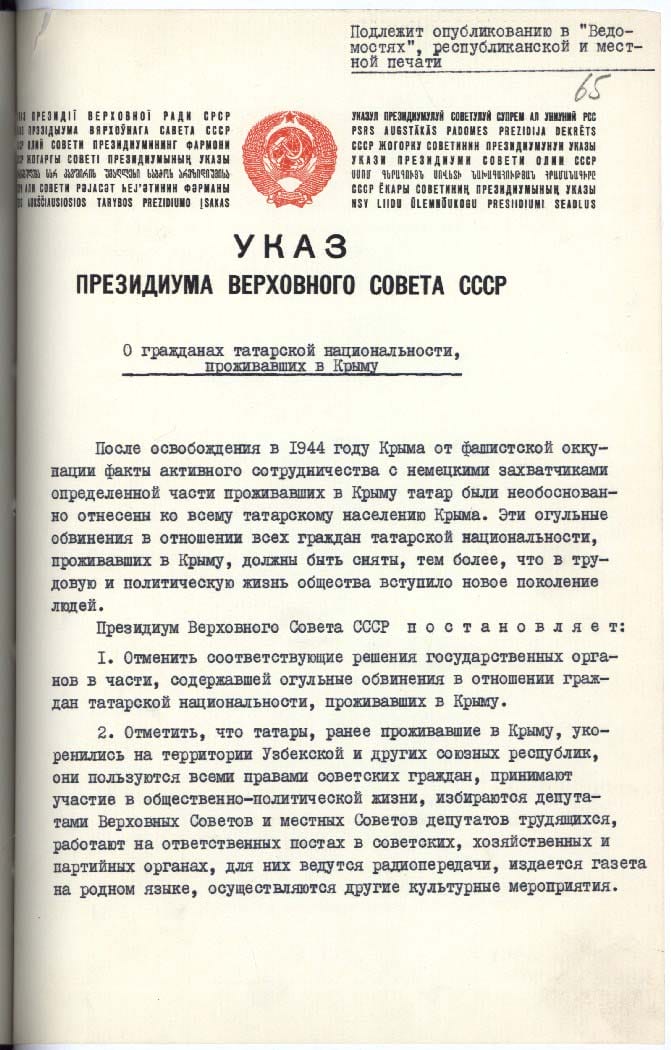

The excerpt below comes from the memoir of Enver Ametov (born 1940, Aranchi village, Bakhchysarai District), an active participant in the Crimean Tatar national movement. Published in Simferopol in 2014, Ametov’s memoir stands apart from oral history interviews, which are shaped by dialogue with a researcher; instead, it offers a cohesive first-person narrative written 45 years later. Readers should note that Ametov’s account is shaped by an established tradition of national movement storytelling. Yet what makes his memoir distinctive is its documentary richness: Ametov checks his own memory against his personal archive, weaving into his story photocopies of arrival slips, Form No. 15 registration applications, official responses, newspaper clippings, and handwritten activist lists.
The first theme is a detailed account of the bureaucratic trap Crimean Tatars faced after the Decree of September 5, 1967. Ametov describes his ordeals in Bakhchisarai and Simferopol from October 1967 to August 1968, citing Soviet reference guides to show how authorities weaponized the sanitary standard for living space (13.65 m² per person): since private owners were barred from building houses larger than 60 m², any family of five was automatically excluded from legal registration. Even when Ametov, unmarried, found enough space and — thanks to a box of chocolates — secured a stamped Form No. 15, the police delayed and ultimately denied his residency registration after an unofficial background check, without explanation.
A second key theme is the network of solidarity that existed in Crimea at the time. While Ametov sharply criticizes the local political elite as “Party chauvinists and Ukrainian Party nationalists”[1], he also expresses deep gratitude toward dozens of Russian and Ukrainian residents of Bakhchysarai, Simferopol, and nearby villages — naming families like the Zhyvotenkos, Yaroshs, Ovlakhovs, Kanakis, and Pohorielovs, as well as women working in hotels and a hair salon — who, despite police pressure, offered shelter to Crimean Tatars. Of special note are the prewar elders fluent in Crimean Tatar and the story of “Aunt Nadia” Yarosh from Kovush, who, after writing a letter to the Central Committee in support of the Crimean Tatars, was interrogated by the KGB and dismissed from her post as a kindergarten director.
Perhaps most powerfully, this excerpt captures how the streets of Simferopol became a “theater of resistance” in the spring and summer of 1968. Ametov describes his May hunger strike, an impromptu folk music and dance concert by the Salgir River on May 22–23, and the establishment of a tent city near the Yalta highway in Mariyino on May 26. Especially striking is the account of the tent camp’s inhabitants being transferred via the Kerch Strait, Kuban, Stavropol, Chechnia, Dagestan, and Baku to Krasnovodsk and Tashkent. Ametov demonstrates how the deportees transformed their forced removal into a tool of counter-propaganda.