
Page 1
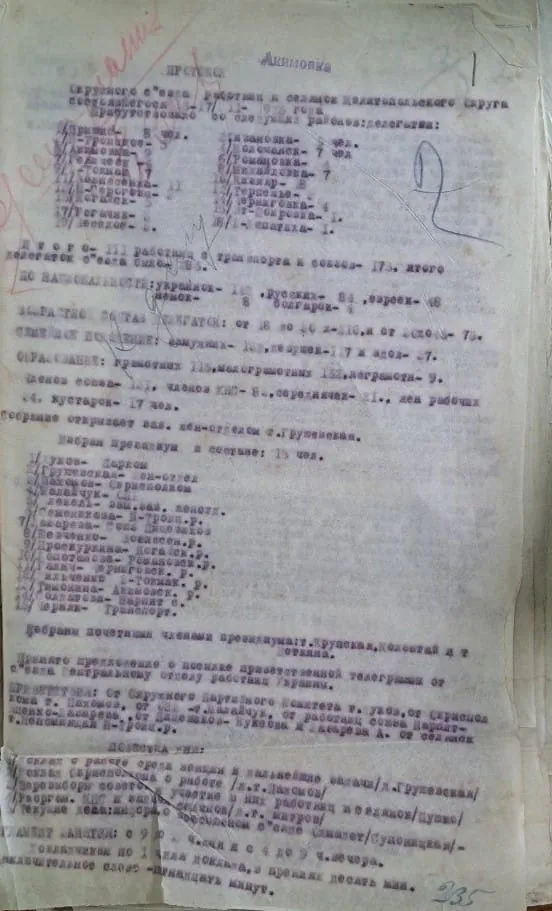
MINUTES
Okruha Congress of Women Workers and Peasant Women, Melitopol District — November 15–17, 1925
Delegates attended from the following districts:
| 1/ Prishib – 8 people | 2/ Ivanovka – 5 people |
| 3/ N.-Toroitskoye – 5 | 4/ Molochansk – 7 people |
| 5/ Akimovka – 9 | 6/ Romanovka – 4 |
| 7/ Genichesk – 6 | 8/ Mikhailovka – 7 |
| 9/ B.-Tokmak – 7 | 10/ Kizliar – 8 |
| 11/ Voznesenka – 11 | 12/ Terpenye – 3 |
| 13/ N.-Serohozy – 3 | 14/ Chernigovka – 4 |
| 15/ Nogaisk – 3 | 16/ Vt.-Pokrovka – 1 |
| 17/ Rogachik – 3 | 18/ V. Lepetikha – 1 |
| 19/ Veseloye – 3 |
Total: 111 workers and 173 from transportation and trade unions; in all, 285 delegates attended the congress.
BY NATIONALITY: Ukrainian women – 142, Russian women – 84, Jewish women – 48,
German women – 8, Bulgarian women – 4.
AGE DISTRIBUTION: 18 to 30 years old – 116; 30 to 45 – 73.
MARITAL STATUS: married – 132, single – 117, widows – 37.
EDUCATION: literate – 115, semi-literate – 152, illiterate – 9.
Union members – 131; KNS members – 8; seredniachka – 21[?]; workers’ wives – 24; artisans – 17.
Comrade Grushevskaya, head of the Women’s Department, opened the meeting.
A presidium of 15 members was elected:
1/ Zhukov – Pa[r]ty Committee
2/ Grushevskaya – Women’s Department
3/ Pakhomov – Okruha Executive Committee
4/ Malaychuk – Okruha Political Education Department
5/ [?]lekel – Deputy Head of the Women’s Department
6/ Semeniukova[?] – N.-Troitsk District
7/ Lazareva – Food Workers’ Union
8/ Shevchenko[?] – Voznesensk District
9/ Proskurskina – Nogaisk District
10/ Lopotanova[?] – Romanovsk District
11/ Galich – Chernigovsk District
12/ Tilchenko – B.-Tokmak District
13/ Timokhina[?] – Akimovka District
14/ Soldatova – Narpit
15/ Cherniak – Transport
Comrades Krupskaya, Kollontai, and Zetskina were elected as honorary members of the Presidium.
The congress adopted a motion to send a congratulatory telegram to the Central Department of Women Workers of Ukraine.
GREETINGS WERE DELIVERED BY: Comrade Zhukov (okruha party committee); Comrade Pakhomov (okruha executive committee); Comrade Malaychuk (Okruha Political Education Department); Yashchenko-Lazareva (women workers of the Narpit union); Kuksova and A. Lazareva (food workers); and Comrade Nepomnyashchaya (peasant women, N.-Troitsk District).
AGENDA:
- Report on work among women and future tasks (Grushevskaya)
- Report on the activities of the Okruha Executive Committee (Comrade Pakhomov)
- Re-elections to the Soviets and the participation of women workers and peasant women (Pushko)
- Reorganization of the KNS and peasant women’s duties (Comrade Dmitrov)
- Current affairs: Report on the Okhmatdet Congress (Suponitskaya)
SCHEDULE: 9:00 a.m. to 3:00 p.m. and 4:00 p.m. to 9:00 p.m.
Speakers were allotted one hour for their reports, 10 minutes for preniya, and 15 minutes for closing remarks.
Page 2
HEARD:
A report was presented on work among women and future tasks. Seventeen participants took part in the preniya.
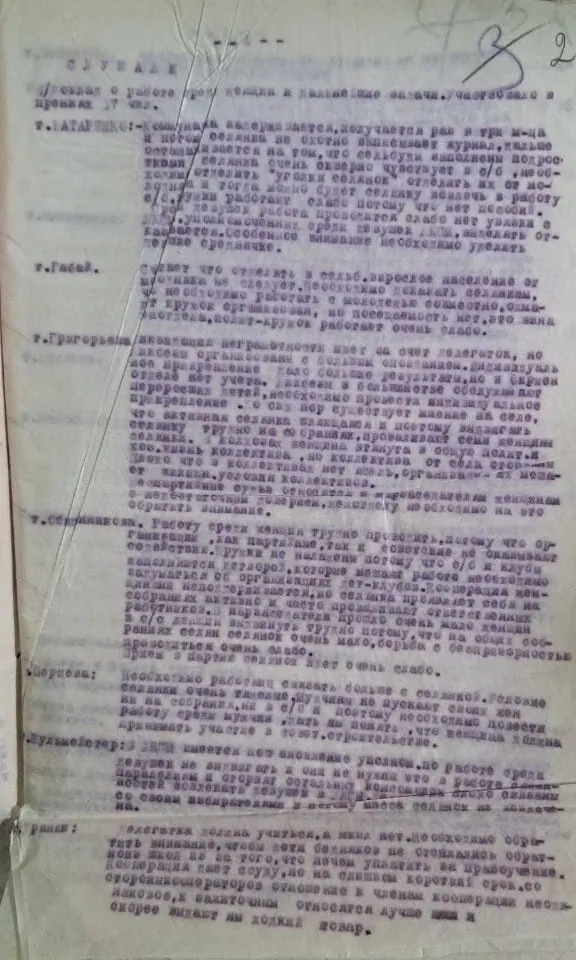
Comrade TATARENKO: “Kommunarka is lagging behind—it’s published only once every three months, so rural women are reluctant to subscribe. She also noted that youth clubs are filled with teenagers, making rural women uncomfortable in cultural centers. Rural women need dedicated spaces, separate from the younger generation, to help involve them in cultural life. Clubs aren’t functioning well because they lack subsidies. Young women do little work because they have no connection with the Komsomol, which refuses to appoint them as representatives. Special attention should be paid to serednichkas.”
Comrade Gabay: She argued that adults in the village should not be separated from the youth; instead, peasant women should be encouraged to work alongside the younger generation. Although an Okhmatdet club was organized, attendance remains low, which she attributed to shortcomings of the Women’s Department. She noted that the political club is also functioning poorly.
Comrade Grigorieva: She reported that female delegates are leading efforts to eliminate illiteracy, but literacy classes were organized too late. Assigning students individually has produced good results, yet the Okruha Women’s Department keeps no records. Most literacy classes end up serving children who are actually too old for them; individualized assignment is necessary. In rural areas, there’s still a perception that active peasant women are “loose,” which makes it hard to nominate them at meetings—often, peasant women themselves reject such nominations. On collective farms, women participate in political and economic life, but these collectives are isolated from the village. She regretted the lack of daycare centers in collectives, citing poor housing as the main barrier. She also noted that non-Party judges do not trust female lay judges, and urged the Women’s Department to address this.
Comrade Obydennikova [?]: She explained that organizing work among women is difficult because both Party and Soviet organizations fail to provide assistance. Study groups haven’t been formed since village cultural centers are occupied with children, which hinders progress; she suggested creating separate children’s clubs. Cooperation among women is not encouraged. Nonetheless, peasant women are active at meetings and often vote out officials. Few women have been elected as People’s Deputies, and it’s hard to nominate women to village councils due to their low attendance at general meetings. Efforts to address the problem of street children, she added, have been weak.
Recruiting peasant women into the Party is progressing very slowly.
Comrade Pertseva: She stressed the need to strengthen ties between women workers and rural women. Rural women face very harsh conditions, and men often prevent their wives from attending meetings or joining village councils. Therefore, she argued, it’s essential to work with men so they understand the importance of women’s participation in council affairs. […]
Comrade Shulmeister: She reported that the Komsomol Executive Committee has resolved not to nominate young women, claiming they are unnecessary. This creates a parallel structure and distances the rest of the Komsomol from their responsibility to engage young women. Delegates have weak connections with their constituents, resulting in low involvement among rural women.
[?]raniak: She highlighted that female delegates want to study, but there are no schools available. She emphasized the importance of ensuring poor children aren’t turned away from school because they can’t pay tuition. While the cooperative provides loans, their terms are too short, and members aren’t treated equally—the cooperative favors the well-off and gives them the more marketable goods.
Page 3
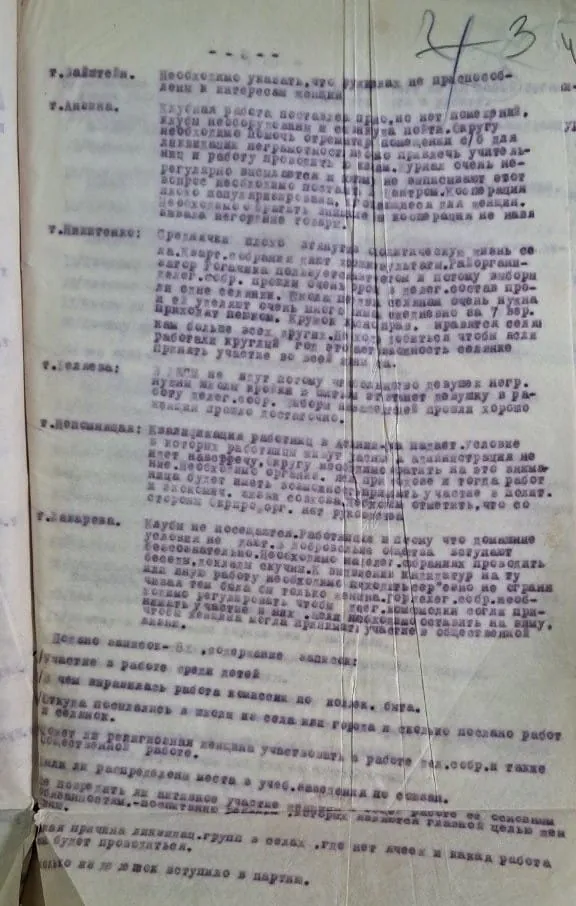
Comrade Weinstein: She pointed out that club activities are not aligned with women’s interests.
Comrade Anzina: She noted that, although club activities are well organized, there are no proper facilities—clubs are unequipped, and rural women have nowhere to go. The okruha should help renovate cooperative premises to support literacy work, recruit female teachers, and carry out these efforts through the clubs. The magazine [“Коммунарка Украины”, Kommunarka Ukrainy] is sent out too irregularly, which discourages subscriptions—this needs to be addressed with the Center. Cooperatives are poorly promoted, and care must be taken to prevent them from imposing substandard goods on women.
Comrade Nikitenko: She observed that seredniachkas are not well integrated into village socialist life. Neigh[borhood] meetings, however, are effective. District organizer Rogachika commands respect, which led to a successful delegates’ assembly election—including one peasant woman elected to the delegation. The school is particularly valued by advanced[?] peasant women, who walk seven versts [around 7 km] weekly to attend. The legal studies club is their favorite. Ensuring the daycare center operates year-round would allow peasant women to fully participate in village life.
Comrade Zhelyaeva: She noted that most young women are not joining the Komsomol as they are illiterate. Tailoring and sewing schools are needed to attract young women to the delegates’ assembly. The elections for People’s Deputies saw strong female turnout.
Comrade Nepomnyashchaya: She reported that the qualifications of women workers in Askania-Nova are declining, with terrible living conditions and an uncooperative administration. The okruha must address this issue. Establishing a daycare center at the state farm would enable women to participate in its political and economic life. She also noted the Okruha Trade Union Committee’s lack of leadership.
Comrade Lazareva: She explained that women workers cannot attend clubs because of home circumstances and often join voluntary organizations without fully understanding their purpose. Delegate meetings should include more engaging discussions, as the reports are boring. Nominations for positions should be taken seriously and not be limited only to women. City delegate assemblies should be designed to allow Komsomol delegates to participate. Women from rural areas should be permitted to stay for the winter so they can take part in public life.
82 notes were submitted; their contents:
1/ Participation in work with children.
2/ What the work of the commission on collective household affairs entailed.
3/ Where were the workers sent to schools—from villages or cities—and how many women workers and peasant women were sent?
4/ Can a religious woman participate in the work of assemblies, as well as in public work?
5/ Were places in educational institutions allocated by union?
6/ Will a woman’s active participation in community work interfere with her primary duties—raising a child, which is a woman’s main purpose?
7/ What is the reason for the dissolution of groups in villages where there are no Party cells, and what work will be carried out?
8/ How many young women have joined the Party?
Page 4
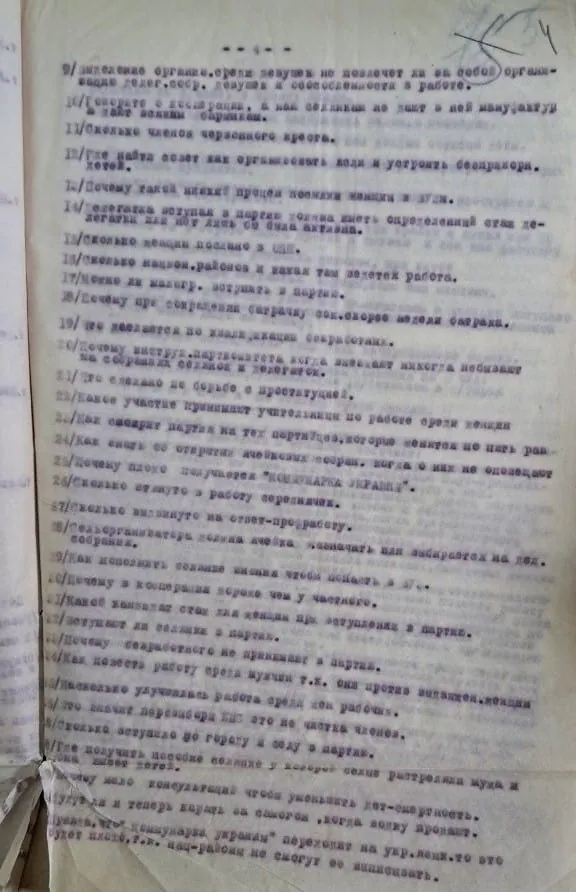
9/ If we create separate organizations for young women, won’t this lead to an isolated delegates’ assembly and hinder our overall work?
10/ You mention cooperation, but we peasant women aren’t assigned any manufacturing work—all those opportunities go to profiteers instead.
11/ How many members does the Red Cross have?
12/ Where can we get guidance on organizing daycare centers and caring for street children?
13/ Why are so few women admitted to universities?
14/ Does a female delegate need prior experience to join the Party, or is being active enough?
15/ How many women have been sent to the Okruha Political Education Department?
16/ How many national districts exist, and what activities are being carried out in them?
17/ Are illiterate people allowed to join the Party?
18/ Why are female farm laborers laid off before male workers during cutbacks?
19/ What steps are being taken to reduce unemployment?
20/ Why do Party Committee instructors never attend meetings of peasant women and female delegates during their field visits?
21/ What actions have been taken to combat prostitution?
22/ What role do women teachers have?
23/ How does the party view members who have been married five times?
24/ How are we supposed to know about cell meetings if no notice is provided?
25/ Why can’t we properly receive Kommunarka Ukrainy magazine?
26/ How many seredniachkas have become involved in this work?
27/ How many women have been nominated for senior trade union positions?
28/ Should the cell appoint a rural organizer, or should she be elected at a general meeting?
29/ How can a rural woman expand her knowledge to qualify for university admission?
30/ Why are prices at cooperatives higher than at private stores?
31/ What is the required probation period for women joining the Party?
32/ Are rural women joining the Party?
33/ Why are unemployed people not accepted into the Party?
34/ How should we approach working with men, given their opposition to nominating women?
35/ How much has work among workers’ wives improved?
36/ What is the purpose of the KNS re-elections—do they mean something other than a purge of members?
38/ How many people have joined the Party in the city and in the countryside?
38/ Where can a peasant woman—whose husband was executed by the Whites and who has children—go for financial assistance?
39/ Why are there so few consultations to address infant mortality?
40/ Now that vodka is being sold, will people still be punished for making moonshine?
41/ Is it true that Kommunarka Ukrainy is switching to Ukrainian? If so, won’t this create problems for national districts that can’t subscribe?
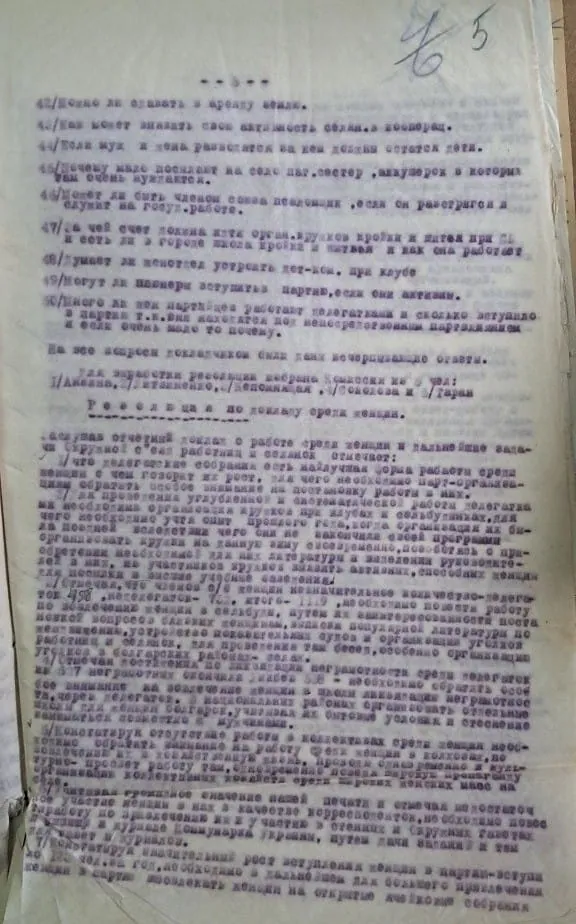
42/ Is it possible to lease land?
43/ How can villagers show their active participation in cooperatives?
44/ If a husband and wife divorce, who should the children live with?
45/ Why are so few public health nurses and midwives being sent to rural areas where they’re urgently needed?
46/ Can a former cantor who has left the clergy and now works in a government job be a member of the union?
47/ Who should fund sewing and dressmaking classes in the village? Is there a sewing and dressmaking school in the city, and how does it operate?
48/ Is the okruha executive committee considering setting up a children’s and youth group at the club?
49/ Can active Pioneers join the Party?
50/ How many wives of Party members serve as delegates or have joined the Party, given their close connection to Party members? If the number is small, why is that?
The speaker provided comprehensive answers to all questions.
A five-person commission was elected to draft a resolution: 1/ Amelina; 2/ Litvinenko; 3/ Nepomnyashchaya; 4/ Sokolova; 5/ Taran.
Resolution on the report regarding work among women:
After hearing the report on women’s work and future tasks, the Okruha Congress of Working Women and Peasant Women notes:
1/ Delegate assemblies have proven to be the most effective form of work among women, as shown by their steady growth. Party organizations should therefore prioritize organizing and supporting these assemblies.
2/ To ensure thorough and consistent work, delegates should organize study circles at clubs and village cultural centers. Last year’s circles started too late and did not finish their programs, so this winter’s study groups must be organized on time, with adequate literature and designated leaders. Identify active, capable women from these groups and encourage them to pursue higher education.
3/ Given the small number of women serving on village councils—458 delegates and 732 non-delegates, totaling 1,119—efforts should focus on engaging women in village cultural centers. This can be achieved by raising issues relevant to women, sharing popular literature on the women’s movement, holding model trials, and creating spaces for women workers and peasant women to gather for discussion, especially in Bulgarian-populated areas.
4/ Noting the progress in reducing illiteracy among delegates—of 627 illiterate women, 538 have completed literacy classes—special attention should be given to involving more women in literacy schools through the delegates. In national districts, establish separate schools for Bulgarian women, considering their living conditions and reluctance to study with men.
5/ Recognizing the lack of collective work among women, efforts should be made to organize women in collective farms and involve them in economic life. At the same time, cultural and educational activities should be conducted there, and the idea of collective farms should be widely promoted among rural women.
6/ Since the press is so important, and women’s participation as correspondents is still limited, efforts should be made to involve women in district and regional newspapers by assigning them articles and tasks for newspapers and magazines.
7/ With 125 women having joined the Party this year, it is important to further increase women’s involvement by inviting them to open cell meetings where their interests are discussed, as well as by involving them in political circles, traveling schools, and regular schools.
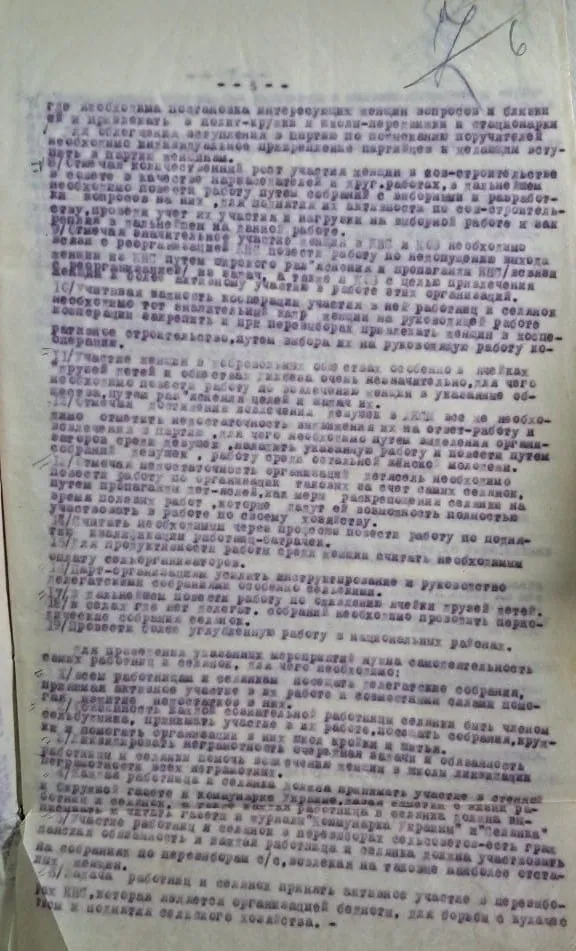
8/ With more women participating as people’s deputies and in socialist construction, future work should include meetings with elections and well-developed agendas to boost women’s engagement. Track their participation and workload in elected positions, and support their ongoing involvement.
9/ Considering women’s significant involvement in the KNS and Health Department, steps should be taken—especially during the KNS reorganization—to encourage women to stay involved. This includes clear communication and promotion of the KNS and Health Department to motivate active participation.
10/ Recognizing the important role of cooperatives and women’s participation in them, efforts should be made to retain women in leadership positions and elect more women to leadership roles during cooperative re-elections.
11/ Women’s participation in voluntary organizations—especially Friends of Children cells and literacy societies—remains limited. More women should be encouraged to join by clearly explaining these organizations’ purpose and goals.
12/ Although more young women are joining the Komsomol, too few are promoted to leadership roles or involved in the Party. To improve this, organizers should be selected from among young women, and outreach to others should be done through meetings.
13/ Since daycare centers are lacking, efforts should be made to establish them with the support of peasant women. These centers would free women during fieldwork, allowing fuller participation in their own farms’ activities.
14/ Trade unions should work to improve the skills of women farm laborers.
15/ For work among women to be effective, village organizers should be compensated for their efforts.
16/ Party organizations should provide stronger guidance and leadership for delegate meetings, especially in rural areas.
17/ Going forward, efforts should be made to establish a Friends of Children cell.
18/ In villages without delegate meetings, political meetings should be organized for rural women.
19/ More in-depth work should be conducted in national districts. […]

The 1920s marked an era when women’s emancipation became central to the Soviet project of social transformation. Eager for rapid modernization, the Soviet government launched sweeping initiatives to address the “women’s issue”. Ambitious campaigns sought to boost the number of women in government and the Bolshevik Party, encourage their active role in public life, and broaden their professional employment opportunities. To “overcome backwardness”, women were urged to attend literacy schools, join clubs and political education classes, and read specialized periodicals. A complex administrative structure was set up for women’s emancipation, with okruha women’s departments and local women’s organizers overseeing grassroots efforts in administrative units and workplaces. Delegate assemblies were established to drive large-scale gender policy campaigns and recruit women into Soviet-Bolshevik institutions.
Soviet gender policy reached the Melitopol Okruha, which existed from 1923 to 1930 — a period of innovative emancipatory practices. The okruha established a women’s department, deployed women’s organizers, and set up delegate assemblies. Records from the okruha department document progress toward key goals of Soviet emancipation. However, the unique administrative, socio-economic, and ethnic features of Melitopol Okruha deeply affected how these initiatives unfolded and their ultimate success.
Frequent administrative changes in the Melitopol Okruha during the 1920s complicated the rollout of Soviet gender policy. When formed in 1923, the okruha included 15 districts and largely mirrored the old Melitopol Powiat. But between 1924 and 1930, its boundaries and composition shifted several times. The changes were most dramatic in 1925, when governorates were abolished, okruhas were consolidated, and those from the dissolved Berdiansk Governorate were added. By 1925, Melitopol Okruha comprised 21 districts, all facing the challenge of rapid administrative integration.
The region’s diverse ethnic and religious makeup required special consideration. To address this, several national districts were established within Melitopol Okruha:
1) Bulgarian: Tsarevodarivskyi/Botiyevskyi, Romaniskyi/Kolarivskyi;
2) German: Molochanskyi (home to Mennonites) and Pryshybskyi. Residents of these districts, especially Mennonites, resisted Soviet emancipation efforts, shaped by gender roles, religious convictions, and language barriers.
Another factor hindering Soviet emancipation was the okruha’s overwhelmingly agrarian character. In 1926, 93% of the population lived in villages, with only 7% residing in cities. Urban centers were more receptive to emancipation thanks to better organization, higher education levels, and greater professional employment among women.
All these factors shaped how emancipation campaigns were conducted. Because most residents lived in villages, most initiatives targeted rural women. In 1926, 90 of the okruha’s 95 delegate assemblies were in villages, just 3 in cities, and 2 at enterprises. This rural focus stands out even more when compared to neighboring Zaporizhzhia Okruha, which had 5 delegate assemblies in the city of Zaporizhzhia alone in 1927. Low female employment in the okruha’s cities — even in major centers like Melitopol and Velykyi Tokmak — influenced the makeup of delegate assemblies. Many delegates were wives of party members and civil servants, while organizers favored recruiting factory workers.
Local party branches set up rural delegate assemblies or party members oversaw them at the village or district level. However, this broad network often highlighted a widespread problem across Ukraine: the shortage of motivated, well-trained organizers who could effectively engage with women. Documents from the Melitopol Women’s Department — including the minutes published below — repeatedly mention a formal, box-ticking approach among leaders, which led many assemblies to fail to meet their goals. Organizers of study groups and political literacy schools also tended to ignore or misunderstand women’s real interests, focusing instead on prescribed materials. This lack of genuine engagement diminished participation and led to frequent turnover in these groups.
The Melitopol Women’s Department treated work in the national districts as a distinct focus. The German districts — especially Molochanskyi — received the most attention, yet yielded modest results. This was attributed to the mixed ethnic makeup of meetings (including Russian women), the lack of German women party members, and what officials called the “religious fanaticism of the Mennonite delegates”.
Nevertheless, some women — especially delegates — actively engaged in Soviet emancipatory practices and sought to change social roles. Minutes and reports from the okruha department frequently mention women’s eagerness to learn to read and write (though overcrowded village cultural centers often hindered this) and their interest in joining clubs. Women also took the initiative to form cooperative organizations. Gradually, women became more active and visible in public life, despite resistance from local patriarchal traditions — both openly within the community (from both men and other women) and subtly from Soviet authorities. Soviet emancipatory policies did help normalize women’s participation in public administration, sometimes leading to outcomes the authorities hadn’t expected. For instance, a 1928 report “On Party Work in Rural Areas” from the Melitopol Okruha Party Committee noted both the “weakness” of party work with women and the growing number of volynkas (spontaneous peasant protests), most of which were started by peasant women.
One effect of 1920s Soviet emancipation policy was a surge in documentation about women in party records — especially those of the women’s departments. While these documents mostly focused on women’s involvement in official emancipatory activities, they also included rich biographical detail, direct quotes, and statistics. This makes it possible to trace women’s life strategies, societal attitudes toward them, the obstacles they faced, and their responses to Soviet policies. Reports, conference minutes, and other records reveal both statements echoing Soviet rhetoric and voices critical of it.
The document provided here sheds light on women’s aspirations and struggles, as well as their perspectives on Soviet policies. It helps us understand the goals, challenges, and results of emancipatory practices in the Melitopol Okruha.
It’s worth noting that such congresses were common in 1920s Ukraine and other Soviet republics. They served as tools for mobilizing women to support socialist change — providing a forum to discuss women’s roles in building socialism and encouraging their political, economic, and social involvement.
The congress was held on a grand scale. Unfortunately, confusion in the minutes’ statistics makes it hard to determine the exact number of participants; the document lists a total of 285. Alongside the women’s department, the heads of the okruha party committee and executive committee led the congress.
The congress began with a report on a specific issue, followed by discussion (rus. preniya). Speakers also received notes with questions and comments from participants. The agenda included: work among women; the okruha executive committee’s activities; council re-elections and the involvement of women workers and peasant women; the reorganization of the Committees of Poor Peasants (KNS) [Комітети незаможних селян] and peasant women’s duties; and information about the recent Okhmatdyt congress.
The most active women and women’s organizers contributed to the discussions. On the first issue, their speeches raised urgent concerns for advancing women’s emancipation: stalled initiatives due to the indifference of Bolshevik organizations toward women’s work, and patriarchal resistance from husbands and even Soviet institutions. Speakers repeatedly highlighted the difficulty of attending likbez schools — despite women’s eagerness — because the silbudy [village cultural centers] were crowded with teenagers. Another challenge was that seredniachkas [middle-class women] were less interested in delegate assemblies than biadniachkas [poor women], and there was debate over whether to focus on outreach to young girls. Women also faced numerous everyday hurdles in trying to move beyond traditional roles, including shortages of organizers, teachers, and other resources.
The submitted notes covered a wide range of issues: 82 were submitted for the first report and grouped into 50 points in the minutes. Topics included both women’s engagement in Soviet practices and everyday life concerns.
Women sought information about Party careers, admission to higher education, the consequences of divorce, balancing motherhood and activism, rural medical care, the high cost of industrial goods, and more. Some questions challenged organizers, touching on awkward party or economic issues — like, “How does the party view members who have been married five times?” As the resolution to the first report shows, official responses tended to be formal rather than genuinely helpful. Notably, despite being called a “congress of women workers and peasant women,” few remarks addressed women workers specifically. Similarly, the experiences of women from ethnic minority regions were largely overlooked.
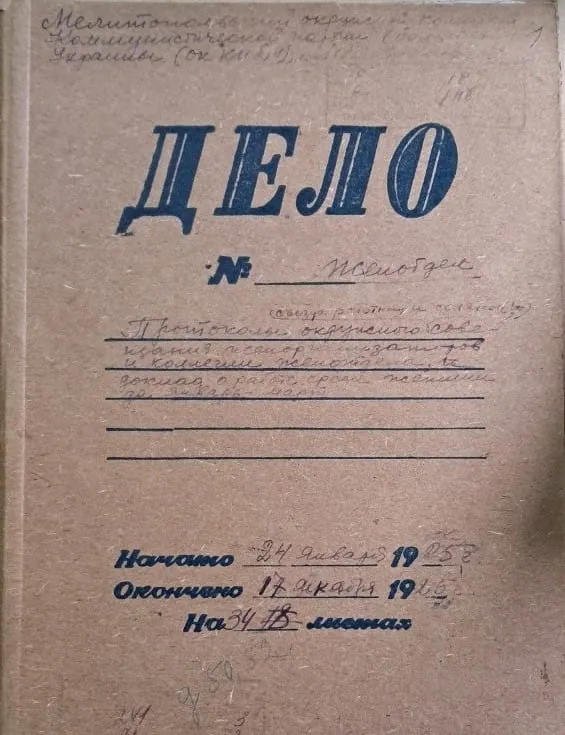
The minutes published here come from a file titled “Minutes of the Okruha Congress of Women Workers and Peasant Women, the Meeting of Women’s Organizers, and the Women’s Department Committee, and a Report on Work Among Women for January–March 1925.” The document was typed in blue ink (likely a copy); in places, the letters are smudged or blurred, making some words and even sentences difficult or impossible to read. Surnames are especially hard to decipher. Illegible words or letters are marked with square brackets and a question mark. The document also contains many spelling and punctuation errors, as well as abbreviations—some of which are expanded in square brackets for clarity. Occasionally, sentences start with a lowercase letter. The letter “ъ” has been replaced with “, likely because that symbol wasn’t available on the typewriter.
Because the document is quite lengthy, this publication offers an excerpt focused on the discussion of the first question.