
“[…] We all knew the electroplating shop involved hazardous work. They gave workers things to supposedly counteract the risks, but it was just ridiculous — milk, some kind of buns. The electroplating shop, then the painting process — both were hazardous, and everyone knew it. What could we say about it? We heard the same things as everyone else. We even went to the bus painting area; even when the booth was empty — after they’d pulled the bus out — we could go in and look around, see what was there. That smell, all of it, you could feel it everywhere. It was the same in the electroplating shop. Besides electroplating, there were other harmful jobs too… I know because my dad was a grinder. Grinding was very common and harmful. For example, even when calculating seniority — one year counted as two. Grinding work was also very harmful… It seems to me that people simply weren’t valued enough to be really cared for in hazardous workplaces. By the way, we never discussed this. Maybe we didn’t talk about it — not even about what actually happened—not because it was painful, but because it was a topic we just wanted to avoid […]”
(Design Engineer at Avtobusprom and LAZ, 1970–2000 )
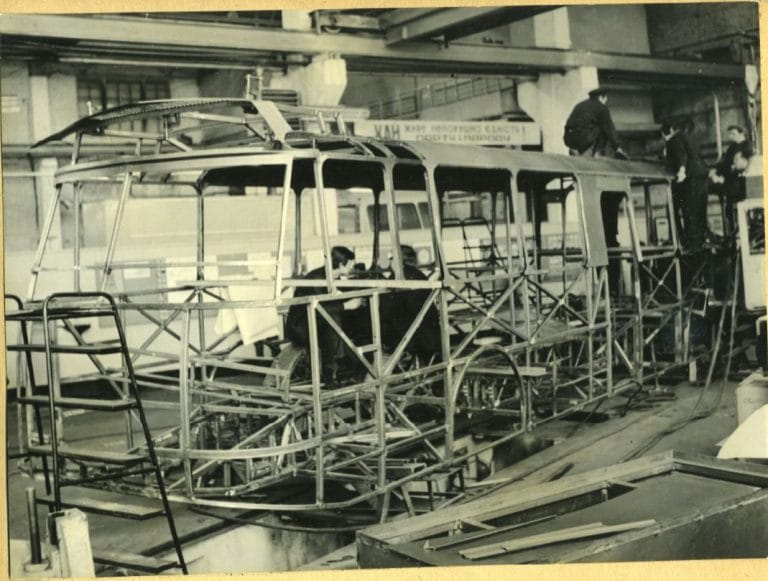
“[…] We didn’t just think [about harmful production]; we took concrete steps to protect the environment. You know? Specifically regarding the paint shop, I don’t remember the exact figures anymore, but I can give you an example. According to standards, painting a single bus required an average of about 50 kilograms, plus a bit more, of various paint and varnish materials — solvents, primer, paint. Less than half of that remained as solid residue on the bus body. The rest either evaporated — meaning it went into the air — or fell to the ground, or ended up in the water. The paint booths had an exhaust system with hydrofilters: water was fed into the upper part, flowing over as if from a single trough, creating a continuous veil, then filling the lower part and overflowing downward. When the exhaust fan was running, it drew out the cloud containing most of the sprayed silver paint; some landed on the car body, some remained in the air. The exhaust fan worked from below, drawing in air mixed with paint and streams of water. The paint clung to the water jets and fell into the basement area, where special coagulants were added to the water, clumping the paint into lumps. At a certain point in that maze, a scraper conveyor moved along the top of the water, collecting the paint into containers. Once in containers, the paint was transported to a dedicated paint processing area. There, the paint was processed using ball mills filled with glass balls 15–20 millimeters in diameter. The paint fell into these mills, where it was ground to a certain consistency. A solvent was added, and this paint was reused to protect various metal structures from corrosion—structures used in construction, columns, and even some non-standard equipment shipped to other plants. There were also drying chambers at the plant; a wet bus with fresh paint needed to be dried thoroughly and quickly. The temperature in the chamber rose to 140–150 degrees. Moreover, those solvents released chemical compounds. We set ourselves the task of ensuring that the exhaust system worked, drawing the mixture of solvent vapors into the air and collecting them. In the middle of the painting complex, we set up drying chambers. From all of them — about 20 in total — we collected vapors using air ducts and exhaust fans, then transported them to the furnace in the largest drying chamber. Our task was to burn the vapors and use the generated heat to dry the buses. The initial attempts yielded no results, so we started gathering information. Over the next year, we organized the process using special catalysts based on platinum electrodes, which are very expensive. In the end, we achieved a very good result and drastically reduced harmfulness — by about 85 percent, if not 90 percent. Please note that we have a northwesterly wind blowing here. Given the location of the bus factory, most emissions were carried by the wind toward Sykhiv, the Sykhiv residential area, along the edge, passing over Shuvar and on to Zubra. It passed the Insulator Plant and the Iskra Plant at the time, moving in a southeasterly direction […]”
(Deputy Technical Director of LAZ, 1986–1997)
“[…] So, when I was heading to the production line, there was milk. They used to give us two crates of milk per workshop. When I did the math, it ended up being a whole truckload. The workshop manager came running over and asked, ‘What are you doing?’ — he spoke in Russian. I said, ‘I’m from the accounting department’. He replied, ‘That must be some kind of mistake’. I said, ‘I know nothing…’ […]
[…] The [production at the Poliaron plant] couldn’t have been harmful — people worked there, lived there, and still live there today. If it had been harmful, they wouldn’t have survived. People spent their whole lives working there, you know. Some say, ‘It’s harmful,’ but working conditions were constantly monitored — the sanitary and epidemiological station was always present, with regular inspections. There were strict requirements for the technological process; all necessary tests were performed, results had to be within limits, and standards were set to ensure nothing was harmful to people. When people talk about fumes, I say: gases come out of the machine while it’s running, but the fumes are released into the air. Honestly, what comes from the cars today is probably more harmful. Back then, it wasn’t like that — no emissions, nothing; everything was normal. If squirrels were running around the factory, how could it be harmful? Even the little birds — the titmice, the sparrows — were always there […]
[…] I: Let’s continue the conversation. Actually, I wanted to clarify this point with you, because, let’s say, there were harmful workshops at Poliaron after all, where people retired earlier, where they were given milk and food.
R: I worked at Poliaron for 28 years. So everything people say — it’s just stories. Some people would say: this harmful, that harmful. I can tell you: the only real challenge was soldering under a microscope. Some of the girls who worked with the microscope had their eyesight deteriorate; sitting and soldering for eight hours straight is unrealistic — not everyone can handle it. Still, they wore short sleeves, skirts, and shorts. The men wore shirts. If it had been truly harmful, people would have been dropping like flies. But people didn’t collapse, die, or even get sick. People can say what they want. I worked there for 28 years; my mother-in-law, I tell you, worked there for 50 years […]”
(Economist and Director of the Poliaron Production Association, 1983–2011)
“[…] Well, you know, I always tried to follow all the safety procedures — what was allowed and what wasn’t. I’m from Siberia and worked as a mechanic there, so safety inspectors would come by and review everything: what’s permitted and what’s not. I was already used to what wasn’t allowed. Sometimes I even did things that were forbidden, but I understood the risks. When you understand, it’s different […]
[…] You know, that’s really how it was — the problem is, when someone is young, they just don’t think [about the impact of hazardous work on their health]. It’s only when they get seriously ill that they start to consider it. But young people think they’re healthy, and that’s just how it is […]
[…] We knew about it, and we talked about [the impact of production on the environment]. We knew the risks existed somewhere. And I’ll tell you, a lot of it still came down to people’s own carelessness. For example, when they brought in acids — sulfuric acid and the like — they’d just leave them in an open area instead of a designated place. They would sit there, sometimes break open and leak, and everything would just evaporate […]”
(Employee of the Poliaron Production Association, 1960–1989)
“[…] I used to catch colds all the time until my doctor — who knew I worked in TV — told me, ‘Volodya, why don’t you get your blood tested for lead?’ I had it tested once; I still have the results, and while my levels weren’t above the norm yet, she said, ‘Listen, your lead levels are approaching a dangerous threshold, which is why you’re getting sick.’ I was always just a little under the weather — runny nose, sore throat, cough — one after another. That’s why I moved to the reliability department. I wasn’t repairing or soldering there anymore, but while I was working in the shop, that’s how I got it […]
[…] I: I see. And maybe they gave you some food for hazardous work, like milk for hazardous work?
R: Milk — yes, that was when I was in the workshop. Not in the department anymore, but back then, when I was soldering and working near the soldering station, they gave me milk […]”
(Electron employee, 1959–1997)
“[…] It was harmful production — I don’t even know what that’s called in Ukrainian. In Russian, it’s a ‘hydro-sandblaster’ [гідропєскоструйка]… It was a cabinet with a window that opened, and you’d hold it with both hands. There was a nozzle that shot out a stream of water and sand. You’d take a part, put it in, hold it, and deal with the grease — that’s what it was. At first, they used sand — like in a mine — and then they added something else, so there was a bit less of that. In the shop, for example, there was the pickling section. There were tanks with sulfuric acid, used to remove rust from parts, and there were always fumes of sulfuric acid […]
[…] But honestly, we didn’t really care much about that; that’s just how things were when it came to [personal protective equipment]. They gave out milk — sometimes juice too. And people retired earlier. We had a section — what was it called — soldering. There was a woman, Tsebiakova, Maria; at first she soldered kettles or something like that. She was the solderer. I think, according to the first list, she retired at 45 because that’s how it was for women. [The standard retirement age was] 55, but she retired 10 years earlier. She was 45, and after they closed the section, she worked as a press operator […]
[…] I: Oh, maybe you were talking about the factory releasing some kind of harmful emissions into the environment?
R: And where did that acid go?
I: Where did they dump it?
R: Into the sewer, I don’t know.
I: Into the sewer?
R: Well, probably into the sewer. Honestly, I don’t even know where it ended up […]”
(Employee of Lvivprylad, 1980–2003)
“[…] Silver nitrate — well, that process is harmful because hydrochloric acid is also used, and during evaporation, it takes place in hot water; the silver is heated, and some of it evaporates through the tail pipe. Still, I wouldn’t say it was extremely harmful — it was just classified as a hazardous industry, which is why workers received benefits. But it wasn’t exceptionally difficult work. As for glassblowing — where you blow with your mouth — that’s harmful to your internal organs, your heart, and lungs. Every time, you have to take a heated piece, put it in your mouth, and blow the ball up to the dimensions specified by the program.
I: Were there any occupational diseases in such work areas?
R: I don’t really remember anything like that — no one ever left their job because of an occupational disease. That didn’t happen.
I: But you say it was harmful. So did the workers feel any effects?
R: Workers feel the effects after they’ve finished working. They’re given early retirement, but after that, what had been slowly affecting them catches up — it only shows itself once they’re retired. Still, people often live a long time. I was talking to a friend a few days ago — he worked as a glassblower almost his whole life, and he’s still alive, three years older than me. That harmful work didn’t harm him. He did retire early, though, and probably worked for about 20 years after retirement […]”
(Glass Factory Worker, 1970s – 2012)
“[…] I’m sure it was harmful, but nobody thought about it back then. I was young and healthy, so it didn’t seem like a big deal. I’d just run over, turn it on, turn it off, and that was it. Occupational safety was just a formality — you know, how could they let that shield get covered in acidic mold, that slime? It was pure negative microbiology — harmful! And then there was walking on those bricks piled up in a heap — three bricks and a plank. The plank might have been wide, so you could walk on it safely, but what about safety? What can you even say? How could you not get zapped by electricity there, or twist your ankle, for example? God forbid something worse happened […]
[…] There were sulfuric acid burns. Back then, the sulfuric acid dosing system was entirely manual. There was a tank — you had to open the tap, pour in about half a bucket of sulfuric acid, add half a liter to a liter of oleic acid, and this mixture went into the fermenter to suppress foam before sending it to the separators. When there’s a lot of foam in the yeast mass, the separators don’t work well, so the foam had to be settled. I remember one incident — I was already working as a shift microbiologist, though it wasn’t on my shift; it happened on another shift. People told me about it, those who saw it. Fortunately, the operator’s assistant acted quickly. He opened the hose and washed her down with cold water at strong pressure. Who knows if she survived, but she had burns — on her body, on her face — because there was acid in the tank, and a pipe on top for venting the system. She opened the valve too hard, and the acid shot up like a fountain, splashing onto the floor and onto her from above. She was wearing a headscarf and robe; it was summer, so she wasn’t wearing much clothing, which actually made it worse because the acid hit her body directly. Luckily, he turned on the water — there were hoses with cold water— and washed her for about 10, maybe 15, minutes […]”
(Employee of the Lviv Yeast Plant since 1984)
“[…] Well, that’s to be expected. There are specific regulations for this, too — it’s a matter of occupational safety, and we have an occupational safety department. Before my first day on the job, I went through training with an instructor, signed the necessary forms, and so on. For broader issues like fresh air, heating, and machine placement, technicians and staff still keep a close eye on things today. Fire safety goes without saying — exhaust vents are installed where needed, within reason, since they’re quite expensive. Still, they installed new ventilation on the third floor just last year to ensure proper airflow. It’s not just factory dust, but also steam from ironing, which is harmful too. They do their best to deal with it, but it’s impossible to eliminate completely. Anyone who stands at the cutting table for a long time ends up with allergic reactions to some type of fur or another. For example, when I’m cutting fur, I actually try to avoid it — they know I can’t usually cut it, but when I have to, I absolutely have to wear a mask because I can’t breathe; I start choking, my eyes and nostrils water. When I asked about it, they told me it’s definitely an occupational hazard […]”
(Artist at the Mayak company since 1987)

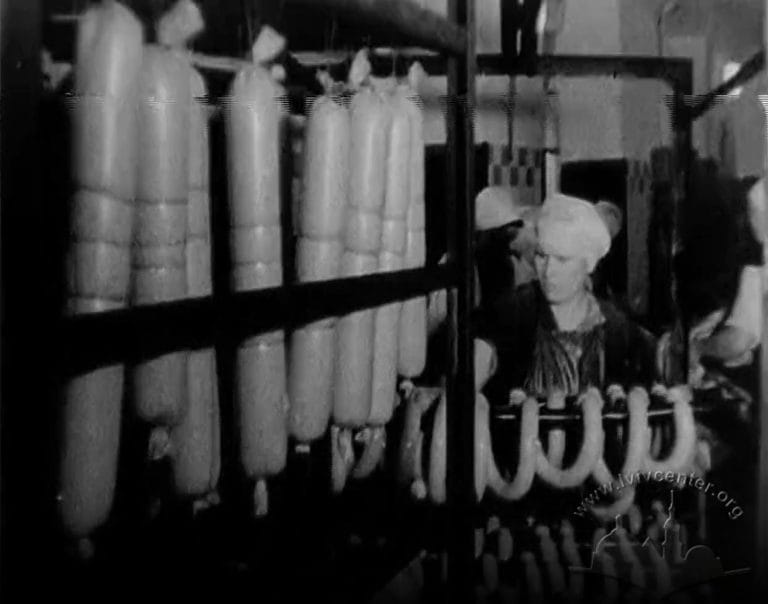
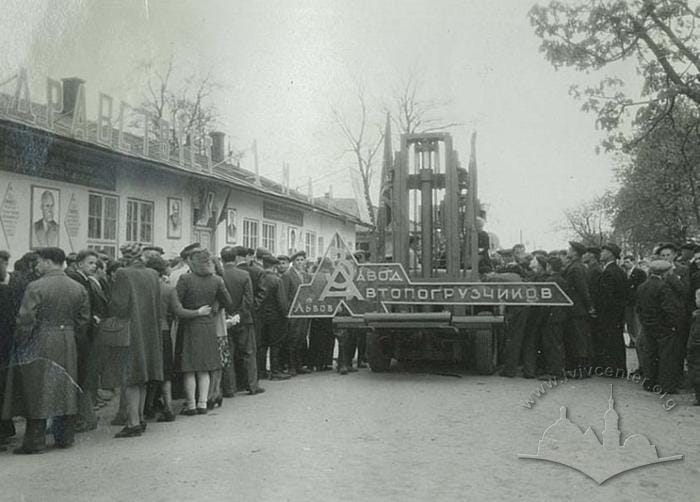

The materials presented here are excerpts from interviews with workers in Lviv’s radio-electronic, machine-building, processing, light, and food industries. These interviews are part of the Un/Archiving Post/Industry project, carried out in 2020–2021, which aimed to collect surviving materials related to the industrial heritage of the Lviv and Donetsk regions and to foster dialogue between generations, regions, and institutions. The recorded bibliographic conversations have been incorporated into the Urban Media Archive’s oral history collection, “Industrial Biographies of the City.” This collection preserves respondents’ memories and reflections on their childhoods and families, the city, education, work, and society, dating back to the 1950s.
The selection presented here covers the period of Perestroika, the 1990s, and the early 2000s, organized into thematic sections. It brings together respondents’ answers to questions about occupational safety and environmental protection.
In the USSR, environmental protection measures were secondary to economic activity. Environmental protection was tied to increases in the production of material goods, housing construction, healthcare development, and improvements in working, living, and recreational conditions for the population. Legislation required measures to protect and improve the use of natural resources, but lacked mechanisms for socio-economic sanctions against violators, who were often the largest and most influential enterprises.
Responsibility for implementing environmental protection measures fell to the relevant ministries, agencies, and enterprise directors, whose primary task was meeting production targets, with environmental concerns coming second. Ministries also had the authority to revise environmental use and pollution standards. Information about the negative impact of human activities on the environment was accessible only to a limited circle of officials and enterprise managers. The deputy director of the Lviv Bus Factory describes in detail the production’s impact on surrounding areas and the installation of treatment facilities, while the administrator of the Poliaron enterprise denies any harmful impact on the environment and workers, citing regulations that provide subsidized meals in the workshops—supposedly to offset negative effects.
A gap between declared standards and actual conditions was also evident in occupational safety. By the late 1980s, the USSR’s occupational safety standards system included over 230 state and 200 industry-specific standards, most incorporating the latest domestic and international advancements. However, sources indicate that actual safety conditions remained unsatisfactory. Workers describe the presence of occupational safety rooms alongside outdated technologies and equipment. Furthermore, the pressure to meet production quotas often led to only perfunctory compliance with safety requirements. Deliberate disregard for personal safety was also common, stemming from a lack of awareness and a certain taboo around discussing the impact of work on personal health and the environment.
Thanks to the respondents’ answers, we learn that the main motivation for taking jobs in hazardous industries was higher wages and preferential seniority. The narrators rarely mention personal protective equipment, focusing instead on the distribution of milk “for hazardous work” and on exercise breaks at light-industry enterprises.