Donate
Quote
Viktor Krupyna, Women in Leadership Positions in the Ukrainian SSR (1945–1991), Reesources.Rerhinking Eastern Europe, Center for Urban History, 03.12.2025
copied

Women in Leadership Positions in the Ukrainian SSR (1945–1991)

Publication date 03.12.2025
After the end of World War II, Soviet authorities returned to a conservative gender policy that emphasized women's maternal roles. [1] This approach was "justified" by the severe demographic losses of the war. In 1944, the honorary title Mother Heroine and the order of the same name were introduced for women who gave birth to and raised ten or more children, while the Order of Maternal Glory was created for mothers of at least seven children. In 1956, paid maternity leave for urban women was nearly doubled to 112 days, and in 1964, this benefit was extended to rural women. By 1981, paid parental leave had expanded to a full year. However, the state's emphasis on motherhood did not exempt women from the broad social responsibilities assigned to them. Instead, Soviet women became "doubly burdened": along with fulfilling maternal and domestic duties, they were also expected to participate fully in public life and to work on equal terms with men in all sectors of the economy.[2] Yet despite official proclamations of gender equality, women remained extremely underrepresented in leadership roles.

After the end of World War II, Soviet authorities returned to a conservative gender policy that emphasized women’s maternal roles. [1] This approach was “justified” by the severe demographic losses of the war. In 1944, the honorary title Mother Heroine and the order of the same name were introduced for women who gave birth to and raised ten or more children, while the Order of Maternal Glory was created for mothers of at least seven children. In 1956, paid maternity leave for urban women was nearly doubled to 112 days, and in 1964, this benefit was extended to rural women. By 1981, paid parental leave had expanded to a full year. However, the state’s emphasis on motherhood did not exempt women from the broad social responsibilities assigned to them. Instead, Soviet women became “doubly burdened”: along with fulfilling maternal and domestic duties, they were also expected to participate fully in public life and to work on equal terms with men in all sectors of the economy.[2] Yet despite official proclamations of gender equality, women remained extremely underrepresented in leadership roles.

At the legislative level and in public discourse, the Soviet state consistently declared that discrimination against women had been successfully eliminated. Article 121 of the 1937 Constitution of the Ukrainian SSR stated that “women in the Ukrainian SSR are granted equal rights with men in all spheres of economic, state, cultural, and socio-political life.”[3] The 1978 Basic Law of the Ukrainian SSR likewise proclaimed the equality of citizens before the law regardless of gender. Article 33 explicitly emphasized that “women and men have equal rights in the Ukrainian SSR,” underscoring the state’s commitment to providing women with opportunities for self-realization on an equal footing with men and to creating conditions that would allow them to combine employment with motherhood.[4]

Public statements routinely highlighted the supposed achievements of the Soviet state in promoting gender equality and improving women’s living conditions, yet internal party documents painted a far more contrasting picture. These documents repeatedly confirmed the persistent problems surrounding women’s representation in various sectors and at different levels of authority. For example, a resolution of the Politburo of the Central Committee of the CPSU(b) dated November 12, 1947, characterized the work of the Personnel Department and oblast committees in nominating and consolidating women in managerial positions as “unsatisfactory” and demanded that they “correct this mistake by decisively nominating women to managerial work.”[5] “We must be bolder in promoting women,” Volodymyr Shcherbytskyi urged high-ranking officials in 1977, pointing in particular to the areas of consumer services, healthcare, education, light industry, and the food industry—sectors which, as he noted, already had a “female aspect.”[6] Government documents consistently recorded “serious shortcomings” stemming from the absence of women in leadership positions across the Soviet administrative system. Shcherbytskyi reiterated similar concerns in 1987, expressing dissatisfaction with women’s extremely weak representation even in industries he himself defined as “belonging to women.”[7] The resolution of the Plenum of the Central Committee of the Communist Party of Ukraine of January 23, 1988, once again acknowledged the problem, stating that “not all party committees […] actively nominate young, capable workers, women, and non-party personnel.”[8] Yet, notably, the resolution’s operative section this time omitted any concrete requirement to increase the presence of women in leadership positions.

Despite constant declarations and repeated appeals, women remained severely underrepresented in leadership positions across all sectors. This is particularly striking given that personnel policy in Soviet Ukraine was tightly controlled by the Communist Party through the nomenklatura system. This mechanism required the prior approval of candidates for leadership posts (as well as their dismissal) by higher-level party committees. The same applied to candidates for deputies: although they were formally nominated by labor collectives, these nominations merely legitimized decisions already made by the Party. In other words, the Communist Party possessed full capacity to regulate the gender composition of governing bodies and to increase the number of women in top positions.

Although the number of women in leadership positions within local (district, city-district, and city) party committees of the Communist Party of Ukraine, as well as among the heads of executive committees, did grow over time, it remained far from anything resembling gender parity. As the table below demonstrates, the share of women heading party committees almost never surpassed 5%. While the proportion of female heads of executive committees was typically nearly twice as high as that of party leaders, it still never rose above 7.7%.
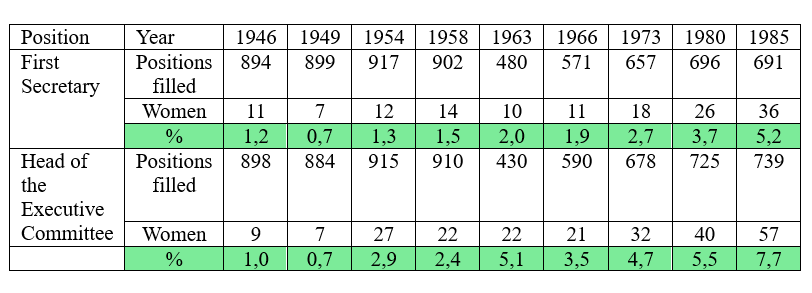
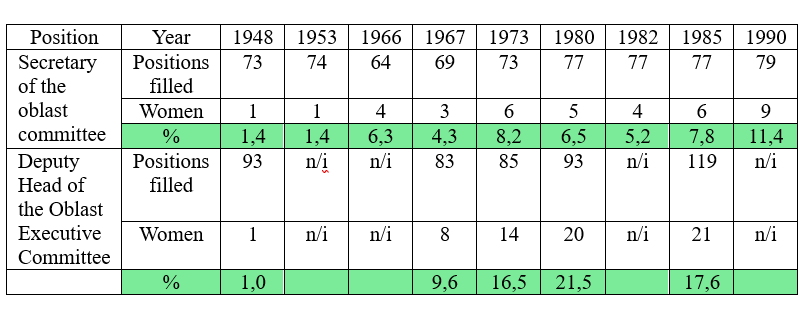
Table 1. Number of women serving as first secretaries of local party committees and as heads of local executive committees, 1946–1985. [9]

Among the rare instances of women heading executive bodies in Soviet Ukraine were, for example, Tamara Nauta, who served as head of the executive committee of the Novoarkhanhelsk City Council of Workers’ Deputies in the Kirovohrad oblast (1973–1987); Nina Selivanova, head of the Balaklava District Executive Committee of the city of Sevastopol in the Crimean oblast (1962–1984); and Svitlana Yevtushenko, who led the executive committee of the Kulykiv District Council of Workers’ Deputies in the Chernihiv oblast (1971–1975). Among party leaders, Zoya Nazarenko headed the Zhovtnevyi District Committee of the Odesa Party Organization (1961–1965), while Kateryna Polataylo served as first secretary of the Zolotonosha District Committee in the Cherkasy oblast (1981–1986).

Gender could also become an important personnel argument in unexpected contexts. One such episode was recalled by Petro Shelest, First Secretary of the Communist Party of Ukraine. In 1972, the first secretary of a district committee of the Communist Party of Ukraine in the Donetsk oblast faced the threat of dismissal due to compromising information about her father, who had allegedly served in the German police during the war. Shelest, defending her by pointing to the unreliability of the evidence and the fact that she had been a child during the occupation, also added that “there are very few women serving as first secretaries of district committees” and that she “works very well.”[10]

At the regional (oblast) level, women’s representation was even more dismal. From 1946 to 1991, no woman ever chaired the oblast committee of the Communist Party of Ukraine—the body that truly governed each oblast. The sole exception to this male monopoly over heads of oblast executive committees was Domnikiia (Dina) Protsenko. Born in 1926, Protsenko graduated from the Kherson Agricultural Institute (1946–1950). She began her career as a zootechnician at the “Soviet Land” state farm, serving five years in that role, before becoming director of the “Inhulets” state farm in Bilozerskyi district, Kherson oblast. Her rise through the party ranks started in 1956 as an instructor in the agricultural department of the Kherson oblast committee—a department she went on to lead in 1960. In 1968, she was appointed first deputy head of the Kherson Oblast Council’s executive committee. In the official endorsement from Petro Shelest, head of the republican party organization, Protsenko was praised as follows: “Comrade D. Y. Protsenko is disciplined, systematically works to improve her knowledge, gives lectures and reports on general political and economic topics, enjoys authority among party and Soviet activists, and is a member of the bureau of the oblast committee of the Communist Party of Ukraine.”[11] She held the position until 1978, after which she led the Ukrainian SSR’s State Committee for Nature Protection until 1988.

Women also did not hold the positions of second secretaries of oblast committees. They were sometimes represented among the third secretaries. It is important to note that in the hierarchy of a regional or local party committee, the first secretary wielded the most power, with the second secretary serving as his de facto deputy; the secretary (informally, the “third”) usually handled issues of ideology or other priority areas. Admittedly, the “female” ones were usually the latter (see Table 2).

Compared to the oblast committees, the number of women in the positions of deputy head of oblast executive committees was greater (note: the head of the oblast executive committee had a first deputy and several other deputies). Thus, in 1948–1952, Kylyna Kyslytsia served as secretary of the Chernihiv oblast committee of the CP(b)U, in charge of propaganda and agitation issues; Nadiya Kolomoyets worked as secretary of the Chernivtsi oblast committee for agriculture (1970–1975); Zoya Nazarenko was secretary of the Odessa oblast committee (1972–1976); and Iryna Mordvina was secretary of the Crimean oblast committee (1982–1988). Among the second-ranking figures in the oblast executive committees, one should mention Nina Pernach, deputy head of the Kharkiv oblast executive committee (1964–1980); Yevhenia Chabanenko, of the Kirovohrad oblast executive committee (1970–1986); Rymma Chepurina, of the Crimean oblast executive committee (1974–1986); and Hanna Maslai, of the Volyn oblast executive committee (1980–1984).

Table 2. Number of women in the positions of secretaries of oblast committees of the Communist Party of Ukraine and deputy heads of the oblast executive committees of councils of workers' deputies of the Ukrainian SSR, 1946–1990 [12]

One of the secretaries of the Volyn oblast committee was Nina Alekseeva, who apparently came to western Ukraine during its post-war Sovietization and personnel expansion from the East. In 1948, this 18-year-old Russian was appointed an instructor, later becoming head of the department and secretary of the Volyn oblast Komsomol committee. After graduating from the philology faculty of Lviv Pedagogical Institute in 1955, she worked as an instructor and deputy head of the propaganda and agitation department of the Volyn oblast party committee; from 1957 to 1959, she was in Kazakhstan for family reasons. Upon returning to Ukraine, she again held nomenklatura positions: secretary of the Novovolynsk and Lutsk city committees, and head of departments in the Volyn oblast committee. From 1969 to 1980, Nina Alekseeva served as secretary of the Volyn oblast committee for ideology.[13]

The party and state leadership of the republic remained almost entirely male. Among the six secretaries of the Central Committee of the Communist Party of Ukraine in the second half of the 20th century, only one woman served—Olha Ivashchenko (the Central Committee was headed by the first secretary, followed by the second secretary; the other four secretaries oversaw various sectors of industryed. note). Born in 1906, she began working in 1921 in agriculture, Komsomol bodies, and the National Library in Kyiv, followed by engineering positions at the Kyiv Electrotechnical Equipment Plant. After World War II, Olha Ivashchenko headed the Kyiv Tochelektroprylad Plant. She transitioned to party work in 1950, when she was appointed second secretary of the Kyiv Oblast Committee of the Communist Party of Ukraine.[14] Ivashchenko served as a secretary in the Central Committee from 1954 to 1965, ending her political career prematurely after attempting to warn Nikita Khrushchev about a conspiracy against him in mid-October 1964.

The highest level of female representation in the Ukrainian SSR’s government bodies was in the Supreme Soviet and local councils. In the Ukrainian SSR’s parliament, women’s representation rose from 26.9% (112 deputies) in 1947 to 36% (234 deputies) in 1985.[15] However, this trend should not be viewed as a natural process of women conquering political space, as the first alternative elections in 1990 resulted in just 2.7% women (13 deputies) being elected to the Ukrainian parliament.[16]

Deputies at all levels underwent nomenklatura selection, meaning their candidacies required prior party committee approval. Petro Shelest candidly revealed his views on regulating the gender and social composition of deputies at a 1970 Politburo meeting of the CPSU Central Committee: “We considered the issue of elections to the Supreme Soviet of the USSR, decided to additionally increase the number of workers by 2–2.5% and women by 1–1.5%. All this is pure formalism. What will happen if there are 20–40 more workers or milkmaids and pig-sitters among the deputies? Will this improve the activities of the ‘Soviet parliament’? I think not.” [17]

In local councils of the Ukrainian SSR, the proportion of women rose from 35.5% in 1953 to 48.3% in 1980.[18] In the Zaporizhia oblast council, women accounted for 15% of deputies in 1950 and 33.5% in 1969; in the Mykolaiv oblast council, the figures were 21% in 1955 and 38.7% in 1959. From 1975 to 1987, women made up 40–45% of the deputies in the oblast councils of the southern region.[19] While acknowledging the manual regulation of the personnel composition of elected bodies, Oleksandr Liashko explained the women’s quotas by the lack of an alternative: “perhaps someone knows a better way to guarantee the right of women—who comprise more than half of society—to participate in the work of state and political institutions?”[20]  The author of the memoirs did not explain why more than half of society was represented by at least a third of the deputies, and not half. As Yuliia Kuzmenko rightly concludes, “the existence of a women’s quota system confirms the fact of political discrimination against women rather than providing grounds to claim that the USSR was a pro-feminist state.”[21]

Assessing the composition of deputies in the Union Supreme Soviet, Carol Nechemias points out that women among them constituted a significant percentage of young and novice deputies. The image of a female deputy included the well-known milkmaid and prominent textile worker. “As participants in the work of the USSR Supreme Soviet, women were more visible than audible,” the researcher notes, testifying to their noticeable activity in discussing issues of health, education, and welfare (31% of women speakers on these topics), while they took limited part in debates on planning, foreign affairs, and the budget.[22] Historian Tatiana Moldavska confirms the social status of female deputies: “The absolute majority of women in the southern oblast councils were young collective farm workers: in the 1950s and 1960s, they made up an average of 40 to 70% of all elected women.” From the mid-1970s to the mid-1980s, women collective farmers accounted for 9–18% of female deputies, rising to about 25% by 1987. [23]

It was in the legislative bodies of the Soviet government that women achieved the highest representation. In 1985–1990, Valentyna Shevchenko headed the Presidium of the Supreme Soviet of the Ukrainian SSR. Her nomenklatura biography began in 1957, at the age of 22, with her appointment as secretary of the Kryvyi Rih city committee of the Komsomol. From 1960 to 1962, she served as secretary of the Dzerzhynskyi district committee of the Communist Party of Ukraine, then held high positions in the central bodies of the party and Soviet government: Secretary of the Central Committee of the Leninist Communist Youth Union of Ukraine (LKSMU), Deputy Minister of Education, Head of the Society for Friendship and Cultural Relations with Foreign Countries. After ten years of experience as deputy chairwoman of the Presidium  of the Supreme Council of the Ukrainian SSR, she headed it in 1985.[24] Valentyna Shevchenko attributed her successful career to hard work, initiative, responsibility, and intransigence towards injustice, specifically emphasizing her lack of “patrons.”[25] Historian Viktor Burenkov attributes her long tenure among the parliamentary leadership to her membership in the “Dnipropetrovsk” clan, whose representatives consistently headed the Presidium of the Supreme Council.[26]

Recalling the circumstances of her election, Valentyna Shevchenko emphasized the decisive role of Volodymyr Shcherbytskyi, First Secretary of the Central Committee of the Communist Party of Ukraine, who lobbied for her candidacy to the Central Committee. According to her, when he informed the Politburo members of the decision to recommend her as head of the Presidium of the Supreme Soviet of the Ukrainian SSR, “the room fell silent”; the Politburo’s preferred candidate “had not been expecting such an announcement.” She described her memory of the moment as follows: “Of course, a precedent had been set—the Chair of the Presidium of the Supreme Soviet of the Ukrainian SSR was now a woman! The second-highest position in the state.”[24] In a later interview, she added: “It was a big risk! Never has a woman in Ukraine held such a high position.”[28] With her sensational reaction, Valentyna Shevchenko actually confirmed the prevailing gender prejudices regarding female leadership.

Not many women held senior executive positions. From 1957 to 1963, Kateryna Zhurska headed the Ministry of Justice of the Ukrainian SSR, and from 1962 to 1967, Alla Bondar led the Ministry of Education of the Ukrainian SSR. As Vitalii Vrublevskyi, assistant to Volodymyr Shcherbytskyi, recalled, the impetus for more active appointment of women to senior positions came during a meeting between the head of the Communist Party of Ukraine and Syrian President Hafez al-Assad, who boasted of having six (according to the meeting transcript, two) female ministers: “Since then,” Vrublevskyi noted, “other things being equal, [Shcherbytskyi] has given preference to women.”[29]

Perhaps it was under the influence of that meeting that women began receiving more appointments in the government. At the suggestion of Prime Minister Oleksandr Liashko, Mariia Orlyk became his deputy in 1978. Born in 1930 in Russia, she had lived in Ukraine since 1933. After graduating from the Kirovohrad Pedagogical Institute, she taught and, starting in 1957, worked in government bodies, including the Kyiv oblast committee of the Communist Party of Ukraine and the city executive committee. From 1975 to 1978, Mariia Orlyk headed the presidium of the Ukrainian Society for Friendship and Cultural Relations with Foreign Countries.[30] In the government, she oversaw the ministries of education, culture, and health care, and unofficially handled organizing cultural leisure for the wives of high-ranking officials. [31]

In 1979, Oleksandra Lukianenko became Minister of Social Policy. Born in 1938, she graduated from the Dnipropetrovsk Medical Institute, worked in her specialty in Kryvyi Rih, and from 1970 served in the IV Main Department of the Ministry of Health of the Ukrainian SSR, which was responsible for the health of the republic’s leadership. From 1973, she worked in the Ministry of Social Security of the Ukrainian SSR, which she later headed.[32]

***

There were few women in the leadership of the central, regional, and local party and Soviet authorities in the Ukrainian SSR. Despite their generally high educational qualifications and numerical dominance among the population, they occupied only a minority of the top positions in party and state authorities, and in some places were completely absent.[33] It is also important to remember the hierarchy of management verticals in the Soviet system of power. There were few female leaders in the main party bodies, and almost none at the central level. Slightly more women held leadership positions in the executive bodies, which were subordinate to party committees of the same level. The councils of deputies at all levels, where the share of women reached 30–50%, played a largely symbolic role in the system of power. Publicly, this gender discrimination was articulated in rather mild forms and always without specific data.

Women were not considered full-fledged candidates for positions of power due to the deep patriarchal traditions of society, which habitually confined them to the private sphere and, at most, the social realm. Despite loud declarations of broad opportunities and equal rights, the Soviet leadership—almost exclusively male—did not recognize women’s potential as equal to its own. Women were often treated as unreliable actors in the management sector, lumped together with “youth” and “non-party” members. They were usually entrusted with ideology and culture, as well as the social sphere, where—despite some improvements in welfare during the second half of the twentieth century—the needs were never fully met. The absence of women in leadership positions was perceived as neglect, frivolity, male selfishness, or indiscipline, but not as a state or political problem.

[1] For more on the vicissitudes of Soviet gender policy in the interwar period, see: Zemziulina, N. “Ideological and Legal Mechanisms for the Formation of Gender Parity in the USSR [Ідеологічні та правові механізми формування ґендерної паритетності в СРСР].” Bulletin of Cherkasy University. Historical Sciences Series 29, no. 282 (2013): 132–38; Labor, O. “‘Effectiveness and Success’: Women and Bolsheviks in Communicative Interaction of the Second Half of the 1920s in Ukraine [«Ефективність і успішність»: жінки й більшовики у комунікативній взаємодії другої половини 1920-х рр. в Україні].” Scientific Works of the Ivan Ohienko Kamianets-Podilsky National University: Historical Sciences 33 (2021): 213–25; Voronina, M. “‘The Contract of a Working Mother’: Myth or Reality in the Ukrainian SSR in the 1920s–1930s [«Контракт працюючої матері»: міф чи реальність в УРСР 1920-х–1930-х рр.].” In Soviet “I” and Soviet “We” Between Ideology and Reality [Радянське «Я» та радянське «Ми» між ідеологією та реальністю], edited by Natalia Shlichta and Tatiana Borodina, 50–58. Kyiv, 2024.

[2]Ashwin Sarah, Introduction: Gender, state and society in Soviet and post-Soviet Russia Gender, State and Society in Soviet and Post-Soviet Russia, ed. by Sarah Ashwin. London and New York, 2000, 1; Smolnitska, M. “Gender: Interaction in the Ukrainian Soviet Society [Гендер: взаємодія в українському радянському соціумі].” In Social Transformations in Ukraine: Late Stalinism and the Khrushchev Era: A Collective Monograph [Соціальні трансформації в Україні: пізній сталінізм і хрущовська доба: Колективна монографія], edited by V. M. Danylenko, 442–43. Kyiv: Institute of History of Ukraine, National Academy of Sciences of Ukraine, 2015;
Oliinyk, N. “Soviet-Style Emancipation: Ukrainian Women in the Socialist Economy [Емансипація по-радянськи: українські жінки в соціалістичній економіці].” Hrani 23, no. 10 (2020): 11.

[3]Constitution (Basic Law) of the Ukrainian Soviet Socialist Republic of 1937 [Конституція (Основний Закон) Української Радянської Соціалістичної Республіки 1937 р.], accessed at the Verkhovna Rada of Ukraine website, https://zakon.rada.gov.ua/laws/show/001_001/ed19370130#Text

[4] Constitution (Basic Law) of the Ukrainian Soviet Socialist Republic of 1978 [Конституція (Основний Закон) Української Радянської Соціалістичної Республіки 1978 р.], accessed at the Verkhovna Rada of Ukraine website, https://zakon.rada.gov.ua/laws/show/888-09/ed19780420#Text.

[5] History of Civil Service in Ukraine: In 5 vols. [Історія державної служби в Україні: у 5 т.], ed. T. V. Motrenko and V. A. Smolii; editorial board led by S. V. Kulchytskyi; Main Department of Civil Service of Ukraine; Institute of History of the National Academy of Sciences of Ukraine (Kyiv: Nika-Tsentr, 2009), vol. 5: Documents and Materials. Book 1. 1914–1991, comp. H. V. Boriak et al., 516, 518.

[6] 26th Congress of the Communist Party of the Soviet Union: February 23 – March 3, 1981. Verbatim Report. Vol. 1 [XXVI съезд Коммунистической партии Советского Союза, 23 февр. – 3 марта 1981 г. Стенографический отчет. Т.1] (Moscow: Politizdat, 1981), 73, 91.

[7] Central State Archive of Public Organizations of Ukraine (TsDAGOU) [Центральний державний архів громадських об’єднань України], 1/25/3272: 125.

[8] TsDAGOU, 1/2/971: 4.

[9] Calculated from: TsDAGOU, file 1/ inventory 67/ case 29: 21, 33, 52; case 7:24, 32, 44, 62, 64; case 482:1; case 491:1; case 494:1; case 504:1; case 505:1; case 593:1, 28; case 599:56, 110; case 639:1; case 640:6; case 643:41; case 644:1, 25; case 685:15; case 686:1; case 687:2; case 689:1, 27, 41; case 847:29; case 1166:9, 10, 11; case 1173:57, 60, 61, 94, 94а, 95; case 1226:21; case 1227:28; case 1228:27; case 1247:105, 132, 152.

[10] Petro Shelest, “The Real Judgment of History Is Still Ahead”: Memoirs, Diaries, Documents, Materials [Петро Шелест: “Справжній суд історії ще попереду”. Спогади, щоденники, документи, матеріали] (Kyiv: Geneza, 2003), 370.

[11] TsDAGOU, 1/25/168: 73.

[12] Calculated from: TsDAGOU, 1/67/52:25, 27, 29, 103; case 395;1; case 683:3; case 696:3; case 703:2; case 835:17; case 847:2, 3; case 1173:50, 90; case 1179:52; case 1223:109; case 1247: 79; Kuzmenko, Y. Party-Soviet Nomenclature in the Context of Socio-Political Transformations in the Ukrainian SSR (1985–1991) [Партійно-радянська номенклатура в умовах суспільно-політичних трансформацій в Українській РСР (1985–1991 рр.)]. Dissertation for the degree of Candidate of Historical Sciences, 07.00.01 – History of Ukraine. Chernihiv, 2012, 371; Lozitskyi, V. S. Politburo of the Central Committee of the Communist Party of Ukraine: History, People, Relations (1918–1991) [Політбюро ЦК Компартії України: історія, особи, стосунки (1918–1991)]. (Kyiv: Heneza, 2005), 185.

[13] TsDAGOU, 1/25/168: 212.

[14] Lozitskyi, V. S. Politburo of the Central Committee of the Communist Party of Ukraine, 185.

[15] Danylenko, V. Features of Soviet Parliamentarism in Ukraine (Second Half of the 20th Century) [Особливості радянського парламентаризму в Україні (друга половина ХХ ст.)]. In History of Ukraine. Little-Known Names, Events, Facts: Collection of Articles, vol. 36 [Історія України. Маловідомі імена, події, факти]. Kyiv: Institute of History of Ukraine, NAS of Ukraine, 2010, 112.

[16] Tishko, I. Women in Politics of Ukraine: 100 Years of Evolution [Жінки в політиці України: 100 років еволюції]. “Гендер в деталях,” 31 January 2019. https://genderindetail.org.ua/season-topic/polityka/zhinki-v-polititsi-ukraini-100-rokiv-evolyutsii-134913.html

[17] Shelest, Petro. “The Real Judgment of History Is Still Ahead, 323.

[18] Moldavska, T. Regional Councils of Deputies in the System of Power Relations in Soviet Society, 1947–1990 (Based on the Example of Southern Regions of the Ukrainian SSR) [Обласні ради депутатів у системі владних відносин радянського суспільства у 1947–1990 рр. (на прикладі південних областей УРСР)]. Dissertation for the degree of Candidate of Historical Sciences. Zaporizhzhia, 2010, 109–110.

[19] Ibid.

[20] Liashko, A. The Burden of Memory: Trilogy: Memoirs [Груз памяти: Трилогия: Воспоминания]. Kyiv: ID “Delovaya Ukraina,” vol. 3, part 1: On the Steps of Power [На ступенях власти], 2001, 49.

[21] Kuzmenko, Y. Women in the Ukrainian Party-Soviet Nomenclature of the Late Soviet Period in the Context of Gender Order Transformations in the USSR [Жінки в українській партійно-радянській номенклатурі пізньорадянського періоду в контексті трансформацій гендерного порядку в СРСР]. In Chronotopes of History. Studies in Honor of Petro Vasylovych Kyrydon (12.03.1961–27.01.2019): Collection of Scholarly Works, ed. and scientific editor A. M. Kyrydon [Хронотопи історії. Студії на пошану пам’яті Петра Васильовича Киридона (12.03.1961–27.01.2019]. (Kyiv: Nika-Center, 2021), 344.

[22] Nechemias, Carol, Women’s Participation: From Lenin to Gorbachev,  Russian women in politics and society, edited by Wilma Rule and Norma C. Noonan. (Westport, Conn.: Greenwood Press, 1996), 22.

[23] Moldavska, Regional Councils of Deputies, 110.

[24] Lozitskyi, Politburo of the Central Committee of the Communist Party of Ukraine, 287.

[25] Shevchenko, V. My Years, My Wealth: Memoirs, Reflections, Answers [Мої літа, моє багатство: Спогади, роздуми, відповіді]. (Kyiv: Prosvita, 2005), 34.

[26] Burenkov, V. The Dnipropetrovsk Clan among the Political Elites of the Ukrainian SSR and the USSR (Late 1920s – Early 1990s) [Дніпропетровський клан серед політичних еліт УРСР та СРСР (кінець 1920-х – початок 1990-х рр.)]. (Zaporizhzhia: Publishing House “Helvetica,” 2020), 187.

[27] Shevchenko, My Years, My Wealth, 163.

[28] Shevchenko, Valentyna. “I Was Offered to Return to Politics. No, Thank You” [ “Мені пропонували повернутися в політику. Ні, дякую”]. Ukraiina Moloda, 12 March 2010. https://umoloda.kyiv.ua/number/1613/169/56799

[29] Vrublevskyi, V. Volodymyr Shcherbytsky: Truth and Myths: Notes of an Assistant: Memoirs, Documents, Rumors, Legends, Facts [Владимир Щербицкий: Правда и вымыслы: Записки помощника: Воспоминания, документы, слухи, легенды, факты]. (Kyiv: “Dovira,” 1993), 50–51.

[30] Orlyk, Mariia Andriivna and I. V. Savchenko. Encyclopedia of Modern Ukraine [Енциклопедія Сучасної України]. Edited by I. M. Dziuba, A. I. Zhukovskyi, M. H. Zhelezniak, et al. Kyiv: Institute of Encyclopedic Research, NAS of Ukraine, 2022, updated 2025. https://esu.com.ua/article-75781.

[31] Liashko, A. The Burden of Memory, 246.

[32] TsDAGOU, 1/2/1146: 180.

[33] In the social structure of Ukraine during 1949–1989, women predominated numerically: in 1949, they accounted for 57.3%, in 1989 – 53.5%. See Gladun, O. Essays on the Demographic History of Ukraine in the 20th Century [Нариси з демографічної історії України XX століття]. Kyiv: M. V. Ptukha Institute of Demography and Social Research, NAS of Ukraine, 2018, 116.


Translation into English: Yuliia Kulish

Periods

Primary Sources

Documents (8)

icon
Gender and Power: The Communist Party of Ukraine on Women in Leadership, 1960
The Resolution of the Secretariat of the Central Committee of the Communist Party of Ukraine (CPU) “On Serious Shortcomings in the Promotion of Women to Leadership Positions”, dated July 4, 1960, noted a significant gender imbalance in Soviet state administration. The CPU placed the blame for the insufficient presence of women in leadership on party committees and the heads of Soviet and economic governing bodies, who, it stated, “underestimate the full importance of this issue.” In the document, absolute and relative figures were presented together only when describing women’s educational level, whereas in all other cases, the share of women was given only in relative terms. Such manipulation of statistics made it impossible...
icon
Valentyna Shevchenko on Her Leading the Presidium of the Supreme Council of the Ukrainian SSR
Valentyna Shevchenko (1935–2020) worked as a senior pioneer leader and a secondary school teacher, later holding leadership positions in the Komsomol and party bodies of the Ukrainian SSR. She served as Deputy Minister of Education and as head of the Society for Friendship and Cultural Relations with Foreign Countries. During the Perestroika period, she rose to the position of Chairwoman of the Presidium of the Supreme Council of the Ukrainian SSR. In independent Ukraine, Valentyna Shevchenko led several civic organizations engaged in humanitarian issues. Her memoirs cover the period from her childhood to the first decade of Ukrainian independence, becoming more detailed as they approach the present. She explained that her motivation for...
Image for Gender and Soviet Cadre Policy in 1960s: Transcript of First Secretaries of Regional Party Committees Meeting
Gender and Soviet Cadre Policy in 1960s: Transcript of First Secretaries of Regional Party Committees Meeting
The meeting of the heads of regional party committees and the leaders of republican executive bodies, held on November 17, 1965, was dedicated to organizational and party work within the CPU (Communist Party of Ukraine) in preparation for the “worthy reception of the 23rd Congress of the CPSU,” scheduled for March 1966. Attendees heard reports from the head of the Ukrainian party organization, Petro Shelest, as well as from nine regional CPU committees. In his speech, an excerpt of which is published below, Petro Shelest addressed preparations for what he called a “momentous event in our lives,” a “landmark date in the life of our Party and our people – the 23rd Congress...
icon
Volodymyr Shcherbytskyi on Male Domination in Soviet Leadership, 1977
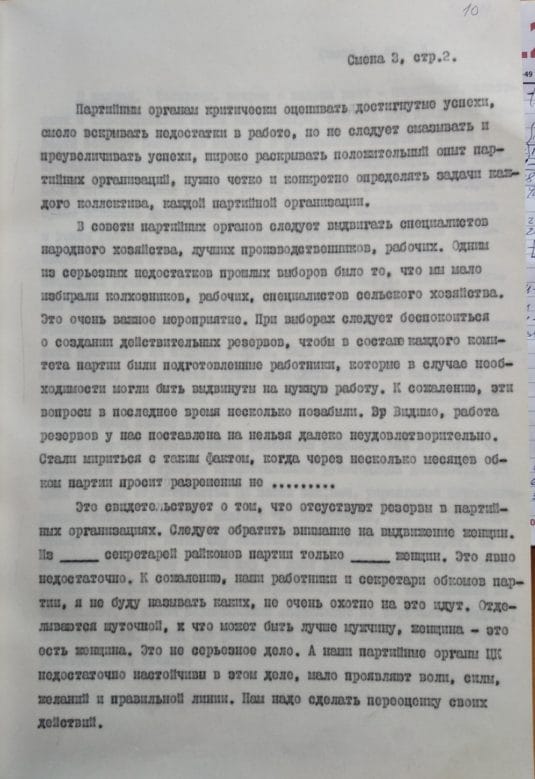
At a meeting with the heads of the Communist Party of Ukraine and state bodies, as well as regional leaders, current issues of the republic and planning for 1978 were discussed. After several speakers, the First Secretary of the Central Committee of the CPU, Volodymyr Shcherbytskyi, took the floor. Listing shortcomings in the current implementation of economic plans and in planning for the coming year, he called on those present to consider candidates for election at the upcoming party conferences and to create a reserve of personnel, particularly among women. Among the one hundred people present at the meeting, there was only one woman — Domnikiia Yosypivna Protsenko, head of the Kherson Regional...
Image for Women Deputies about their Goals in the Supreme Soviet of the Ukrainian SSR, 1990
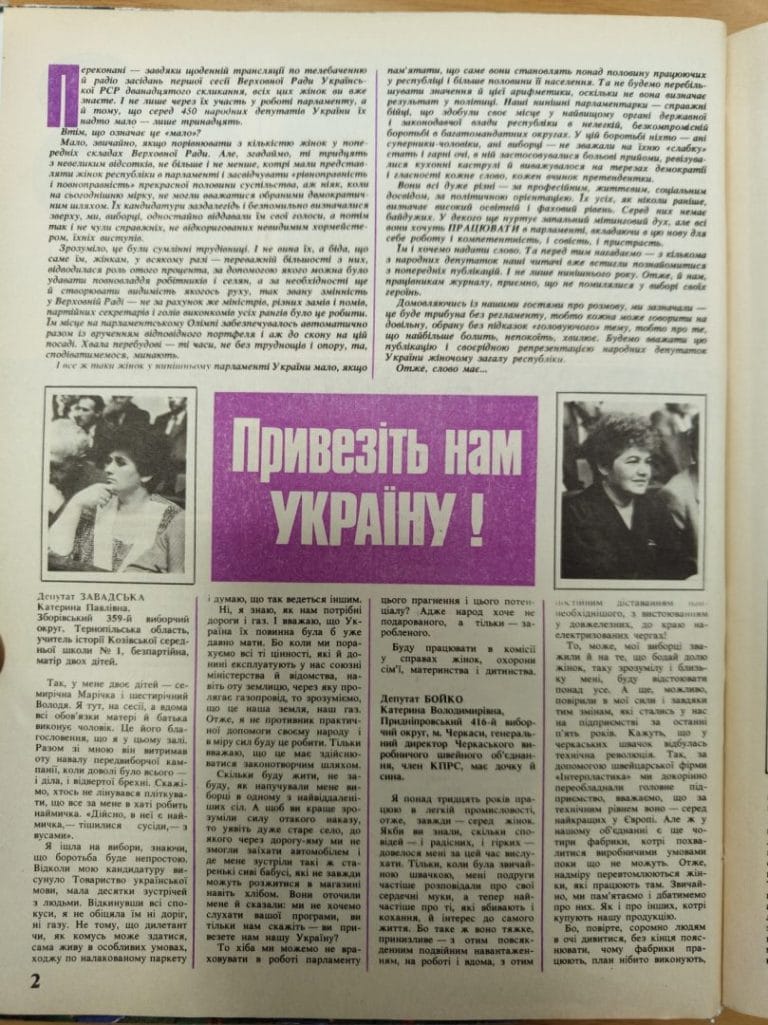
Women Deputies about their Goals in the Supreme Soviet of the Ukrainian SSR, 1990
After the elections to the Supreme Soviet of the Ukrainian SSR of the 12th convocation in March 1990, female representation in parliament decreased from 234 (36%) deputies to 13 (2.7%). One of the reasons for this was the introduction of alternative voting, which brought real competition to the elections, and thus the practice of previous "women's quotas" no longer worked. Correspondent Lyudmila Shushrina, in the preface to the article "Bring us our Ukraine!", bitterly acknowledged the formal role of women in the previous convocations of the supreme councils, where their presence was meant to demonstrate "equality and full citizenship," creating the appearance of the workers' and peasants' sovereignty, but they rarely got re-elected...
Image for Chair of the Presidium of the Supreme Soviet of the Ukrainian SSR Valentyna Shevchenko on Women in Politics: An Interview from 1989
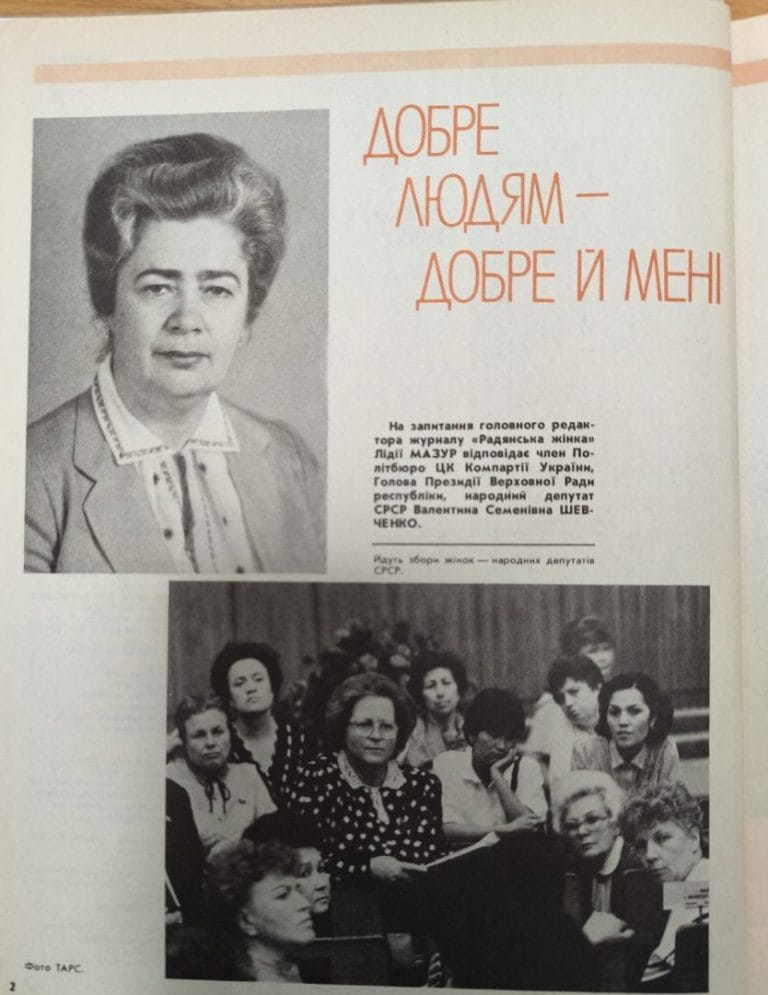
Chair of the Presidium of the Supreme Soviet of the Ukrainian SSR Valentyna Shevchenko on Women in Politics: An Interview from 1989
Valentyna Shevchenko (1935–2020) had a distinguished Soviet political career. She began her professional path in 1954 as a school Pioneer leader in Kryvyi Rih. Three years later, she transitioned to work in the Komsomol, and later moved into Party structures. In 1962, she assumed the position of Secretary of the Central Committee of the Leninist Communist Youth Union of Ukraine (LKSMU). From 1975 to 1985, Shevchenko served as Deputy Chair of the Presidium of the Supreme Soviet of the Ukrainian SSR, and in 1985 she became its Chair — making her, under the 1978 Constitution of the Ukrainian SSR, the head of the republic’s highest state authority. Her interview, published in the newspaper...
Show more Collapse all

Images (0)

Show more Collapse all

Videos (0)

Show more Collapse all

Audio (0)

Show more Collapse all

Recommended literature

Sources:

  • Vrublevskii V. Vladimir Shcherbitskii: Pravda i vymysly: Zapiski pomoshchnika: Vospominaniia, dokumenty, slukhi, legendy, fakty. Kyiv: Dovira, 1993.

  • Liashko A. Gruz pamiati: Trilogia: Vospominaniia. Kiev: ID “Delovaia Ukraina”, 2001, kn. 3, ch. 1: Na stupeniakh vlasti.
  • Petro Shelest: “Spravzhnii sud istorii shche poperedu”. Spohady, shchodennyky, dokumenty, materialy. Kyiv: Heneza, 2003.
  • Shevchenko V. Moi lita, moje bahatstvo: Spohady, rozdumy, vidpovidi. Kyiv: Prosvita, 2005.
  • Istoriia derzhavnoi sluzhby v Ukraini: u 5 t. / [O.H. Arkusha, O.V. Boiko, Ye.I. Borodin ta in.; vidp. red. T.V. Motrenko, V.A. Smolii; redkol.: S.V. Kulchytskyi (ker. avt. kol.) ta in.]; Holov. upr. derzh. sluzhby Ukrainy, In-t istorii NAN Ukrainy. K.: Nika-Tsentr, 2009. T. 5: Dokumenty i materialy. Knyha 1. 1914–1991, Uporiad.: H.V. Boriak (ker. kol. uporiad.), L.Ia. Demchenko, R.B. Vorobei). 824 s.

Recommended literature: 

  • Kuzmenko Yu. Zhinky v ukrainskii partiino-radianskii nomenklaturi piznioradianskoho periodu v konteksti transformatsii hendernoho poriadku v SRSR, Khronotopy istorii. Studii na poshanu pamiati Petra Vasylovycha Kyrydona (12.03.1961–27.01.2019): zb. nauk. pr., uporiad. i nauk. red. d.i.n., prof. A.M. Kyrydon. Kyiv: Nika-tsentr, 2021, 329–344.
  • Stiazhkina O. Henderni vymiry radians’koi povsiakdennosti 1960 – seredyny 1980-kh rokiv, Kraieznavstvo, 2010, №3, 214–223.
  • Smolnitska M. Hender: vzaiemodiia v ukrainskomu radianskomu sotciumi, Sotsialni transformatsii v Ukraini: piznii stalinizm i khrushchovska doba: Kolektyvna monohrafiia, vidp. red. V.M. Danylenko. Kyiv: In-t istorii Ukrainy NANU, 2015, 442–443.
  • Voronina M. “Kontrakt pratsiuiuchoi materi”: mif chy realnist v USRR 1920–1930-kh rr., Radian­ske “ia” i radians’ke “my” mizh ideolohiieiu i realnistiu, zah. red. Natalii Shlikhty, upor. Tetiany Borodinoi. Kyiv, 2024, 50–58.
  • Labur O. “Rezultatyvnist ta uspishnist”: zhinky ta bilshovyky v komunikatyvnii vzaiemodii druhoi polovyny 1920-kh rr. v Ukraini, Naukovi pratsi Kamianets-Podilskoho natsionalnoho universytetu imeni Ivana Ohiienka: istorychni nauky. 2021, vyp. 33: 213–225.
Comments and discussions