PARTING WITH DAD
We couldn’t all walk together because Dad struggled to keep up and kept falling behind. At the crossroads, wheat had already been laid out in the shape of a cross, so we quickened our pace. It was difficult and awkward for Mom to walk with Antos, who was still too small to hold onto her neck, so Marysia helped her. We emerged into the fields beyond Kuty, but our acquaintances—the refugees from Stara Huta—were nowhere in sight. They had a cart drawn by a single horse; the children and those too tired to walk usually rode in it. That was the case with Lucina, Petrus’s wife and our closest neighbor, who was carrying her son Edzio. Our Genia was brave, but Marysia had no rest. I was very frail; it was a blessing I could even walk on my own with my little bundle.
We kept looking back to see if Dad was following us, as we had already gone quite far toward Shumsk, but neither our fellow fugitives nor Dad with his trio were in sight. Mom and Yuzio were glad they had gone ahead, since the rumbling of the cart on the stone road could be heard from far away. As we later learned, they were trying to avoid the main road by taking shortcuts along the side roads.
But still, what had happened to Dad? We didn’t know whether our dog Azor had run after Dad or had turned back to guard the house. Meanwhile, the closer we got to Shumsk, the more fear gripped us. The burning villages lit up the road so brightly that we were as visible as the palm of a hand. Eventually, we had to walk quite close to those burning houses and could even hear the voices of dying people.
Mom barely made it to Shumsk with us, but she didn’t go much further into town. She simply turned right toward a farmstead. There was a small garden, the gate was open, and dawn was slowly breaking. Birds were chirping in the trees, rejoicing in the warm morning. Without waiting for the owner’s permission, we sat down on the soft grass. The younger children fell asleep while we older ones began to pray that Dad would reach us safely.
Early in the morning, the owner woke up—an elderly man named Tsentkevych who kept goats. He invited us inside, helped lift the children from the grass, and laid them on the bed. He brought us water to wash up and treated us to tea and goat’s milk.
After a while, we heard screams and crying from the street. We went out into the yard and saw the tortured being carted down the road toward the cemetery, a river of blood flowing behind the carts—it was a terrifying sight. The church was filled with people who had managed to escape; among them, it was easy to recognize those who had lost their minds. We learned that the village of Zaluzhzhia near Shumsk had been burned to the ground, and its residents tortured.
We were still waiting for Dad, although Mom had begun to doubt that he was still alive. Around ten o’clock, our dog Azor ran into the yard, barking joyfully, and behind him came Dad—so exhausted he was barely recognizable. Mom cried out, “He’s alive!” He had indeed miraculously escaped death.
HOW DAD SURVIVED
He hadn’t even reached the intersection when he suddenly heard a continuous roar and recognized Ukrainian words. Looking around, he saw a wave of Ukrainians coming toward him, one after another. By God’s grace, there was a lake nearby. Dad left the cow and the bucket of honey behind and, as quickly as he could, jumped into the water. He dove deep under a bush, holding onto the branches. Quite some time passed before the voices stopped echoing, the flashlight beams faded, and the mob finally moved on. Dad never found out what happened to the cow in that darkness; apparently, this time they managed to take all three after all.
Dad used to say: I always thought I wasn’t afraid of anything, but I was afraid to come out of my hiding place. When I finally did, shivering from the cold, I realized that a long road still lay ahead. Where was my family? Where were the refugees from Stara Huta? Everyone was far away, and wherever I looked, the sky was red with burning villages. He told how he doubted he’d make it to Shumsk, as the road was becoming more and more dangerous. I trudged along until suddenly I heard a dog barking—and there was Azorek, right at my feet, overjoyed to have found his master. That’s how Azorek led him back to his family, who had feared the worst: that Dad might have been in Zaluzhzhia during the killings.
You can imagine our joy when we, a group of children, saw our father alive and already somewhat dried off from the mud. Mr. Tsentkevych offered our exhausted newcomer some goat’s milk, but Dad, thanking him, asked only for clean water. For food, we had bread, lard from home, and tea, but what mattered most was safety and rest. Although the banderites feared the Germans, and there were already too many people in Shumsk for raids to be easily carried out, no one could guarantee our safety.
A few days into our stay with Mr. Tsentkevych, we received a telegram from my brother Janek in Mizoch stating that on a certain day (I don’t remember exactly which one) there would be transportation from Kremenets to Germany, and asking us to come to Kremenets as soon as possible. Dad went straight to the German unit and found out they could take us to Kremenets as early as the next day. It was a shame to leave, because our Azorek had run off home and hadn’t returned. Dad went to a Ukrainian neighbor who lived near Mr. Tsentkevych and asked him to take the dog in if he saw a black dog at Mr. Tsentkevych’s house. Dad also told him the dog’s name was Azor and that he wasn’t aggressive.
IN KREMENETS
The Germans transported us to Kremenets in military GAZ trucks. Once there, we learned that our transport to Germany would depart from Zdolbuniv. I no longer remember the exact date, but I do recall standing on the platform in Zdolbuniv before sunset, waiting for the train. We had also traveled to Zdolbuniv by train, but a terrible ordeal awaited us there.
According to the schedule, the train was due any minute, but an announcement over the loudspeaker informed us that it was delayed because several cars had been uncoupled following an attack and killings by the banderites. We no longer expected to see Janek and Genia. It was reported that only the locomotive and two cars had survived. People cried and waited with us, not knowing what we might witness. At last, we saw the locomotive approaching very slowly, having been shot at. We ran toward it rather than waiting for it to come closer, but had to turn back—no one was visible in those cars.
After a long wait, watching people get off the train, we finally saw Genia, holding a small bundle, and Jan, holding a small package. Genia wore a dark blue dress with white polka dots. It’s hard to put into words how happy we were to see them safe and sound.
As the sun was setting, we had to consider where to spend the night. Those not planning to travel farther scattered to nearby houses, asking for a place to stay, even for just one night. We were taken in by a very poor family who understood we had nowhere else to go and let us stay. It was impossible to remain there long, though, because they didn’t even have any food. Mom took little Antos and went to ask the wealthier people for help. Janek and Genia, meanwhile, ended up with a family where they could remain without having to move again.
The people Mom turned to for help warned her not to leave the city, especially in the direction of the village of Vidla, because Poles were being killed there. It was a childless Czech family. They insisted that Mom leave little Antos with them. But the woman found out where my mother lived and came to see her, trying to convince her to leave the child—a child who, she said, had a chance of surviving. My mother flatly refused: “I will not give up my son; no matter what fate befalls us, I will not give him to anyone.” The woman fed us bread, milk, vegetables, and fruit. She returned again, hoping Mom had changed her mind and would secure a future for her child.
After thanking them, we had to say goodbye to the family who had helped us recover, and set off once more on our journey into the unknown. When we left, it was very hot. The sun beat down mercilessly, but our path was somewhat shaded. Small trees, densely covered with paradise apples (similar to cherry plums), shielded us from the sun. Following this path, we reached a park in the forest with benches; we felt a welcome coolness, and the children ran joyfully because there was a place to sit while they waited to see where Mom would settle. Meanwhile, Dad went to ask people to give us, as he put it, “a roof over our heads,” and we’d figure out the rest ourselves. After all, Yuzio and I could help the older people and earn money for food that way.
THE BARRACKS IN RIVNE
Suddenly, three armed Germans appeared beside us. One of them asked in Polish, “Don’t you have a home? Come with us.” Then, under his breath, he added, “You’ll have something to eat and a place to sleep.” We walked for a long time; the children struggled to keep up, and so did Mom and Antos. Yuzio helped carry our luggage, since we still had plenty. The Germans walked ahead, making sure we followed.
Finally, they stopped near two cars and told us to get into one of them. We were so exhausted that we didn’t care where they were taking us. I don’t remember how long we drove, but when we finally stopped, one of the Germans opened the door and told us to get out. We had arrived at the Rivne barracks. That’s how our new life began in the camp, which already housed several thousand refugees from various cities. We had a temporary roof over our heads and bunk beds, but the food situation varied. The main question was: what would they do with us?
We had to get up at 6 a.m. for roll call. All the families went out to the square and lined up in columns: father, mother, the oldest child, and each subsequent child. A commission of several Germans went around inspecting the families—those with more adults and blond-haired people were sent to barracks in Germany. It’s unclear exactly what criteria they used to decide who would be sent to Auschwitz, Majdanek, or other extermination sites.
During the day, only mothers with small children and the elderly remained in the barracks. I don’t know why there were so few elderly people. The Volksdeutsche assisted the Germans with work assignments and transportation. Mostly men, young people, and some women were sent out to perform various types of labor. Working in the fields was very dangerous—Ukrainians might approach and kill someone, often after first killing a German or Volksdeutscher guard.
The “meal” in the barracks consisted of a cup of black coffee and two slices of bread (for the elderly, with jam or margarine) in the morning, and the same in the evening. There were no lunches. My mother, having a small child, couldn’t work cleaning the barracks, so whenever she had free time and felt hungry, she would go out into the street to beg for alms, especially for milk for the children—she only ventured into town. Within a few weeks, only a few families remained, mostly those with the sick, the elderly, or the disabled. Our family—my father, already elderly; my mother with a small child; three slightly older children (I was counted among the young ones because I was small); Marysia, who, though 19, was almost raven-haired; and short, resolute, dark-haired Yuzio—were, of course, not suitable for the trip to Germany. The Germans probably thought, “Poor things—what are we going to do with them?” A decision had to be made, as the Hungarian army was advancing day by day.
Early in the morning, a car reeking of gasoline pulled up—the same one that used to take us to work. We were told to get in, and they drove us off into the unknown.
ZDOLBUNIV PRISON
They brought us to the prison in Zdolbuniv: a high fence, several barracks-style buildings, a crowd of children in the courtyard, and a few German guards. Two families, including ours, were crammed into a cell barely 15 square meters. We could hardly sleep without lying on top of one another. To make matters worse, a little girl in our group was gravely ill—she died the next day. I don’t recall the exact illness, but it was an infectious disease, possibly typhus. Every day, they carried out the dead and buried them behind the fence.
It was easy to get sick under such conditions: we relieved ourselves where we were—children used tin cans or empty food containers, while adults waited until morning. At 6 a.m., the doors would open, and shouts would ring out: “Alles antrete,” get out quickly; everyone hurried, but not everyone could fit through the door. Those in the back were struck with whips on their legs and backs. I also recall that in Rivne, before 6 a.m., a Volksdeutscher named Kozmial would run around with a whip, dragging still-sleeping children out of their beds.
The prison food was almost the same as in the barracks: bread and black coffee without sugar, but it was a little better because we were given porridge for lunch every day. Four of us went to work, while my mother and her four children stayed behind; along with the other mothers, they were assigned as cleaners. We weren’t allowed outside the fence. But once, while in the courtyard with the children, Mom heard a voice from behind the fence: “Mom, Mom, Mommy…” She recognized Janek’s voice and quickly went to a small hole in the board where a twig had fallen through.
Through that hole, Janek saw Mom and the children. He shared something very important: the next day, at the same time (it was evening), Mom, Dad, and the children should come to the gate—because they would be letting us out. They had reached an agreement with the prison’s chief warden, a German, who had promised to do so. When we returned from work—Dad, Yuzio, Marysia, and I—and Mom told us the news, we could hardly believe we’d only have to spend about ten more hours in this stinking place, and that we wouldn’t have to fear the whips anymore.
ESCAPE FROM PRISON
Early September 1943: tonight, we’re escaping from prison. A German soldier arrived and opened the heavy gates. Since there were several of us and the opening was narrow, it took a few minutes to get through. “Los, los, schnell, schnell”—faster, faster—we heard him say. We stepped out onto a dirt road, unsure whether to go right or left. As far as I remember, we turned left because we could see streetlights in that direction. We walked nearly three kilometers: Dad, Yuizo, Mom carrying Antos in her arms, Mania, Stasia, Elia, Yurek, and Genia, all taking turns—Dad took the bundle from Yuizo, Yuizo took Genia, and Marysia carried Antos. Gradually, we drew closer to the town, leaving the prison far behind us.
We considered seeking social welfare assistance, so Mom wanted to reach the church as quickly as possible, hoping the priest would receive us before he went to sleep. As we approached Zdolbuniv, we noticed many German soldiers already present.
THE BARRACKS AT THE CEMENT FACTORY
Here, we had already fallen into a trap—and it happened so easily. Seeing a group of people with luggage and several small children, the Germans put us in a car and took us to the barracks near the cement factory. Three families were already living there: the Vozniaks, a family of Jehovah’s Witnesses whose child had recently died; the Bzhuzhkos from Mokszyszow near Tarnobrzeg; and the Zhyhadlos. We had a new roof over our heads again—something Dad had worried about so much—but I can’t even remember if we had as much as a piece of dry bread for dinner. If I’m not mistaken, Mom brought a piece of bread with margarine from prison that day.
The beds were bunk beds with hay mattresses. After an eventful day and prayer—finally outside the prison (though were we really safe from the banderites?)—we fell asleep and would likely have slept even longer, but a German and a Volksdeutscher woke us up to take the adults off to work, leaving the mothers with the children.
Nearby, behind a tall barbed-wire fence and iron gates guarded by soldiers, stood several wooden barracks where German soldiers lived. The gate bore the inscription “Firma tdt,” and about a dozen soldiers wore red armbands with a black skull on their sleeves—an image that terrified us. Not far from this compound was a railroad embankment where additional tracks were to be laid.
The work was grueling: wagons would arrive filled with earth that I couldn’t even move with a shovel because the ground was as hard as stone. I was already considered an adult, but I still had only a child’s strength. I kept wondering why the Hungarian soldier pacing next to me had the audacity to urge me on with the words “arbeit, arbeit.” I looked at him in disbelief—could he really not see that I was barely able to unload just a few clumps of earth from the wagon?
Each day dragged on as if it were a year. On top of everything, the food was terrible. Ukrainian cooks made soups from the leftovers the Germans left behind, using scraps of fried eggs or sausage scraped from pans. Dad, Yuzio, and Mom somehow managed to stomach the food, but I couldn’t eat it. As soon as we approached the benches for lunch, I would vomit—even before taking a bite. After a few days, I got sick; I couldn’t eat—I didn’t even like bread anymore, which had always been my favorite food. There was a Hungarian army unit near our barracks, and Mom would bring bread and milk from them every day. They were kind and compassionate when they saw a mother with a child, so they always shared bread, milk, or canned goods with us.
No one thought about the mothers with children who had stayed behind—there were four of them with sixteen children in total. The Vozniaks had six children; the Bzhuzhko family had two; the Zhyhadlo family had two; and there were four of us. Each family had to search for food, begging from people who warned them not to go beyond the city limits, because banderites were killing “Lyakhs” there.
ILLNESS
Let me tell you about my illness. At the time, I was so sick I couldn’t walk. I didn’t go to work; I lay on the bottom bunk of a three-tiered bed. Around nine o’clock, the door creaked open, and a moment later a large dog was sitting beside me. Someone called the dog, and he jumped off the bed. Standing a few steps away was a two-meter-tall German man—when he left, he had to bend almost in half to fit through the door. He was the boss of the “tdt” company, a man named Shpeck. Alongside him stood a Volksdeutsch man half his height. Both personally came to speak with an ordinary “worker” whose absence had caused the company significant losses. However, they both agreed I was indeed sick—“krank, krank.”
The Volksdeutscher helped me out of bed and took me to a German doctor, whose door was marked with a black skull. Despite this, the doctor was very pleasant and attentive during the examination. He stroked my black, curly hair, then showed me his own—just as black, but straight—and gave me medicine in pills and drops. He asked the Volksdeutscher to explain how to take them and told me I needed to eat. He also gave me a sick note—I no longer remember for how long—but I didn’t end up needing it.
THE ESCAPE AND HIDING IN THE SPARE CAR
A few days later, my parents decided they had to escape and break free from that torment. Whenever my dad spoke about “Firma tdt,” he would say, “Firma tdt: work like an ox, but eat like a cat.” Even Ela remembered how foul the yard was, with its lake, dirty water, a dead cow, and all sorts of filth floating around—and nobody cared. I don’t remember the exact date, but it was sometime in late September. After midnight, we set off toward the train station, though not to the station itself. Dad had noticed some spare railcars while returning from work on the railroad embankments. Soon, we found ourselves among those railcars, and there was one where we were supposed to live. It was hard to open. Dad shone his flashlight inside—there was a lot of straw, as if someone had untied several sheaves. A small round stove stood inside, with a pipe lying on the side that led outside, and a small window opening Dad had already spotted earlier. We were tired and hungry, but fell asleep instantly.
In the morning, we were awakened by the rumbling of wagons passing one by one along two ropes, hauling sand from the high embankment to the cement plant. The children really enjoyed the sight. Dad and Yuzio went to the large vegetable garden, where they quickly found work, and by lunchtime Mom had enough to cook a meal. Yuzio brought back potatoes, cabbage, and other vegetables. There was no good bread, nor any milk. We were afraid to go outside because the Germans might spot us. Fortunately, our railcar was in the middle of many others, with so many on the outer tracks. Zdolbuniv was famous for its large rail junction.
We rested in the car, while Dad and Yuzio worked hard. Since the harvest had already been gathered but many leaves remained, nothing went to waste: they dug ditches and built silage pits for the winter […]. We were glad to have gone unnoticed, even though smoke came out of the chimney, and there was a toilet nearby where people were constantly coming and going.
As the weather grew colder, we had to start thinking about finding a new “home.” In late October, a man from the railroad service slipped a note into our window that read “To Kalynivka” while we were still asleep. This message hastened our decision to move immediately.
THE FAMILY SETS OUT FOR POLAND
Mom went to the parish to ask the priest for help with our difficult situation. The day before, she had run into Mrs. Bzhuzhko, who was living with us in a barracks near the cement factory, and they began talking about fleeing to Poland. Mrs. Bzhuzhko explained she had family in Mokryszow near Tarnobrzeg. She said that if we could arrange transportation for both families with the priest’s help, we could go to Mokryszow for a while, until we found a place to live.
At the priest’s, Mom asked if it would be possible to arrange transportation for both families to Tarnobrzeg. The priest promised her he would take care of it, since he knew a train engineer who worked that route, and would try to meet with him. He told Mom to return the next day. We waited anxiously, wondering if it would work out or if we would be forced off the train car that was supposed to leave for Kalynivka. That night, we slept soundly, and the next day after lunch, Mom came home smiling—the priest had arranged a trip to Poland for us and the Bzhuzhkos. He told us where to wait; a train would come to pick us up.
That evening, feeling anxious, we went to the designated spot. The Bzhuzhko family was already there, with a lot of luggage—even a sewing machine—while we had just a few things in a bag. At the last moment, Brother Janek arrived to say goodbye. We were already seated when the train began to pull away, but Janek was still standing on the train step; he didn’t jump down until after the whistle blew. It was very moving, especially for Mom and Dad—both were crying, and so were we.
As soon as we entered the car, we were startled to see German officers in the corner. Two of them, noticing the small children, stepped aside to make room for us. Taking pity, one said in a mix of languages, “Poor children, hungry.” He then took out a gingerbread loaf, sliced it, and shared it with all of us. We were relieved that these Germans were different from those we’d met before. The car was probably designed to transport criminals, with bars on the windows, but that didn’t bother us. The ride was pleasant; the swaying car lulled the children to sleep, but the parents stayed awake, knowing that not only were we heading into the unknown, but a dangerous stop awaited us—a stop both the engineer and the German officers were aware of. They glanced at their watches, wondering if it was time to get off, a few kilometers before the station in Radziwillow.
After a while, the train slowed and then came to a complete stop. The Germans rushed to help us, unloading the Bzhuzhko family’s luggage, while we picked up the children who didn’t want to walk. The train pulled away, but we didn’t know which way to go. It was a dark night, and a light rain was falling. Eventually, we turned right and ended up in a ditch. The children began to cry: it had been warm in the train car, but now it was cold, and some had only just woken up. Dad, being the oldest, felt the greatest sense of responsibility. Once we climbed out of the ditch onto the stubble field, Mr. Bzhuzhko suggested, “Let’s look for the road,” but Dad objected: “Under no circumstances, because there might be banderites ambushes near the road; that’s why they dropped us off here. We have to be quiet so they don’t track us down.”
A moment later, everyone turned to look at a light approaching in the darkness. My heart skipped a beat, fearing these might be banderites who, knowing about the arrival of the train bringing Poles to the border, had set out with flashlights to find us. The light drew nearer, but soon it became clear there was only one person—a great relief. When he was close, he waved his flashlight at us and asked in Polish, “People, who are you?” Dad replied, “Poles.” The man threw his arms around Dad’s neck, kissed him, and hugged the older children. It was so dark we could only make out his face in the flashlight’s beam.
He was a middle-aged man, perhaps an employee of the State Railways. After greeting us, he said, “Welcome, dear compatriots. I’m glad to have met you. You’re no longer in danger from the knife. Follow me.” He set off ahead, and we followed close behind. We walked a short distance across a field, came out onto a dirt road, took a few steps, and passed through a fence—he opened the gate—and we climbed the steps to the house. About a dozen people were already there, including several children. Despite the late hour, a few people were still awake, and the room was furnished with straw-filled mattresses. They welcomed us warmly, offered to put the children on the mattresses, and let us rest beside them, since the axe no longer hung over our heads. A woman in the kitchen woke up and offered us something to drink, which we politely declined, as all we needed was rest in the warmth.
We began to pray, as did those who were still awake, thanking the Lord God for saving us from the hands of criminals. Then we fell asleep. In the morning, we learned that the estate had been specially prepared for refugees from Volhynia by its owner, a countess. There were people in charge of the kitchen, preparing meals in the morning, at noon, and in the evening.
We stayed there for only three days, as the main purpose of our stay was to process our documents at the Arbeitsamt in Brody—to obtain the Kenkart, without which we could not cross the border at Brody. After our documents were processed, we were escorted to the train and traveled to Poland. We arrived in Brody, where our documents were checked, and then continued to Dębica, and finally to Tarnobrzeg.

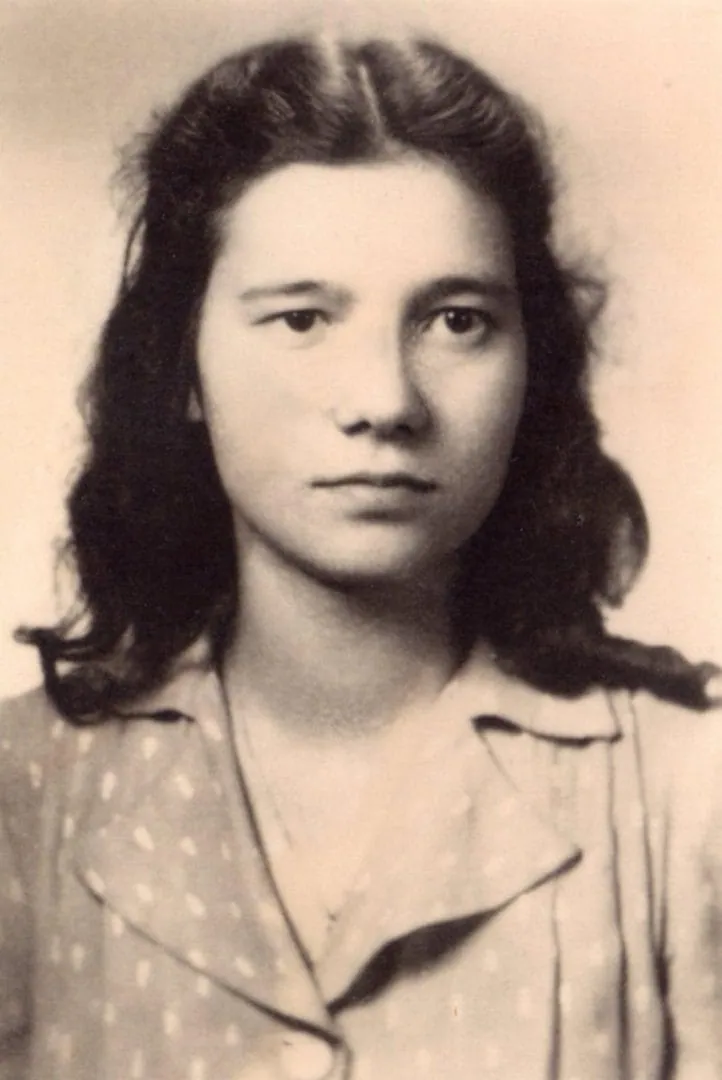


This excerpt from her memoirs is by Stanislawa Kwiecinska (née Jelenkowska), the grandmother of the author of this commentary. Stanislawa was born on June 18, 1929, on the Stavchyny khutir, situated between the Polish village of Stara Huta and the Ukrainian village of Ruska Huta in Volhynia during the Second Polish Republic. She wrote her memoirs with her many descendants in mind: 9 children, 24 grandchildren, and 5 great-grandchildren. Stanislawa made notes in a notebook in the 2000s, and her youngest daughter, Anna Sikora, later typed the text and arranged for its publication in 2018.
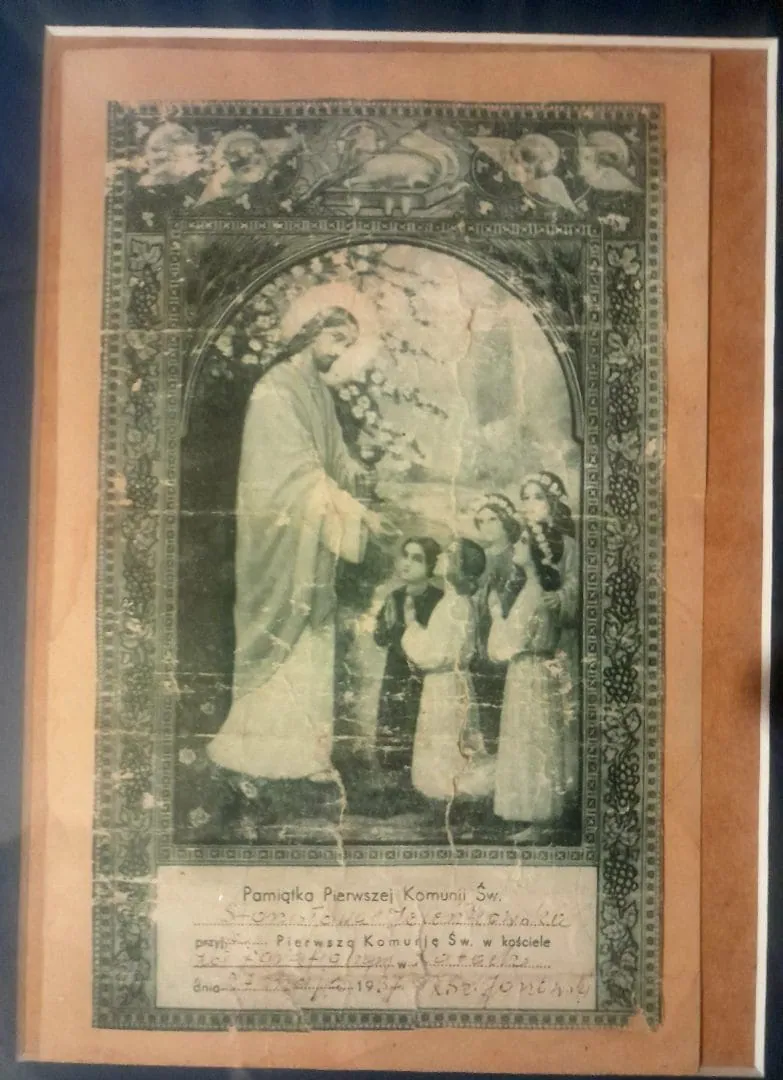
These memoirs serve as a testament to the life and values of traditional Polish communities in Volhynia before World War II, where family and faith were of great importance. The only item Stanislawa managed to bring back to Poland still hangs on her wall—a First Holy Communion certificate from the church in Kuty/Konty. Where the villages once familiar to her stood, there is now only a forest clearing and overgrown fruit trees. Both the Stavchyny khutir and Stara Huta were burned and destroyed, and most of their inhabitants were killed by UPA members in July 1943 during the so-called “Bloody Sunday”—a wave of organized ethnic cleansing targeting 99 Polish villages in Volhynia [1].
Memoirs by Poles born before the war in what is now Ukraine—then the eastern provinces of the Second Polish-Lithuanian Commonwealth, or the so-called “Kresy”—began to appear in the 1990s. These accounts often idealize life in Volhynia and Galicia before World War II, contrasting it with the violence, deportations, and exiles that followed. This is partly because most of the testimonies were written by people whose childhood coincided with the interwar period, which, in adulthood, may seem both simplified and idealized [2]. During the Polish People’s Republic, publishing such texts was impossible. Poles born outside the Polish People’s Republic were expected to forget their place of origin to build “friendship among nations” with the Soviet Union and to settle the post-German lands, which official propaganda called “returned territories” [3].
The events of World War II in Volhynia described by Stanislawa were also documented by her relatives and other local Poles. Her brother, Jerzy Jelenkowski (1935–2015), left memoirs of those experiences [4]. The collection of Ewa and Vladislav Szemashko includes an account by Jan Vereshchynskyi, Stanislawa’s cousin (her mother’s brother’s son), describing how UPA members burned Stanislawa’s grandparents and other maternal relatives in Zelenyi Dub, a neighboring village [5]. Jan managed to escape thanks to his Ukrainian neighbor, Khrystia Huk [6]. The local UPA leader, Mykola Androshchuk, references the UPA attacks on Zelenyi Dub and other Polish villages, as well as Polish reprisals against the Ukrainian civilian population, in his Notes of an Insurgent [7]. Jan’s brother, Ambrozy Vereshchynskyi, also miraculously survived. He described his experiences—burying his parents, brothers, and sisters, which he had to endure as a child—in his own memoirs [8]. Jerzy Jelenkowski and Ambrozy Vereshchynskyi became active participants in the Kresy movement, which, in addition to social and cultural activities, sought to turn the Volhynia tragedy into a political issue. Stanislawa, however, devoted her life to raising her children, caring for her grandchildren, and tending to her husband, who was very ill in his final years; as a result, she had no time for activism. This is also reflected in the themes she addresses in her memoirs.
A firsthand account of the bloody events in Volhynia during World War II, written from a woman’s perspective, is a rare phenomenon. Stanislawa wrote her memoirs as the eldest daughter and guardian of several younger siblings. Although her memories touch on events of major political significance, her narrative focuses primarily on daily life and her family’s struggle for survival. In 1943, when her family was forced to flee, Stanislawa was only 14. Despite her youth, the responsibility for her siblings and the hard labor she performed alongside adults gave her a perspective on the world that was remarkably mature for her age. Stanislawa recalls fleeing on foot with small children, facing the threat of death, and seeing mutilated bodies along the way. During those days, it was her mother, Marcelina, who was the main force behind the family’s survival: she found food, sought help, and provided emotional support, while her father, Marian, was often on the verge of a breakdown. The family endured hardship in local labor camps, facing hunger and disease. Upon returning to Poland, they survived bombings and struggled to adjust to their new environment.
Stanislawa’s family—the Jelenkowskyis on her father’s side and the Vereshchynskyis on her mother’s—had lived in Volhynia since at least the 17th century. According to available records, they were members of the declassed nobility who, as a result of Russification policies following the January Uprising of 1863, lost their economic standing and became more closely tied to the peasantry. Yet, during the Second Polish-Lithuanian Commonwealth, they aimed to provide their children with the best possible education and a higher social status. The family owned a small plot of land, but their main income came from the blacksmith shop run by Stanislawa’s father, Marian, who made metal tools, fences, and buggies. Because Marian’s work was manual labor, the family was not classified as “Polish gentry” during the first Soviet occupation of Volhynia (1939–1941) and thus escaped possible deportation to Siberia or death. Marian was respected in the area; he made and repaired axes, flails, and scythes for Ukrainian peasants from the neighboring village of Ruska Huta, which likely helped maintain good relations and may have saved the family from death in 1943. Local villagers often visited Marian for professional reasons, and his blacksmith shop became a meeting place for the Ukrainian and Polish communities. Stanislawa recalled how heated political debates would drift into her ears, though as a child and a woman, she was not allowed to participate.
Stanislawa’s memoir can be read as a testimony to a time of extreme violence and frenzied nationalism. These were times of difficult choices: whom to trust to survive, whether to stay in one’s home or flee into the unknown. Stanislawa’s family had no relatives or friends in central Poland, making the decision to leave their small hometown extremely difficult. After the fierce battles of 1939, the Polish state officially ceased to exist. Although the Polish government-in-exile did not cede the territories east of the Buh River, it also offered no support to the local Polish civilian population.
People relied solely on their own strength and the kindness of those they met along the way. Stanislawa’s family delayed leaving their home as long as possible. The killings in Zelenyi Dub became the final straw. Sometimes, help and support arrived from unexpected sources. Even eighty years after the war, Stanislawa still remembers those who helped them—for instance, the Ukrainian Hapin from Moschenytsa, a UPA partisan who had served with her father in the tsarist army and later defended their family from his own comrades-in-arms. The narrator, however, did not remember the attackers; most likely, they were strangers not from the immediate area. Stanislawa recalls German soldiers returning from the front who shared their food with her family on a train bound for Poland. Some of “their own” unexpectedly let them down: a family of Polish refugees from Volhynia who had promised to help them settle in Poland, but deceived them upon arrival and advised them to contact social services.
Stanislawa’s memoirs end with her starting work at a steel mill in Stalowa Wola and marrying in 1958. At first glance, it might seem like a happy ending. After the war, Stanislawa was unable to continue her education and, at a very young age, had to start earning a living for herself and her large family. For a traditional family from a Volhynia village, life in an industrial city was very foreign. Stanislawa still speaks with a distinctive “eastern accent” and loves to sing Volhynia songs at family gatherings. Because of her painful memories, she did not dare to visit her native village until 2007. There, she prayed at her mother’s family grave in Zelenyi Dub and could barely find the spot in the meadow, now overgrown with tall grass, where her family home once stood. Today, Stanislawa lives with her younger daughter, Anna, and her family in the village of Prawiedniki, near Lublin. When Russia’s full-scale war against Ukraine began, her many children and grandchildren joined efforts to help Ukrainian refugees, especially large families who, like Stanislawa decades earlier, were forced to flee their “little homelands” to escape the horrors of war.
Elzbieta Kwiecinska, granddaughter of Stanislawa Kwiecinska