
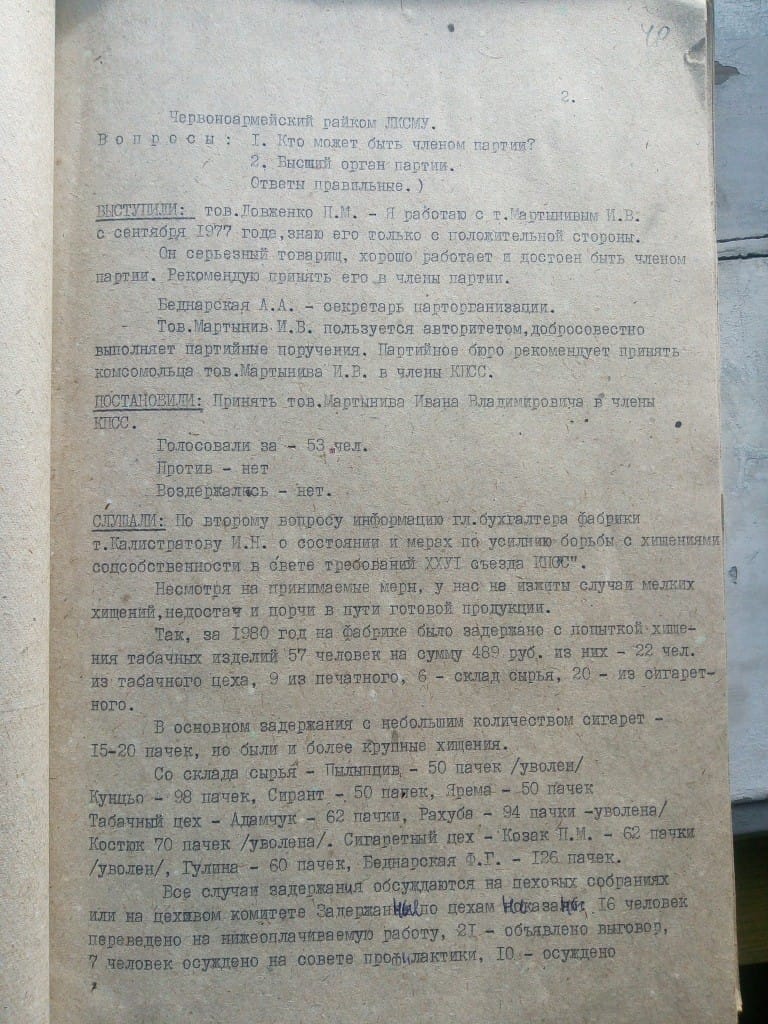
State Archive of Lviv Oblast, fund P-319: Party Organization of the Lviv Tobacco Factory, inventory 1, case 62: Minutes of Party Meetings, pp. 40–46: Minutes No. 4 of the Party Meeting of Communists of the Party Organization of the Lviv Tobacco Factory, dated May 7, 1981. pp. 40–46.
HEARD: On the second issue, a report was delivered by the factory’s chief accountant, Comrade I. N. Kalistratov, regarding the current situation and efforts to strengthen the fight against the theft of socialist property in accordance with the requirements of the 26th Congress of the CPSU [Communist Party of the Soviet Union].
Despite the measures taken, cases of petty theft, shortages, and damage to finished products in transit have not been eliminated.
For example, in 1980, 57 people were apprehended at the factory for attempting to steal tobacco products valued at 489 rubles. Among them, 22 worked in the tobacco workshop, 9 in the printing shop, 6 in the raw materials warehouse, and 20 in the cigarette workshop.
Most of the detentions involved small quantities of cigarettes — 15 to 20 packs — but there were also cases of larger-scale theft.
From the raw materials warehouse: P. – 50 packs (dismissed), K. – 98 packs, S. – 50 packs, Y. – 50 packs. Tobacco workshop: A. – 62 packs, R. – 94 packs (dismissed), K. – 70 packs (dismissed). Cigarette workshop: K. – 62 packs (dismissed), G. – 60 packs, B. – 126 packs.
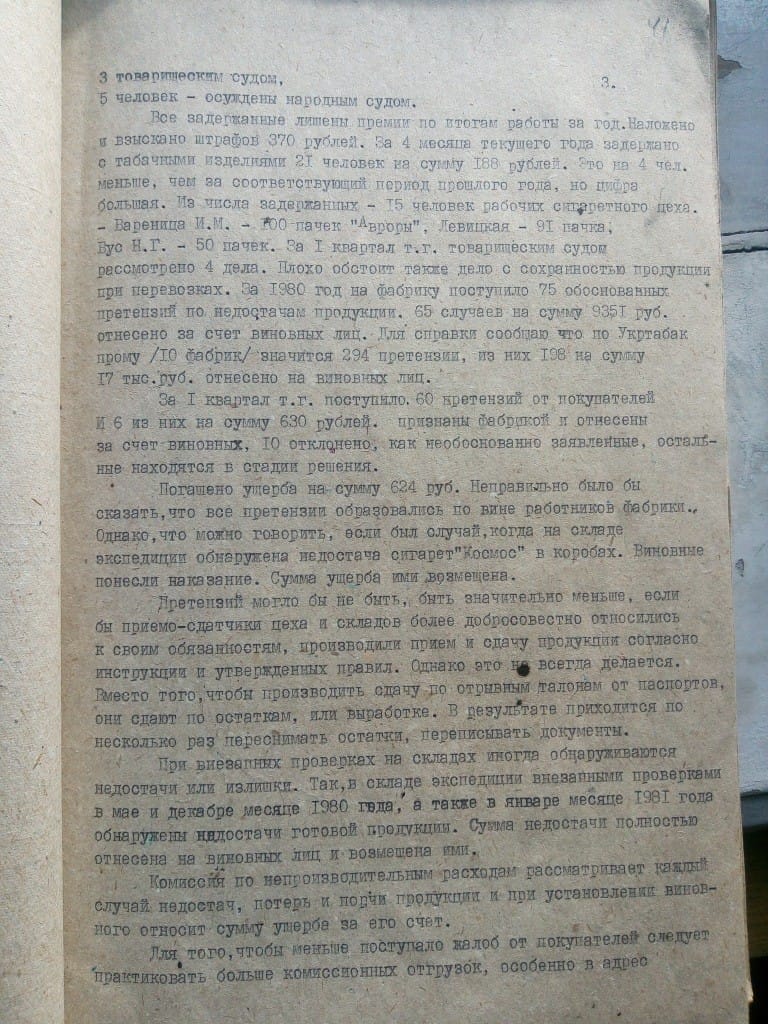
All cases of detention are discussed at workshop meetings or by the workshop committee. Those detained by the workshop were punished as follows: 16 people were transferred to lower-paying work, 21 received a reprimand, 7 were condemned by the prevention council, 10 were condemned by a comrades’ court, and 5 were convicted by the people’s court.
All detainees were deprived of their annual performance bonuses. Fines totaling 370 rubles were imposed and collected. In the first four months of this year, 21 people were detained with tobacco products valued at 188 rubles. This is 4 fewer than during the same period last year, though the figure remains high. Of those detained, 15 were workers from the cigarette workshop: V. – 100 packs of Aurora, L. – 91 packs, and V. – 50 packs. During the first quarter of this year, the comrade’s court heard 4 cases. The situation regarding product safety during transportation also remains poor. In 1980, the factory received 75 valid claims regarding product shortages. In 65 cases totaling 9,351 rubles, the amounts were charged to the responsible individuals. For reference, Ukrtabakprom [trust] (10 factories) has 294 claims on record, of which 198, totaling 17,000 rubles, were charged to the responsible parties.
In the first quarter of this year, 60 claims were received from customers. Of these, 6 totaling 630 rubles were recognized by the factory and charged to the responsible parties, 10 were rejected as unfounded, and the remainder are pending resolution.
Damages totaling 624 rubles were covered. It would be incorrect to say that all claims arose due to the fault of factory employees. However, a shortage of Kosmos cigarettes in cartons was discovered in the shipping warehouse. Those responsible were punished, and they reimbursed the amount of the damage.
There might be no claims, or significantly fewer, if the receiving and shipping clerks in the workshop and warehouses took their duties more seriously and handled product receipt and shipment in accordance with instructions and approved rules. However, this is not always the case. Instead of issuing products based on the detachable slips from the shipping documents, they issue them based on inventory balances or production output. As a result, inventory counts must be repeated several times, and documents must be rewritten.
During surprise inspections of warehouses, shortages or surpluses are sometimes discovered. For example, in the shipping warehouse, surprise inspections conducted in May and December 1980, as well as in January 1981, revealed shortages of finished products. The full amount of the shortage was charged to the responsible individuals and reimbursed by them.
The Commission on Non-productive Expenses reviews each case of shortages, losses, and product damage and, upon identifying the responsible party, charges them for the loss.
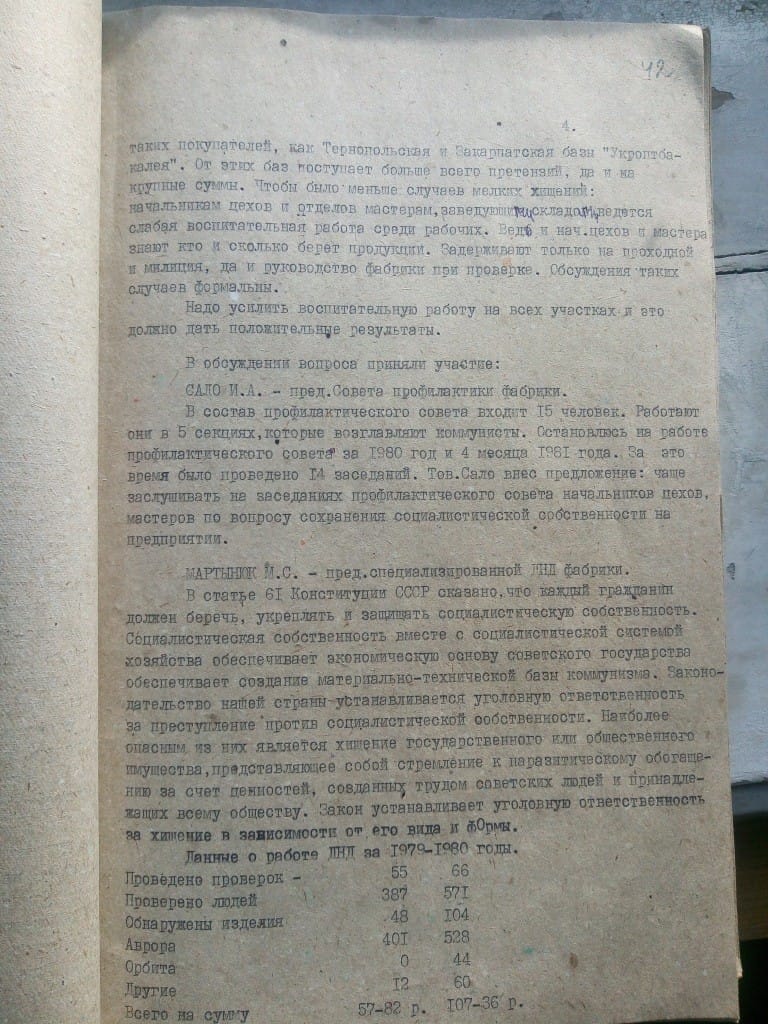
To reduce the number of customer complaints, more consignment shipments should be used, particularly for customers such as the Ternopil and Zakarpattia branches of Ukroptbakaleya. The majority of claims come from these branches and involve large sums. To decrease instances of petty theft, workshop and department heads, foremen, and warehouse managers are not doing enough to educate workers. After all, the heads of workshops and foremen know who is taking products and how much. Yet, only the security guards at the entrance, the police, and factory management during inspections actually catch them. Discussions of such cases are merely formalities.
Educational efforts must be strengthened across all areas, which should yield positive results.
The following participated in the discussion of the issue:
I. A. SALO — Chair of the factory’s Prevention Council.
The Prevention Council comprises 15 members, working in 5 sections led by communists. I will focus on the Council’s activities in 1980 and the first four months of 1981. During this period, 14 meetings were held. Comrade Salo proposed that workshop heads and foremen should be heard more often at Prevention Council meetings regarding the preservation of socialist property at the enterprise.
M. S. MARTYNIUK — Chair of the factory’s Specialized Voluntary People’s Militia.
Article 61 of the Constitution of the USSR states that every citizen must preserve, strengthen, and defend socialist property. Socialist property, together with the socialist economic system, forms the economic foundation of the Soviet state and ensures the creation of the material and technical basis of communism. Our country’s legislation establishes criminal liability for crimes against socialist property. The most serious of these is the theft of state or public property, which represents a pursuit of parasitic enrichment at the expense of assets created by the labor of the Soviet people and belonging to all of society. The law determines criminal liability for theft depending on its type and form.
Data on the activities of the Voluntary People’s Militia for 1979–1980.
Inspections conducted — 55 66
Individuals inspected 387 571
Items confiscated 48 104
Aurora brand 401 528
Orbita brand 0 44
Other brands 12 60
Total value 57-82 rubles 107-36 rubles
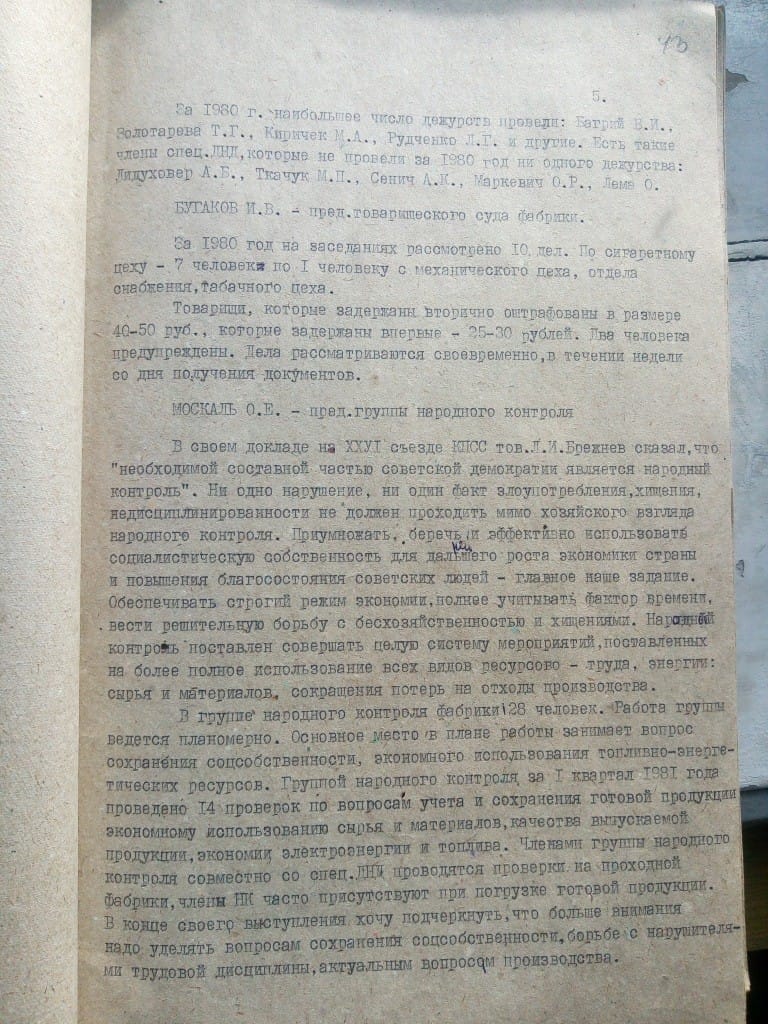
In 1980, the following individuals performed the highest number of duty shifts: V. I. Bagrii, T. G. Zolotareva, M. A. Kirichek, L. G. Rudchenko, and others. Some members of the Voluntary People’s Militia did not perform a single duty shift in 1980: A. B. Lidukhover, M. P. Tkachuk, A. K. Senich, O. R. Markevich, and O. Lema.
I. V. BUGAKOV — Chairman of the factory’s Comrades’ Court.
In 1980, 10 cases were reviewed at meetings: seven involved individuals from the cigarette workshop, and one each from the mechanical workshop, the supply department, and the tobacco workshop.
Comrades detained a second time were fined 40–50 rubles; those detained for the first time were fined 25–30 rubles. Two people received warnings. Cases are reviewed promptly, within a week of receiving the documents.
O. E. MOSKAL — Chair of the People’s Control Group
In his report to the 26th Congress of the CPSU, Comrade Leonid Ilyich Brezhnev stated that “people’s control is an essential component of Soviet democracy” [1]. Not a single violation, nor any instance of abuse, theft, or indiscipline, should escape the watchful eye of public oversight. Our main task is to increase, preserve, and efficiently utilize socialist property for the continued growth of the country’s economy and the improvement of the well-being of the Soviet people. We must ensure strict economy, give greater consideration to time factors, and wage a resolute struggle against mismanagement and embezzlement. People’s Control is responsible for implementing a comprehensive system of measures aimed at maximizing the utilization of all types of resources — labor, energy, raw materials, and supplies — and reducing losses from production waste.
The factory’s People’s Control Group consists of 28 members and operates systematically. The primary focus of their work plan is the preservation of socialist property and the efficient use of fuel and energy resources. In the first quarter of 1981, the People’s Control Group conducted 14 inspections related to the accounting and preservation of finished products, the efficient use of raw materials and supplies, the quality of manufactured goods, and the conservation of electricity and fuel. Members of the People’s Control Group, together with the Voluntary People’s Militia, conduct inspections at the factory entrance and are frequently present during the loading of finished products. In conclusion, I would like to emphasize that even greater attention must be paid to preserving socialist property, combating violations of labor discipline, and addressing current production issues.
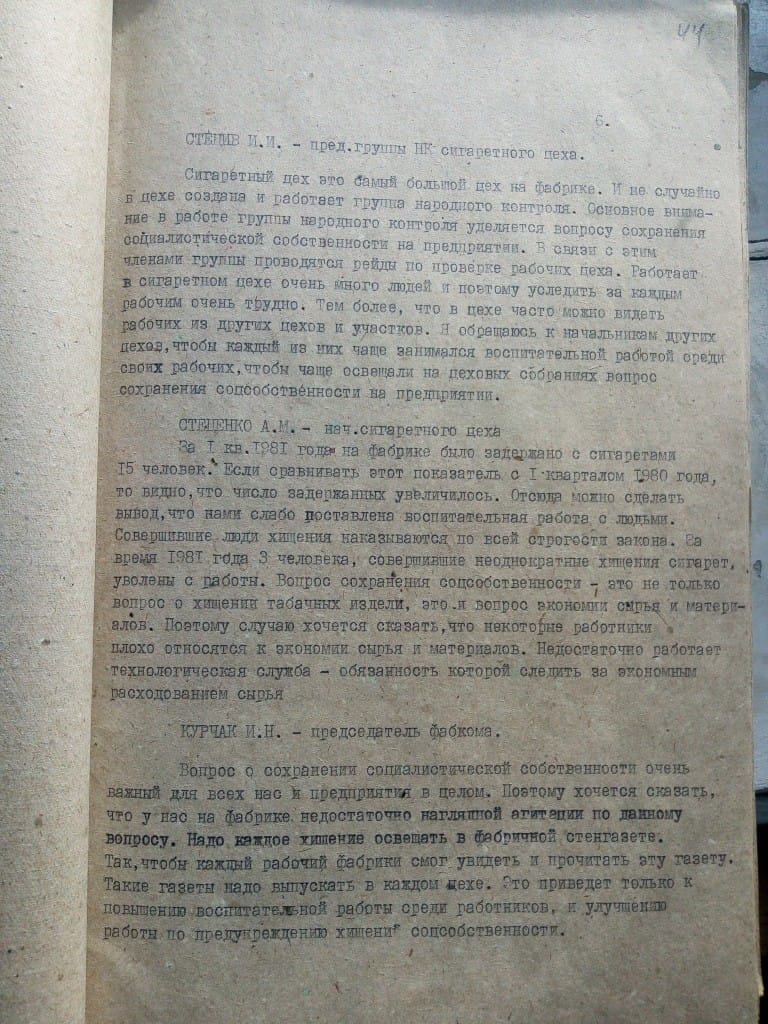
I. I. STETSIV — Chair of the People’s Control Group of the cigarette workshop.
The cigarette workshop is the largest in the factory. It is no coincidence that a people’s control group has been established and operates here. The primary focus of the group is preserving socialist property at the enterprise. To this end, group members conduct inspections of workshop employees. Because so many people work in the cigarette workshop, it is very difficult to monitor every worker — especially since employees from other workshops and sections are often present. I urge the heads of other workshops to conduct educational work with their staff more frequently and to address the issue of preserving socialist property at the enterprise more regularly in workshop meetings.
A. M. STETSENKO — Head of the Cigarette Workshop
In the first quarter of 1981, 15 people were caught with cigarettes at the factory. Compared to the first quarter of 1980, this number has increased, indicating that our educational efforts with staff have been insufficient. Those who committed theft are punished to the full extent of the law. In 1981, three individuals who repeatedly stole cigarettes were dismissed from their jobs. Preserving socialist property is not limited to conserving raw materials and supplies. I would also like to point out that some employees display a poor attitude toward conserving raw materials and supplies. The technical department, which is responsible for monitoring the efficient use of raw materials, is not functioning effectively.
I. N. KURCHAK — Chairman of the Factory Committee.
The issue of preserving socialist property is extremely important for all of us and for the enterprise as a whole. However, we do not have enough visual propaganda on this matter at our factory. Every case of theft should be reported in the factory wall newspaper, ensuring that every worker can see and read about it. Such newspapers should be published in every workshop. This will help improve educational work among the workers and strengthen efforts to prevent the theft of socialist property.
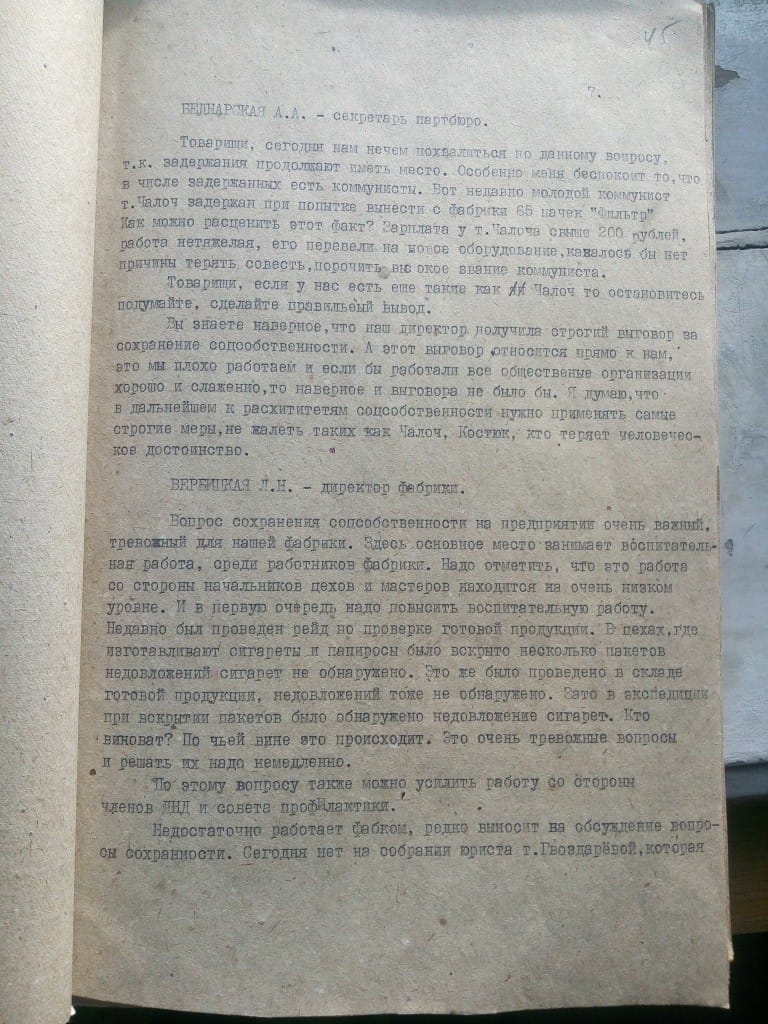
A. A. BEDNARSKAYA — Secretary of the Party Bureau.
Comrades, we have nothing to be proud of on this matter, as detentions continue to occur. I am especially troubled that some of those detained are communists. Just recently, a young communist, Comrade Ch., was caught trying to take 65 packs of Filter from the factory. How should we interpret this? Comrade Ch. earns over 200 rubles, the work is not difficult, and he was transferred to new equipment — there seems to be no reason for him to abandon his conscience or disgrace the honorable title of communist.
Comrades, if individuals like Ch. are still among us, we must stop, reflect, and draw the proper conclusions.
You are probably aware that our director received a severe reprimand regarding the preservation of public property. This reprimand applies directly to us; we are not doing our jobs well enough. If all public organizations worked effectively and in harmony, perhaps there would have been no reprimand. I believe that, going forward, the strictest measures must be applied to those who plunder social property. We must show no mercy to people like Chaloch and Kostiuk, who abandon their human dignity.
L. N. VERBITSKAYA — Factory Director.
The issue of preserving socialist property at the enterprise is extremely important and remains a cause for concern at our factory. The main priority here is educational work among the factory’s workers. It should be noted that this work, carried out by shop foremen and heads, is currently at a very low level. Above all, we must improve our educational efforts. A recent inspection was conducted to check finished products. In the shops where cigarettes and cigarillos are manufactured, several packages were opened, and no under-filling of cigarettes was found. However, in the shipping department, under-filling of cigarettes was discovered when packages were opened. Who is responsible? Whose fault is this? These are very troubling issues and must be resolved immediately.
In this regard, the efforts of the Voluntary People’s Militia’s members and the Prevention Council can also be strengthened.
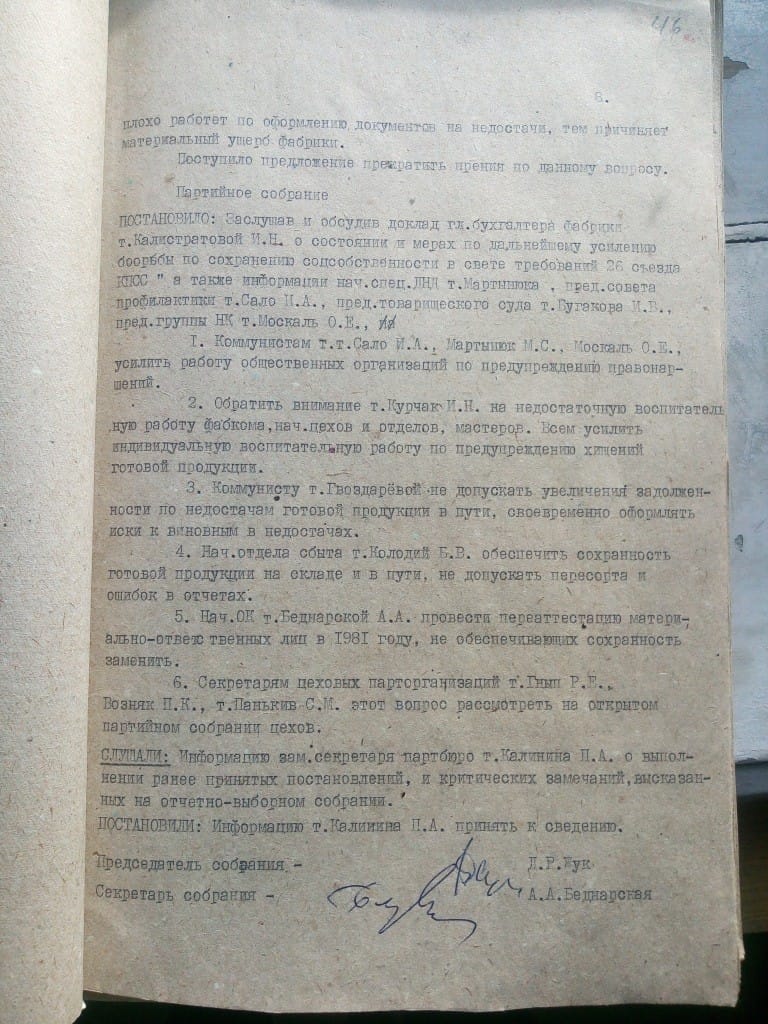
The factory committee is not doing enough; it rarely raises security issues for discussion. Comrade Gvozdeva, the lawyer, is absent from today’s meeting and is not effectively processing documentation for shortages, which results in financial losses for the factory.
A motion was made to close the debate on this issue.
Party Meeting
RESOLVED: Having heard and discussed the report of the factory’s chief accountant, Comrade I. N. Kalistratova, on the state of affairs and measures to further strengthen the preservation of socialist property in light of the requirements of the 26th Congress of the CPSU, as well as the information provided by the head of the Voluntary People’s Militia, Comrade Martyniuk; the Chair of the Prevention Council, Comrade I. A. Salo; the Chairman of the Comrades’ Court, Comrade I. V. Bugakov; and the Chairman of the People’s Control Group, Comrade O. E. Moskal
- Communist comrades I. A. Salo, M. S. Martyniuk, and O. E. Moskal shall intensify the efforts of public organizations to prevent offenses.
- Comrade I. N. Kurchak is to be informed about the insufficient educational work carried out by the factory committee, workshop, and department heads, and foremen. All are to intensify individual educational efforts to prevent the theft of finished products.
- Comrade Gvozdeva is to prevent an increase in arrears due to shortages of finished products in transit and to file timely claims against those responsible for these shortages.
- Head of the Sales Department, Comrade B. V. Kolodii, must ensure the safety of finished products in the warehouse and during transit and prevent misclassification and errors in reports.
- The Head of the Personnel Department, Comrade A. A. Bednarskaya, shall conduct a re-certification in 1981 of all personnel responsible for inventory and replace those who fail to ensure its safety.
- The secretaries of the workshop party organizations — Comrades R.E. Gnyp, P.K. Vozniak, and S.M. Pankiv — are to discuss this issue at an open party meeting in the shops.
<…>
Chair of the meeting – [signature] D. R. Zhuk
Secretary of the meeting – [signature] A. A. Bednarskaya


This document is an excerpt from the minutes of a meeting of the party organization at the Lviv Tobacco Factory in Vynnyky, which addressed issues such as theft, shortages, defects, and other — mostly minor but very common — violations. Most of those present at the meeting were members of the Communist Party, yet the discussion focused on the factory’s operations and every employee’s performance. This illustrates the party’s “leading and guiding” role, its omnipresence in both ideological and productive spheres, and its importance for both vertical and horizontal integration. The minutes were recorded in Russian, the dominant language in the public sphere during the late Soviet era.
The minutes present a systematic list of speeches from responsible officials: the chief accountant, the chair of the prevention council, the chair of the specialized voluntary people’s militia, the chair of the comrades’ court, the chairs of the people’s control groups, the workshop foreman, the chair of the factory committee, the secretary of the party bureau (effectively the head of the factory’s party organization), and the factory director herself. The perspectives of the discipline violators are absent from the source, although it notes that some are communists. In this publication, we have used only a single letter to identify those accused of theft, withholding their full personal details.
It is also notable that, even among this list of speakers, women held prominent positions at the factory. This presence reflects both the particular nature of the tobacco industry — with its high proportion of female labor — and the Soviet emancipatory project, which promoted women’s participation in industrial work alongside motherhood and civic engagement. Since this project began as early as the 1920s, and with the impact of World War II, women entered the workforce en masse. As a result, women’s career advancement in the USSR — especially in certain sectors and “female” professions — was even more pronounced than in other socialist or capitalist countries.
At the heart of the source is the concept of “socialist property” — the belief that building communism requires all means of production to belong collectively to the “people,” either through state or cooperative ownership. The official discourse of the era is exemplified by a statement from the head of a voluntary people’s militia: “Our country’s legislation establishes criminal liability for crimes against socialist property. The most serious of these is the theft of state or public property, which represents a pursuit of parasitic enrichment at the expense of assets created by the labor of the Soviet people and belonging to all of society”. Collective ownership became dominant after the forced nationalization of enterprises and collectivization of agriculture in the 1930s, though some private initiative persisted. In the late Soviet period, individual interests and practices aimed at supplementing official income through informal exchanges became more prevalent. Armstrong, a scholar of socialist property, notes that the general trend in late Soviet policy was to gradually transfer real control over property to individuals and enterprises, even as socialist ownership was formally maintained. These years were characterized by contradictions between private interests and the ideology of collectivism and the common good.
Petty theft was one sign of the increasing self-interested motives of the period, but it also belonged to a longer tradition of working-class ethics dating back to the early industrialization of the 19th century. Many researchers argue that workplace theft holds several meanings: it can be seen as a correction of social injustice — where workers view theft as compensation for insufficient wages and lack of social security; it reflects the blurred line between private and public spheres; it serves as resistance to rational industrial discipline, as workers try to reclaim the fruits of their labor; it also expresses solidarity and emotional bonds among workers, since theft often requires organization, participation, or at least the deliberate turning of a blind eye by many; and, in other interpretations, it demonstrates the workforce’s incomplete “modernization” — such as former peasants — or their covert sabotage of the socialist system. The most common explanation, especially in former workers’ narratives, is the need to “survive” in a shortage economy (see Hignett 2016, 205–207), where meeting a family’s basic needs depended on “getting by”, “scoring”, or “scrounging”. However, this explanation does not exclude others: the cited source includes a case of a worker with substantial (in the collective’s view) financial security who still resorted to theft. According to Hignett, participation in the late Soviet informal economy was driven more by rising expectations for consumption and the desire for scarce, symbolic goods than by literal physical “survival”.
The source also highlights various forms of solidarity among workers involved in theft: “To decrease instances of petty theft, workshop and department heads, foremen, and warehouse managers are not doing enough to educate workers. After all, the heads of workshops and foremen know who is taking products and how much. Yet, only the security guards at the entrance, the police, and factory management during inspections actually catch them. Discussions of such cases are merely formalities”. The source indicates that theft was a well-established practice and that a certain consensus existed among workers regarding its acceptability, provided it did not exceed a “reasonable” amount of appropriated goods.
There was also considerable flexibility and negotiation regarding the consequences of theft. While formal instructions determined the severity of punishment based on the amount stolen and the frequency of offenses, collective bodies could consider personal circumstances, such as the need to care for a large family, as grounds for leniency (Kawamoto, p. 191). Party membership, however, was regarded as a burden. For many, being a Communist Party member not only failed to provide privileges or career advancement, but also imposed additional burdens — the obligation to spend time on public work and the inability to participate in various grassroots and shadow practices of “self-provision” (see in particular: Archer 2022), such as theft, “fartsovka”, or “working for oneself” using the enterprise’s tools and materials. The incomes and lifestyles of party members were often the focus of public attention, and participation in informal exchanges — giving or taking bribes, exchanging services, purchasing luxury goods at “flea markets”, or granting others access to benefits for a fee — was widespread among elites, yet these actions remained risky. This stemmed from the special requirements of “Communist morality” within the official ideological system, in which party members were subject to particular scrutiny and expected to demonstrate more exemplary behavior than others. In the cited source, this is especially evident in the emphasis on Comrade Ch.’s transgressions.
Petty theft in enterprises was not an isolated act but part of a broader informal economy that grew during the late Soviet decades, filling gaps left by the official economy. Cigarettes taken from the factory could be consumed privately, but most often were sold through personal contacts at retail outlets. Additional documents from the Vynnyky Tobacco Factory collection further illustrate this, noting that female workers took not only cigarettes from the workshop but also packaging from the cardboard workshop. The functioning of the “gray market” depended on connections and friendly relationships among many people, both inside and outside the enterprise. Judging by lists of the most frequently stolen products — particularly the cheapest filterless Aurora cigarettes, priced at 14 kopecks a pack and leading by a wide margin (witnesses said they tasted of shag tobacco, stale hay, and burnt wood) — these were not luxury items, but rather evidence of the routine and frequent theft of small quantities of cheap goods.
The protocol lists several collective bodies responsible for addressing workplace theft: the factory committee, workshop committees, the prevention council, the comrades’ court, the commission on non-production expenses, and the factory’s voluntary people’s militia. This diversity, as noted by, also reflects a long history of efforts to involve and mobilize workers “from below” within a system of “real socialism” that was strictly regulated from above. Cases involving more serious violations were heard in the people’s courts referenced in the source, which represented the lowest level of the general judicial system.
The factory committees (fabcom) initially emerged in 1917 as an expression of direct worker self-management within enterprises, but were soon incorporated into a system of vertical subordination, similar to that of trade union organizations. Subsequently, they were mainly engaged in implementing centralized policies, mobilizing workers to support state initiatives, negotiating social benefits, and pursuing mutual aid strategies. They also took part in agitation and propaganda for socialist competitions and “shock” labor assigned from above to boost production outcomes. Trade unions were just one of several bodies involved in distributing essential benefits, such as housing, vacation vouchers, places in factory kindergartens, and the establishment of canteens, among other things.
Regarding judicial bodies, “workers’ disciplinary courts” first appeared in 1919 as a form of workers’ self-governance to address minor violations and conflicts, but they did not last long. During the Khrushchev “Thaw”, comrades’ courts were reinstated as a sign of a return to greater democracy, participatory practices, and the delegation of some state powers to citizens themselves, aiming for more effective (self-)control and mutual surveillance. Members of comrades’ courts were elected at general meetings. These bodies handled violations of labor discipline, improper behavior in public places, and cases of domestic violence and parental neglect. In 1963, the jurisdiction of comrades’ courts expanded to include cases of petty hooliganism, petty theft, and speculation — provided they were first-time offenses — which significantly increased their caseload.
These courts could use measures such as moral pressure, fines, apologies, and warnings, as well as recommend that management demote an individual, transfer them to unskilled labor, or even deprive them of the right to use living space. The trials were public and exemplary, aiming more to promote “communist morality” and public condemnation, and serve as a warning to other collective members, rather than to punish the specific offender (Kawamoto 2015). After a decline following Khrushchev, the role of comrades’ courts was revived by the 1977 Statute of Comrades’ Courts; by Andropov’s time, these bodies had become significantly important in the campaign to strengthen labor discipline. Y. Kawamoto suggests that in the late Soviet period, comrades’ courts increasingly shifted focus from family matters and interpersonal relationships to the protection of socialist property, reflecting the era’s trend toward redrawing the boundaries between the private and public. In the cited source, the issue of theft is considered in isolation from other violations, unlike in Stalin’s time, when stealing cigarettes could lead to examinations of family relationships or discussions of a suspect’s husband’s alcohol addiction.
Similarly, the Voluntary People’s Militias (днд, in Russian) were another collective body to which the state delegated certain surveillance and control powers. Participation in these groups was also by election and could be both voluntary and, to varying degrees, compulsory — as well as, in different cases, either active or mostly formal. Members of People’s Militias volunteered their time to maintain order in public places and combat hooliganism and minor disciplinary violations in workplaces, particularly involving drunkenness and conflicts. Naturally, these individuals sometimes pursued their own interests, such as seeking bonuses or awards, gaining access to authority, or simply enjoying the opportunity to use force (Kiyohiro Matsudo, 2015). As Matsudo writes, they were often criticized for focusing on policing public spaces during off-duty hours, while petty thefts in the workplace frequently went unnoticed. This was also attributed to feelings of solidarity and camaraderie with colleagues who might have been committing such thefts.
How effective were these agencies’ actions? The source indicates that they attempted to use both economic incentives (withholding bonuses, demotion) and non-economic ones (“educational work”, moral appeals, social shame — for example, exposure in wall newspapers, calls for corporate solidarity, etc.). The lack of economic incentives and positive motivation is also illustrated by a statement from the chair of a people’s control group, who emphasized “surveillance” as an important collective practice: “Because so many people work in the cigarette workshop, it is very difficult to monitor every worker—especially since employees from other workshops and sections are often present”. A notable example of corporate solidarity is the statement by Bednarska, the secretary of the Party Bureau: “You are probably aware that our director received a severe reprimand regarding the preservation of public property. This reprimand applies directly to us; we are not doing our jobs well enough. If all public organizations worked effectively and in harmony, perhaps there would have been no reprimand”. Such appeals to a sense of guilt over the director’s penalty were intended to foster social affect and leverage emotional attachment to the enterprise’s leader, who in the socialist system was often perceived as a highly important paternalistic (or, in this case, maternalistic) figure. The text highlights methods of moral influence, education, and agitation far more than economic ones. Clearly, economic incentives were quite limited, especially in a context where unemployment was officially nonexistent. If someone was dismissed, they were either guaranteed a position at another enterprise in their city or returned to the same enterprise if no other nearby enterprises were available. The official discourse emphasized “re-education” rather than punishment.