
THROUGH THE EYES OF NEW SOVIET CITIZENS
A Letter from Nadiya Savych of Dnipropetrovsk
* * *
During the challenging years under Polish nobility, many people from western Ukraine emigrated in search of a better life abroad. Nadiya Savych was among them. Like many others, she eventually found her path back to the Soviet Union, arriving in Dnipropetrovsk with her husband and children just a few months ago.
Nadiya Savych wrote to her countrymen overseas, sharing her impressions of returning to her homeland. The Russian-language newspaper Vestnik, published in Toronto, printed an abridged version of her letter, omitting some personal passages.
Below is the reprinted letter from Nadiya Savych, as it appeared in the Canadian newspaper Vestnik.
* * *
Dear friends!
I can hardly believe we can’t just call you, hop on a tram for a visit, or drop by the club for tea. I’m writing this from our fourth-floor balcony, pausing to take in the view. The city is so beautiful—lush greenery everywhere, and the Dnipro River winding through its heart. From here, I watch riverboats glide by and bridges stretching across the water. When the city lights come on at night, I just want to stand and take it all in. It’s the perfect time to dream.
Now, dear friends, let me tell you a little about how we’re settling in here, in our Motherland. We arrived in Dnipropetrovsk and have been staying with Vukelić—the Yugoslav woman from Kirkland Lake; do you remember her? She attended the Second Slavic Congress in Toronto. We’re still living with her for now. It’s a bit crowded; the children sleep on the floor while we take the beds. There’s a huge construction boom, but finding housing is still tough. They promised us an apartment at the end of this month or early next month.
We’ve met some very nice people here. Our Valia has become friends with some girls. The local youth are very eager to make friends with newcomers. Now the young men and women have left to weed the fields on the collective farms, and the children are at summer camps [1]. So almost no schoolchildren are to be seen on the city streets. Our Sasha will also be going to a children’s camp in the Orlovshchyna starting July 1. The Volodarskyi Factory provided him with a travel package, the one where Vania got a job. But he hasn’t started working yet; last week he went back to his hometown to see his family and friends. When he returns, he’ll start working. The Volodarskyi Factory employs 3,500 people. They sew men’s and women’s suits and coats. A suit or coat costs about 600 karbovanets. Vania will work at this factory as a cutter [2].
I won’t go into every detail just yet—we’re still getting settled, and any early impressions might turn out wrong. Food and clothing prices remain high. As for care packages sent from abroad, people here are grateful for them at first, and they certainly help. But I think those sending the parcels should consider their own needs, too. Life here is good for proactive, hardworking people.
The other day I was browsing accordions at the department store—the best ones here cost 1,400 karbovanets (back in Canada, they range from 500 to 1,000 dollars). Some things are still in short supply, and you see lines for them, but the stores truly have everything you could want. I was even surprised by some of what I saw. The items aren’t as colorful as back home, but I was impressed by the vacuum cleaner and the washing machine. The pot-shaped vacuum cleaner is excellent and costs 545 karbovanets.
On weekends, women dress beautifully in expensive outfits, though fashion here is completely different from that in America [3].
We’re enjoying ourselves so far. We’ve already been to two name-day parties, gone boating twice, and even swam in the Dnipro. Last Sunday, they “baptized” me in the river so thoroughly I nearly drowned! Some friends suggested taking the kids to the Black Sea, but until we’ve really settled in, I’m not planning any trips. I haven’t even visited my relatives yet—Vania went on his own and has been there a whole week. The kids have traveled so much that they weren’t eager to go, and besides, who knows how the transportation is between villages. So, my visit will have to wait. As I mentioned, Sasha goes to camp on July 1, and Valia will join the older group in August. Volodia will stay home with me; we need to help him get used to being around other people, since he’s always been just with us. I’m going to the clinic daily now: Sasha’s getting his teeth filled, and Volodia is having a checkup. He’s had a few fevers, so I told the doctor, and they advised an exam. Childcare here is truly excellent.
Once I’m finished with the kids’ appointments, I’ll go to the clinic myself and try to get treatment for my legs. Here, if someone can’t leave home, doctors will come to treat them at home.
I’m also learning how to shop at the markets. They’re much like they used to be, just more civilized now [4]. You can buy all sorts of greens, strawberries, cherries, and more—strawberries are 8 karbovanets per kilo, and greens are quite affordable, just 1 karbovanets. In stores, you pay first and then pick up your goods, which is why people queue up—it can take a while. But there’s already a self-service store here in Dnipropetrovsk, just like in Canada. Every morning, we buy milk at a little street kiosk. People say things have improved a lot since last year—there’s much more milk, butter, sugar, and bread available now, and there are no shortages of these, especially bread, butter, and milk.
We cook on an electric stove, though natural gas is being installed in the city—it hasn’t reached every area yet. All the new buildings under construction have gas from the start.
We’ve met some wonderful people who’ve helped us with advice. Valia has become friends with their daughter, who’s about her age.
We’d really love to hear from you—write and let us know how you’re doing. Wishing you all good health and much success.
Nadia, Ivan, and family
Dnipropetrovsk.
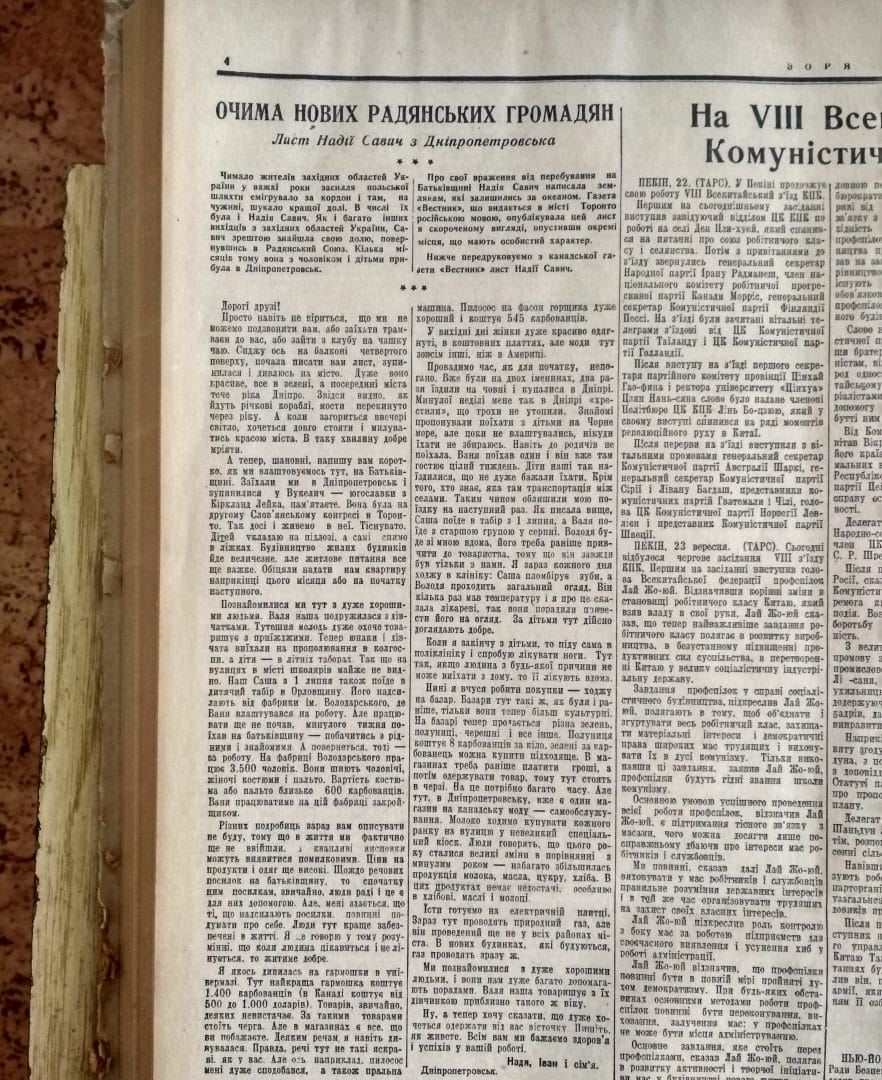

In September 1956, the newspaper Zoria — the official mouthpiece of the Dnipropetrovsk Oblast and City Committees of the Communist Party of Ukraine and the local councils of workers’ deputies — published an article titled “Through the Eyes of New Soviet Citizens: A Letter from Nadiya Savych of Dnipropetrovsk.” Like all Soviet publications, it was heavily censored and infused with the propaganda themes of the time, presenting only officially sanctioned information from the party and authorities.
Nadiya Savych’s published letter—from a Ukrainian woman who moved with her family from Canada to Soviet Ukraine in 1955—embodied these very themes. Her personal “success story” was crafted to showcase the supposed advantages of life in the USSR and persuade other Ukrainians, especially those in Canada, to follow suit. The letter specifically targeted Ukrainian readers loyal to the Soviet Union in Toronto, first appearing in the Russian-language newspaper Vestnik before being reprinted in the Dnipropetrovsk-based Zoria. The letter’s content and its publication illuminate Savych’s biography and the circumstances that led her family to Dnipropetrovsk in 1956.
The Thaw marked a shift in Soviet leadership’s approach to groups who, during the late Stalinist era, found it nearly impossible to move to the USSR. In 1955, a campaign began to “repatriate” those who had left their homes during the Russian and Austro-Hungarian empires, those who had lived in territories later incorporated into the USSR, or those unable to return after World War II. Official Soviet documents from the 1950s and 1960s referred to people from lands annexed after World War II as “re-emigrants,” while those who left the USSR during the war were labeled “repatriates.”
During the peak migration years of 1955–1956, both “repatriates” and “re-emigrants” arrived in Ukraine from Europe, Asia, and the Americas, with “re-emigrants” making up the majority. In the Dnipropetrovsk region, newcomers came from Argentina, Brazil, Greece, Uruguay, China, and France; Nadiya Savych’s family—the only one from Canada—was among them. Most families included children, elderly parents, or relatives, and in nearly every case, Ukrainian women in these families were married to foreign men.
The authorities’ main challenge was to provide adequate housing and living conditions and meet the social needs of these new arrivals. Many returnees expected a standard of living not just equal to, but better than, what they had experienced abroad. These expectations shaped most returning families’ adaptation strategies. The initial weeks and months were often a period of adjustment, as the “new Soviet citizens” confronted reality and decided whether to stay or seek opportunities to leave again. Immigrants disappointed by their reception raised concerns among officials, as unmet hopes for a better life in the USSR led to dissatisfaction and a desire to return abroad.
To encourage Ukrainians in Canada to return, a committee called “For Return to the Motherland” was formed. The Soviet regime especially targeted the Ukrainian diaspora in Canada through organizations loyal to the USSR, such as the United Ukrainians of Canada, the Communist Party of Canada, and a network of affiliated associations. The “return” campaign—which ultimately failed—also aimed to sow divisions among Ukrainians in Canada. Publishing letters from those who had left Canada for Ukraine was intended to promote a positive image of the USSR and persuade others that a better life awaited them at home.
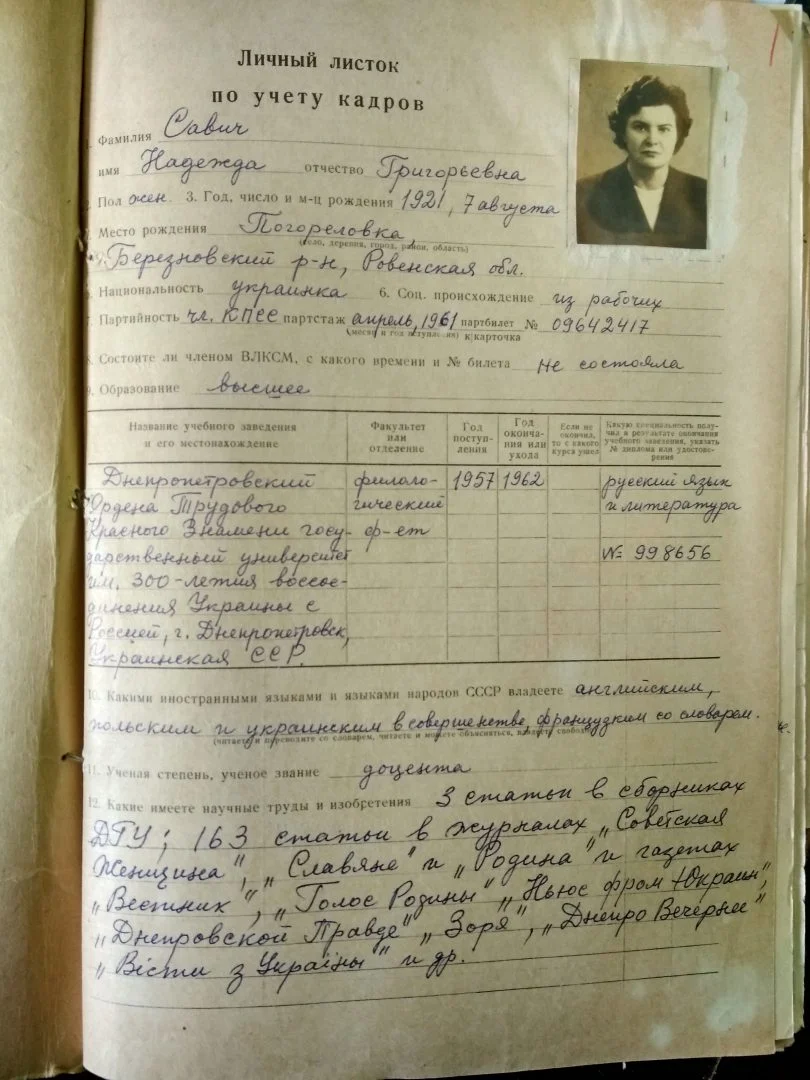
Nadiya Savych became part of this propaganda campaign; her trajectory mirrored that of many Ukrainians who ended up in Canada during the interwar years. Her biography unfolds in distinct Polish, Canadian, and Ukrainian/Soviet chapters. Archival materials from Oles Honchar Dnipro National University help reconstruct the main stages of her life. Born in 1921 as Nadiya Hryshchuk to a peasant family in the Rivne oblast (then part of Poland), she experienced her first migration in 1928 when her father emigrated to Canada. After a workplace injury and subsequent dismissal, he “was returned by his company” to Poland, but “the Polish police began persecuting him because of his democratic views and statements.” In October that same year, the whole family left for Canada. In her statement, Savych explained, “…my father took the family abroad in search of a better life.”
Nadiya lived in Canada from 1934 to 1956, first in Montreal, where she and her sister completed English-language schooling and learned French. At seventeen, she married Ivan Savych, a laborer and member of the underground Communist Party of Canada—which she soon joined. Between 1938 and 1945, she periodically worked as a seamstress, then taught Russian in St. Catharines, Ontario, from 1947 to 1950. After relocating to Toronto, she worked as a seamstress in a private shop before becoming a typist and translator at the Soviet Ukrainian Bookstore, affiliated with the United Ukrainians of Canada. This organization united “progressive” Ukrainians, whose community opposed Ukrainian nationalist groups.
Nadiya’s move to Toronto coincided with escalating conflict between rival camps of the Ukrainian diaspora, much of which played out in the press. She soon became active in this sphere, joining the Gorky Club—a workers’ organization within the Federation of Russian Canadians—and working for the newspaper Kanadskyi Gudok (later renamed Vestnik in 1941). From her first article in 1936 to her departure for the Ukrainian SSR in 1956, she published 76 articles on a range of topics: labor, youth, and women’s movements; critiques of Canadian government policy; Soviet policies; life in the USSR; international affairs; and more. In 1949, she was elected to the executive board of the Federation of Russian Canadians and was re-elected several times.
In short, by the time she returned to Ukraine, Nadiya was already an experienced correspondent, deeply committed to communist ideology. This background profoundly shaped her life in the USSR, where her integration and career were influenced by her Communist activism in Canada. The year after she relocated, she enrolled in the Faculty of Philology at Dnipropetrovsk State University and graduated in 1962. She later lectured in the Department of English, eventually heading it from 1969 until her death in 1976. In addition to English, she taught courses on the United States and England. Her research explored the influence of English on the Ukrainian language in Canada and foreign language teaching methods. Although she never defended her dissertation, she was awarded the title of associate professor in 1972, after two years of correspondence with Moscow institutions.
After moving to Ukraine, she continued publishing in Canada as a freelance correspondent for Vestnik and also appeared in Moscow-based periodicals. Most of her Canadian-targeted articles were overtly propagandistic. Several of her pieces were also published in the newspapers Dneprovskaya Pravda and Dnepr Vecherniy.
From the mid-1950s, Communist leadership shifted social policies to address citizens’ everyday problems, aiming to compete with Western countries that offered constant criticism. In Dnipropetrovsk, as in most Soviet cities, housing shortages were especially severe. The “Khrushchevka” construction boom had not yet begun—and even when it did, it failed to resolve the housing crisis for many. City residents could wait decades for an apartment. Nadiya Savych’s family, however, received theirs soon after arriving: an apartment in the city center, a sought-after location where immigrants hoped for the benefits and support they had been promised.
In the article below, Nadiya Savych shares her impressions of returning to Ukraine. However, the newspaper column “Through the Eyes of New Soviet Citizens” never became a regular feature—attempts to engage other immigrants in “open” conversation apparently fell flat.