
3. “Amendment to the Law on Maternity Protection for Female Workers.”
4. “Parallel Establishment of Nurseries and Daycare Centers at the Expense of Substitute Institutions.”
Following the speeches by Ms. Shorova and Ms. M. Kolabinska, a discussion began.
Ms. Volinevska emphasized the importance of introducing maternity protection for all working women. She also suggested that employers should be required to pay contributions for both female and male employees. Furthermore, she proposed that the care system should support the children of both female and male workers.
She acknowledged the success of the project to establish district nurseries alongside factory-based centers managed by specialized institutions.
She also highlighted the need to amend the law to prohibit terminating an employment contract if a female employee presents a doctor’s note indicating that her delivery is scheduled within 4 months from the date of notice.
Ms. Rusinova opposed the project proposed by Ms. Volinevska regarding taxation to support maternity protection for working men as well, noting that this would require going even further and taxing every citizen. Instead, it would be more appropriate to impose a tax on employers for all working women as a cheaper labor force.
She acknowledged that the project to establish local nurseries was reasonable and even necessary, emphasizing that since nurseries are currently closely tied to factories, the costs of maintaining them are often disproportionately high relative to the number of children in their care. For example, at P. P. G. [Polish Rubber Industry], the cost of maintaining a daycare center for 60 children is 400 zlotys, whereas a nursery serving only 15 children costs 900 zlotys. Moreover, the number of children will not increase due to the great distance between the workers’ housing and the factory.
Regarding local — district-level — nurseries, she expressed the view that such nurseries can exist only under the direction of a specialized institution, rather than under the management of several factories, since disputes and misunderstandings would constantly arise between them. As an institution capable of managing local nurseries, one could propose, for example, the Social Protection Service. In Włocławek (at the request of factory owners and workers), a facility is currently being established that will be managed directly by the Social Protection Service. A potential drawback of local nurseries is that mothers may not be able to breastfeed their infants. However, preliminary observations indicate that female workers often lose their milk quickly and, as a result, do not use their work breaks for breastfeeding. If specialized studies confirm that only a small percentage of female workers produce milk, establishing district nurseries would be both rational and justified, as it would benefit more children.
Ms. Shelinska emphasized the need to legislate the establishment of daycare centers instead of nurseries, where this is more practical.
For example, in Krosno, a factory wants to open a nursery even though female employees live 2–10 km away and would be unable to bring their children. In this case, establishing a daycare center would be more practical. However, the employer is reluctant, knowing that a center serving many children would be considerably more expensive than maintaining an empty nursery.
She stated that the maternity protection contribution should be paid by all citizens and collected by social insurance agencies, which would then manage district nurseries. In these nurseries, children could be fed by nannies. Assigning maternity protection to the social insurance service would help standardize care for mothers and children, as currently female employees often rely on three separate systems — factory-based, social, and municipal — each operating independently.
Dr. Ovoidzinska confirmed that existing factory-affiliated nurseries provide relatively little benefit and also emphasized the need to establish district nurseries.
She proposed that women be granted mandatory leave from work two weeks before giving birth.
Dr. Rudolfova-Skokovska — /Department of Health/.
She deemed it necessary to impose a tax for the benefit of maternal health on both men and women, arguing that this is solely a matter of demographic policy.
She raised the need to organize rational care for pregnant employees.
Ms. Pshedborska
Believing that nurseries are the only rational form of care, she spoke against the legislative establishment of daycare centers and instead favored continuing their operations as substitute care.
She recognized the need to extend maternity protection to factories that employ fewer than 100 women and to introduce a tax on all employers who hire women.
Employers would pay this tax to the Social Protection Office, which would maintain a separate fund from which it would distribute funds among institutions providing maternity protection. Every female employee who gives birth would receive a referral to Kropli Mleka (Drop of Milk) or another institution providing assistance.
Ms. Higerova raised the issue of the need to extend the period during which it is prohibited to terminate an employment contract — four months prior to childbirth — as well as to extend the period of maternity benefits to 12 weeks, six of which would fall during the prenatal period.
Ms. Tarnovska proposed making efforts to ensure childcare for all children of female factory workers — specifically, to organize additional care at centers for those children who cannot attend nurseries due to the long distance between the factory and their homes, in factories where nurseries are available.
Ms. Pavelska raised the need to extend childcare services to factories employing fewer than 100 women.
She explained the necessity of maintaining all three forms of childcare: factory-based nurseries, district nurseries, and daycare centers. She also emphasized the major role these centers play in protecting maternity rights, as they have paved the way for and influenced female workers’ attitudes toward nurseries and the need for comprehensive care for both mother and child. Additionally, the centers enable monitoring to support healthy pregnancies.
The prohibition on terminating an employment contract should apply throughout the entire period of pregnancy.
Ms. Savitska
She supported Ms. Pavelska’s proposal to extend the term of the employment contract to cover the entire period of pregnancy.
She raised the need to introduce paid 6-day breaks from work to which female employees would be entitled during pregnancy. After all, currently, when employers do not pay for these breaks, female employees try to avoid taking them, even if it is harmful to their health.
Ms. Kolabinska
Believing that care at centers provided by substitute care institutions has reached full development, she proposed that these institutions (substitute care) simultaneously begin organizing nurseries.
This project is planned for implementation in the near future within the 1st district.
Ms. Medzinska
She spoke in support of the draft amendment to Article 15 of the Law of July 2, 1924, on the Employment of Women and Minors. It is necessary to ensure maternity protection for all working women, and the best way to implement this provision is to impose a tax on employers for each woman they hire. Extending this levy to male employees as well should not even be considered, as it would shift the issue of childcare into an entirely different dimension than it is now — when it is viewed as a form of protection for women’s labor.
Many years of practice have revealed serious shortcomings in the law.
Nurseries operate very well in some communities but are barely noticeable in others. Oversight in the daycare centers is often inadequate, too. Therefore, amendments to the law should preserve existing achievements while allowing for a diverse range of childcare forms.
Now is a very opportune time to amend the law. The question of whether an employer is required to care for an employee’s child is no longer up for debate.
To thoroughly examine all aspects of this matter and prepare a corresponding draft, the Ministry should establish a special commission comprising not only Ministry representatives but also doctors and specialists, as well as representatives of relevant institutions involved in infant care. Once finalized, the draft will be sent to female inspectors for their comments.
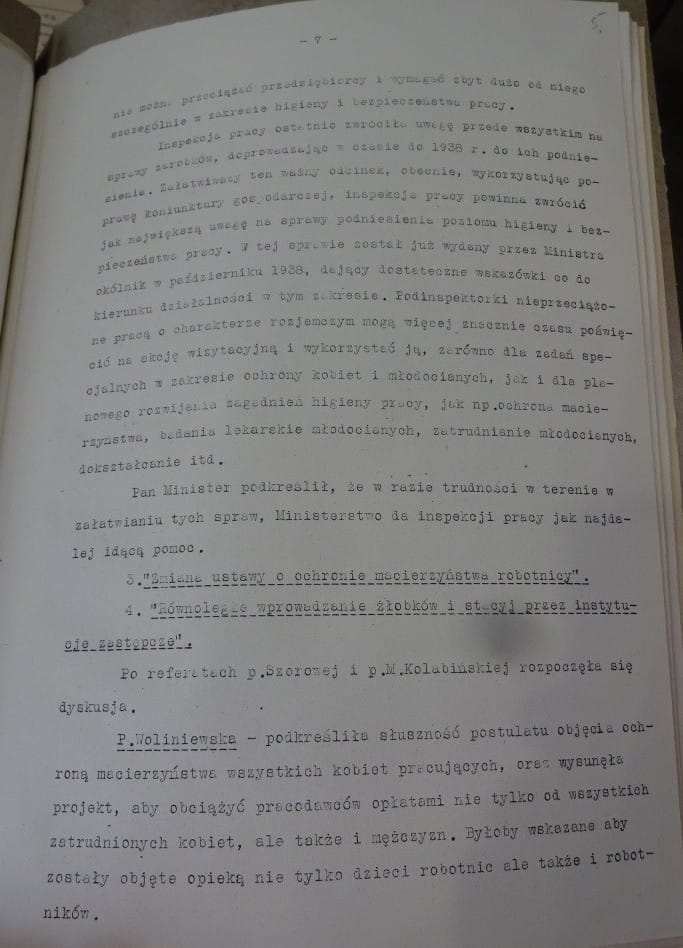
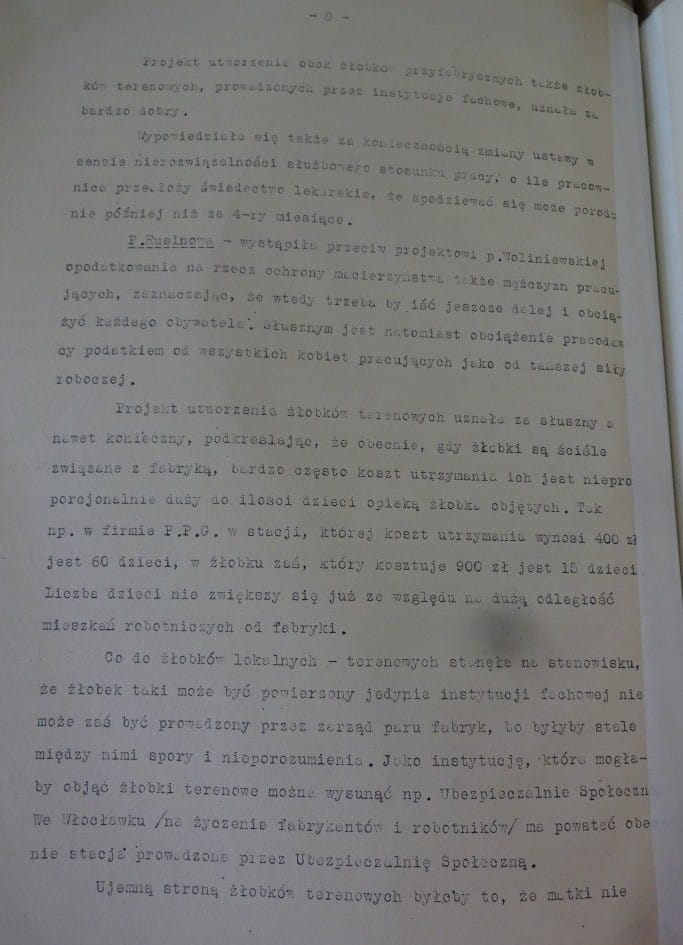
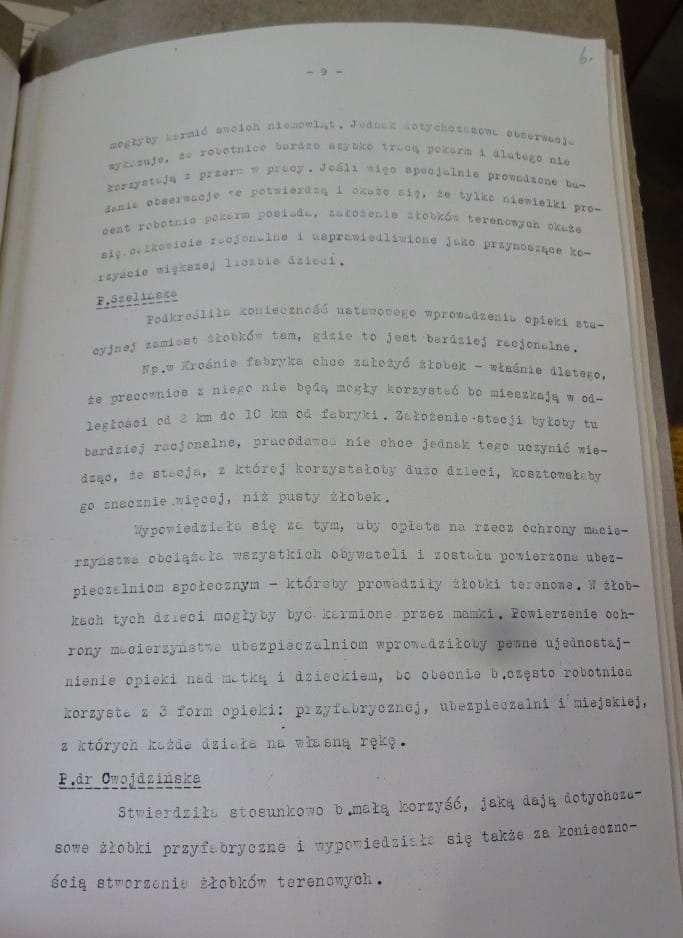
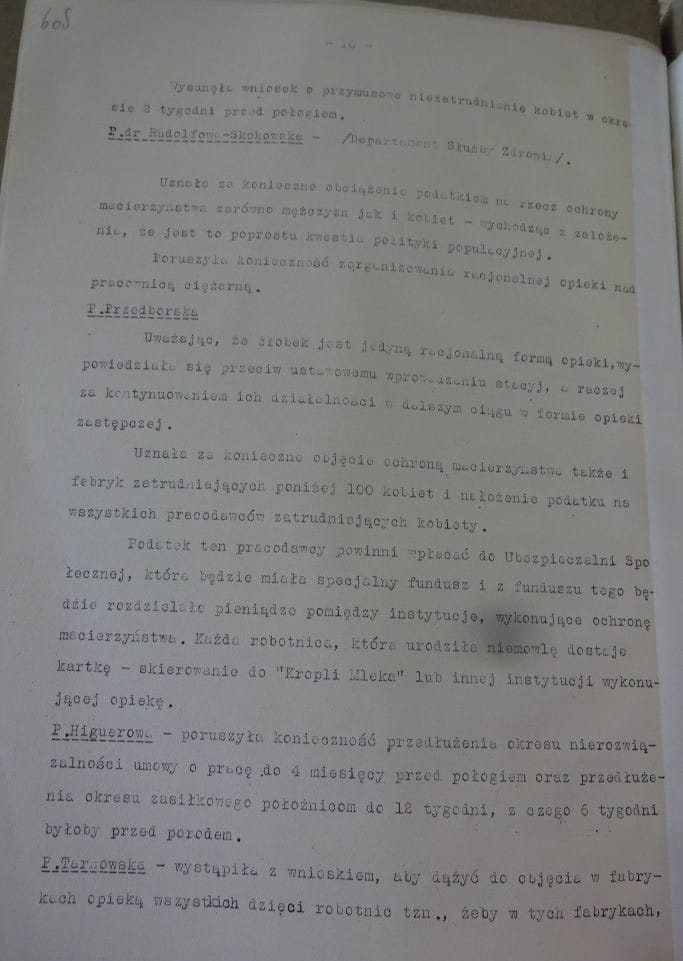
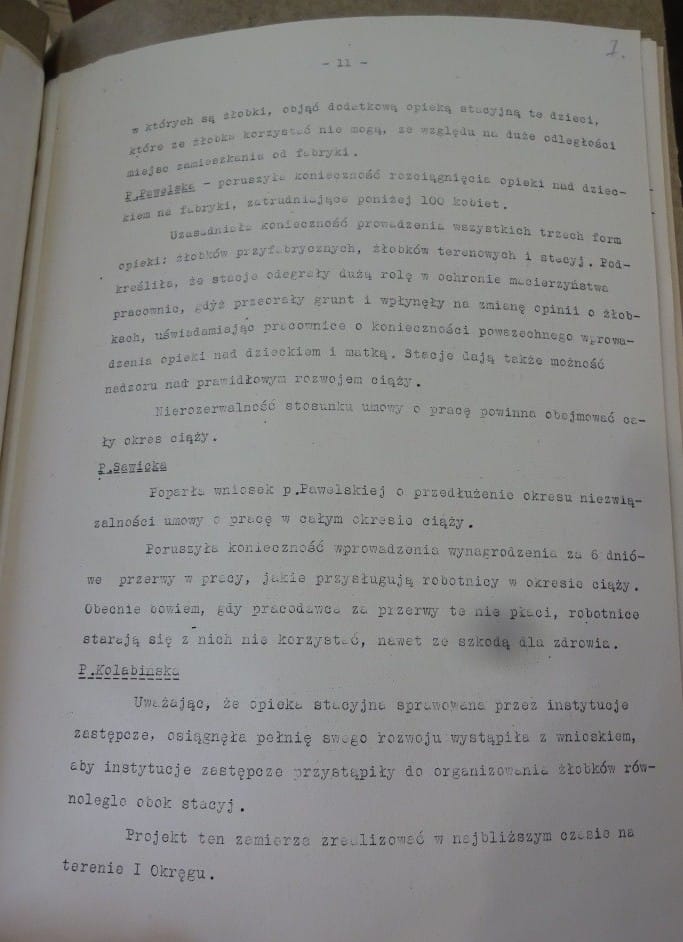
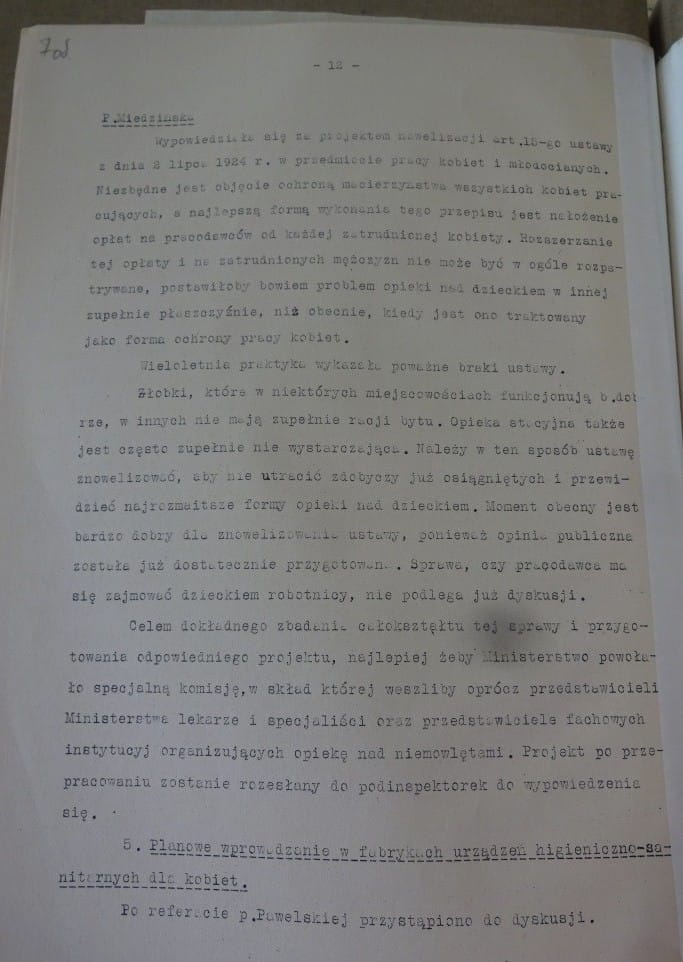

This source provides an excerpt from the transcript of a conference of female labor inspectors in Lviv, which focused on women’s labor and the care of their young children. The transcript captures a discussion among female scholars and practicing labor inspectors about needed changes. All participants in the discussion are women, highlighting the significant role women played in the civil service as advocates for care and welfare for vulnerable groups, even as key decisions regarding resource allocation remained in the hands of male professionals.
In the Second Polish Republic, the Labor Inspectorate under the Ministry of Social Welfare was established in 1919, and legislation concerning women’s and adolescents’ labor was introduced in the 1924 law. In 1927, a separate department within the Inspectorate was created to focus on female workers and adolescents. One of the inspectors’ primary responsibilities was to conduct workplace visits, which involved detailed inspections of facilities and monitoring compliance with occupational safety regulations. This included overseeing the operation of nurseries and mobile medical stations for infants (stacja lotna), as well as ensuring proper conditions for breastfeeding mothers, among other duties.
Morgan Labbe discusses the significance of social protection in the new independent states that emerged after World War I: “The new Central European states that emerged at the end of World War I established ambitious social protection systems in response to the high expectations and needs of a population impoverished by recent hardships. These states also had to demonstrate to the Allied powers and international organizations that ‘social peace’ in Eastern Europe would stabilize the redrawn territories within the sphere of influence of Soviet Russia” (Labbe 2022, 79). In this context, the newly established Ministry of Social Welfare and the Labor Inspectorate — tasked with implementing state policies—became crucial. Labbe also highlights the role of socially engaged scholars who became civil servants in the Ministry, the Central Statistical Office, and other institutions, maintaining a strong activist stance and striving to improve conditions for women and young people in the workplace (Popova 2025).
One such specialist is the speaker mentioned at the beginning of the transcript, Maria Kolabinska (1879–1957). She studied sociology at Jagiellonian University and later at the University of Lausanne; after earning her doctorate in 1912, she worked at the Social Work Bureau in Warsaw and, during World War I, taught at a school in Kalisz. In 1919, she began working as an assistant inspector at the Ministry of Labor and Social Welfare, combining her research skills with the practical implementation of government policies. Another speaker, Irena Shorova, was a researcher, social activist, and author of a brochure on ergonomics and work organization titled Posture at Work and Seating Devices (1935).
Nearly all participants in the discussion were prominent social activists. Janina Medzinska, also a scholar and labor inspector, was involved in a Marxist educational circle in her youth and moved in socialist circles. She attended the international congress of labor inspectors in Vienna in 1937 and served as head of the Women’s and Adolescents’ Inspection Section from 1931 to 1939, where she coordinated summer camps for women. Dr. Izabela Cwojdzinska-Gadzikiewicz, a physician and occupational health and safety specialist, wrote extensively on sanitary conditions in coal mines, occupational diseases, and workplace poisoning, continuing her work even after World War II. Dr. Maria Skokowska-Rudolf, another physician, saved many Jews during the Nazi occupation of Warsaw as head of a medical station and hospital. Jozefina Shelinska (1905–1991) — a Ph.D. in Polish studies, lecturer, translator, and Bruno Schulz’s lover—worked at the Central Statistical Office and was active in the underground during the Nazi occupation. Felicia Maria Pshedborska — a Ph.D., lecturer, poet, journalist, and labor inspector from Lodz — wrote about women in Lodz factories, the abuse of power by foremen toward female workers, and other social issues. Countess Maria Tarnovska played a pivotal role in developing the Polish Red Cross after Poland gained independence, led medical units during the Polish-Soviet War, and, during the interwar period, headed the nursing division of the Polish Red Cross, focusing on nursing education and hygiene promotion. During the Nazi occupation, she helped organize the Main Welfare Council (Główna Rada Opiekuńcza) and participated in the underground resistance. Pelagia Pavelska served as a district (obwodowa) sub-inspector in the Kielce Voivodeship and as an inspector for women’s and youth affairs, publishing articles critical of the working and living conditions of the working class and exposing exploitation and workplace hazards. Matilda Wolinevska, a social activist who organized scout troops in the 1930s and served as a military training instructor at a girls’ high school in Lublin, was also university-educated like many participants in the discussion. Overall, these well-known participants were distinguished by their professional expertise and their strong commitment to social and civic activism — especially on behalf of disadvantaged groups.
The congress transcript captures a pivotal period in the evolution of Poland’s social security system, marking the shift from employer-based provisions to a broader, state-run model of social protection. The complexities of this transformation, especially during the economic crises of the interwar years, are evident in debates over whether to establish public nurseries alongside those run by factories. During this era, Poland’s childcare system for workers’ children operated as a “mixed economy of welfare,” with nurseries and kindergartens set up by entrepreneurs, religious, civic, and charitable organizations. Many children, however, remained under the care of their immediate or extended families and rural communities. A particularly notable initiative was the public charitable organization Kropla mleka, established in Lodz in 1905 as part of the Warsaw Hygiene Society. It became one of the largest organizations of its kind in the Polish territories, providing hygiene education, medical care, and food to children from poor families while also promoting breastfeeding.
The 1924 law mandated that employers establish nurseries in enterprises employing more than 100 women. If there were too few infants among the employees, a so-called stacja lotna — a mobile service supporting families with infants through home visits — had to be organized instead. Children’s welfare was thus considered primarily in relation to women workers, though some enterprises also accepted the children of male employees. Another notable debate in the transcript centers on whether the maternity protection tax should be paid by enterprises according to the number of women employed, by all employees, or by all citizens. This discussion further illustrates the ongoing shift from employer responsibility to a broader, state-based system involving society as a whole.
The transcript demonstrates the inspectors’ detailed understanding of the realities on the ground and the gap between official regulations and everyday practices. Participants criticize industrialists for evading their social responsibilities — for instance, by setting up factory daycare centers that female workers could not realistically access due to distance, while at the same time opposing the creation of stacje lotne, which could have aided more families. Other sources reveal that some women resisted the establishment of nurseries, often due to traditional and religious views of what constituted a “good mother,” as well as a general aversion to the “collectivization of children” — a concept associated with Soviet practices depicted in the media. By the late 1930s, only half of eligible children were actually enrolled in daycare programs (Świdrak 2019, 137).
The women at the meeting agreed that collective, professional childcare was progressive and essential for improving the well-being of both children and working mothers. Nevertheless, as civil servants, they also sought to balance these needs with employers’ interests. During the economic crisis, factories hired more women and young people because they could be paid lower wages, which led to a rise in the number of children needing daycare. It wasn’t until the late 1930s, after the worst of the crisis had subsided, that inspectors more forcefully demanded that factory owners open nurseries — a demand that was often left unmet due to the outbreak of World War II.
Despite their reformist focus on supporting women, youth, and the working classes, the female inspectors also held many views common to their era that now appear discriminatory. For instance, the lower cost of female labor compared to male labor was accepted as a given and even embedded in regulations. Other blind spots in their perspective included a lack of advocacy for Jewish workers, even though discrimination against them was prevalent. As Zhanna Popova observes, efforts to improve conditions for Jewish workers or prevent their discrimination were never discussed by the inspectors (Popova 2023, 312–313). Notably, at least two inspectors present at the meeting — Jozefina Shelinska and Maria Pshedborska — were of Jewish descent, and during World War II, several activists mentioned here were involved in underground resistance and aiding Jews. However, in the interwar years, the specific plight of Jewish female workers was absent from their professional agenda.