
Growing up in Skala
(P.19 – 47)
I received my primary education at the Pulaski School, a Polish institution, every day until 1.30 p.m. The school was free, but it was not obligatory, and a large number of the peasants never sent their children there. Classes were held on Shabbos, but the Jews didn’t go and the Polish pupils used to tell us what homework had been assigned. While in elementary school I wrote an essay for a contest sponsored by a savings bank on why people should save money. Uncle Wolf helped me with the essay and I won first prize.
Each ethnic group in the school had religious instruction once a week from its own special teacher. The Catholic priest taught the Poles; Father Derewienko, the Orthodox priest, taught the Ukrainians; and Mr.Bouk instructed the Jews. Mr.Bouk was an old bachelor who lived with his two unmarried sisters. …
In addition to the Pulaski school, I went to Hebrew school from 3:00 to 6:30 four afternoons a week and all day Sunday. On Sundays in the summer, Hebrew school classes would often go to the little forest near the train station for lessons and a picnic.
The school was part of the Tarbut movement, and our teachers, who had all been educated in the movement’s seminary, were very dedicated. There was a strong Zionist atmosphere in the school. All the subjects – Jewish poetry, literature, and Tanach with Rashi’s commentaries – were studied in Hebrew, and it was also the language used in our special projects and plays. I loved Hebrew school and thrived on the work, using the huge school library with much gusto.
[…]
For an hour on the late afternoon after Hebrew school we went to the home of Sluwa Kassierer to do homework under her supervision. Sluwa and her two sisters, all of them seamstresses, supported their old parents and lived in two small rooms. They were close to thirty, and their unmarried state was considered a shanda, an embarrassment. Every family who could afford a few pennies considered it proper to send their children to the Kassierers to do their homework. Actually, we didn’t do much there – we usually ate apples and socialized.
After eighth grade, I wanted to go to high school, but there was none in Skala. Fifteen kilometers away, in Borszczow, there were a state high school, with a quota for Jews, and an expensive private school. A lawyer manque named Lachmann organized a school in Skala in a rented room for a student body of twelve, covering the first two years of high school on the strength of his brilliance as a teacher of math, history, geography, and literature. My father had once wanted to send me to Hebrew high school in Stanislaw, but this never materialized, so after Lachmann’s session from 8:00 a.m. to 1:00 in the afternoon, I continued at the Tarbut school. The teachers determined the curriculum for the higher grades and essentially taught what they wanted.
The tuition of both schools, which was high, came from Grandfather Azriel, who was interested in my education and had also paid for Hebrew elementary school because my father didn’t have the money. Azriel came to our house every Saturday afternoon with a gift of chocolate and asked what book I was reading. Whether Polish or Hebrew, I’d tell him its story or recite a poem for him. He was the first person I went to whenever I got a good grade. When Lachmann gave me A’s, grandpa Azriel took me to the Cukiernia, a coffee house, for currant drinks and ice cream with waffle-wafers.
[…]
My two grandmothers, who differed on just about everything else, agreed that sewing should be my livelihood – and the sooner the better. In grandmother Hinda’s view, advanced schooling was a waste of time and money for a girl and had the potential to make her “crazy”. I was willing to take the risk, and my father was delighted.

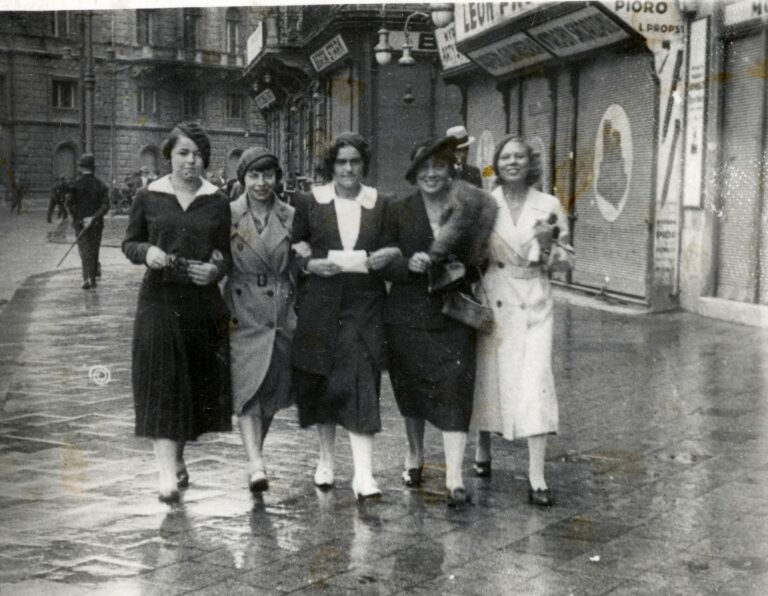

The excerpts presented here are drawn from the memoirs of Fanya Gottesfeld, a Jewish girl from the Galician town of Skala, who survived the Holocaust. In her recollections, she revisits her youth, which unfolded in interwar Poland. Her account bears a distinctive quality: at the onset of the Holocaust, she was eighteen years old—old enough to perceive and record the events unfolding around her, yet still young enough for her reflections to remain free from the hardened frameworks of political dogma or inherited prejudice.
Her memories can be interpreted through five overlapping contexts—cultural, economic, political (interethnic), and ethical. The following analysis engages with each of these dimensions to reconstruct the anthropological perspective of her experience and to illuminate how the events she describes intersected with broader social processes.
Fanya’s personal recollections as a young woman offer a compelling microhistory of a town in interwar Galicia and provide an opportunity to envision how she perceived it as a teenager—in all its fullness and contradictions. The reliability of such sources, however, is both their strength and their limitation. Their strength lies in the vivid, detailed portrayal of everyday life—elements often absent from official or public records. Their limitation, in turn, stems from the need for continual verification and comparison of the described events and facts with other sources.
Recognizing that all memories constitute a subjective narrative of lived experience, the authenticity of Fanya Gottesfeld’s recollections can be viewed in parallel with the travelogue of Chone Gottesfeld, a relative of the author. Chone, who later became a well-known journalist for the New York Yiddish newspaper Forverts, visited his native Skala in 1936 and recorded his impressions of what he witnessed there. Since his travelogue aimed to portray the hardships of Galician Jewish life to elicit support from American Jews, it is reasonable to assume that he may have deliberately omitted certain aspects of local life that did not serve this purpose. Fanya’s memoirs, by contrast, were not written with any audience in mind. Taken together, the two accounts complement one another, offering a more nuanced picture of life in a small Galician town.
In her recollections of interwar Skala, Fanya constructs an image of a lost idyll—di alte heim. Despite the financial hardships of her relatives, her memories evoke a sense of harmonious adolescence: a happy family life, a love of learning, first romance, and many friendships. Her portrayal of the Skala shtetl—a border town with its own distinct features—largely mirrors the experiences of other Galician towns that shared comparable cultural, demographic, and economic conditions.
Fanya’s memories reveal how the norms of traditional society are intersected with modern practices in everyday life. Her family can be seen as typical of Galician Jewish households in the interwar period, in which the life choices of her parents differed markedly from those of earlier generations who had lived in the region under Habsburg rule. A close reading of the life trajectories described in her memoirs sheds light on various forms of adaptation—individual choices, patterns of social mobility, emigration, and re-emigration. The latter is illustrated by the example of her friend’s father, Shimko Bosek, who returned from Palestine to Skala in the early 1930s after failing to adjust to the harsh working conditions and climate of the settlement. His disappointment with life in the Middle East and return to Europe exemplify why many Jews, after the difficult process of emigration, ultimately came back to Poland. This case also illustrates the tension between political discourse and social practice. Although Zionism gained significant popularity in Galicia during the interwar period—particularly after the financial crisis of 1924–1925—the number of those returning from Palestine exceeded the number who managed to settle there permanently. This excerpt from Fanya’s memoirs highlights several factors that shaped changing attitudes toward emigration (aliyah) to Palestine, the most important being the emergence in the 1930s of systematic preparatory training (hakhshara) for prospective emigrants.
The details provided in this excerpt about cultural, educational, and political life in Skala enrich our understanding of several key modern processes: how the Jewish community functioned within a small-town environment, how state authorities influenced and regulated local social life, and which political and cultural initiatives of contemporary parties found genuine support among the population. For instance, the mention of the Bet Am community center illustrates how, during the interwar period, the local community succeeded in creating its own cultural institution—one that became both a hub of national life and an educational center, where Jewish children received schooling and developed a sense of modern identity.
Fanya began writing her memoirs in 1988, a circumstance that makes them distinctive for several reasons. First, they were composed decades after the war, rather than during the period of postwar criminal investigations, which allowed the author far greater freedom in shaping her own narrative. Second, a challenge for the author was an already established canon of collective memory within her community—one that, for example, tacitly portrayed Ukrainians exclusively as collaborators and accomplices in crimes against humanity. Fanya’s account of survival diverged from this convention. Without renouncing her testimony—and despite criticism—she remained convinced that her story of rescue carried essential lessons of human kindness that needed to be shared.