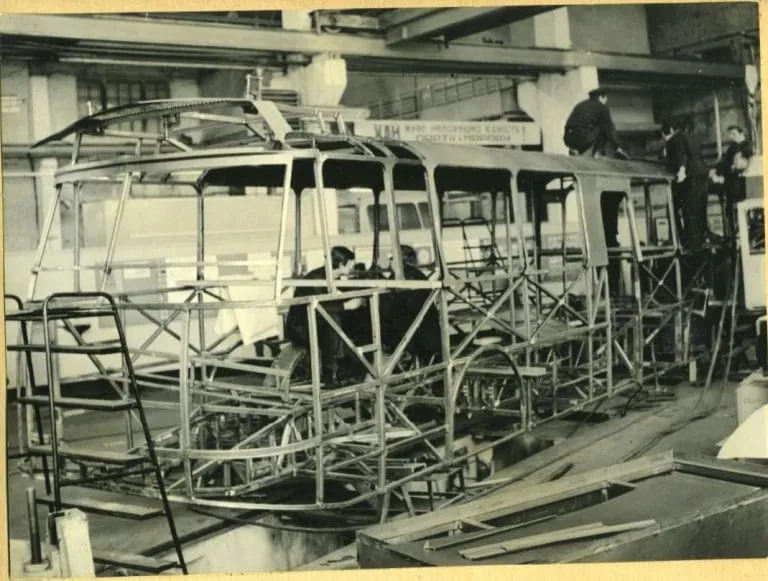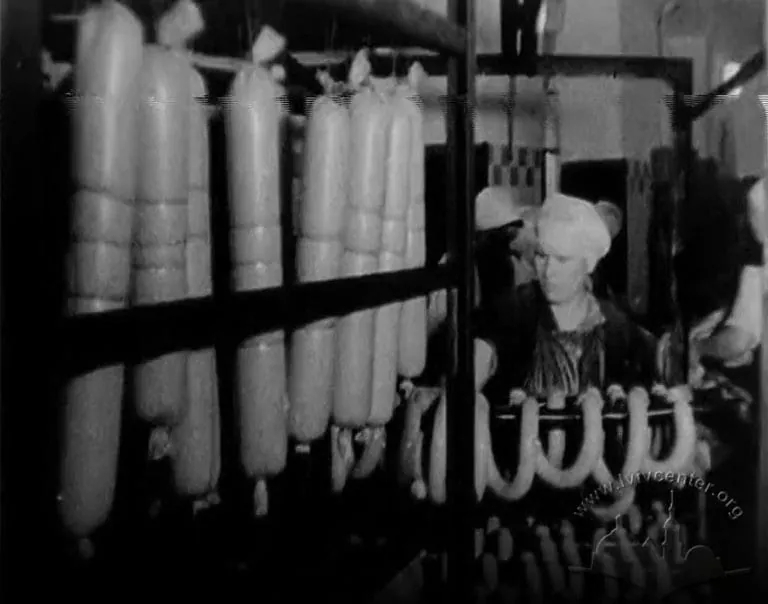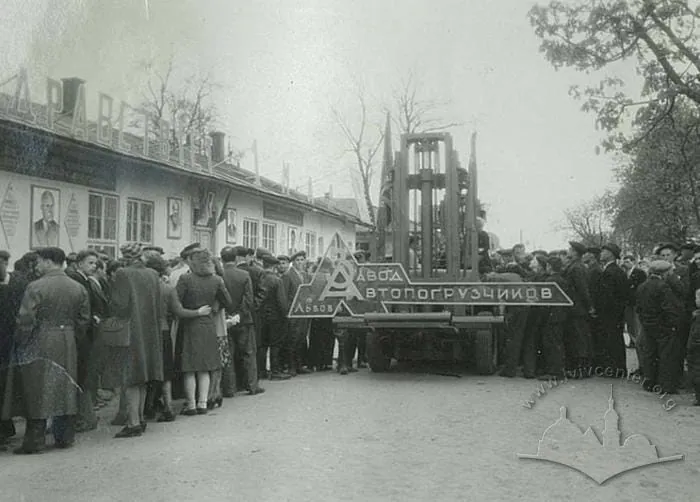

This reflection by Dr. Nataliya Kibita (University of Oxford) is based on the three interviews from the ‘Industrial biographies of the city‘ Urban Media Archive’s collection. The collection was a part of the project “Un/archiving Post/industry”, implemented by the Center for Urban History in 2020 – 2021. The analyzed interviewers represent workers from the city’s major industrial enterprises (Lviv Bus Factory/LAZ, Fork Truck Plant/Avtonavantazhuvach, and Meat-Packing Plant), and cover thier work experiences during the period of ‘perebudova’ and the early 1990s.
In 1991, the Soviet Union collapsed and Ukraine became an independent state. With independence came the task of building the Ukrainian economy, one that would serve the Ukrainian people and the Ukrainian state. The task was daunting.
Until the fall of the Soviet Union, the Ukrainian economy had been fully integrated into the all-union economic complex, managed from Moscow through central planning and administrative agencies that regulated supplies, prices, investment, the construction of new factories, standards, labour regulations, wages, and finances, among other things.
When Ukraine declared independence, it needed to carve the national economy out of the all-union structures and, since the planned economy collapsed anyway, find a way to transition to a market economy.
The documents, provided below, are three interviews with people who experienced both systems, the planned economy and the transition to a market economy. All three remained employed throughout the 1990s, a decade when the Ukrainian economy contracted and the country faced hyperinflation and unemployment. All three watched the factories where they had worked decay in the late 1990s and early 2000s, and for all three, this decay was the reason they eventually left.
It is notable, that although the interviewees differed in status, age, career path, and industry, they share the same perception of the eras they lived through. Life before 1991 was stable, predictable, and, as the interviewee from Avtonavantazhuvach put it, ‘normal’. The “abnormal” period, however, was not the 1990s, despite the country’s dire economic situation. Rather, it was the early 2000s, when, in the words of a former LAZ employee, ‘asset stripping (deriban) became blatant’ (‘дерибан пішов конкретний’), and the factory stopped being a source of income.
This periodisation might seem unusual. However, as recent Soviet citizens, the majority of Ukrainians valued equality of opportunity over wealth accumulation. The 1990s were certainly a time of great poverty. Those who were wealthy were few and, most importantly, had no influence on or interest in state affairs. The majority of the population and the state were bound together in the effort to overcome the economic crisis, and the state declared its devotion to defending the economic interests of workers.
By the end of the 1990s, however, the era of equality of opportunity, let alone one more propagated than real, had come to an end, and a new era began: that of the rule of the oligarchy. The state no longer defended equality of opportunity. The power elites aligned their interests with the oligarchs, who were now keen to participate in state affairs. As a result, a new, oligarchic system took shape, one based on inequality of opportunity. Workers experienced this system as they watched their factories destroyed, and for them, this was truly abnormal.
At the heart of the interviews is the role the Soviet factory played in workers’ lives. In the Soviet Union, the factory was more than a workplace. It was the site where the Soviet regime interacted directly with workers. This relationship rested on a tacit ‘social contract’. The state took on the obligation to provide comprehensive social welfare, equality, economic security, and stability. In return, workers offered political compliance and quiescence (Cook, 1992).
However, with the onset of perebudova and glasnist — the economic and political reforms Mikhail Gorbachev initiated in 1986-88 — the regime tacitly withdrew from this contract. The reforms were designed to accelerate the growth of the Soviet economy. But this growth could be achieved only by increasing productivity and cost accountability, which in turn would be impossible without undercutting the basic provisions of the social contract, including employment security and the socialised services the state provided through the factories. At the same time, the state weakened its control over prices and legalised private retail trade, which resulted in higher prices for necessities and a growing deficit of goods. In doing so, the state tacitly repudiated ‘the basic principles of universal state provision and egalitarian distribution’ (Cook, 1992) on which the old social contract had been based.
According to the interviews, workers viewed their obligation to the state in purely economic terms, rather than political ones, that is, an obligation to work honestly, though remarkably, this did not always extend to a duty not to steal.
Petty theft, which was characteristic of the entire Soviet period, was morally unacceptable when wages were paid regularly and the factory provided social support. Once wages became so low that it was impossible to live on them, however, stealing and petty theft became morally justified. Selling products stolen from the factory on the black market could become one sure way for workers to make a living.
In the 1980s, the factory authorities acted in accordance with this understanding, although their responses were not the same. At the meat-processing factory, one could be fired for being caught at the exit with stolen goods, or for missing too many working days. At Avtonavantazhuvach, by contrast, a worker caught stealing and selling items produced at the factory risked little more than a lecture from a manager about the reputational cost of the theft, labour shortage being the main reason for such leniency.
But there was another aspect to the petty theft: peer pressure. Someone who did not steal from the factory was treated with suspicion, as a person who might denounce the theft. For someone involved in the social life of the factory, with close personal relationships among co-workers, taking a moral stand against stealing could carry a high social cost. As a result, ‘everyone was stealing everything.’
The workers’ attitude towards work ethic during the Soviet period, however, was less conditional on the size of the wage. According to the interviewee from the meat-processing factory, during the Soviet period, contrary to the Soviet proverb ‘We pretend to work, and they pretend to pay us,’ workers at her factory were hardworking and conscientious, despite the low pay. ‘No one deliberately made defective products; people tried [to do their best], they were responsible at that time, disciplined.’ The state, she insists, knew this, because no one was fired for producing defective goods.
Combined, the interviews offer a coherent and detailed picture of the factory as ‘the basic unit in society’ (Ashwin, 1998), one that regulated the lives of workers in Soviet Ukraine, but also demonstrated the Soviet regime’s commitment to fulfilling the obligations it had taken upon itself through the social contract.
The Soviet Ukrainian factory offered several essential goods and services to workers, although access could sometimes depend on a worker’s party membership. Still, a young adult new to the city and the factory would be offered professional training at a vocational school and a place in the factory dormitory. Married couples, with or without children, could obtain a separate dormitory room or an apartment in a block of flats that the factory built for its employees. For the children of factory employees, factories ran kindergartens and, in summer, pioneer camps.
The factories organised transportation for workers who lived in remote areas or in the countryside. The factory also organised weekend outings and offered tickets to the theater and the opera house. For summer vacations, workers could stay at the factory’s Black Sea or Azov Sea resorts, or at sanatoriums.
Factories had canteens and cafeterias. Although, for reasons that the interviewee from LAZ does not explain, shop floor workers ‘rarely ate in the canteens’. Perhaps because it still was not cheap enough.
Contrary to most services, which a worker could chose to use or not — a worker might, for example, not need housing — the health check-ups the factory provided were mandatory.
The factory-based healthcare system fits neatly with the ideology of the state of workers and peasants. However, it was also necessary to ensure the functioning of the industry, which by the end of the 1980s was characterised by the low level of automation in production and, at the same time, the chronic labour shortage. Production at the Soviet factories could be hazardous to workers’ health. At Avtonavantazhuvach, a factory where ‘many ruined their health,’ the retirement age was 45 for women and 50 for men. Common occupational illnesses at the meat-processing factory included polyarthritis, rheumatism, and respiratory diseases. At the LAZ factory, ‘many died; even the young.’ By providing regular medical check-ups and adequate medical care, the factories, therefore, increased the time the worker continued working.
Health damage aside, the interviews describe factory life in positive tones, as the time when the interviewees had ‘a lot of fun.’ Social involvement with the collective, through clubs, sports competitions, parades, and joint celebrations of personal and public holidays, left little personal time, kept people motivated and inspired. Communication and ‘not being left alone’ were valued so high that even the extra hours workers sometimes had to put in on weekends or holidays to meet plan targets are remembered through a positive lens.
There is, however, no paradox here. Despite the hardships, factories made workers feel valued members of society and gave sense of belonging. There was camaraderie among workers, and any conflict was resolved among themselves. Professional life, and to some degree private life, was organised in a way that many found comforting. Besides, until the mid-1980s, the rules of promotion were clear: those who were party members could expect to obtain a management position above the factory shop floor. Joining the party was a choice each worker could make for him- or herself.
All three interviewees had escaped their villages for the city of Lviv where life was easier and more exiting, that is, better than on the collective farm. Lviv was the beacon of sovietisation in Western Ukraine (Amar, 2015). Following its annexation after the Second World War, the Lviv region was industrialised. As the interviews show, state-organised welfare and leisure contributed to the public acceptance of the communist postulate of the superiority of collective over individual. However, by the time the Soviet Union collapsed, ‘the region had not yet achieved the level of sovietisation of central or eastern Ukraine’ (Kibita, 2024). Recent kolhospnyky, Lviv workers had not become fully dependent on the state for their well-being. Indeed, the factory had become their primary source of legal and illegal income, but it was not their only source. Echoing peasants from central and eastern Ukraine, who were similarly reluctant to fully commit to factory life, Lviv workers too maintained links to the land, as the surest source of survival and independence.